
Ujasusi Blog’s East Africa Monitoring Team | 06 January 2026 | 0200 GMT
Snaposhot
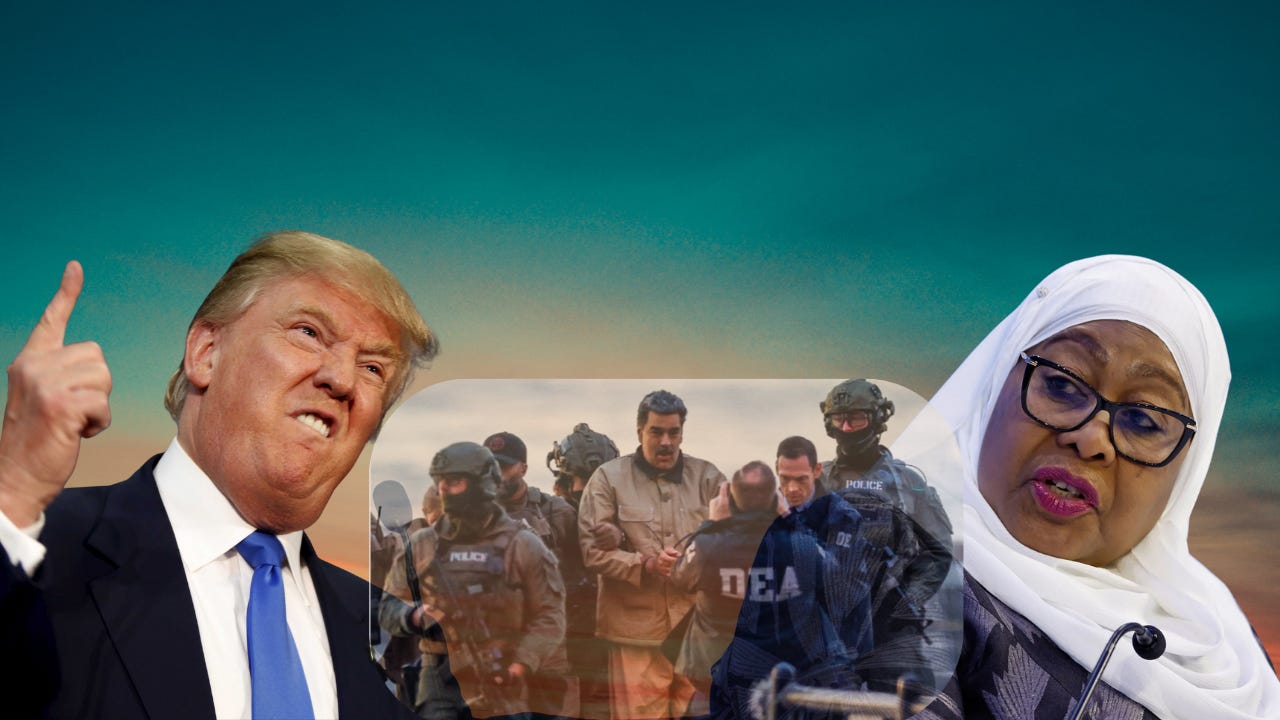
Trump’s arrest of Nicolás Maduro establishes a new precedent for extraterritorial enforcement against foreign leaders accused of threatening US interests. The operation deployed narco-terrorism indictments, military force, and legal frameworks dating to the 1989 Noriega intervention. Whether this precedent extends to Tanzania’s Samia Suluhu Hassan depends on five critical factors: existing federal indictments, narco-terrorism nexus, strategic priority alignment, international law barriers, and cost-benefit calculations that justified Venezuelan intervention.
🔎 What Legal Mechanisms Exist for Arresting Foreign Leaders?
The United States possesses three primary legal frameworks for enforcing extraterritorial jurisdiction against foreign leaders:
Direct Military Intervention (Noriega Model): Invasion and forcible arrest under Bill Barr’s 1989 legal opinion that UN Charter prohibitions do not prevent “forcible abductions” to enforce domestic US law
International Tribunal Cooperation (Taylor Model): Pressure through Special Courts established by UN Security Council with US diplomatic leverage and financial rewards
Federal Indictment with Law Enforcement Operation (Maduro Model): Southern District of New York indictments coupled with Delta Force/CIA operations framed as law enforcement rather than military action
Critical Distinction: The Maduro operation represents an escalation from historical precedents—whilst Noriega’s 1990 capture followed a declared state of war, Maduro’s arrest occurred without Congressional authorisation or formal declaration of hostilities.
🌍 What Are Trump’s Strategic Priorities in Africa vs Latin America?
Latin American Interventionism:
Venezuela: Designated Cartel de los Soles as Foreign Terrorist Organization (July 2025)
$50 million bounty for Maduro (August 2025)
Military blockade and naval armada deployment (December 2025)
Direct justification: Narco-terrorism “flooding the United States” with cocaine
African Engagement Framework:
Transactional diplomacy prioritising minerals deals and supply chains
Focus on countering China’s trade advantage
Selective bilateral engagement through advisor Massad Boulos
Reduced democracy promotion emphasis compared to previous administrations
Tanzania-Specific Position: The State Department’s December review cites “religious freedom, free speech, obstacles to US investment and violence against civilians”—notably absent are narcotics charges or terrorism designations that triggered Venezuela action.