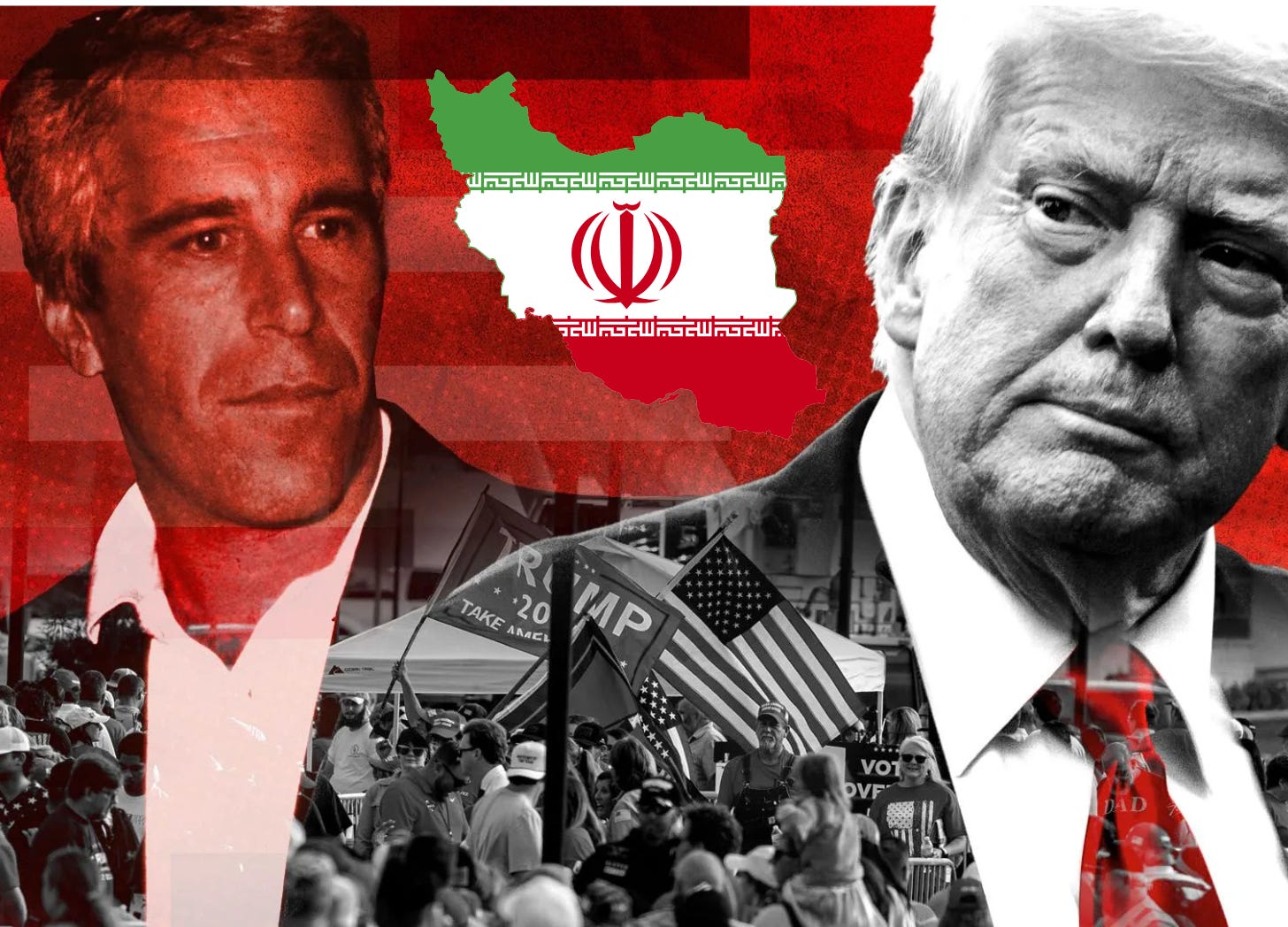
Is Trump Planning to Strike Iran to Deflect from the Epstein Scandal?
Ujasusi Blog’s Global Affairs Desk | 19 February 2026 | 0045 GMT
Snapshot
The question of whether Trump would strike Iran to deflect from the Epstein files scandal is best answered not by asking whether he is calculating enough to plan such a distraction, but whether he is cornered enough that the institutional restraints on military escalation have stopped mattering to him. The evidence suggests they have.
🔍 What Does It Actually Mean to Ask Whether Trump Would “Use” Iran?
The framing of this question — would Trump use Iran as a distraction — implies a level of cold strategic deliberation that misreads how Trump operates. A president who on 5 February 2026 posted a video depicting former President Barack Obama and former first lady Michelle Obama as apes, then refused to apologise, saying “No, I didn’t make a mistake” — during Black History Month, at the peak of Epstein fallout coverage — is not running a carefully managed information operation. He is a man under acute political pressure whose impulse control degrades in direct proportion to how cornered he feels.
That distinction matters enormously for intelligence analysis. The question is not whether Trump sat in the Oval Office and decided to manufacture an Iran crisis to bury the Epstein story. The question is whether his behavioural pattern, combined with a permissive strategic environment, makes escalation more likely precisely because his domestic political position is weakening. The answer is yes — and the evidence is substantial.
📊 The Domestic Pressure Context: How Bad Is It Really?
The Epstein files are not a routine political scandal. They represent a slow-moving but compounding legitimacy crisis that the White House has visibly failed to contain.
As of February 2026, Trump and Melania appear in more than 38,000 references across the released documents — more frequently than almost any other individual outside Epstein’s direct associates. The DOJ’s own release included an FBI-compiled list of unverified sexual assault allegations against Trump, and the document dump is expected to continue, with the political fallout growing longer heading into the November 2026 midterm elections.
The political damage is measurable and sustained. A Quinnipiac poll conducted 8–12 January 2026 placed Trump’s overall approval at 40% with 54% disapproval — unchanged from October and December 2025, suggesting a floor has been reached but no recovery is underway. Six House Republicans voted to overturn Trump’s Canada tariffs. Senator Thom Tillis held up the president’s Fed chair nomination. The administration pulled back its sustained anti-immigration enforcement push in Minnesota. Democrats are jumping on the opening, with prediction markets favouring them to win control of the House in the midterms.
This is the domestic environment in which Trump is making Iran decisions. It is not background noise. It is the operating condition.
🧠 The Behavioural Intelligence Case: Trump as a Non-Rational Actor
Classical intelligence analysis treats the rational actor model as a default, derived from frameworks like Graham Allison’s Essence of Decision (1971) and operationalised across CIA and DIA threat assessments. Behavioural intelligence analysis — drawing on political psychology literature including Jerrold Post’s The Psychological Assessment of Political Leaders (2003) and Margaret Hermann’s Leader Trait Analysis framework — asks a different question: what cognitive and emotional patterns actually drive this specific leader’s decisions under stress?
Trump’s documented behavioural profile under domestic political pressure includes several recurring features directly relevant to this assessment.
Escalation as pressure release. Trump does not absorb political pressure internally and deliberate — he externalises it. The overnight Truth Social posts during the Epstein fallout, the Obama video, the “locked and loaded” Iran declaration on 2 January 2026 — these are not coordinated communications strategy. They are pressure-release mechanisms that happen to have geopolitical consequences. The Obama video alone occupied a full news cycle and forced even Republican senators to respond to racial controversy rather than Epstein document content. The White House initially rejected “fake outrage” over the post, only to then blame a staffer — a rare admission of a misstep from an administration that normally refuses to concede anything. That sequence — provocation, defence, tactical retreat — is Trump’s instinctive pattern, not a planned operation.
Commitment traps and credibility anxiety. Trump declared publicly on 2 January 2026 that “help is on its way” to Iranian protesters. That statement is now a strategic commitment with credibility costs attached to non-fulfilment. Analysts at the Washington Institute for Near East Policy have noted that failure to act after that declaration risks emboldening Iran and undermining US deterrence across the region. For a president already being publicly described as losing his grip on his own party, the prospect of backing down from a threat directed at a regime his base despises is politically intolerable — regardless of what the strategic calculus says.
Base consolidation under threat. When Trump’s domestic coalition fragments, his instinct is to perform decisive action for the audience that remains loyal. The data here is unambiguous. After Operation Midnight Hammer struck Iranian nuclear sites in June 2025, Republican approval surged from 57% to 82% in a single week — a 25-percentage-point jump from a single military action. For a president whose overall approval sits at 40% and whose grip on moderate Republicans is visibly slipping over Epstein and tariffs, a strike that consolidates his base while repositioning him as commander-in-chief carries acute political logic — even if the broader American public opposes intervention by 48% to 28%.
⚙️ The Strategic Environment: Permissive Conditions for Escalation
None of the behavioural analysis above would translate into actual military action without a permissive strategic environment. Iran currently provides one.
The protests that erupted in late December 2025 gave Trump a moral and narrative frame he could not have engineered: an Islamic theocracy massacring civilians while Trump publicly promises to rescue them. The UN special rapporteur on Iran stated at least 5,000 protesters were killed, while thousands more have been detained. Iran’s internet shutdown from 8 January and restrictions on foreign media have made independent verification difficult, but the scale of the crackdown is not seriously disputed.
The military infrastructure for escalation is already in place. According to two senior US officials speaking to Reuters on condition of anonymity, the US military is preparing for the possibility of sustained, weeks-long operations against Iran — a disclosure that raises the stakes considerably for the diplomacy underway between Washington and Tehran. The USS Gerald R. Ford carrier strike group has been ordered toward the Middle East. F-15E fighters have landed in Jordan. Additional Patriot and THAAD missile defence systems are being pre-positioned. This is not routine force posture — this is an administration building strike options in real time.
Trump has repeatedly used the word “decisive” to describe the effect he wants any US action to have — phrasing that has led aides to refine options ranging from limited IRGC strikes to scenarios aimed at far greater pressure. Retired four-star General Jack Keane has assessed publicly that any campaign this time would be “much larger” than Operation Midnight Hammer, targeting Iranian civilian and military leadership, ballistic missile infrastructure, and IRGC command nodes.
The diplomatic track remains alive but fragile. A second round of indirect US-Iran talks mediated by Oman in Geneva has been confirmed, with both sides describing the first round as a “good start.” Iran’s foreign minister Abbas Araghchi has oscillated between threatening “immediate, all-out, and unprecedented” retaliation and signalling openness to negotiation — sometimes within days of each other. That oscillation reflects Tehran’s own uncertainty about how serious Trump’s escalation intent is, and the reality that Iran, having already absorbed Operation Midnight Hammer, has significant incentives to avoid a second, larger round of US strikes while its nuclear programme remains degraded.
🔄 The Interaction Effect: Where Domestic Pressure Meets Strategic Opportunity
The most analytically important insight is not that Trump would fabricate an Iran crisis to distract from Epstein. It is that the Epstein crisis removes the restraints that might otherwise cause him to accept a negotiated outcome when one is available.
A politically secure Trump — high approval ratings, unified party, midterms comfortably in hand — would have stronger institutional incentives to bank a diplomatic win with Iran, accept the Oman-mediated framework, and declare victory. Political security gives leaders the latitude to exercise restraint without it being read as weakness.
A politically embattled Trump has none of that latitude. Every act of restraint gets read, by his base and his critics alike, through the lens of the Epstein files, the approval ratings, and the fraying Republican coalition. In that environment, a military strike on Iran is not just a foreign policy decision — it is a political reset. It changes the subject. It activates the base. It generates the kind of rally-around-the-flag dynamic that temporarily suppresses domestic criticism. And it gives Trump back the thing he values most: the front page.
That is not a wag-the-dog conspiracy. It is a structural incentive, and it operates whether Trump consciously recognises it or not. As one Chatham House analysis of the administration’s overall strategy noted, with perma-crisis as the baseline, the White House is betting that public focus will be dragged away by the next trending issue. Iran is the biggest trending issue available. The military assets are positioned. The moral frame is established. The credibility commitment has been made publicly. And the president’s domestic political floor is not holding.
🏁 Bottom Line Assessment
The probability that Trump orders some form of military action against Iran — whether targeted IRGC strikes, cyberattacks, or a broader air campaign — is higher than a rational actor model suggests and is being materially elevated by domestic political pressure from the Epstein fallout, not independently of it.
The key variables to monitor are straightforward. If the Oman-mediated Geneva talks produce a framework agreement, the strike risk drops — but Trump would need to accept a diplomatic outcome while his base is watching for weakness, a politically costly concession in the current environment. If the talks collapse, if Iran executes detained protesters en masse, or if Iranian forces directly target US personnel, the restraints dissolve entirely.
What the Epstein files have done is not create the Iran crisis. They have ensured that the man deciding whether to resolve it peacefully or militarily is operating under maximum domestic political duress, with degraded institutional support, a base that rewards decisive action, and a deep psychological need to control the narrative. That combination does not guarantee a strike. But it makes one considerably more likely than the strategic variables alone would predict.