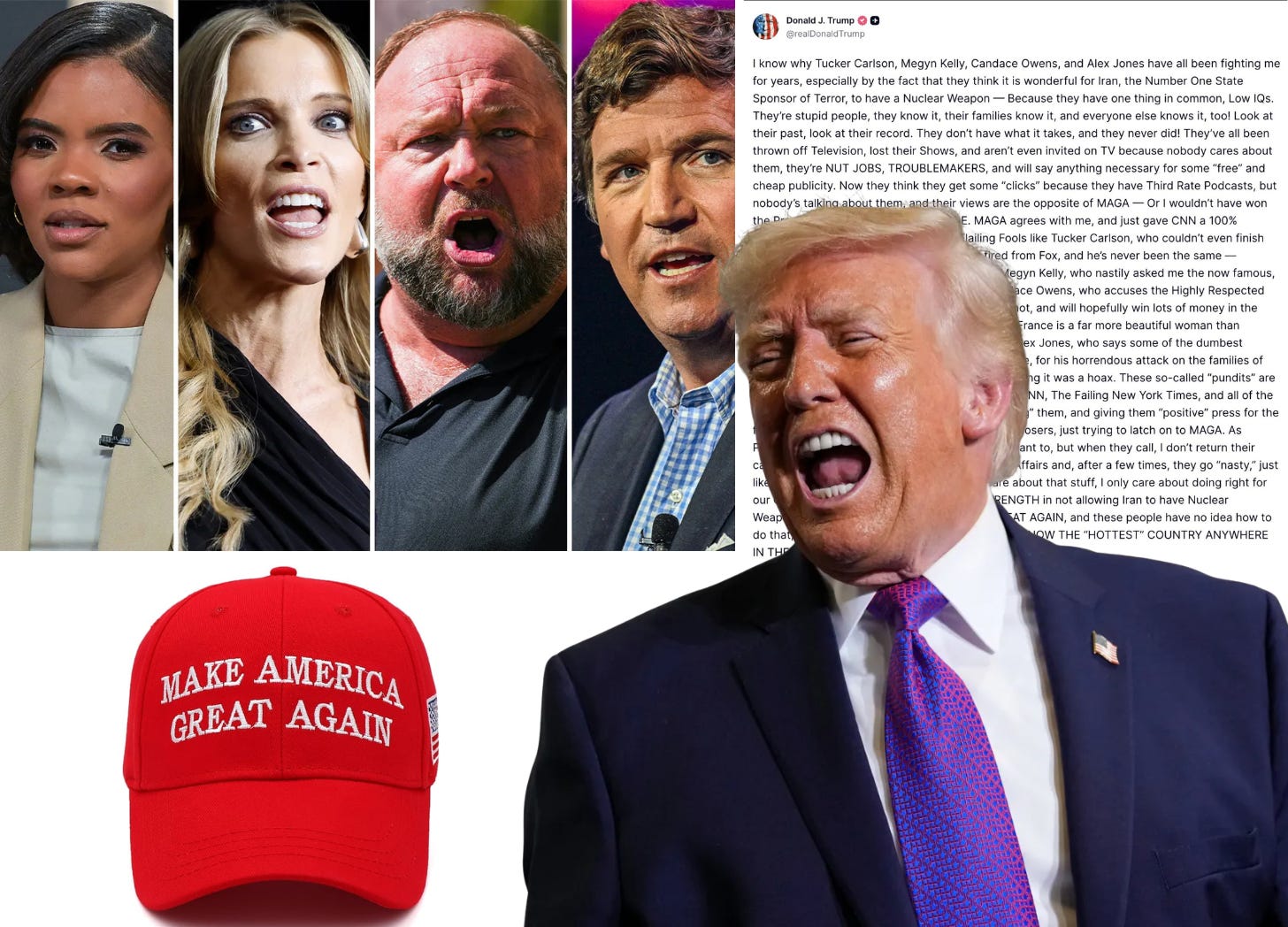
Trump Calls Tucker Carlson, Megyn Kelly, Candace Owens, and Alex Jones “Stupid People” as Iran War Fractures MAGA Media
Ujasusi Blog’s U.S. Desk | 09 April 2026 | 2325 BST
On 9 April 2026, President Donald Trump published a 485-word Truth Social post denouncing four prominent right-wing media figures — Tucker Carlson, Megyn Kelly, Candace Owens, and Alex Jones — as “stupid people” with “low IQs.” The attack followed days of sustained criticism from all four over Trump’s conduct of Operation Epic Fury, the US-Israeli military campaign against Iran launched on 28 February 2026, and marked the most public fracture yet between Trump and the conservative media infrastructure that helped return him to the White House.
The Iran War Triggered a Conservative Media Revolt Against Trump
Operation Epic Fury — the 38-day US-Israeli air campaign that assassinated Supreme Leader Ali Khamenei, destroyed over 85% of Iran’s defence industrial base, and closed the Strait of Hormuz — formally ended with a ceasefire on 7 April 2026. The White House declared total victory. The conservative media ecosystem did not.
Tucker Carlson delivered a 43-minute monologue framing Trump’s Iran rhetoric as morally corrupt and “evil,” expressing personal outrage at Trump’s Easter Truth Social post threatening to bring “hell” to Iran and urging US officials to defy any orders that could kill civilians. Alex Jones, overcome with emotion on air, called the president a “dementia risk” who must be removed from office. Candace Owens called Trump a “genocidal lunatic” and demanded Congress and the military intervene.
Megyn Kelly, reacting to Trump’s Truth Social post warning that “a whole civilization will die tonight,” said Trump’s behaviour was completely irresponsible, adding that no president should threaten to wipe out an entire civilian population in a social media post.
The proximate flashpoint was Trump’s Easter morning post — expletive-laden, threatening to strike Iranian power plants and bridges — which Carlson called “vile on every level,” arguing it amounted to mocking the religion of Iran and, by extension, all religion.
Trump’s Truth Social Post Named Each Figure and Rehearsed Old Grievances
Trump’s 9 April response did not engage the substance of the Iran criticism. The post revived personal histories: Carlson’s dismissal from Fox News, Kelly’s 2015 debate question about Trump’s treatment of women, Owens’s defamation lawsuit exposure over her claims about France’s First Lady, and Jones’s Sandy Hook liability. Each attack was framed as disqualification rather than rebuttal.
This is analytically significant. A president defending a war on the merits would dispute the strategic or legal arguments. Trump instead attacked the messengers’ credibility, career trajectories, and television ratings — a rhetorical pattern consistent with delegitimisation rather than debate.
Figure Criticism of Trump Trump’s Counter-Attack Tucker Carlson Called Iran rhetoric “evil,” urged officials to defy orders “Couldn’t finish college,” “broken man” after Fox firing Megyn Kelly Called war “folly,” Trump’s posts “disgusting” Resurfaced 2015 debate question Candace Owens Called Trump a “genocidal lunatic” Defamation lawsuit reference, appearance comparison Alex Jones Floated 25th Amendment, called Trump “dementia risk” Sandy Hook liability, “bankrupt”
The Structural Damage to MAGA’s Media Coalition Is Real and Measurable
Trump’s political strength has always depended less on party institutions than on a decentralised media coalition — podcasters, streamers, and activists who translate his message to millions of loyal voters. That coalition delivered him the White House in 2024. Now its most powerful voices are working to keep him in check, accusing him of betraying the “America First” promises that built the movement.
A Morning Consult poll released this week found Trump’s approval rating in positive territory in just 17 of 50 states, down from 22 earlier in 2026. The share of Republicans who “strongly approve” of Trump dropped in every competitive Senate and House battleground this quarter.
A 2025 Pew Research study showed just 9% of Republicans and Republican-leaning independents said they often got their news from the Tucker Carlson Network — a figure that contextualises Carlson’s direct electoral influence but understates his role as a permission structure for Republican dissent. When Carlson says the Iran war is wrong, wavering Trump voters have cover to agree.
Joe Rogan, whose 2024 Trump endorsement was among the most consequential of the campaign, called the Iran war “insane, based on what he ran on” and said supporters feel “betrayed.” Rogan was not named in Trump’s post — an omission that merits attention.
Trump’s Attack Pattern Reflects Exposure Management, Not Confidence
The analytical inference this article advances: Trump’s 9 April post was not a sign of strength but of a president managing exposure on a war eroding his base faster than the ceasefire can stabilise it. A politically secure leader does not spend 485 words attacking podcast hosts. The decision to personalise — to invoke college dropouts, defamation suits, and television ratings — signals that no substantive defence of the war’s conduct was available. The post reads less as a counter-argument than as an attempt to pre-empt a permission cascade: the moment when enough prominent voices criticise a leader that previously loyal followers feel authorised to do the same.
Megyn Kelly, despite her Iran criticism, stated plainly that she would still vote Republican over any Democrat regardless of Trump’s conduct. That line is the most strategically important data point of the week. It confirms the fracture is over conduct, not allegiance. The conservative media figures attacking Trump are not defecting to the Democratic Party. They are competing for the post-Trump right, positioning themselves for a political environment in which “America First” survives but Trump himself does not.
For intelligence analysts monitoring the United States as a geopolitical actor, the Iran war has now produced a secondary conflict of equal significance: a succession struggle inside the American right, fought through podcasts and Truth Social posts, whose outcome will shape US foreign policy well beyond the current administration’s term.
Independent intelligence analysis takes time and resources — if this work matters to you, please consider supporting it by donating HERE