

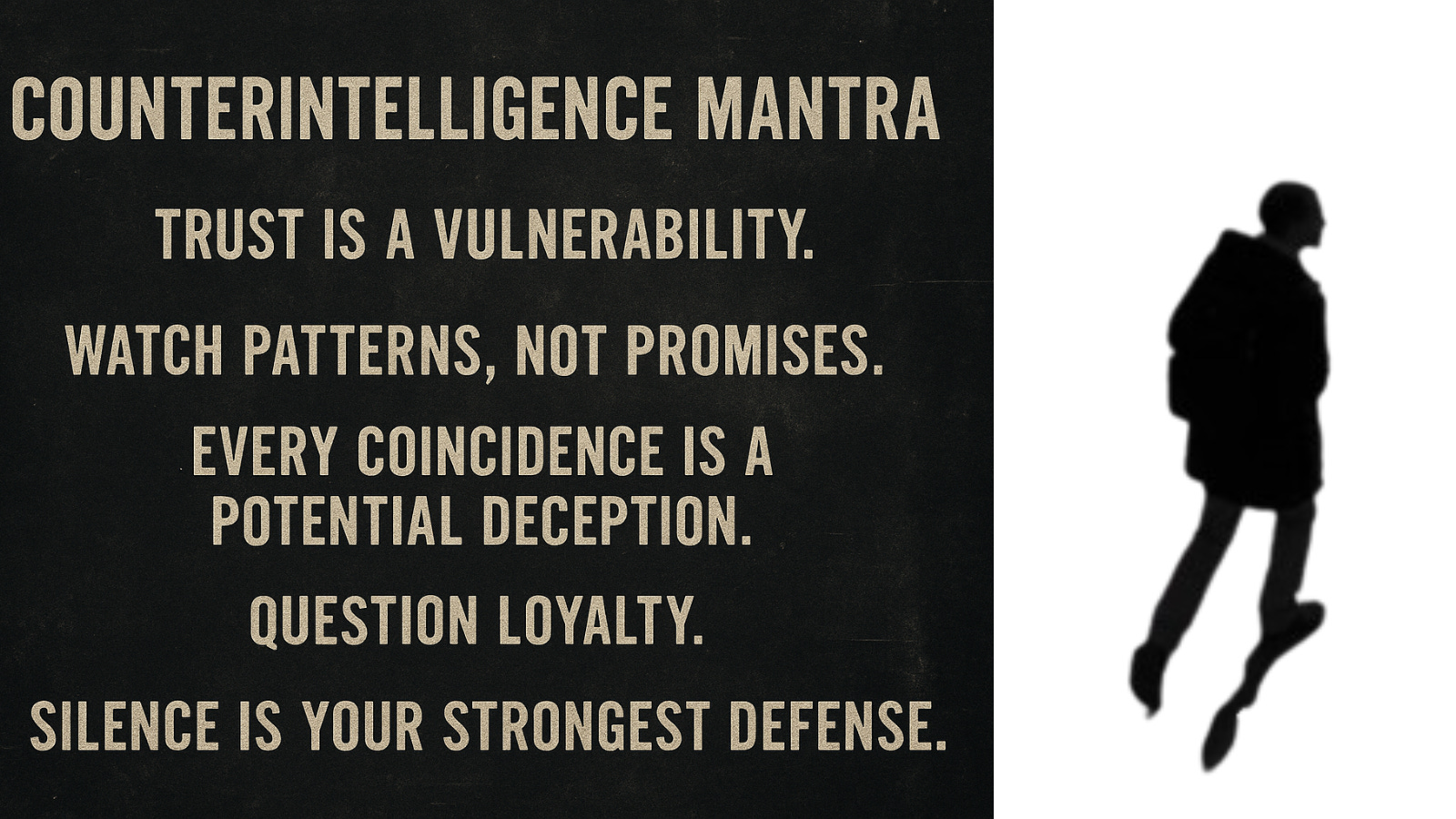
In the world of espionage, where shadows collide and secrets are currency, the discipline of counterintelligence (CI) remains a nation's last internal line of defence. Unlike external surveillance or conventional military operations, counterintelligence operates inwards—detecting betrayal, identifying deception, and safeguarding institutions from infiltration. Yet, for all its critical importance, CI often lacks a unifying mental framework accessible to both operatives and analysts alike. This is where the concept of a Counterintelligence Mantra emerges—not as mysticism, but as a distilled code of vigilance, deeply internalised by those entrusted with protecting state secrets from within.
A mantra in this context refers to a guiding set of principles—maxims, creeds, or psychological codes—that shape how CI professionals think, act, and decide. Intelligence officers, much like elite soldiers or surgeons, require not just training, but a clear, mentally reinforced ethos. The mantra, then, becomes a safeguard against complacency and manipulation, and a beacon when operating under moral ambiguity or institutional pressure.
I. Why Counterintelligence Requires a Mantra
Unlike general intelligence gathering, counterintelligence is inherently paranoid by design. It presupposes deception in every corner and internal threat within every loyalty. This psychological posture must be calibrated—not paralysing, but constructively vigilant. The challenge is striking that balance: how to remain alert without being paralysed by distrust.
A mantra serves three critical functions:
Cognitive Alignment: CI officers must react swiftly but cautiously. A mantra reinforces mental discipline under pressure.
Institutional Cohesion: In agencies plagued by bureaucracy or political interference, a unifying CI code offers an ideological centre.
Operational Vigilance: A well-crafted mantra reduces operational errors, encourages red-teaming, and promotes behavioural pattern recognition over surface loyalty.
II. Historical Precedents for CI Mantras
While no agency has formally published a "counterintelligence mantra," their actions, doctrines, and legendary officers have offered cryptic approximations:
James Jesus Angleton (CIA CI Chief) once remarked, "Deception is a state of mind—and the mind of the State." His approach to CI was almost mystical in its suspicion.
KGB Doctrine emphasised that "there are no coincidences"—a phrase that became almost gospel in Eastern Bloc CI philosophy.
MI5's internal motto: “Think the unthinkable. Then check it.”—underscoring the operational importance of constant doubt.
These phrases illustrate how, even in the absence of an official code, intelligence agencies have lived by mantras—whether articulated or simply embedded in organisational culture.
AD

III. The Philosophy Behind a CI Mantra
Counterintelligence is not merely a technical function—it is a mindset. It requires:
Anticipation: Understanding not only what an adversary might do but also why and when.
Scepticism: Never accepting surface explanations, official narratives, or unverified allegiances.
Pattern Recognition: Observing behaviours over time rather than reacting to isolated events.
Emotional Detachment: Remaining unmoved by rank, charm, or past camaraderie.
A CI mantra encapsulates these elements into a concise, repeatable mental framework. It is a doctrine distilled into memory.
IV. Crafting the Counterintelligence Mantra
A. The One-Line Mantra
"Trust is a vulnerability. Watch patterns, not promises. Silence is your strongest defence."
This version is meant for quick recall and psychological anchoring during operations.
B. The Five Pillars of Counterintelligence
Assume Compromise: Never presume integrity based on position or past service.
Watch Behaviour: Loyalty is a pattern, not a performance.
Neutralise Emotion: Sentiment is the enemy of detection.
Probe the Narrative: Truth often hides in contradiction.
Document Everything: The best defence is a forensic memory.
C. The Ten Commandments of CI
Thou shalt suspect proximity.
Thou shalt test loyalty.
Thou shalt verify sources thrice.
Thou shalt distrust charisma.
Thou shalt study silence.
Thou shalt respect no rank blindly.
Thou shalt expect betrayal, even from old friends.
Thou shalt never ignore patterns.
Thou shalt be invisible in observation.
Thou shalt always protect the protector.
D. The Counterintelligence Officer’s Creed
“I stand not as a seeker of secrets but as a guardian of integrity. Where others see loyalty, I question motive. Where others see promotion, I trace the path. I work unseen, suspecting all and protecting those who must never be known. I serve not fame, not flag, but the silent duty of the unseen war.”
V. Applications in Modern Intelligence
A. National Intelligence Agencies
In agencies like the CIA, MI5, FSB, or MSS, a CI mantra can be embedded in:
Recruitment protocols
Oaths of induction
Routine psychological evaluations
B. Corporate Espionage Defence
Private sector CI units can adopt a mantra to:
Reinforce zero-trust policies
Train staff on insider threat indicators
Cultivate corporate CI awareness among HR and IT departments
C. Military Intelligence
Field operatives in hostile environments (e.g., Afghanistan, Sahel) benefit from codified vigilance protocols
A CI mantra becomes part of the soldier’s Rules of Internal Engagement
VI. Critiques and Limitations
While the idea of a CI mantra is attractive, it must avoid certain traps:
Over-paranoia: If misapplied, a mantra could foster toxic suspicion.
Authoritarian misappropriation: Regimes may misuse such doctrines to justify purges or internal oppression.
Oversimplification: CI is deeply complex; a mantra must complement, not replace, professional tradecraft.
VII. Counterintelligence in the Age of AI
The future of CI is increasingly entwined with digital systems and behavioural analytics. Mantra-like logic can now be embedded in algorithms:
AI-powered insider threat systems model behaviour over time, flagging anomalies
Machine learning CI tools can be trained on doctrines derived from mantra-style logic
In this digital age, CI mantras may serve not just human operatives but as guiding heuristics for intelligence algorithms.
VIII. Intelligence Outlook
In a world of hybrid warfare, social engineering, and deepfake diplomacy, counterintelligence must become proactive, not reactive. A mantra offers the psychological foundation for this shift. It is not a dogma, but a lens—a way of seeing danger where others see routine.
For African intelligence agencies, especially, many of which are still building CI capacity, adopting such mantras may also serve to professionalise internal security without relying solely on imported doctrine. It provides an Africanised philosophical foundation—rooted in vigilance, not vengeance.
Conclusion
Counterintelligence is not only a profession but a state of mind. In an age of misinformation, digital infiltration, and politicised security services, the need for an internal code of vigilance has never been more urgent. The counterintelligence mantra, in its various forms—from one-line precepts to ten-point commandments—offers a strategic tool for agencies, analysts, and nations seeking to defend not just secrets, but the very integrity of the state.
Let those who guard the shadows never forget: trust is a vulnerability, vigilance is a virtue.
Prepared by Ujasusi Blog Team | 01/06/2025