


The fragile calm in post-conflict Syria has been disrupted by a powerful geopolitical shift: the emergence of President Ahmed al-Sharaa as Syria’s new leader and the surprising diplomatic overtures made toward Damascus by former U.S. President Donald Trump. Trump's decision to recognize al-Sharaa’s presidency, remove several U.S. sanctions, and signal possible reintegration of Syria into regional security dialogues has not only shocked global observers—it has also triggered alarm bells across jihadist networks.
As Syria begins to re-engage with the international community, it now faces a resurgent threat from a constellation of terrorist groups who see the shifting balance of power as an opportunity to re-establish themselves. This article explores how these developments could ignite a new wave of terror targeting President al-Sharaa and his administration, outlines possible trajectories, and offers a rigorous forecast of short-, medium-, and long-term scenarios.
Context: Trump’s Diplomatic Pivot and Its Symbolism
Trump’s recent meeting with President al-Sharaa, along with his public endorsement of Syria's path to "renewed national unity," marked a clear break from traditional U.S. policy that had long viewed Damascus as a pariah regime. The move, viewed through the lens of strategic realism, represents an attempt to:
Counterbalance Iranian influence in Syria by elevating an alternative leadership perceived to be more pragmatic.
Prevent further expansion of Russian and Chinese intelligence footprints in the Levant.
Undermine remnants of ISIS and al-Qaeda by backing a strong central government with limited but increasing Western legitimacy.
However, in doing so, Trump may have unwittingly painted a large target on al-Sharaa’s back. Jihadist groups that once controlled vast swathes of Syrian territory now see al-Sharaa as a symbol of foreign-backed governance, opening the door for ideological and operational campaigns aimed at his destabilization.
Key Terror Groups Recalibrating Around Syria
1. Islamic State (ISIS)
Despite the territorial collapse of the so-called caliphate, ISIS remains active in the Syrian desert and parts of Deir ez-Zor. The group thrives on chaos and is ideologically opposed to any regime legitimized by the West. For ISIS, al-Sharaa's perceived Western alliance provides a renewed rallying point.
2. Hayat Tahrir al-Sham (HTS)
The dominant group in Idlib province, HTS has evolved from its al-Qaeda roots but remains hostile to Damascus. The group may exploit the anti-Western sentiment stemming from Trump's gestures to delegitimize al-Sharaa among Sunni populations.
3. Al-Qaeda Central (AQC) and Hurras al-Din
Al-Qaeda’s Syrian affiliate, Hurras al-Din, maintains a strategic presence and continues to push for a global jihadist narrative. The group may view al-Sharaa’s government as an extension of the U.S.-led regional order.
4. Iran-backed Militias (Non-State but Semi-Legitimate Actors)
Ironically, groups like Hezbollah and other IRGC-linked forces might also find themselves at odds with al-Sharaa if they perceive his alignment with Trump as undermining Tehran's influence. Though not traditionally classified as terror groups by all states, their asymmetric operations could be directed at Syria’s new leadership under certain conditions.
Vulnerability Analysis: Why al-Sharaa is a Prime Target
1. Symbolism of Compromise
Terrorist organizations thrive on purity narratives. Al-Sharaa’s openness to Western engagement undercuts their justification for jihad and opens him to being labeled an apostate or collaborator.
2. Security Architecture Still Fragile
Despite reclaiming major territories, Syria’s intelligence and military infrastructure remain overstretched, underfunded, and plagued by factional loyalties. Protecting high-profile individuals like al-Sharaa is logistically complicated.
3. Socio-Economic Discontent
The country remains battered economically. Terror groups may exploit youth unemployment, food insecurity, and public frustration to stir dissent or recruit operatives.
4. External Actors Stirring the Pot
Turkey, Israel, Iran, and even Russia have varied interests in Syria’s future. Proxies aligned with these nations may become tools for subversive activity under the guise of jihadist attacks.
Strategic Outlooks
Short-Term Outlook (0–6 Months)
Security Risks: Expect sporadic attacks near symbolic locations—government buildings, pro-al-Sharaa rallies, and diplomatic installations.
Messaging Wars: Increased propaganda targeting al-Sharaa from jihadist media channels like Al-Naba (ISIS) and Al-Andalus (AQ).
External Pressure: Iran-backed militias may quietly withdraw support or actively sabotage the emerging regime.
Medium-Term Outlook (6 Months–2 Years)
Internal Fragmentation: Risk of defections within the Syrian military and intelligence apparatus, especially among Sunni factions disillusioned with the direction of governance.
Terrorist Entanglements: Consolidation of sleeper cells in urban centers. Renewed alliances between HTS and smaller jihadist groups are possible.
Foreign Sabotage: High-profile assassination attempts or IED attacks possibly carried out by foreign-trained cells.
Long-Term Outlook (2–5 Years)
Resilience or Collapse: If al-Sharaa survives the initial period, he may consolidate power, especially if backed by a revamped intelligence infrastructure and international economic investment.
Revolutionary Threat: If domestic reform stalls and terror attacks increase, public protests could evolve into another insurgency.
Transnational Spillover: Syrian instability could re-export jihadists into Iraq, Jordan, and even the Gulf, creating wider regional insecurity.
Forecast Table: Terrorist Activity Targeting al-Sharaa
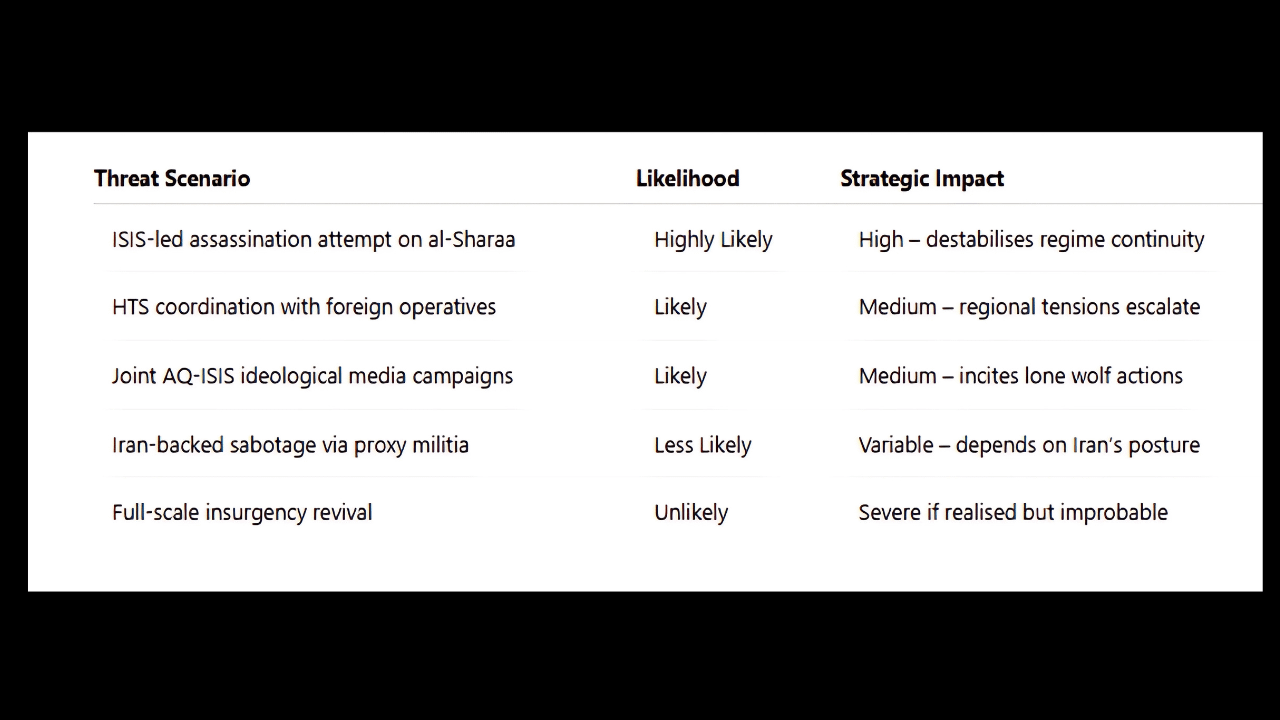
This analysis reflects the best available open-source intelligence and geopolitical trends as of May 2025. Developments are fluid, and the situation may evolve rapidly depending on regional alignments and internal dynamics.
SOURCE: OSINT