

Ujasusi Blog’s Terrorism Monitor Desk | 19 January 2026 | 2315 GMT
Snapshot
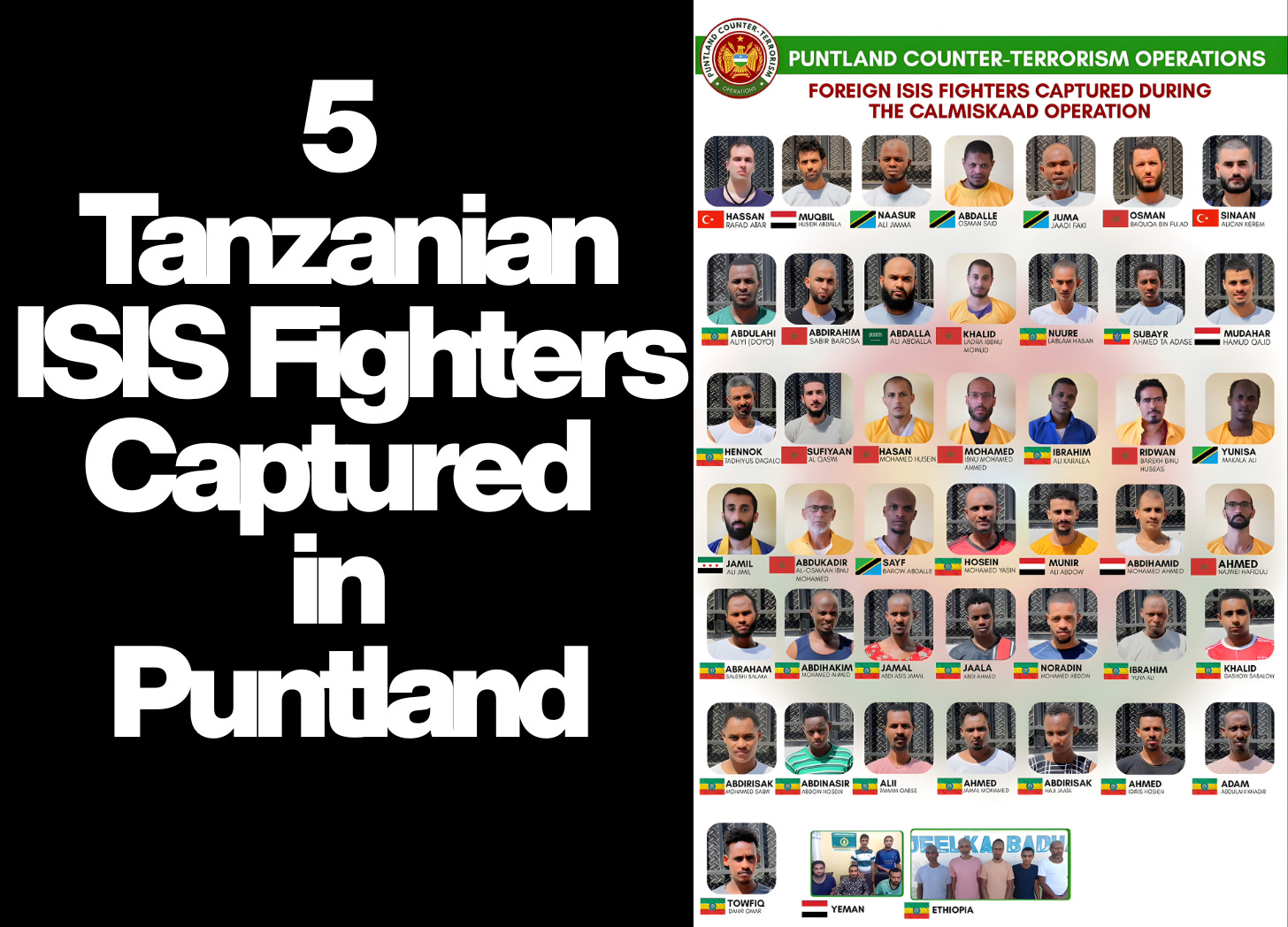
Puntland Counter-Terrorism Operations captured multiple Tanzanian foreign fighters during the ongoing Al-Miska’at offensive, with Puntland authorities publicly displaying captured combatants on 18 January 2026 in Bosaso. These captures confirm Tanzania’s emergence as a major recruitment reservoir across multiple jihadist networks including Islamic State-Somalia (IS-S), Islamic State-Mozambique (IS-CAP), Allied Democratic Forces (IS-DRC), and al-Shabaab. The captures coincide with Tanzania’s gravest domestic security crisis since independence: the disputed 29 October 2025 election triggered state-orchestrated massacres with ICC submissions alleging an estimated 10,000 deaths, creating unprecedented state fragility where politicised security forces—accused of perpetrating the massacres—have lost public legitimacy, eroding the community cooperation essential for counter-terrorism whilst simultaneously driving recruitment through grievance, repression, and state terror.
📋 TABLE OF CONTENTS
1. What Is the Al-Miska’at Operation and Tanzania’s Multi-Front Jihadist Presence?
Operation Hilaac Results
Tanzania’s Transnational Jihadist Network Presence
Islamic State-Somalia (IS-S)
Islamic State-Mozambique (IS-CAP)
Allied Democratic Forces (IS-DRC)
Al-Shabaab
Strategic Assessment
2. How Did Tanzania Become a Jihadist Recruitment Hub? The Historical Pipeline (1998-2025)
Phase 1: Al-Qaeda’s East African Legacy (1998-2010)
Phase 2: Al-Shabaab’s Recruitment Surge (2010-2015)
Phase 3: Islamic State Emergence and Diversification (2015-2020)
Phase 4: Consolidation and Mainstreaming (2020-2024)
Why Tanzania? The Al-Karrar Office’s Strategic Calculus
3. How Did Tanzania’s Security Apparatus Collapse?
The 29 October 2025 Election Massacres
Politicisation and Delegitimisation of Security Forces
Tanzania Intelligence and Security Service (TISS)
Tanzania People’s Defence Force (TPDF)
Tanzania Police Force
4. How Does Security Apparatus Collapse Enable Terrorism?
Erosion of Community Cooperation (includes Tanga case study)
Grievance-Based Recruitment Acceleration
State Capacity Diversion
Institutional Knowledge Loss
International Cooperation Breakdown
Legitimacy of Jihadist Narratives
5. What Is the Strategic Threat Assessment?
Immediate Threats (2026-2027)
6. Conclusion: State Terror Enables Transnational Terrorism
What Is the Al-Miska’at Operation and Tanzania’s Multi-Front Jihadist Presence?
Operation Hilaac Results
Operation Hilaac (Lightning), launched by Puntland Security Forces in November 2024, achieved significant territorial gains against IS-S: 65% reclamation by January 2025, expanding to 98% by June 2025, with over 200 militants killed, 150+ captured, and 100+ bases destroyed. U.S. AFRICOM conducted 109+ airstrikes in 2025, killing 46 militants in February operations targeting senior IS-S leadership.
On 18 January 2026, Puntland authorities publicly displayed captured foreign fighters in Bosaso, revealing at least five Tanzanian fighters amongst Ethiopia’s largest contingent, Yemen, Morocco, Turkey, Saudi Arabia, and Syria. This confirms intelligence assessments that foreign fighters constitute 60-70% of IS-S’s operational strength, with West Point’s Combating Terrorism Center reporting Tanzanians and Ethiopians jointly represent the majority of new recruits.
The 31 December 2024 attack on a Puntland base—IS-S’s most sophisticated assault—employed 12 foreign fighters including two Tanzanians, utilising two VBIEDs, four suicide bombers, and coordinated assault teams demonstrating advanced training.
Tanzania’s Transnational Jihadist Network Presence
Islamic State-Somalia (IS-S): Operating from Cal Miska’ad Mountains in Puntland’s Bari Region, IS-S hosts the al-Karrar office—Islamic State’s General Directorate of Provinces for Central, Eastern, and Southern Africa—making it a strategic hub for foreign fighter coordination, financial flows, and institutional knowledge transfer across the continent. West Point’s Combating Terrorism Center confirms Tanzanians and Ethiopians jointly represent the majority of new recruits in IS-S training camps. UN monitoring teams report Tanzanians constitute one of three largest foreign fighter contingents alongside Ethiopians and Yemenis. The January 2026 Puntland presentation revealed at least five Tanzanian fighters amongst captured combatants, whilst the 31 December 2024 suicide assault employed two Tanzanians in a 12-member all-foreign-fighter attack team.
Islamic State-Mozambique (IS-CAP): West Point CTC reports large Tanzanian contingents documented since 2017 operating in Cabo Delgado Province. Tanzania’s shared 770-kilometre border with Mozambique facilitates recruitment and infiltration, whilst IS-CAP operations directly threaten Tanzania’s southern regions.
Allied Democratic Forces (IS-DRC): Institute for Security Studies confirms ADF broadened recruitment from traditional Ugandan/Congolese bases to Kenya and Tanzania. In February 2022, FARDC arrested three Tanzanian ADF members in Beni, DRC—the first documented Tanzanian nationals detained with the group. Africa Defense Forum reports ADF recruits from DRC, Burundi, Kenya, Somalia, and Tanzania. In 2018, a Tanzanian ADF cell arrest reportedly triggered U.S. Embassy Kinshasa closure due to terrorist threats.
Al-Shabaab: Al-Shabaab recruited significant numbers of Tanzanians in early 2010s, establishing rudimentary training camps on Tanzanian soil. Historical al-Qaeda recruitment networks from the 1998 Dar es Salaam embassy bombing provided infrastructure subsequently exploited by al-Shabaab. Whilst al-Shabaab maintains predominantly Somali identity, coastal Tanzanian Muslims continue as recruitment targets.
Strategic Assessment: U.S. intelligence and UN monitoring confirm Tanzanians constitute one of three largest foreign fighter contingents in IS-S alongside Ethiopians and Yemenis. Tanzania’s 72 million population—East Africa’s largest Swahili-speaking nation—combined with maritime access, porous borders, and current state collapse positions it as a strategic recruitment reservoir for multiple IS affiliates and competing jihadist networks across East and Central Africa.