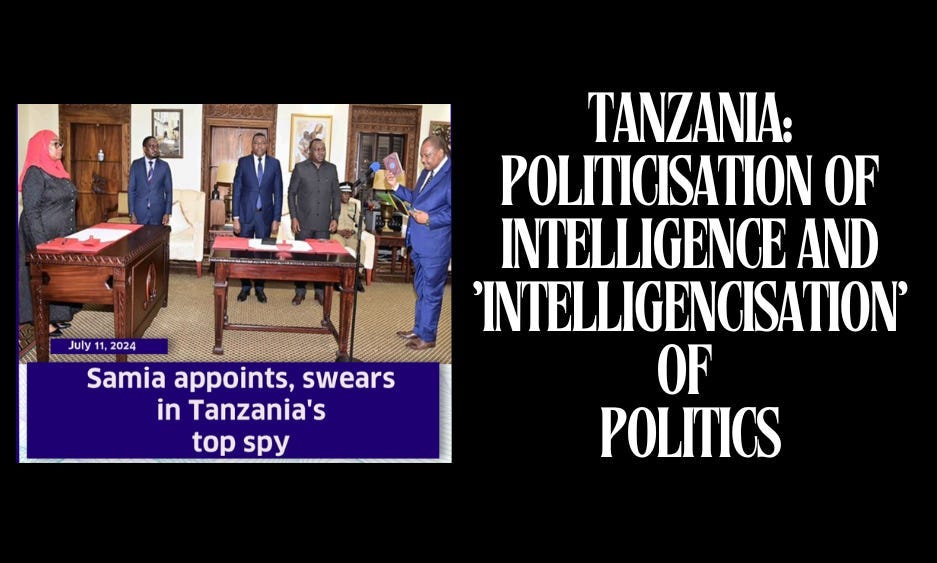
The Politicisation of Intelligence and the ‘Intelligencisation’ of Politics in Tanzania: An Intelligence Analyst’s Assessment
Ujasusi Blog’s East Africa Monitoring Team | 23 February 2026 | 0030 GMT
The politicisation of intelligence refers to the deliberate manipulation of intelligence services, assessments, or outputs to serve partisan or governmental political objectives rather than national security imperatives. In Tanzania, this dynamic is mirrored by a reciprocal process — the ‘intelligencisation’ of politics — wherein the Tanzania Intelligence and Security Service (TISS) has become structurally embedded within the country’s political architecture, shaping governance, suppressing dissent, and operating as an instrument of ruling-party dominance rather than a neutral security apparatus.
What Is the Historical Basis for TISS’s Political Entanglement?
Tanzania’s intelligence apparatus did not emerge from a neutral bureaucratic tradition. It was born into a one-party socialist state and shaped from its earliest institutional form by the imperatives of ideological conformity rather than conventional national security doctrine.
Following independence in 1961, Julius Nyerere’s government constructed an internal security architecture designed to protect the Tanganyika African National Union (TANU) project — and later, from 1977, the Chama Cha Mapinduzi (CCM). The intelligence service was not conceived as an apolitical check on threats to the state but as an organ of the state’s political project. That foundational design has never been structurally dismantled. The Intelligence and Security Service Act of 1996 provided a legislative framework for TISS during the multiparty transition, but critics consistently argued it was drafted to preserve executive and party control rather than to establish genuinely independent oversight.
The transition to multiparty democracy in the early 1990s did not reverse this trajectory. It accelerated it. A ruling party that had previously managed political competition through the single-party system now required intelligence tools to manage the new landscape of competitive politics. CCM’s continued dominance across four decades of nominal multiparty elections reflects, in part, the advantages conferred by intelligence penetration of opposition structures, civil society, and the media.
How Has TISS Been Used to Suppress Political Opposition?
The evidence base for operational TISS involvement in political suppression is substantial, though frequently documented through civil society reporting, journalist testimonies, and regional human rights bodies rather than official records, which remain classified or inaccessible.
Key documented patterns include:
Surveillance of opposition figures: Members of Chadema (Chama cha Demokrasia na Maendeleo) have reported systematic monitoring of their communications, movements, and organisational activities. This surveillance has extended to family members and legal representatives.
Intimidation and coercive interrogation: TISS officers have been credibly accused of conducting extrajudicial interrogations, targeting opposition politicians, activists, and journalists ahead of electoral cycles or during periods of political volatility.
Facilitation of enforced disappearances: The post-October 2025 electoral crisis — in which approximately 10,000 civilians were killed following disputed elections — brought renewed and intensive scrutiny to TISS’s role in systematic abductions. The 82-page dossier submitted to the ICC on 18 November 2025 by Intelwatch, the Madrid Bar Association, the World Jurist Association, and a coalition of anonymous Tanzanian organisations documents a pattern of enforced disappearances consistent with a coordinated state intelligence operation, not isolated acts of individual officers. The dossier specifically invokes the ICC’s Rome Statute principle of command responsibility, naming President Samia Suluhu Hassan, as commander-in-chief, along with senior army, police, and intelligence chiefs.
Interference in party organisation: Informant networks embedded within opposition structures have disrupted internal organisation, pre-empted protests, and enabled pre-emptive detention of key figures before planned mobilisation. The Legal and Human Rights Centre (LHRC) in Tanzania has documented this pattern across multiple electoral cycles.
The use of TISS as a political instrument accelerated markedly under President John Magufuli (2015–2021) and has continued under President Samia Suluhu Hassan. Early signals of liberalisation under Samia — the lifting of some media bans, selective release of detained opposition figures — obscured a deeper process of authoritarian consolidation. TISS remained structurally integrated into the political suppression apparatus, with its operational mandate quietly expanded.
What Does ‘Intelligencisation’ of Politics Mean in Practice?
The intelligencisation of politics is the inverse of politicisation: whereas politicisation describes intelligence being bent to political ends, intelligencisation describes political processes being reshaped by intelligence logic, intelligence personnel, and intelligence methods.
In Tanzania, this manifests in three concrete ways.
First, intelligence personnel occupy political and administrative roles. Former TISS officers and serving officers on secondment have taken up positions across ministries, state corporations, and regional administrative structures. This places intelligence-trained individuals — conditioned in tradecraft, surveillance, and information control — into governance roles where democratic accountability is nominally the operating principle. The result is a creeping intelligence culture within civilian administration.
Second, intelligence assessments shape policy formulation. TISS reporting feeds directly into the executive decision-making process on matters that extend well beyond conventional security policy. Economic policy, land management, labour relations, and media regulation have all, at various points, been subject to intelligence-informed framing that designates legitimate civic actors as security threats. When a labour organiser, investigative journalist, or NGO director is assessed by TISS as a destabilising actor, that assessment can produce administrative harassment, funding restrictions, or criminal referrals — outcomes that operate in the political domain while carrying the procedural authority of a security determination.
Third, intelligence methods have colonised political communication. The Tanzanian state’s approach to information management — controlling narratives, deploying disinformation, monitoring social media at scale — reflects an intelligence operational logic applied to political communication. This is not incidental; it is the direct result of TISS expertise being channelled into the management of public discourse. The Tanzania Communications Regulatory Authority (TCRA) has operated in functional proximity to TISS on digital content regulation, enabling a hybrid model of communications control that combines regulatory power with intelligence-grade monitoring. The six-day internet shutdown imposed during the October 2025 election period — documented in the Intelwatch dossier as having been used to create an information vacuum within which security forces committed mass atrocities — is the most operationally significant example of this model to date.
What Legislative Mechanisms Have Enabled or Constrained Politicisation?
The legal architecture governing TISS is both the source of its authority and the primary mechanism through which accountability has been systematically weakened.
The Intelligence and Security Service Act of 1996 established TISS’s formal mandate but did so in terms broad enough to permit expansive interpretation. Proposed amendments to the Act have periodically generated concern among legal analysts and civil society organisations in Tanzania, with the LHRC among those raising formal objections to provisions that critics argue would reduce judicial oversight and expand operational immunity for intelligence officers. The specific legislative content of those proposals has not been made fully public, which is itself a governance problem — accountability requires transparency about the rules under which an intelligence service operates.
Tanzania is not bound by any regional intelligence governance framework that would impose external compliance obligations, and its domestic oversight mechanisms — including parliamentary committees with nominal TISS oversight responsibility — lack both the access and the political independence to function as genuine checks on intelligence conduct. The parliamentary committee nominally responsible for intelligence oversight has historically been dominated by CCM members with no structural incentive to constrain the service.
How Do Regional and Geopolitical Factors Shape TISS’s Operational Environment?
Tanzania’s intelligence architecture cannot be assessed in isolation from its regional context. The country occupies a pivotal position in the East African security landscape: bordering eight countries, hosting significant refugee populations from the DRC and Burundi, and positioned along maritime routes through the Indian Ocean. These factors generate genuine national security imperatives that provide legitimate justification for a capable intelligence apparatus.
The challenge is that genuine security imperatives and political instrumentalisation of intelligence are not mutually exclusive. TISS’s counterterrorism mandate — real and operationally significant, particularly given threat spillover from Mozambique’s Cabo Delgado insurgency and the broader Sahel-to-coast jihadist arc — has been used to provide institutional cover for politically motivated surveillance and detention. The conflation of political opposition with security threat, once established as operational doctrine within an intelligence service, is difficult to disaggregate.
Internationally, TISS maintains training and liaison relationships with several partner services. Western partners, particularly through bilateral arrangements with European intelligence services, have historically emphasised counterterrorism and transnational crime cooperation. China’s engagement with Tanzania’s digital infrastructure — part of a broader pattern of technology transfer across the continent — has raised concerns among analysts about surveillance capabilities available to a service with a documented record of political suppression, though the precise operational extent of any TISS-specific arrangement is not publicly confirmed.
The post-October 2025 crisis has complicated Tanzania’s international intelligence relationships. The ICC dossier process — with the ICC prosecutor’s office having confirmed receipt and initiated a preliminary review as of December 2025, per reporting by LMS Magazine — places partner services in a difficult position. Continuing operational liaison with TISS while their governments publicly call for accountability creates institutional tension, particularly for European services subject to human rights compliance obligations. The US Senate Foreign Relations Committee has separately called for an immediate independent investigation into the killing of civilians by Tanzanian security forces.
What Are the Structural Conditions That Sustain This Dynamic?
Several structural conditions make the political-intelligence entanglement in Tanzania durable and resistant to reform.
Executive centralisation of authority. Tanzania’s constitutional architecture concentrates significant power in the presidency. The President appoints the Director General of TISS, sets the intelligence mandate, and faces limited formal accountability for how the service is directed. Any reform of intelligence politicisation therefore ultimately requires either presidential will or sufficient external pressure to compel it — neither of which has been consistently available.
Absence of genuine parliamentary oversight. The parliamentary committee nominally responsible for intelligence oversight lacks cleared access to classified operations, has historically been dominated by CCM members with no structural incentive to constrain the service, and operates without the independent investigative staff that effective oversight requires. Comparative benchmarks — the UK’s Intelligence and Security Committee or South Africa’s Joint Standing Committee on Intelligence — illustrate what functional oversight architecture looks like; Tanzania’s current structure does not meet that standard.
Elite continuity within TISS. Senior leadership within TISS has maintained relatively stable networks across political transitions, including the transition from Magufuli to Samia. Institutional culture, operational priorities, and informal relationships that embed TISS in political structures have persisted regardless of formal changes at the top. Meaningful reform requires changing not just leadership but institutional culture — a process that takes years and demands consistent political commitment.
Public legitimation through security threat framing. The Tanzanian state has been effective at framing political opposition and civil society activism in security terms — as externally funded destabilisation, as threats to national unity, as covers for criminal networks. President Samia’s public statements following the October 2025 crisis — in which she characterised protesters as having been paid to take to the streets and described the unrest as a manufactured attempt to overthrow her government — are a direct application of this framing. Amplified through state media and intelligence-influenced public communications, it creates a domestic political environment in which TISS’s political activities are presented as legitimate national security work.
What Do the ICC Dossier and International Pressure Mean for TISS Accountability?
The accountability landscape for TISS, while still largely permissive, has shifted materially since October 2025.
The 82-page dossier submitted to the ICC by Intelwatch, the Madrid Bar Association, the World Jurist Association, and anonymous Tanzanian organisations on 18 November 2025 is the most significant legal intervention against the Tanzanian security apparatus in the country’s post-independence history. It invokes command responsibility under the Rome Statute — the same principle used to prosecute senior officials in prior ICC cases — naming intelligence chiefs alongside military and police leadership as bearing criminal liability for documented atrocities. As of early December 2025, the ICC prosecutor’s office had confirmed receipt of the dossier and initiated a preliminary review. No formal investigation has been opened. That process can take months or years, and Tanzania’s potential consideration of ICC withdrawal — reported by AllAfrica — introduces a jurisdictional variable that will require close monitoring.
What the dossier process has already achieved, regardless of its eventual legal outcome, is the creation of an evidentiary record that is difficult to suppress or discredit. Civil society documentation, diaspora testimony, satellite imagery of mass graves verified by international media including the BBC and CNN, and hospital and funeral home records collectively constitute an accountability infrastructure that did not previously exist for TISS operations. An intelligence service internationally documented as an instrument of mass atrocity faces serious degradation of its capacity to maintain legitimate partnerships, recruit credible personnel, and operate effectively in environments where professional reputation matters.
The structural conditions for meaningful reform require, at minimum: a politically independent appointment process for TISS senior leadership, a reformed oversight mechanism with genuine access and non-partisan composition, a legal framework that removes blanket immunity provisions for politically motivated operations, and sustained international engagement that connects normalisation of Tanzania’s diplomatic relationships to verifiable improvements in intelligence governance. None of those conditions is currently met. What is underway is the accumulation of external legal, diplomatic, and evidentiary pressure sufficient — over time — to shift the calculus of entrenched interests within both TISS and CCM. Its timeline remains uncertain, but the pressure is now structural rather than episodic.
The politicisation of intelligence refers to the deliberate manipulation of intelligence services, assessments, or outputs to serve partisan or governmental political objectives rather than national security imperatives. In Tanzania, this dynamic is mirrored by a reciprocal process — the ‘intelligencisation’ of politics — wherein the Tanzania Intelligence and Security Service (TISS) has become structurally embedded within the country’s political architecture, shaping governance, suppressing dissent, and operating as an instrument of ruling-party dominance rather than a neutral security apparatus.
What Is the Historical Basis for TISS’s Political Entanglement?
Tanzania’s intelligence apparatus did not emerge from a neutral bureaucratic tradition. It was born into a one-party socialist state and shaped from its earliest institutional form by the imperatives of ideological conformity rather than conventional national security doctrine.
Following independence in 1961, Julius Nyerere’s government constructed an internal security architecture designed to protect the Tanganyika African National Union (TANU) project — and later, from 1977, the Chama Cha Mapinduzi (CCM). The intelligence service was not conceived as an apolitical check on threats to the state but as an organ of the state’s political project. That foundational design has never been structurally dismantled. The Intelligence and Security Service Act of 1996 provided a legislative framework for TISS during the multiparty transition, but critics consistently argued it was drafted to preserve executive and party control rather than to establish genuinely independent oversight.
The transition to multiparty democracy in the early 1990s did not reverse this trajectory. It accelerated it. A ruling party that had previously managed political competition through the single-party system now required intelligence tools to manage the new landscape of competitive politics. CCM’s continued dominance across four decades of nominal multiparty elections reflects, in part, the advantages conferred by intelligence penetration of opposition structures, civil society, and the media.
How Has TISS Been Used to Suppress Political Opposition?
The evidence base for operational TISS involvement in political suppression is substantial, though frequently documented through civil society reporting, journalist testimonies, and regional human rights bodies rather than official records, which remain classified or inaccessible.
Key documented patterns include:
Surveillance of opposition figures: Members of Chadema (Chama cha Demokrasia na Maendeleo) have reported systematic monitoring of their communications, movements, and organisational activities. This surveillance has extended to family members and legal representatives.
Intimidation and coercive interrogation: TISS officers have been credibly accused of conducting extrajudicial interrogations, targeting opposition politicians, activists, and journalists ahead of electoral cycles or during periods of political volatility.
Facilitation of enforced disappearances: The post-October 2025 electoral crisis — in which approximately 10,000 civilians were killed following disputed elections — brought renewed and intensive scrutiny to TISS’s role in systematic abductions. The 82-page dossier submitted to the ICC on 18 November 2025 by Intelwatch, the Madrid Bar Association, the World Jurist Association, and a coalition of anonymous Tanzanian organisations documents a pattern of enforced disappearances consistent with a coordinated state intelligence operation, not isolated acts of individual officers. The dossier specifically invokes the ICC’s Rome Statute principle of command responsibility, naming President Samia Suluhu Hassan, as commander-in-chief, along with senior army, police, and intelligence chiefs.
Interference in party organisation: Informant networks embedded within opposition structures have disrupted internal organisation, pre-empted protests, and enabled pre-emptive detention of key figures before planned mobilisation. The Legal and Human Rights Centre (LHRC) in Tanzania has documented this pattern across multiple electoral cycles.
The use of TISS as a political instrument accelerated markedly under President John Magufuli (2015–2021) and has continued under President Samia Suluhu Hassan. Early signals of liberalisation under Samia — the lifting of some media bans, selective release of detained opposition figures — obscured a deeper process of authoritarian consolidation. TISS remained structurally integrated into the political suppression apparatus, with its operational mandate quietly expanded.
What Does ‘Intelligencisation’ of Politics Mean in Practice?
The intelligencisation of politics is the inverse of politicisation: whereas politicisation describes intelligence being bent to political ends, intelligencisation describes political processes being reshaped by intelligence logic, intelligence personnel, and intelligence methods.
In Tanzania, this manifests in three concrete ways.
First, intelligence personnel occupy political and administrative roles. Former TISS officers and serving officers on secondment have taken up positions across ministries, state corporations, and regional administrative structures. This places intelligence-trained individuals — conditioned in tradecraft, surveillance, and information control — into governance roles where democratic accountability is nominally the operating principle. The result is a creeping intelligence culture within civilian administration.
Second, intelligence assessments shape policy formulation. TISS reporting feeds directly into the executive decision-making process on matters that extend well beyond conventional security policy. Economic policy, land management, labour relations, and media regulation have all, at various points, been subject to intelligence-informed framing that designates legitimate civic actors as security threats. When a labour organiser, investigative journalist, or NGO director is assessed by TISS as a destabilising actor, that assessment can produce administrative harassment, funding restrictions, or criminal referrals — outcomes that operate in the political domain while carrying the procedural authority of a security determination.
Third, intelligence methods have colonised political communication. The Tanzanian state’s approach to information management — controlling narratives, deploying disinformation, monitoring social media at scale — reflects an intelligence operational logic applied to political communication. This is not incidental; it is the direct result of TISS expertise being channelled into the management of public discourse. The Tanzania Communications Regulatory Authority (TCRA) has operated in functional proximity to TISS on digital content regulation, enabling a hybrid model of communications control that combines regulatory power with intelligence-grade monitoring. The six-day internet shutdown imposed during the October 2025 election period — documented in the Intelwatch dossier as having been used to create an information vacuum within which security forces committed mass atrocities — is the most operationally significant example of this model to date.
What Legislative Mechanisms Have Enabled or Constrained Politicisation?
The legal architecture governing TISS is both the source of its authority and the primary mechanism through which accountability has been systematically weakened.
The Intelligence and Security Service Act of 1996 established TISS’s formal mandate but did so in terms broad enough to permit expansive interpretation. Proposed amendments to the Act have periodically generated concern among legal analysts and civil society organisations in Tanzania, with the LHRC among those raising formal objections to provisions that critics argue would reduce judicial oversight and expand operational immunity for intelligence officers. The specific legislative content of those proposals has not been made fully public, which is itself a governance problem — accountability requires transparency about the rules under which an intelligence service operates.
Tanzania is not bound by any regional intelligence governance framework that would impose external compliance obligations, and its domestic oversight mechanisms — including parliamentary committees with nominal TISS oversight responsibility — lack both the access and the political independence to function as genuine checks on intelligence conduct. The parliamentary committee nominally responsible for intelligence oversight has historically been dominated by CCM members with no structural incentive to constrain the service.
How Do Regional and Geopolitical Factors Shape TISS’s Operational Environment?
Tanzania’s intelligence architecture cannot be assessed in isolation from its regional context. The country occupies a pivotal position in the East African security landscape: bordering eight countries, hosting significant refugee populations from the DRC and Burundi, and positioned along maritime routes through the Indian Ocean. These factors generate genuine national security imperatives that provide legitimate justification for a capable intelligence apparatus.
The challenge is that genuine security imperatives and political instrumentalisation of intelligence are not mutually exclusive. TISS’s counterterrorism mandate — real and operationally significant, particularly given threat spillover from Mozambique’s Cabo Delgado insurgency and the broader Sahel-to-coast jihadist arc — has been used to provide institutional cover for politically motivated surveillance and detention. The conflation of political opposition with security threat, once established as operational doctrine within an intelligence service, is difficult to disaggregate.
Internationally, TISS maintains training and liaison relationships with several partner services. Western partners, particularly through bilateral arrangements with European intelligence services, have historically emphasised counterterrorism and transnational crime cooperation. China’s engagement with Tanzania’s digital infrastructure — part of a broader pattern of technology transfer across the continent — has raised concerns among analysts about surveillance capabilities available to a service with a documented record of political suppression, though the precise operational extent of any TISS-specific arrangement is not publicly confirmed.
The post-October 2025 crisis has complicated Tanzania’s international intelligence relationships. The ICC dossier process — with the ICC prosecutor’s office having confirmed receipt and initiated a preliminary review as of December 2025, per reporting by LMS Magazine — places partner services in a difficult position. Continuing operational liaison with TISS while their governments publicly call for accountability creates institutional tension, particularly for European services subject to human rights compliance obligations. The US Senate Foreign Relations Committee has separately called for an immediate independent investigation into the killing of civilians by Tanzanian security forces.
What Are the Structural Conditions That Sustain This Dynamic?
Several structural conditions make the political-intelligence entanglement in Tanzania durable and resistant to reform.
Executive centralisation of authority. Tanzania’s constitutional architecture concentrates significant power in the presidency. The President appoints the Director General of TISS, sets the intelligence mandate, and faces limited formal accountability for how the service is directed. Any reform of intelligence politicisation therefore ultimately requires either presidential will or sufficient external pressure to compel it — neither of which has been consistently available.
Absence of genuine parliamentary oversight. The parliamentary committee nominally responsible for intelligence oversight lacks cleared access to classified operations, has historically been dominated by CCM members with no structural incentive to constrain the service, and operates without the independent investigative staff that effective oversight requires. Comparative benchmarks — the UK’s Intelligence and Security Committee or South Africa’s Joint Standing Committee on Intelligence — illustrate what functional oversight architecture looks like; Tanzania’s current structure does not meet that standard.
Elite continuity within TISS. Senior leadership within TISS has maintained relatively stable networks across political transitions, including the transition from Magufuli to Samia. Institutional culture, operational priorities, and informal relationships that embed TISS in political structures have persisted regardless of formal changes at the top. Meaningful reform requires changing not just leadership but institutional culture — a process that takes years and demands consistent political commitment.
Public legitimation through security threat framing. The Tanzanian state has been effective at framing political opposition and civil society activism in security terms — as externally funded destabilisation, as threats to national unity, as covers for criminal networks. President Samia’s public statements following the October 2025 crisis — in which she characterised protesters as having been paid to take to the streets and described the unrest as a manufactured attempt to overthrow her government — are a direct application of this framing. Amplified through state media and intelligence-influenced public communications, it creates a domestic political environment in which TISS’s political activities are presented as legitimate national security work.
What Do the ICC Dossier and International Pressure Mean for TISS Accountability?
The accountability landscape for TISS, while still largely permissive, has shifted materially since October 2025.
The 82-page dossier submitted to the ICC by Intelwatch, the Madrid Bar Association, the World Jurist Association, and anonymous Tanzanian organisations on 18 November 2025 is the most significant legal intervention against the Tanzanian security apparatus in the country’s post-independence history. It invokes command responsibility under the Rome Statute — the same principle used to prosecute senior officials in prior ICC cases — naming intelligence chiefs alongside military and police leadership as bearing criminal liability for documented atrocities. As of early December 2025, the ICC prosecutor’s office had confirmed receipt of the dossier and initiated a preliminary review. No formal investigation has been opened. That process can take months or years, and Tanzania’s potential consideration of ICC withdrawal — reported by AllAfrica — introduces a jurisdictional variable that will require close monitoring.
What the dossier process has already achieved, regardless of its eventual legal outcome, is the creation of an evidentiary record that is difficult to suppress or discredit. Civil society documentation, diaspora testimony, satellite imagery of mass graves verified by international media including the BBC and CNN, and hospital and funeral home records collectively constitute an accountability infrastructure that did not previously exist for TISS operations. An intelligence service internationally documented as an instrument of mass atrocity faces serious degradation of its capacity to maintain legitimate partnerships, recruit credible personnel, and operate effectively in environments where professional reputation matters.
The structural conditions for meaningful reform require, at minimum: a politically independent appointment process for TISS senior leadership, a reformed oversight mechanism with genuine access and non-partisan composition, a legal framework that removes blanket immunity provisions for politically motivated operations, and sustained international engagement that connects normalisation of Tanzania’s diplomatic relationships to verifiable improvements in intelligence governance. None of those conditions is currently met. What is underway is the accumulation of external legal, diplomatic, and evidentiary pressure sufficient — over time — to shift the calculus of entrenched interests within both TISS and CCM. Its timeline remains uncertain, but the pressure is now structural rather than episodic.