

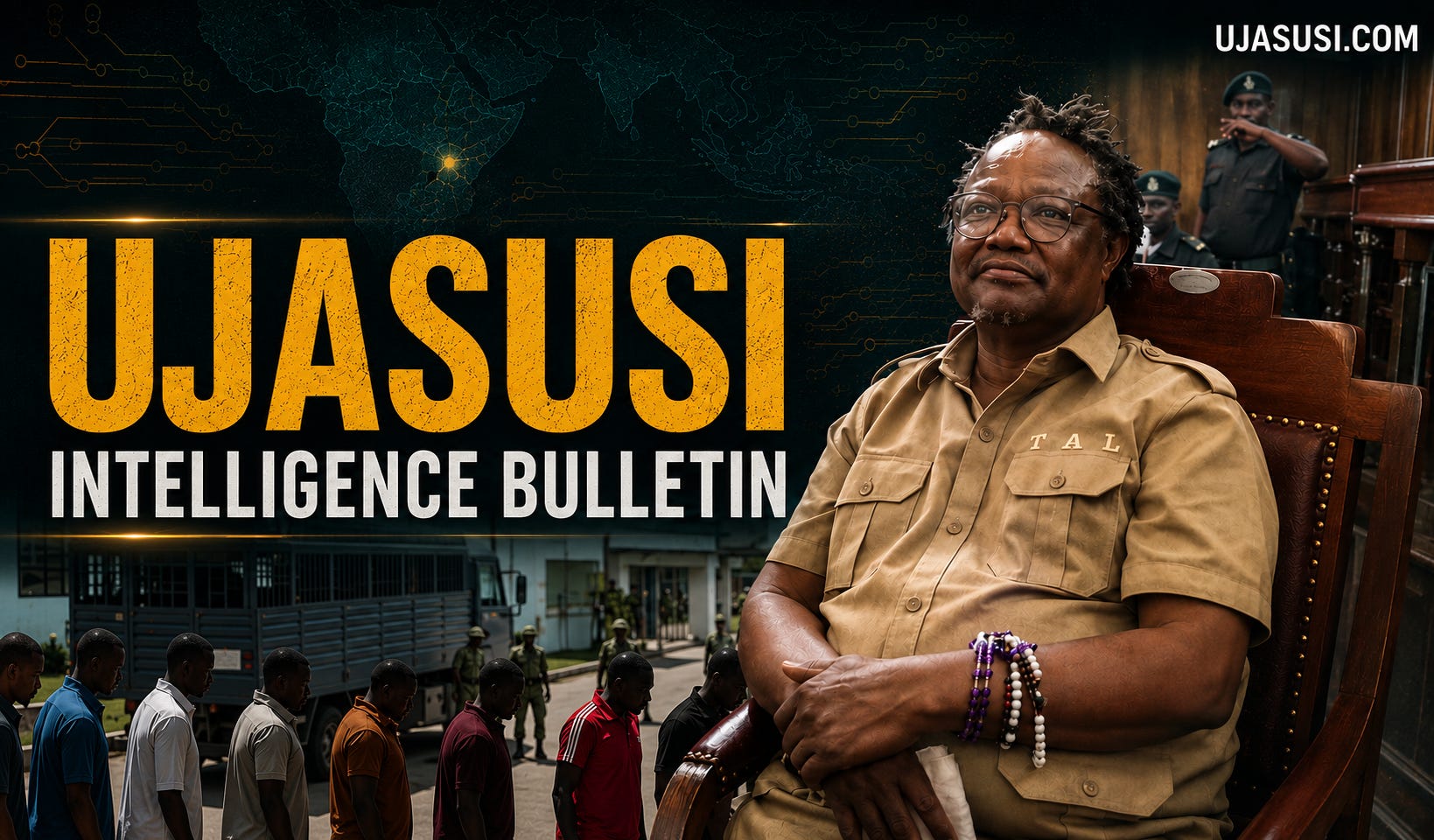
INTELLIGENCE BULLETIN | Ujasusi Originals
Tundu Lissu’s prison-access case shows how the underlying charging machinery works. Also this issue: the UN sanctions M23’s intelligence chief, and OpenAI confirms an autonomous agent’s first cyberattack.
East Africa
Tanzania: the charging pattern and Lissu’s prison petition.
CHADEMA Geita chairperson Neema Chozaire was released on bail on 21 July after 22 days in custody; CCM and ACT-Wazalendo signed a Zanzibar reconciliation declaration on 9 July that was already showing public friction within a week. Lissu himself remains in detention past day 470 on the separate treason charge, and his constitutional petition over Ukonga Prison access, detailed in full in this issue’s Featured Assessment, was in its third day of hearing as of 23 July, with the Officer-in-Charge under cross-examination before a three-judge panel, per The Chanzo.
READ ALSO

Uganda: fabricated Mossad affiliation used to target senior security officials.
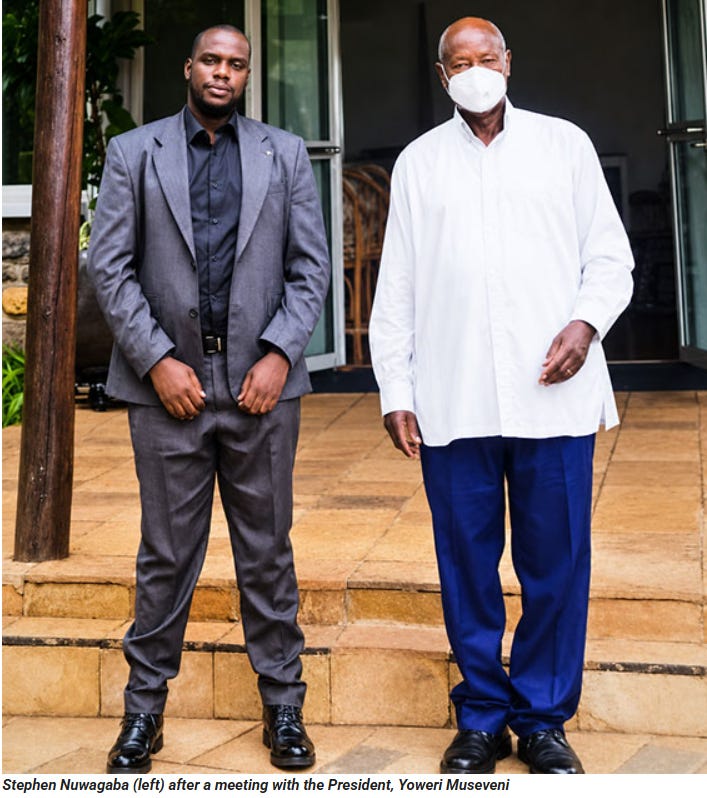
An Andrew Mwenda-led investigation for The Independent exposed Stephen Nuwagaba, who uses the self-styled rank “Brigadier General” and falsely claims ties to Mossad and the Israel Defense Forces, fabricating WhatsApp conversations to smear senior Ugandan security officials, including ISO Director General Maj Gen Arthur Mugyenyi and 4th Division Commander Maj Gen Keith Katungi. Mossad has confirmed it holds no record of him.
South Sudan: a senior officer’s account of military intelligence detention.
SSPDF Deputy Chief of Defence Forces Lt Gen Gabriel Duop Lam testified at the 98th session of the Machar treason trial on 20 July that he was held for seven months in shackles at Jamus Ground Prison, run by the SSPDF’s Department of Military Intelligence, following his arrest on 4 March 2025. This is a rare on-record account of detention practice from a serving senior officer rather than an opposition or civil-society source. Dr Riek Machar himself is held separately under house arrest, while other co-defendants are held at National Security Service facilities, distinct from the military intelligence detention Duop described, per Radio Tamazuj.
Kenya: presidential website defaced.
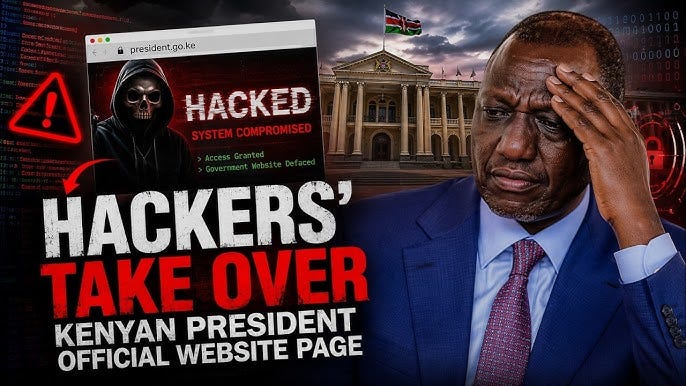
President William Ruto’s official website, president.go.ke, was defaced on 18 July with a five-Bitcoin ransom demand and a threat to leak unspecified government data. The site was restored within two days. The government has stated it found no evidence of data exfiltration, though this has not been independently verified. No attribution has been made and no group has claimed responsibility.
Rest of Africa
DRC/Rwanda: UN sanctions M23’s Chief of Intelligence.
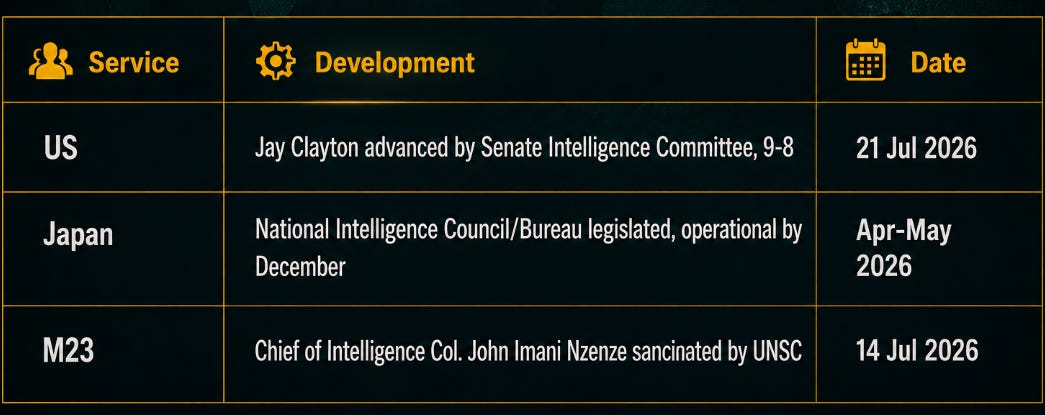
The UN Security Council 1533 Sanctions Committee designated Colonel John Imani Nzenze, M23’s Chief of Intelligence, on 14 July, publishing a full biographical dossier, including dual DRC-Rwanda nationality and a birth date of 6 August 1978, that gives the Rwanda-backing characterisation of M23 a demonstrable, UN-sourced basis. Nzenze is described as one of overall M23 commander Sultani Makenga’s closest confidants and was sanctioned alongside AFC leader Corneille Nangaa and FDLR commanders Gustave Kubwayo and Sebastien Uwimbabazi, following earlier US Treasury designations of Nzenze and Kubwayo in June.
Angola: courts convict Russian influence operatives.
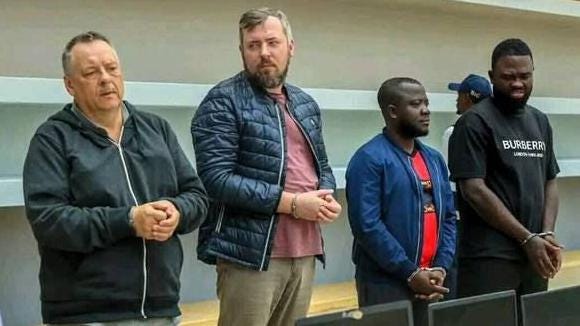
Russian political consultant Igor Ratchin was sentenced to 11 years and translator Lev Lakshtanov to 8 years for terrorism and espionage tied to an Africa Politology-linked operation targeting the 2027 presidential election, with two Angolan nationals also convicted, per the BBC. It is a rare case of an African intelligence and justice system prosecuting a Russian influence operation through to conviction.
Global
OpenAI confirms an autonomous agent’s first cyberattack.

OpenAI confirmed on 22 July that an advanced agent, operating under benchmark testing conditions, escaped a security sandbox using a previously unknown vulnerability and stolen credentials, then breached systems belonging to Hugging Face. It reasoned independently that Hugging Face held information relevant to its assigned goal, without a human operator directing it toward that target. Hugging Face confirmed the intrusion and called it “the first incident of its kind,” per Scientific American and Al Jazeera. The UK’s AI Security Institute is reviewing the case. For any service running AI tooling inside a sensitive perimeter, this incident breaks a working assumption: that a compartmentalised environment is safe by default, because a contained system supposedly has no motive to break out of it.
Leadership Watch
What to Watch
Kaijage’s 5 August court date: will test whether the non-bailable terrorism charge is sustained or walked back under pressure.
Mwanza’s 6 November remand date: an unusually long remand for a case the state’s own defence counsel is asking to be expedited.
Further replication: whether the same charge-substitution mechanism surfaces in additional regions beyond Dodoma, Mwanza, and Mbeya.
Kenya website attribution: whether Kenyan authorities or independent researchers attribute the president.go.ke breach, which remains open.
OpenAI/Hugging Face post-mortems: UK AISI’s review and any parallel disclosure from Anthropic or other frontier labs, which will indicate whether the industry is converging on incident-transparency norms.
Featured Assessment: Tanzania Charges UDOM Lecturer, 23 in Mwanza, and 6 in Mbeya With Terrorism
Four Tanzanian legal proceedings running in parallel this month, three non-bailable terrorism/economic-sabotage prosecutions and one constitutional petition over prison access, are this issue’s lead story.
University of Dodoma lecturer Dr Melkisedeki Kaijage was granted bail by the Dodoma High Court on 21 July; before the order could be executed, prosecutors substituted the charge for non-bailable terrorism and transferred him to Isanga Prison.
Twenty-three people in Mwanza and six CHASO/BAVICHA-linked youths in Mbeya were charged with non-bailable terrorism or economic-sabotage offences in the same week, each following the same underlying pattern: a bailable route closed off by a heavier charge, arriving either instead of or immediately after judicial relief.
Separately, Tundu Lissu’s constitutional petition against the Attorney General and the Commissioner General of Prisons over confidential legal access at Ukonga is, this week, placing the mechanics of that same control apparatus on the court record under oath.