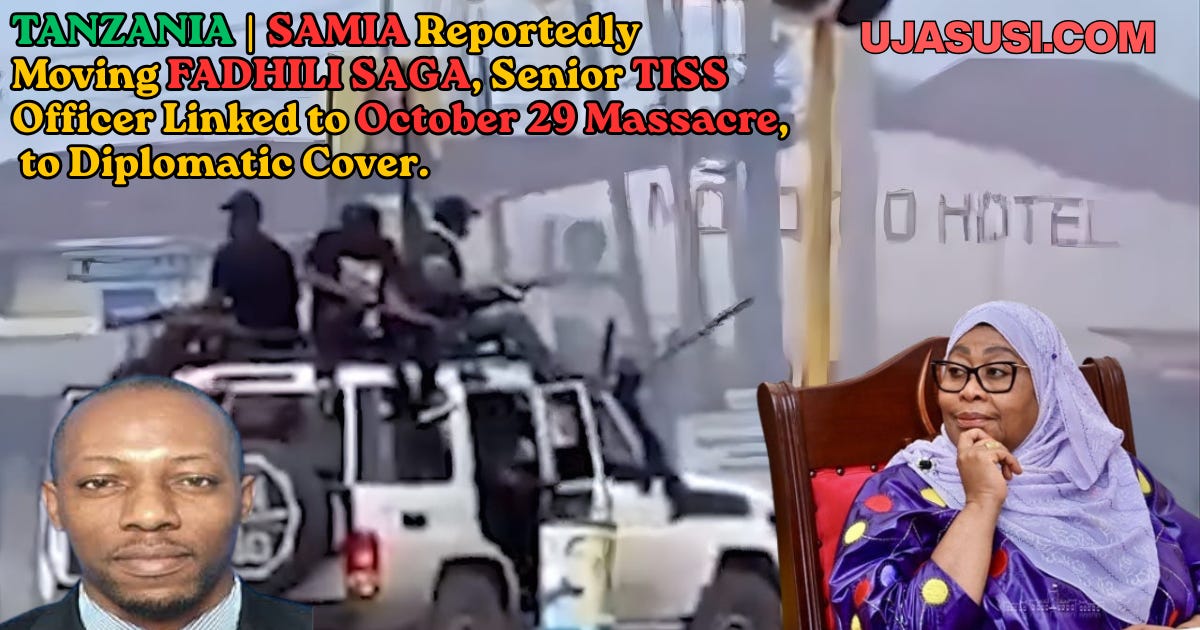
TANZANIA | Samia Reportedly Moving Fadhili Saga, Senior TISS Officer Linked to October 29 Massacre, to Diplomatic Cover
Ujasusi East Africa Monitoring Team | 01 June 2026 | 0000 BST
Intelligence Brief
Classification: Open-Source / Source-Informed Intelligence Assessment
Product Type: Strategic Accountability Intelligence Brief
Date: 01 June 2026
Geographic Focus: Tanzania / diplomatic-cover redeployments / post-October 29 accountability exposure
Primary Subject: Fadhil Mufwimi Saga
Key Actors and Institutions: President Samia Suluhu Hassan; Tanzania Intelligence and Security Service; Tanzania People’s Defence Force; Ministry of Foreign Affairs; State House; diplomatic service; KMKM; police; presidential inner circle
Core Question: Is the reported movement of Fadhil Mufwimi Saga into a diplomatic or embassy-cover role part of a wider state strategy to shield, relocate, or contain figures linked to the October 29, 2025 massacre architecture?
1. Key Judgements
KJ-1: Saga’s operational seniority is established.
Fadhil Mufwimi Saga was a Senior Intelligence Officer and Director of Internal Operations within TISS before and during the October 29, 2025 massacre. This placed him in the operational layer most relevant to domestic intelligence tasking, protest monitoring, internal security operations, inter-agency coordination, and post-massacre evidence management. Confidence: High, source-informed.
KJ-2: The unresolved issue is not whether Saga was operationally senior, but whether he is now being moved into diplomatic or embassy cover.
If he is appointed ambassador, confirmation may appear through public channels. If he is posted as an attaché, counsellor, administrative officer, security liaison, intelligence officer, or embassy staffer under diplomatic cover, public confirmation may never appear. Verification would depend on indirect indicators: human-source reporting, travel patterns, host-country diplomatic lists, embassy appearances, accreditation leaks, diplomatic training, or disappearance from domestic operational visibility. Confidence: Moderate for the analytic approach; Low to Moderate for the specific posting until indicators accumulate.
KJ-3: Saga’s possible move should be assessed as part of a post-massacre pattern, not as an isolated rumour.
The reported ambassadorial appointments of senior TPDF figures after the October 29 massacre indicate that diplomacy may already be functioning as a relocation channel for sensitive coercive-sector personnel. Saga’s potential embassy-cover move would represent the intelligence-service extension of that same pattern. Confidence: Moderate.
KJ-4: Waziri Salum Rajab’s mysterious demotion broadens the pattern from military redeployment to inner-circle liability management.
As Samia Suluhu Hassan’s long-serving personal secretary, Waziri Salum Rajab occupied a sensitive access, scheduling, message-flow, and presidential gatekeeping role. His recent demotion or distancing should be treated as a potential indicator of post-massacre inner-circle reorganisation, damage control, or information containment. Confidence: Moderate, source-informed.
KJ-5: If Saga is moved into diplomatic or embassy cover, the leading hypothesis is protective redeployment.
Such a move would remove a Senior Intelligence Officer and former Director of Internal Operations from the domestic accountability environment, place him under state-managed external cover, reduce access by victims, lawyers and journalists, and keep a potentially damaging insider under regime control. Confidence if move is strongly indicated: High.
KJ-6: Diplomatic cover would not erase potential liability, but it could delay, obstruct, and complicate accountability.
For an ambassador, diplomatic immunity and host-state protocol would create formal shielding. For an attaché or embassy officer, opacity itself would become the shield. Either route would function as tactical protection rather than permanent legal exoneration. Confidence: High.
KJ-7: The ICC dossier strengthens the structural relevance of Saga’s case.
The dossier frames the October 29 massacre as alleged crimes against humanity committed through a widespread or systematic attack, pursuant to state policy, involving police, military and intelligence operatives. Saga’s role as Senior Intelligence Officer and Director of Internal Operations places him within the category of actor most likely to be evidentially significant to command-responsibility and operational-coordination analysis. Confidence: High for contextual relevance.
2. Bottom Line Assessment
The reported move of Fadhil Mufwimi Saga into a diplomatic or embassy-cover role should be treated as a high-priority intelligence lead within a broader post-October 29 massacre personnel pattern.
The key issue is not Saga’s seniority. That is established: he was a Senior Intelligence Officer and Director of Internal Operations within TISS before and during the massacre. The key issue is whether Samia Suluhu Hassan’s government is now attempting to move him out of the domestic security environment through formal diplomacy or opaque embassy cover.
READ ALSO
This possibility is significant because it follows a visible pattern. Senior TPDF figures have reportedly been moved into ambassadorial roles after the October 29 massacre, and Waziri Salum Rajab — Samia’s long-serving personal secretary — has been mysteriously demoted or distanced. Taken together, these movements suggest more than routine reshuffling. They point to a possible post-massacre liability-management architecture.
That architecture appears to have three layers:
Military layer: senior TPDF officers moved into ambassadorial posts;
Presidential inner-circle layer: Waziri Salum Rajab demoted or distanced from the centre;
Intelligence layer: Saga potentially moved into diplomatic or embassy cover.
If Saga’s move is confirmed or strongly indicated, it would likely represent the TISS component of the same pattern: controlled extraction, shielding, containment, and loyalty management.
The central intelligence judgement is:
A confirmed or strongly indicated diplomatic-cover posting for Fadhil Mufwimi Saga would be strong circumstantial evidence that Samia’s government is managing exposure around the October 29 massacre rather than enabling accountability.
3. Source and Information Evaluation
Source A: Direct Source-Informed Assessment on Saga’s Role
Content: Fadhil Mufwimi Saga was a Senior Intelligence Officer and Director of Internal Operations within TISS before and during the October 29 massacre.
Reliability: A/B — source-informed assessment from a former TISS member and close observer of Tanzanian intelligence circles.
Information Credibility: 2 — assessed as highly credible in context, while recognising that TISS internal appointments are often opaque and not publicly documented.
Use in Assessment: Establishes Saga’s operational seniority. The brief does not treat his TISS role as speculative.
Source B: Hilda Newton X Post
Content: Claims Saga was involved in October 29 massacre operations and is being prepared for an embassy posting in Asia.
Reliability: C — politically engaged source with possible activist or insider access; claim requires corroboration through indicators.
Information Credibility: 3–4 — plausible in context, especially given pattern indicators, but not independently confirmed.
Use in Assessment: Generates the diplomatic-cover lead. Does not by itself confirm the posting.
Source C: Tanzania Massacre Perpetrators Database
Content: Lists Fadhil Mufwimi Saga as a senior intelligence-linked figure within public accountability mapping.
Reliability: B/C — structured accountability source, but not a judicial body.
Information Credibility: 3 — useful for public naming and accountability mapping; not a legal finding.
Use in Assessment: Shows Saga has already been publicly identified in massacre-related accountability material.
Source D: Ujasusi Reporting on TPDF Ambassadorial Appointments
Content: Reports that senior TPDF figures, including Maj. Gen. Mbaraka Naziad Mkeremy and Maj. Gen. Marco Elisha Gaguti, were moved into ambassadorial roles after the October 29 massacre, amid rising ICC-related pressure.
Reliability: B — specialist political-security reporting with direct relevance to Tanzanian elite personnel movements.
Information Credibility: 2–3 — useful for pattern analysis.
Use in Assessment: Establishes the key pattern indicator: diplomacy as a possible relocation channel for senior coercive-sector figures.
Source E: Waziri Salum Rajab Demotion
Content: Waziri Salum Rajab, long-serving personal secretary to Samia Suluhu Hassan, was recently and mysteriously demoted or distanced.
Reliability: B — source-informed political-insider reporting.
Information Credibility: 2–3 — significant because of Rajab’s proximity to the president, though the exact reason for demotion remains opaque.
Use in Assessment: Expands the pattern from military redeployment to presidential inner-circle liability management.
Source F: ICC Article 15 Dossier
Content: Frames the October 29 massacre as alleged crimes against humanity involving a widespread or systematic attack, state policy, command responsibility, and police–military–intelligence coordination.
Reliability: B — structured legal submission, but not an ICC finding, indictment or arrest warrant.
Information Credibility: 2–3 for structural allegations; 4 where individual claims are absent, redacted or not independently verified.
Use in Assessment: Strengthens the legal and structural relevance of Saga’s position as Senior Intelligence Officer and Director of Internal Operations.
4. Intelligence Problem
The intelligence problem is no longer simply:
“Will Saga become an ambassador?”
That question is too narrow.
The more accurate intelligence problem is:
“Is Samia’s government reorganising, relocating, distancing, or shielding individuals connected to the October 29 massacre command environment through a mix of ambassadorial appointments, opaque embassy postings, demotions, and controlled redeployments?”
Saga’s case sits within this broader problem.
If he is made an ambassador, the move will likely leave public traces. If he is placed under embassy cover as attaché, counsellor, security liaison, administrative officer or intelligence-cover officer, the move may remain deliberately opaque.
Therefore, absence of a public appointment notice would not disprove the claim.
The intelligence standard should be:
Do accumulated indicators make the diplomatic-cover hypothesis more likely than routine reassignment or no movement at all?
5. Pattern Analysis: Post-October 29 Massacre Personnel Management
5.1 Military Layer: Ambassadorial Redeployment of Senior TPDF Figures
The reported ambassadorial appointments of senior TPDF officers after the October 29 massacre are important pattern indicators.
Such appointments may be explained as routine diplomatic use of senior retired or reassigned officers. However, the timing — after a massacre, amid ICC-related pressure, and involving senior coercive-sector figures — creates a stronger analytical possibility: diplomacy being used as an elite personnel-management tool.
The operational meaning is clear:
remove sensitive officers from domestic command visibility;
protect them from direct questioning;
reward loyalty without keeping them in exposed command roles;
reduce internal friction by avoiding punishment;
preserve state control through formal assignment;
create distance between the presidency and operational violence.
If this pattern is already visible in TPDF, Saga’s alleged move should be assessed as the possible intelligence-service equivalent.
5.2 Presidential Inner-Circle Layer: Waziri Salum Rajab
Waziri Salum Rajab’s demotion or distancing is relevant because of his long-standing proximity to Samia Suluhu Hassan.
A president’s personal secretary is not merely a clerical aide. In many African presidential systems, such an official can sit close to:
presidential scheduling;
visitor access;
informal gatekeeping;
document flow;
sensitive correspondence;
appointment channels;
political messages;
internal instructions;
liaison with security and protocol personnel;
knowledge of who met the president, when, and for what purpose.
If Rajab was abruptly demoted after the October 29 massacre, that movement should be treated as a possible indicator of inner-circle damage control.
It may indicate one or more of the following:
distancing the president from a long-serving insider;
blame management;
containment of sensitive knowledge;
internal distrust;
restructuring access to the president;
effort to break an evidentiary chain around decision flow;
reorganisation of the presidential gatekeeping system after a major crisis.
This does not require Rajab to have had a direct operational role in the massacre. His relevance lies in proximity, access, and timing.
5.3 Intelligence Layer: Fadhil Mufwimi Saga
Saga is the most sensitive potential case in this pattern because he was a Senior Intelligence Officer and Director of Internal Operations within TISS.
Internal Operations is not peripheral. In the Tanzanian intelligence context, such a role sits close to domestic security priorities, political threat monitoring, internal opposition surveillance, and coordination with other organs during internal unrest.
If Saga is now being moved into diplomatic or embassy cover, the significance is higher than a normal reassignment.
It would mean that the state may be moving a senior intelligence operations figure away from the domestic accountability environment at the same time that other sensitive military and inner-circle personnel are being moved, demoted, or distanced.
In intelligence terms, Saga would not simply be an exposed official. He would also be a potential custodian of operational memory.
6. Why Saga Is a High-Value Liability
Because Saga was Senior Intelligence Officer and Director of Internal Operations, he is likely to have had visibility into matters relevant to several accountability lines.
These include:
pre-election threat assessments;
TISS monitoring of opposition and protest networks;
internal deployment planning before 29 October;
liaison with police operations command;
liaison with TPDF or special units;
any use of KMKM or Zanzibar-linked elements in Dar es Salaam;
designation of protest-control zones;
identification of Magomeni, Morocco, Karume, Kurasini, Kariakoo and Posta as control points;
rules of engagement or informal shoot-to-kill instructions;
intelligence reporting to State House;
communication between TISS leadership and presidential actors;
detention, interrogation, disappearance or intimidation operations;
post-massacre evidence management;
information suppression and narrative control.
This makes Saga dangerous in two directions.
To victims and accountability actors, he is dangerous if protected because he may evade scrutiny.
To the regime, he is dangerous if abandoned because he may know too much.
That is the logic of containment.
READ ALSO
7. Diplomatic Cover: Ambassador vs Attaché Scenario
The Saga lead should be assessed under two different pathways.
7.1 Ambassadorial Appointment
If Saga is appointed ambassador, the move may eventually become visible through:
State House appointment announcement;
swearing-in ceremony;
host-country agrément;
Ministry of Foreign Affairs update;
embassy biography;
host-country diplomatic list;
national-day event photos;
official presentation of credentials.
This would provide a stronger public trail.
7.2 Embassy-Cover or Attaché Posting
If Saga is posted as an attaché, counsellor, administrative officer, security liaison, intelligence liaison, or embassy staffer under cover, the move may remain opaque.
Confirmation would likely come through indirect indicators such as:
presence at diplomatic induction or Centre for Foreign Relations training;
disappearance from known TISS operational circles;
diplomatic or service passport processing;
travel to a specific capital;
embassy event appearances;
inclusion in host-country diplomatic lists under generic title;
airport sightings;
family relocation;
human-source reporting from Foreign Affairs, TISS, airport, embassy or training circles;
sudden sanitisation of online references;
host-country protocol leaks.
For this reason, the absence of a public announcement is not evidence against the attaché scenario.
8. Dossier-Derived Relevance
The ICC dossier is relevant because it frames the October 29 massacre as a state-linked mass-violence event, not as scattered disorder.
Its key relevance to Saga is structural:
it alleges crimes against humanity;
it alleges a widespread or systematic attack;
it alleges state policy;
it identifies police, military and intelligence operatives as part of the massacre architecture;
it highlights command responsibility;
it references evidence suppression, blackout conditions and body disposal;
it contains a dedicated section on perpetrators and chain of command.
This directly elevates the importance of Saga’s position.
As Senior Intelligence Officer and Director of Internal Operations, Saga sat in the layer most likely to connect field activity, intelligence planning, inter-agency coordination and command reporting.
The dossier does not need to be treated as judicial proof for its relevance. In intelligence terms, it defines the accountability battlefield in which Saga’s movement becomes significant.
9. KMKM and Mixed-Force Indicators
The dossier alleges that KMKM elements were deployed to Dar es Salaam during the October 29 massacre period. Hilda Newton’s claim also refers to a force involving TISS and KMKM elements.
This is not proof of Saga’s command over KMKM. But it creates an investigative lead: whether mixed-force formations operated in Dar es Salaam under police, military, intelligence, Zanzibar or joint command.
Key questions:
Was KMKM formally deployed to Dar es Salaam?
Who authorised the deployment?
Was it requested by the Union government, Zanzibar authorities, TISS, police or military?
Did KMKM personnel operate in identified protest-control zones?
Were KMKM personnel attached to TISS-directed units?
Did Saga have operational contact with them?
Were Zanzibar-linked forces used because of loyalty concerns among mainland units?
If verified, the use of KMKM in Dar es Salaam would be a major indicator of non-routine force composition and possible central coordination.
10. Evidence Suppression and Human-Evidence Management
The dossier alleges blackout conditions, curfews, intimidation of doctors, restriction of documentation, and removal or disposal of bodies.
This matters because evidence management is not limited to physical evidence.
It also includes human evidence.
In this brief, human evidence means individuals whose roles, access, memories, instructions, movements, communications, or institutional positions may help reconstruct command chains, operational planning, massacre execution, and post-massacre concealment.
Human evidence includes:
officers who issued orders;
officers who transmitted orders;
drivers;
armoury personnel;
operational commanders;
detention-site staff;
hospital intermediaries;
body-removal personnel;
intelligence officers;
communications officers;
presidential aides;
protocol officers;
liaison officers.
Saga, Rajab, and the redeployed TPDF officers fall into different but potentially related human-evidence categories.
Saga: operational intelligence memory;
TPDF officers: military command or personnel-chain knowledge;
Rajab: presidential access and message-flow knowledge.
This is why the pattern matters.
The state may not only be moving people. It may be managing witnesses, insiders, and institutional memory.
11. Hypotheses
Hypothesis 1: Routine Personnel Reshuffle
The military appointments, Rajab demotion and possible Saga move are unrelated administrative changes.
Supporting indicators:
transparent appointment process;
unrelated timing;
normal career-path logic;
no secrecy;
no pattern of other October 29 massacre-linked figures being moved.
Current Assessment: Possible but increasingly weak if further personnel movements cluster around massacre-linked actors.
Confidence: Low to Moderate.
Hypothesis 2: Elite Rebalancing After Political Crisis
Samia may be restructuring the security and presidential apparatus after the massacre to consolidate control, remove unreliable figures, and rebalance factions.
Supporting indicators:
changes across military, intelligence and State House;
movement of sensitive personnel without public accountability language;
promotions and demotions serving factional balance;
no direct legal pressure attached to each individual.
Current Assessment: Plausible and may overlap with shielding.
Confidence: Moderate.
Hypothesis 3: Liability Management and Protective Redeployment
Samia’s government is moving, demoting, or distancing individuals linked to the October 29 massacre command environment to reduce legal, political and reputational exposure.
Supporting indicators:
senior TPDF figures sent to ambassadorial roles;
presidential personal secretary demoted;
Saga reportedly prepared for embassy cover;
lack of domestic investigations;
rising ICC, EACJ, sanctions or international-media pressure;
use of diplomatic or opaque external postings;
clustering of changes after the massacre.
Current Assessment: Leading hypothesis.
Confidence: Moderate now; High if Saga movement is confirmed or strongly indicated.
Hypothesis 4: Insider Containment
The state is keeping sensitive individuals within controlled structures to prevent leaks, defections or cooperation with accountability mechanisms.
Supporting indicators:
exposed figures not prosecuted but reassigned;
no public disgrace, only controlled movement;
postings that preserve salary, status and dependence;
movement away from domestic scrutiny;
secrecy around destination and duties.
Current Assessment: Highly plausible as a sub-component of Hypothesis 3.
Confidence: Moderate to High.
12. Indicators and Warning Signs
Saga-Specific Indicators
confirmed presence at diplomatic training or Centre for Foreign Relations;
disappearance from known TISS operational circles;
diplomatic or service passport processing;
travel to an Asian capital;
appearance in embassy or protocol photos;
host-country diplomatic-list entry under any title;
reports of family relocation;
removal from internal TISS operations functions;
human-source confirmation from Foreign Affairs, TISS, airport, embassy or training circles.
Pattern Indicators
further ambassadorial appointments of senior TPDF, police, TISS or State House-linked figures;
quiet retirements or demotions of presidential aides;
sudden State House staff changes;
unexplained transfers of security officers linked to the October 29 massacre;
promotions of officers involved in massacre operations;
removal of officers from domestic command without investigation;
clustering of changes after ICC or EACJ activity;
relocation of exposed figures to countries less likely to cooperate with rights pressure;
reduction of public references to named officers.
External Pressure Indicators
ICC communications naming specific officials;
EACJ filings naming security officers;
sanctions submissions to the United States, United Kingdom, European Union or Canada;
host-country objections to Tanzanian appointees;
foreign parliamentary questions;
international media focus on named perpetrators;
diaspora campaigns targeting receiving countries.
13. Priority Intelligence Requirements
PIR-1: Is Fadhil Mufwimi Saga being moved into any diplomatic, embassy, attaché, liaison or foreign-service cover role?
PIR-2: If yes, what is the destination country, title, cover function and expected start date?
PIR-3: Is the move ambassadorial and public, or attaché/embassy-cover and opaque?
PIR-4: Has Saga attended diplomatic training or been seen at the Centre for Foreign Relations?
PIR-5: Has Saga disappeared from domestic TISS operational visibility?
PIR-6: Are there passport, travel, airport, embassy or Foreign Affairs indicators linked to Saga?
PIR-7: Do the ambassadorial appointments of senior TPDF officers form part of a wider post-massacre security-sector relocation strategy?
PIR-8: What exactly changed in Waziri Salum Rajab’s position, and who replaced him?
PIR-9: Was Rajab’s demotion connected to October 29 massacre decision-flow, access-control, documentation, or presidential distancing?
PIR-10: Are other presidential aides, security advisers, TISS officers, police commanders or military officers being moved quietly?
PIR-11: Was KMKM deployed to Dar es Salaam, and under whose command?
PIR-12: Did TISS, TPDF, police and KMKM operate through a joint crisis structure?
PIR-13: Is there evidence of a coordinated state effort to manage human evidence after the October 29 massacre?
14. Implications
14.1 For Samia Suluhu Hassan
If this pattern is confirmed, it would suggest the presidency is actively managing exposure around the October 29 massacre.
The issue would not be limited to one officer. It would imply a broader effort to reorganise the human architecture around the massacre.
This would weaken any claim that the massacre was a rogue operation.
14.2 For TISS
Saga’s possible movement would place TISS at the centre of the accountability question.
If a Senior Intelligence Officer and Director of Internal Operations is moved abroad after a massacre, investigators and analysts will naturally ask why.
This could damage TISS liaison relationships, especially with foreign services sensitive to human-rights exposure.
14.3 For TPDF
The ambassadorial appointments of senior TPDF officers may be interpreted as reward, removal, protection or containment.
If the officers had any proximity to October 29 massacre operations, their diplomatic roles may become politically and legally controversial.
14.4 For State House
Rajab’s demotion raises questions about presidential access, internal communications, and document flow.
Even if not operationally connected to the massacre, the timing gives it intelligence relevance.
14.5 For Accountability Actors
The pattern provides a roadmap for investigation.
Rather than focusing only on killings, lawyers and investigators should track personnel movements after the massacre.
Post-massacre personnel management can reveal fear, knowledge, control and possible obstruction.
15. Scenario Outlook
Scenario 1: Saga Remains in Tanzania
Saga is not moved abroad, but may be quietly reassigned or shielded domestically.
Probability: Moderate.
Impact: Moderate.
Implication: The shielding may remain internal rather than diplomatic.
Scenario 2: Saga Is Posted as Attaché or Embassy Officer
Saga leaves Tanzania under opaque diplomatic or embassy cover without public announcement.
Probability: Moderate.
Impact: High.
Implication: Strong support for the shielding hypothesis, especially if destination and cover role are concealed.
Scenario 3: Saga Is Appointed Ambassador
Saga receives a public ambassadorial appointment.
Probability: Low to Moderate.
Impact: Very High.
Implication: The state would be openly relocating a Senior Intelligence Officer and former Director of Internal Operations after public accountability naming. This would likely trigger activist, legal and diplomatic scrutiny.
Scenario 4: Saga’s Move Is Blocked or Delayed
Exposure causes the government to pause, redirect, or disguise the move.
Probability: Low to Moderate.
Impact: High.
Implication: Would indicate sensitivity around his name and validate early exposure.
Scenario 5: Wider Pattern Expands
More TPDF, TISS, police or State House-linked figures are moved, demoted, posted abroad, retired or hidden.
Probability: Moderate to High.
Impact: Very High.
Implication: Would strengthen the assessment that Samia’s government is managing the human architecture of October 29 massacre accountability.
16. Confidence Statement
This assessment has high confidence that Fadhil Mufwimi Saga was a Senior Intelligence Officer and Director of Internal Operations within TISS before and during the October 29 massacre, based on source-informed knowledge.
It has moderate confidence that Saga is now a politically and legally exposed intelligence figure because he is publicly named in accountability material and occupied a role highly relevant to command-responsibility analysis.
It has low to moderate confidence that he is currently being moved into diplomatic or embassy cover. The claim is plausible, but direct or indirect indicators still need to be collected.
It has moderate confidence that a broader post-October 29 massacre personnel-management pattern exists, involving senior TPDF ambassadorial appointments and the demotion or distancing of Waziri Salum Rajab.
It has high confidence that if Saga is moved abroad under diplomatic or embassy cover, the move would be consistent with protective redeployment, insider containment, and state shielding.
17. Final Intelligence Judgement
The Saga lead should no longer be treated as an isolated rumour about a possible foreign posting.
It should be assessed as part of a broader post-October 29 massacre personnel pattern involving military redeployments, presidential inner-circle demotion, and possible intelligence-service shielding.
Fadhil Mufwimi Saga was a Senior Intelligence Officer and Director of Internal Operations within TISS before and during the massacre. That role placed him close to the domestic operational layer most relevant to protest monitoring, deployment coordination, inter-agency liaison, command reporting, and post-massacre evidence management.
The reported ambassadorial appointments of senior TPDF figures suggest that diplomacy may already be functioning as a relocation channel for sensitive coercive-sector officials. Waziri Salum Rajab’s mysterious demotion suggests possible damage control within Samia’s inner administrative circle. Saga’s possible movement into diplomatic or embassy cover would extend this pattern into TISS.
The strongest assessment is therefore:
A confirmed or strongly indicated diplomatic-cover posting for Fadhil Mufwimi Saga would be strong circumstantial evidence that Samia Suluhu Hassan’s government is managing exposure around the October 29 massacre through controlled redeployment, shielding, and insider containment.
If Saga is appointed ambassador, the evidence may become public. If he is posted as an attaché or embassy officer, the evidence may remain deliberately opaque. Either way, the key intelligence question is no longer Saga’s operational relevance. That is established.
The question is whether the state is now reducing his accessibility to domestic accountability actors while keeping him under state control because he matters too much.
No advertisers. No institutional backers. Just readers. Support Ujasusi at HERE.
Intelligence Brief
Classification: Open-Source / Source-Informed Intelligence Assessment
Product Type: Strategic Accountability Intelligence Brief
Date: 01 June 2026
Geographic Focus: Tanzania / diplomatic-cover redeployments / post-October 29 accountability exposure
Primary Subject: Fadhil Mufwimi Saga
Key Actors and Institutions: President Samia Suluhu Hassan; Tanzania Intelligence and Security Service; Tanzania People’s Defence Force; Ministry of Foreign Affairs; State House; diplomatic service; KMKM; police; presidential inner circle
Core Question: Is the reported movement of Fadhil Mufwimi Saga into a diplomatic or embassy-cover role part of a wider state strategy to shield, relocate, or contain figures linked to the October 29, 2025 massacre architecture?
1. Key Judgements
KJ-1: Saga’s operational seniority is established.
Fadhil Mufwimi Saga was a Senior Intelligence Officer and Director of Internal Operations within TISS before and during the October 29, 2025 massacre. This placed him in the operational layer most relevant to domestic intelligence tasking, protest monitoring, internal security operations, inter-agency coordination, and post-massacre evidence management. Confidence: High, source-informed.
KJ-2: The unresolved issue is not whether Saga was operationally senior, but whether he is now being moved into diplomatic or embassy cover.
If he is appointed ambassador, confirmation may appear through public channels. If he is posted as an attaché, counsellor, administrative officer, security liaison, intelligence officer, or embassy staffer under diplomatic cover, public confirmation may never appear. Verification would depend on indirect indicators: human-source reporting, travel patterns, host-country diplomatic lists, embassy appearances, accreditation leaks, diplomatic training, or disappearance from domestic operational visibility. Confidence: Moderate for the analytic approach; Low to Moderate for the specific posting until indicators accumulate.
KJ-3: Saga’s possible move should be assessed as part of a post-massacre pattern, not as an isolated rumour.
The reported ambassadorial appointments of senior TPDF figures after the October 29 massacre indicate that diplomacy may already be functioning as a relocation channel for sensitive coercive-sector personnel. Saga’s potential embassy-cover move would represent the intelligence-service extension of that same pattern. Confidence: Moderate.
KJ-4: Waziri Salum Rajab’s mysterious demotion broadens the pattern from military redeployment to inner-circle liability management.
As Samia Suluhu Hassan’s long-serving personal secretary, Waziri Salum Rajab occupied a sensitive access, scheduling, message-flow, and presidential gatekeeping role. His recent demotion or distancing should be treated as a potential indicator of post-massacre inner-circle reorganisation, damage control, or information containment. Confidence: Moderate, source-informed.
KJ-5: If Saga is moved into diplomatic or embassy cover, the leading hypothesis is protective redeployment.
Such a move would remove a Senior Intelligence Officer and former Director of Internal Operations from the domestic accountability environment, place him under state-managed external cover, reduce access by victims, lawyers and journalists, and keep a potentially damaging insider under regime control. Confidence if move is strongly indicated: High.
KJ-6: Diplomatic cover would not erase potential liability, but it could delay, obstruct, and complicate accountability.
For an ambassador, diplomatic immunity and host-state protocol would create formal shielding. For an attaché or embassy officer, opacity itself would become the shield. Either route would function as tactical protection rather than permanent legal exoneration. Confidence: High.
KJ-7: The ICC dossier strengthens the structural relevance of Saga’s case.
The dossier frames the October 29 massacre as alleged crimes against humanity committed through a widespread or systematic attack, pursuant to state policy, involving police, military and intelligence operatives. Saga’s role as Senior Intelligence Officer and Director of Internal Operations places him within the category of actor most likely to be evidentially significant to command-responsibility and operational-coordination analysis. Confidence: High for contextual relevance.
2. Bottom Line Assessment
The reported move of Fadhil Mufwimi Saga into a diplomatic or embassy-cover role should be treated as a high-priority intelligence lead within a broader post-October 29 massacre personnel pattern.
The key issue is not Saga’s seniority. That is established: he was a Senior Intelligence Officer and Director of Internal Operations within TISS before and during the massacre. The key issue is whether Samia Suluhu Hassan’s government is now attempting to move him out of the domestic security environment through formal diplomacy or opaque embassy cover.
READ ALSO
This possibility is significant because it follows a visible pattern. Senior TPDF figures have reportedly been moved into ambassadorial roles after the October 29 massacre, and Waziri Salum Rajab — Samia’s long-serving personal secretary — has been mysteriously demoted or distanced. Taken together, these movements suggest more than routine reshuffling. They point to a possible post-massacre liability-management architecture.
That architecture appears to have three layers:
Military layer: senior TPDF officers moved into ambassadorial posts;
Presidential inner-circle layer: Waziri Salum Rajab demoted or distanced from the centre;
Intelligence layer: Saga potentially moved into diplomatic or embassy cover.
If Saga’s move is confirmed or strongly indicated, it would likely represent the TISS component of the same pattern: controlled extraction, shielding, containment, and loyalty management.
The central intelligence judgement is:
A confirmed or strongly indicated diplomatic-cover posting for Fadhil Mufwimi Saga would be strong circumstantial evidence that Samia’s government is managing exposure around the October 29 massacre rather than enabling accountability.
3. Source and Information Evaluation
Source A: Direct Source-Informed Assessment on Saga’s Role
Content: Fadhil Mufwimi Saga was a Senior Intelligence Officer and Director of Internal Operations within TISS before and during the October 29 massacre.
Reliability: A/B — source-informed assessment from a former TISS member and close observer of Tanzanian intelligence circles.
Information Credibility: 2 — assessed as highly credible in context, while recognising that TISS internal appointments are often opaque and not publicly documented.
Use in Assessment: Establishes Saga’s operational seniority. The brief does not treat his TISS role as speculative.
Source B: Hilda Newton X Post
Content: Claims Saga was involved in October 29 massacre operations and is being prepared for an embassy posting in Asia.
Reliability: C — politically engaged source with possible activist or insider access; claim requires corroboration through indicators.
Information Credibility: 3–4 — plausible in context, especially given pattern indicators, but not independently confirmed.
Use in Assessment: Generates the diplomatic-cover lead. Does not by itself confirm the posting.
Source C: Tanzania Massacre Perpetrators Database
Content: Lists Fadhil Mufwimi Saga as a senior intelligence-linked figure within public accountability mapping.
Reliability: B/C — structured accountability source, but not a judicial body.
Information Credibility: 3 — useful for public naming and accountability mapping; not a legal finding.
Use in Assessment: Shows Saga has already been publicly identified in massacre-related accountability material.
Source D: Ujasusi Reporting on TPDF Ambassadorial Appointments
Content: Reports that senior TPDF figures, including Maj. Gen. Mbaraka Naziad Mkeremy and Maj. Gen. Marco Elisha Gaguti, were moved into ambassadorial roles after the October 29 massacre, amid rising ICC-related pressure.
Reliability: B — specialist political-security reporting with direct relevance to Tanzanian elite personnel movements.
Information Credibility: 2–3 — useful for pattern analysis.
Use in Assessment: Establishes the key pattern indicator: diplomacy as a possible relocation channel for senior coercive-sector figures.
Source E: Waziri Salum Rajab Demotion
Content: Waziri Salum Rajab, long-serving personal secretary to Samia Suluhu Hassan, was recently and mysteriously demoted or distanced.
Reliability: B — source-informed political-insider reporting.
Information Credibility: 2–3 — significant because of Rajab’s proximity to the president, though the exact reason for demotion remains opaque.
Use in Assessment: Expands the pattern from military redeployment to presidential inner-circle liability management.
Source F: ICC Article 15 Dossier
Content: Frames the October 29 massacre as alleged crimes against humanity involving a widespread or systematic attack, state policy, command responsibility, and police–military–intelligence coordination.
Reliability: B — structured legal submission, but not an ICC finding, indictment or arrest warrant.
Information Credibility: 2–3 for structural allegations; 4 where individual claims are absent, redacted or not independently verified.
Use in Assessment: Strengthens the legal and structural relevance of Saga’s position as Senior Intelligence Officer and Director of Internal Operations.
4. Intelligence Problem
The intelligence problem is no longer simply:
“Will Saga become an ambassador?”
That question is too narrow.
The more accurate intelligence problem is:
“Is Samia’s government reorganising, relocating, distancing, or shielding individuals connected to the October 29 massacre command environment through a mix of ambassadorial appointments, opaque embassy postings, demotions, and controlled redeployments?”
Saga’s case sits within this broader problem.
If he is made an ambassador, the move will likely leave public traces. If he is placed under embassy cover as attaché, counsellor, security liaison, administrative officer or intelligence-cover officer, the move may remain deliberately opaque.
Therefore, absence of a public appointment notice would not disprove the claim.
The intelligence standard should be:
Do accumulated indicators make the diplomatic-cover hypothesis more likely than routine reassignment or no movement at all?
5. Pattern Analysis: Post-October 29 Massacre Personnel Management
5.1 Military Layer: Ambassadorial Redeployment of Senior TPDF Figures
The reported ambassadorial appointments of senior TPDF officers after the October 29 massacre are important pattern indicators.
Such appointments may be explained as routine diplomatic use of senior retired or reassigned officers. However, the timing — after a massacre, amid ICC-related pressure, and involving senior coercive-sector figures — creates a stronger analytical possibility: diplomacy being used as an elite personnel-management tool.
The operational meaning is clear:
remove sensitive officers from domestic command visibility;
protect them from direct questioning;
reward loyalty without keeping them in exposed command roles;
reduce internal friction by avoiding punishment;
preserve state control through formal assignment;
create distance between the presidency and operational violence.
If this pattern is already visible in TPDF, Saga’s alleged move should be assessed as the possible intelligence-service equivalent.
5.2 Presidential Inner-Circle Layer: Waziri Salum Rajab
Waziri Salum Rajab’s demotion or distancing is relevant because of his long-standing proximity to Samia Suluhu Hassan.
A president’s personal secretary is not merely a clerical aide. In many African presidential systems, such an official can sit close to:
presidential scheduling;
visitor access;
informal gatekeeping;
document flow;
sensitive correspondence;
appointment channels;
political messages;
internal instructions;
liaison with security and protocol personnel;
knowledge of who met the president, when, and for what purpose.
If Rajab was abruptly demoted after the October 29 massacre, that movement should be treated as a possible indicator of inner-circle damage control.
It may indicate one or more of the following:
distancing the president from a long-serving insider;
blame management;
containment of sensitive knowledge;
internal distrust;
restructuring access to the president;
effort to break an evidentiary chain around decision flow;
reorganisation of the presidential gatekeeping system after a major crisis.
This does not require Rajab to have had a direct operational role in the massacre. His relevance lies in proximity, access, and timing.
5.3 Intelligence Layer: Fadhil Mufwimi Saga
Saga is the most sensitive potential case in this pattern because he was a Senior Intelligence Officer and Director of Internal Operations within TISS.
Internal Operations is not peripheral. In the Tanzanian intelligence context, such a role sits close to domestic security priorities, political threat monitoring, internal opposition surveillance, and coordination with other organs during internal unrest.
If Saga is now being moved into diplomatic or embassy cover, the significance is higher than a normal reassignment.
It would mean that the state may be moving a senior intelligence operations figure away from the domestic accountability environment at the same time that other sensitive military and inner-circle personnel are being moved, demoted, or distanced.
In intelligence terms, Saga would not simply be an exposed official. He would also be a potential custodian of operational memory.
6. Why Saga Is a High-Value Liability
Because Saga was Senior Intelligence Officer and Director of Internal Operations, he is likely to have had visibility into matters relevant to several accountability lines.
These include:
pre-election threat assessments;
TISS monitoring of opposition and protest networks;
internal deployment planning before 29 October;
liaison with police operations command;
liaison with TPDF or special units;
any use of KMKM or Zanzibar-linked elements in Dar es Salaam;
designation of protest-control zones;
identification of Magomeni, Morocco, Karume, Kurasini, Kariakoo and Posta as control points;
rules of engagement or informal shoot-to-kill instructions;
intelligence reporting to State House;
communication between TISS leadership and presidential actors;
detention, interrogation, disappearance or intimidation operations;
post-massacre evidence management;
information suppression and narrative control.
This makes Saga dangerous in two directions.
To victims and accountability actors, he is dangerous if protected because he may evade scrutiny.
To the regime, he is dangerous if abandoned because he may know too much.
That is the logic of containment.
READ ALSO
7. Diplomatic Cover: Ambassador vs Attaché Scenario
The Saga lead should be assessed under two different pathways.
7.1 Ambassadorial Appointment
If Saga is appointed ambassador, the move may eventually become visible through:
State House appointment announcement;
swearing-in ceremony;
host-country agrément;
Ministry of Foreign Affairs update;
embassy biography;
host-country diplomatic list;
national-day event photos;
official presentation of credentials.
This would provide a stronger public trail.
7.2 Embassy-Cover or Attaché Posting
If Saga is posted as an attaché, counsellor, administrative officer, security liaison, intelligence liaison, or embassy staffer under cover, the move may remain opaque.
Confirmation would likely come through indirect indicators such as:
presence at diplomatic induction or Centre for Foreign Relations training;
disappearance from known TISS operational circles;
diplomatic or service passport processing;
travel to a specific capital;
embassy event appearances;
inclusion in host-country diplomatic lists under generic title;
airport sightings;
family relocation;
human-source reporting from Foreign Affairs, TISS, airport, embassy or training circles;
sudden sanitisation of online references;
host-country protocol leaks.
For this reason, the absence of a public announcement is not evidence against the attaché scenario.
8. Dossier-Derived Relevance
The ICC dossier is relevant because it frames the October 29 massacre as a state-linked mass-violence event, not as scattered disorder.
Its key relevance to Saga is structural:
it alleges crimes against humanity;
it alleges a widespread or systematic attack;
it alleges state policy;
it identifies police, military and intelligence operatives as part of the massacre architecture;
it highlights command responsibility;
it references evidence suppression, blackout conditions and body disposal;
it contains a dedicated section on perpetrators and chain of command.
This directly elevates the importance of Saga’s position.
As Senior Intelligence Officer and Director of Internal Operations, Saga sat in the layer most likely to connect field activity, intelligence planning, inter-agency coordination and command reporting.
The dossier does not need to be treated as judicial proof for its relevance. In intelligence terms, it defines the accountability battlefield in which Saga’s movement becomes significant.
9. KMKM and Mixed-Force Indicators
The dossier alleges that KMKM elements were deployed to Dar es Salaam during the October 29 massacre period. Hilda Newton’s claim also refers to a force involving TISS and KMKM elements.
This is not proof of Saga’s command over KMKM. But it creates an investigative lead: whether mixed-force formations operated in Dar es Salaam under police, military, intelligence, Zanzibar or joint command.
Key questions:
Was KMKM formally deployed to Dar es Salaam?
Who authorised the deployment?
Was it requested by the Union government, Zanzibar authorities, TISS, police or military?
Did KMKM personnel operate in identified protest-control zones?
Were KMKM personnel attached to TISS-directed units?
Did Saga have operational contact with them?
Were Zanzibar-linked forces used because of loyalty concerns among mainland units?
If verified, the use of KMKM in Dar es Salaam would be a major indicator of non-routine force composition and possible central coordination.
10. Evidence Suppression and Human-Evidence Management
The dossier alleges blackout conditions, curfews, intimidation of doctors, restriction of documentation, and removal or disposal of bodies.
This matters because evidence management is not limited to physical evidence.
It also includes human evidence.
In this brief, human evidence means individuals whose roles, access, memories, instructions, movements, communications, or institutional positions may help reconstruct command chains, operational planning, massacre execution, and post-massacre concealment.
Human evidence includes:
officers who issued orders;
officers who transmitted orders;
drivers;
armoury personnel;
operational commanders;
detention-site staff;
hospital intermediaries;
body-removal personnel;
intelligence officers;
communications officers;
presidential aides;
protocol officers;
liaison officers.
Saga, Rajab, and the redeployed TPDF officers fall into different but potentially related human-evidence categories.
Saga: operational intelligence memory;
TPDF officers: military command or personnel-chain knowledge;
Rajab: presidential access and message-flow knowledge.
This is why the pattern matters.
The state may not only be moving people. It may be managing witnesses, insiders, and institutional memory.
11. Hypotheses
Hypothesis 1: Routine Personnel Reshuffle
The military appointments, Rajab demotion and possible Saga move are unrelated administrative changes.
Supporting indicators:
transparent appointment process;
unrelated timing;
normal career-path logic;
no secrecy;
no pattern of other October 29 massacre-linked figures being moved.
Current Assessment: Possible but increasingly weak if further personnel movements cluster around massacre-linked actors.
Confidence: Low to Moderate.
Hypothesis 2: Elite Rebalancing After Political Crisis
Samia may be restructuring the security and presidential apparatus after the massacre to consolidate control, remove unreliable figures, and rebalance factions.
Supporting indicators:
changes across military, intelligence and State House;
movement of sensitive personnel without public accountability language;
promotions and demotions serving factional balance;
no direct legal pressure attached to each individual.
Current Assessment: Plausible and may overlap with shielding.
Confidence: Moderate.
Hypothesis 3: Liability Management and Protective Redeployment
Samia’s government is moving, demoting, or distancing individuals linked to the October 29 massacre command environment to reduce legal, political and reputational exposure.
Supporting indicators:
senior TPDF figures sent to ambassadorial roles;
presidential personal secretary demoted;
Saga reportedly prepared for embassy cover;
lack of domestic investigations;
rising ICC, EACJ, sanctions or international-media pressure;
use of diplomatic or opaque external postings;
clustering of changes after the massacre.
Current Assessment: Leading hypothesis.
Confidence: Moderate now; High if Saga movement is confirmed or strongly indicated.
Hypothesis 4: Insider Containment
The state is keeping sensitive individuals within controlled structures to prevent leaks, defections or cooperation with accountability mechanisms.
Supporting indicators:
exposed figures not prosecuted but reassigned;
no public disgrace, only controlled movement;
postings that preserve salary, status and dependence;
movement away from domestic scrutiny;
secrecy around destination and duties.
Current Assessment: Highly plausible as a sub-component of Hypothesis 3.
Confidence: Moderate to High.
12. Indicators and Warning Signs
Saga-Specific Indicators
confirmed presence at diplomatic training or Centre for Foreign Relations;
disappearance from known TISS operational circles;
diplomatic or service passport processing;
travel to an Asian capital;
appearance in embassy or protocol photos;
host-country diplomatic-list entry under any title;
reports of family relocation;
removal from internal TISS operations functions;
human-source confirmation from Foreign Affairs, TISS, airport, embassy or training circles.
Pattern Indicators
further ambassadorial appointments of senior TPDF, police, TISS or State House-linked figures;
quiet retirements or demotions of presidential aides;
sudden State House staff changes;
unexplained transfers of security officers linked to the October 29 massacre;
promotions of officers involved in massacre operations;
removal of officers from domestic command without investigation;
clustering of changes after ICC or EACJ activity;
relocation of exposed figures to countries less likely to cooperate with rights pressure;
reduction of public references to named officers.
External Pressure Indicators
ICC communications naming specific officials;
EACJ filings naming security officers;
sanctions submissions to the United States, United Kingdom, European Union or Canada;
host-country objections to Tanzanian appointees;
foreign parliamentary questions;
international media focus on named perpetrators;
diaspora campaigns targeting receiving countries.
13. Priority Intelligence Requirements
PIR-1: Is Fadhil Mufwimi Saga being moved into any diplomatic, embassy, attaché, liaison or foreign-service cover role?
PIR-2: If yes, what is the destination country, title, cover function and expected start date?
PIR-3: Is the move ambassadorial and public, or attaché/embassy-cover and opaque?
PIR-4: Has Saga attended diplomatic training or been seen at the Centre for Foreign Relations?
PIR-5: Has Saga disappeared from domestic TISS operational visibility?
PIR-6: Are there passport, travel, airport, embassy or Foreign Affairs indicators linked to Saga?
PIR-7: Do the ambassadorial appointments of senior TPDF officers form part of a wider post-massacre security-sector relocation strategy?
PIR-8: What exactly changed in Waziri Salum Rajab’s position, and who replaced him?
PIR-9: Was Rajab’s demotion connected to October 29 massacre decision-flow, access-control, documentation, or presidential distancing?
PIR-10: Are other presidential aides, security advisers, TISS officers, police commanders or military officers being moved quietly?
PIR-11: Was KMKM deployed to Dar es Salaam, and under whose command?
PIR-12: Did TISS, TPDF, police and KMKM operate through a joint crisis structure?
PIR-13: Is there evidence of a coordinated state effort to manage human evidence after the October 29 massacre?
14. Implications
14.1 For Samia Suluhu Hassan
If this pattern is confirmed, it would suggest the presidency is actively managing exposure around the October 29 massacre.
The issue would not be limited to one officer. It would imply a broader effort to reorganise the human architecture around the massacre.
This would weaken any claim that the massacre was a rogue operation.
14.2 For TISS
Saga’s possible movement would place TISS at the centre of the accountability question.
If a Senior Intelligence Officer and Director of Internal Operations is moved abroad after a massacre, investigators and analysts will naturally ask why.
This could damage TISS liaison relationships, especially with foreign services sensitive to human-rights exposure.
14.3 For TPDF
The ambassadorial appointments of senior TPDF officers may be interpreted as reward, removal, protection or containment.
If the officers had any proximity to October 29 massacre operations, their diplomatic roles may become politically and legally controversial.
14.4 For State House
Rajab’s demotion raises questions about presidential access, internal communications, and document flow.
Even if not operationally connected to the massacre, the timing gives it intelligence relevance.
14.5 For Accountability Actors
The pattern provides a roadmap for investigation.
Rather than focusing only on killings, lawyers and investigators should track personnel movements after the massacre.
Post-massacre personnel management can reveal fear, knowledge, control and possible obstruction.
15. Scenario Outlook
Scenario 1: Saga Remains in Tanzania
Saga is not moved abroad, but may be quietly reassigned or shielded domestically.
Probability: Moderate.
Impact: Moderate.
Implication: The shielding may remain internal rather than diplomatic.
Scenario 2: Saga Is Posted as Attaché or Embassy Officer
Saga leaves Tanzania under opaque diplomatic or embassy cover without public announcement.
Probability: Moderate.
Impact: High.
Implication: Strong support for the shielding hypothesis, especially if destination and cover role are concealed.
Scenario 3: Saga Is Appointed Ambassador
Saga receives a public ambassadorial appointment.
Probability: Low to Moderate.
Impact: Very High.
Implication: The state would be openly relocating a Senior Intelligence Officer and former Director of Internal Operations after public accountability naming. This would likely trigger activist, legal and diplomatic scrutiny.
Scenario 4: Saga’s Move Is Blocked or Delayed
Exposure causes the government to pause, redirect, or disguise the move.
Probability: Low to Moderate.
Impact: High.
Implication: Would indicate sensitivity around his name and validate early exposure.
Scenario 5: Wider Pattern Expands
More TPDF, TISS, police or State House-linked figures are moved, demoted, posted abroad, retired or hidden.
Probability: Moderate to High.
Impact: Very High.
Implication: Would strengthen the assessment that Samia’s government is managing the human architecture of October 29 massacre accountability.
16. Confidence Statement
This assessment has high confidence that Fadhil Mufwimi Saga was a Senior Intelligence Officer and Director of Internal Operations within TISS before and during the October 29 massacre, based on source-informed knowledge.
It has moderate confidence that Saga is now a politically and legally exposed intelligence figure because he is publicly named in accountability material and occupied a role highly relevant to command-responsibility analysis.
It has low to moderate confidence that he is currently being moved into diplomatic or embassy cover. The claim is plausible, but direct or indirect indicators still need to be collected.
It has moderate confidence that a broader post-October 29 massacre personnel-management pattern exists, involving senior TPDF ambassadorial appointments and the demotion or distancing of Waziri Salum Rajab.
It has high confidence that if Saga is moved abroad under diplomatic or embassy cover, the move would be consistent with protective redeployment, insider containment, and state shielding.
17. Final Intelligence Judgement
The Saga lead should no longer be treated as an isolated rumour about a possible foreign posting.
It should be assessed as part of a broader post-October 29 massacre personnel pattern involving military redeployments, presidential inner-circle demotion, and possible intelligence-service shielding.
Fadhil Mufwimi Saga was a Senior Intelligence Officer and Director of Internal Operations within TISS before and during the massacre. That role placed him close to the domestic operational layer most relevant to protest monitoring, deployment coordination, inter-agency liaison, command reporting, and post-massacre evidence management.
The reported ambassadorial appointments of senior TPDF figures suggest that diplomacy may already be functioning as a relocation channel for sensitive coercive-sector officials. Waziri Salum Rajab’s mysterious demotion suggests possible damage control within Samia’s inner administrative circle. Saga’s possible movement into diplomatic or embassy cover would extend this pattern into TISS.
The strongest assessment is therefore:
A confirmed or strongly indicated diplomatic-cover posting for Fadhil Mufwimi Saga would be strong circumstantial evidence that Samia Suluhu Hassan’s government is managing exposure around the October 29 massacre through controlled redeployment, shielding, and insider containment.
If Saga is appointed ambassador, the evidence may become public. If he is posted as an attaché or embassy officer, the evidence may remain deliberately opaque. Either way, the key intelligence question is no longer Saga’s operational relevance. That is established.
The question is whether the state is now reducing his accessibility to domestic accountability actors while keeping him under state control because he matters too much.
No advertisers. No institutional backers. Just readers. Support Ujasusi at HERE.