

Ujasusi Blog’s East Africa Monitoring Team | 09 March 2026 | 0225 GMT
Tanzania Police Arrest 27 BAWACHA Members on International Women’s Day 2026
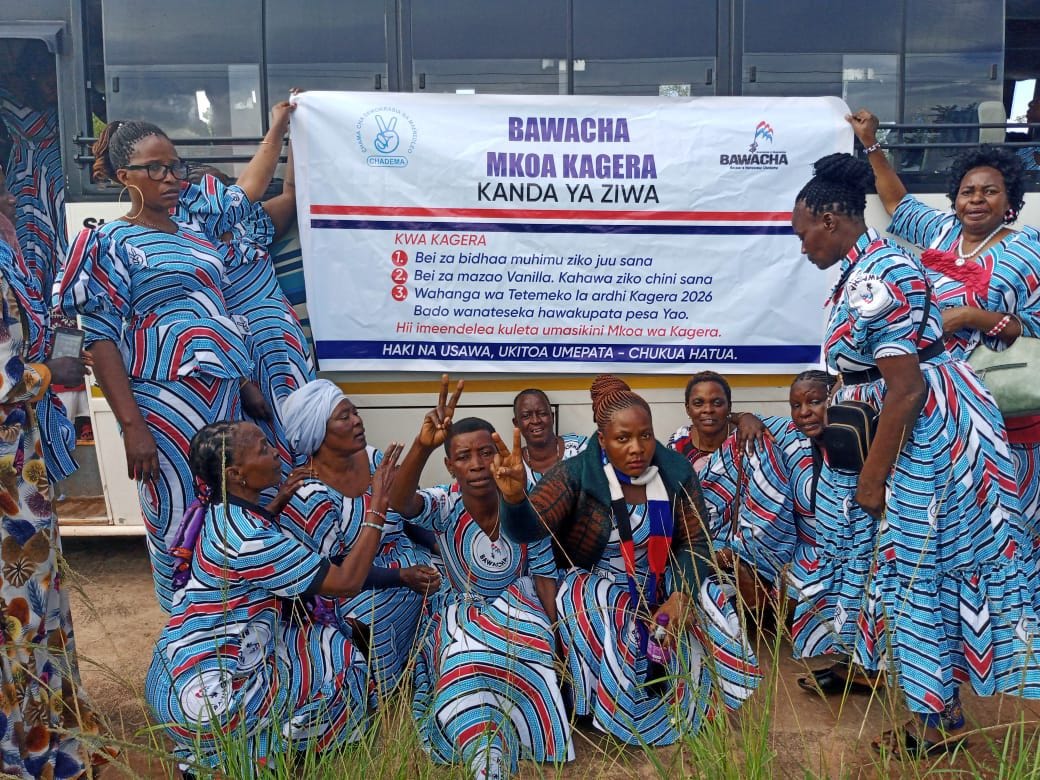
Tanzania Police Force detained 27 members of BAWACHA, the women’s wing of opposition party CHADEMA, in Musoma Municipality, Mara Region, on 8 March 2026. The arrests followed the deployment of tear gas against women who had gathered to commemorate International Women’s Day, in direct defiance of a police prohibition issued one week earlier.
What Happened in Musoma on 8 March 2026?
The Tanzania Police Force in Mara Region had formally ordered BAWACHA leaders to halt their planned International Women’s Day commemorations in Musoma Municipality on 2 March 2026. BAWACHA’s national leadership publicly rejected the ban.
On 8 March, women assembled in Musoma town following a Catholic Mass at a local church. According to JAMBO TV reporting, police deployed tear gas in broad daylight to disperse the gathering. Mara Regional Police Commander Senior Assistant Commissioner of Police (SACP) Pius Lutumo confirmed 27 arrests on charges of:
Causing public disturbance
Obstructing economic activity on the Nyerere Highway (Musoma-Bunda road)
Defying a lawful prohibition issued on 1 March 2026
Among those detained was BAWACHA National Secretary General Pamela Maassay. Party uniforms were reported confiscated during the operation.
What Was the Legal Basis for the Ban?
Police cited civil suit number 8323 of 2025, filed by former CHADEMA vice-chairperson Said Issa Mohamed and two other party trustees from Zanzibar. A court injunction issued in June 2025 as part of that case temporarily froze CHADEMA’s political activities and assets. CHADEMA’s legal team has argued that the injunction has since expired. Police continued to treat it as operative.
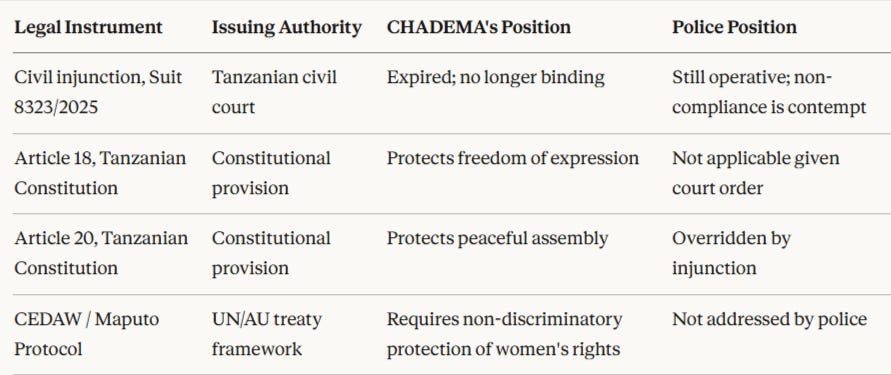
The Tanzania Human Rights Defenders Coalition (THRDC) specifically invoked Articles 18 and 20 of the Constitution of the United Republic of Tanzania, as well as Tanzania’s obligations under the Convention on the Elimination of All Forms of Discrimination Against Women (CEDAW) and the Maputo Protocol, in its condemnation issued the same day.
What Did BAWACHA Say?
BAWACHA National Chairperson Sharifa Suleiman, elected to the position in January 2025, issued the following formal demands:
Immediate and unconditional release of all 27 detained members
Return of confiscated party uniforms
Recognition that the gathering was peaceful and constitutionally protected
BAWACHA denied all charges of violence and economic obstruction. The organisation’s statement characterised the police operation as gender-based harassment designed to suppress political dissent, and concluded with an explicit declaration that it was “not ready to be silenced.”
How Did Civil Society Respond?
THRDC, through its Advocacy Department head, issued a formal condemnation on 8 March 2026, documenting a pattern broader than Musoma alone. Key findings:
Incidents of women being stopped and detained occurred across multiple regions of Tanzania between 6 and 8 March 2026, indicating nationally coordinated enforcement rather than a localised decision
The operation violates Articles 18 and 20 of the Tanzanian Constitution
Tanzania’s treaty obligations under CEDAW and the Maputo Protocol require the state to protect women’s civic participation without political discrimination
THRDC recalled that in March 2023, President Samia Suluhu Hassan herself attended a BAWACHA International Women’s Day event in Kilimanjaro Region as an official guest, citing this as evidence of a sharp and deliberate reversal in state posture toward the organisation.
What Are the Key Intelligence Dimensions?
1. National Coordination Pattern
THRDC’s documentation of multi-regional incidents between 6 and 8 March points to authorisation above the Mara Regional Police Commander level. This is consistent with the post-October 2025 institutional framework in which Tanzania’s police and intelligence architecture have functioned as a unified instrument of political suppression.
2. The Catholic Church Proximity
The crackdown unfolded immediately after a Catholic Mass. Police denied blocking entry to the church itself, but the sequence, women dispersed within minutes of leaving a Catholic service, generates acute political sensitivity. The Samia administration is already managing a deteriorating relationship with the Catholic Church hierarchy, which has been among the most prominent institutional critics of the post-election violence that claimed approximately 10,000 lives following the October 2025 general election.
3. Targeting of National Leadership
The arrest of a national secretary general, rather than local organisers exclusively, signals deliberate high-value targeting. Pamela Maassay’s presence in Musoma and her subsequent detention indicate either that national BAWACHA leadership deployed to reinforce the event, or that police intelligence anticipated senior officials and prepared accordingly.
4. Uniform Confiscation as Intimidation Doctrine
The seizure of party uniforms replicates a documented pattern. In October 2024, BAWACHA Publicity Secretary Aisha Machano was abducted, beaten, stripped, and photographed by captors who interrogated her specifically about the burning of kitenge fabrics bearing President Samia’s image. Confiscating visible markers of collective identity from opposition women in public spaces is an established TISS-linked psychological operation tactic, not incidental police procedure.
How Does This Fit the Broader Tanzania Repression Framework?
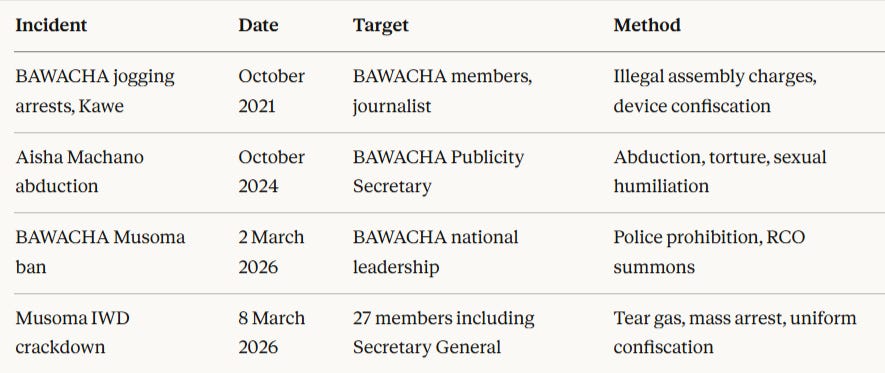
The trajectory is consistent: each incident escalates the coercive threshold applied to BAWACHA, shifts from local to national targeting, and deploys increasingly intrusive methods.
What Should CHADEMA Do?
This is the question the Musoma crackdown forces into sharp focus. With the Tundu Lissu treason trial pending, approximately 10,000 civilians killed in the post-election massacre, the party’s ballot access systematically stripped, and now its women’s wing tear-gassed on International Women’s Day, the evidence is unambiguous: the Samia administration has no intention of moderating its repression. CHADEMA cannot litigate, negotiate, or demonstrate its way out of a political environment deliberately structured to eliminate it. The party requires a comprehensive strategic recalibration across four fronts.
1. Internationalise the Legal Fight Aggressively
CHADEMA’s most underutilised asset is the ICC preliminary examination. The party’s legal team should be submitting timestamped, corroborated documentation of every incident, including the Musoma operation, directly to the ICC Office of the Prosecutor as supplementary evidence of a continuing and systematic attack on a civilian population. THRDC’s multi-regional incident report for 6 to 8 March is precisely the category of civil society corroboration that strengthens a crimes against humanity dossier. Simultaneously, CHADEMA should be filing formal communications to the UN Special Rapporteur on the Rights to Freedom of Peaceful Assembly and of Association, the UN Special Rapporteur on Violence Against Women, and the African Commission on Human and Peoples’ Rights. Each filing is a diplomatic cost imposed on Dar es Salaam at minimal operational cost to the party.
2. Neutralise the Injunction Weaponisation
Civil suit 8323 of 2025 is being deployed as a political weapon, not a legal instrument. CHADEMA’s legal strategy must prioritise obtaining a definitive judicial ruling on whether that injunction has expired, and if courts refuse to provide one, that refusal itself becomes a documented denial of access to justice, submissible to international treaty bodies. The party should also pursue a constitutional challenge to the application of a civil injunction to prohibit participation in a United Nations-recognised international observance. Even if the challenge fails in Tanzanian courts, the proceedings generate a formal record and international visibility.
3. Convert BAWACHA into a Global Human Rights Asset
The tear-gassing of unarmed women on International Women’s Day is one of the most internationally legible human rights violations imaginable. CHADEMA’s communications apparatus should be producing English, French, and Swahili documentation packages specifically designed for distribution to foreign ministries, UN Women, international feminist organisations, and diaspora networks. BAWACHA Chairperson Sharifa Suleiman and detained Secretary General Pamela Maassay should become internationally recognised names in the same way that Tundu Lissu has become a reference point for Tanzania’s democratic crisis. The party currently under-invests in converting individual incidents into sustained international advocacy profiles.
4. Decentralise and Harden Organisational Resilience
The targeting of national leadership in Musoma, rather than local organisers alone, exposes a structural vulnerability: CHADEMA’s operational model concentrates authority and visibility in identifiable national figures who are now systematically being arrested, charged, or disappeared. The party needs to build a decentralised cellular structure in which regional and district-level organisational capacity can function independently when national leadership is incapacitated. This is not a novel concept; it is standard doctrine for political movements operating under authoritarian conditions, drawing on models as varied as the African National Congress’s underground structures during apartheid and the Polish Solidarity movement’s decentralised resilience under martial law. CHADEMA’s intelligence and security committee, to the extent one exists in functional form, should be leading this architectural redesign.
None of these options is without risk or cost. But the alternative, continuing to react to each crackdown with public statements and domestic legal filings that Tanzanian courts and police routinely ignore, simply extends a losing dynamic. The strategic reality CHADEMA faces is that Samia’s repression machine has demonstrated institutional momentum, external diplomatic cover through the Washington lobbying operation, and a willingness to escalate. The party’s response must match that scale of ambition, or accept progressive elimination as the outcome.
What Are the International Implications?
The Musoma operation carries direct exposure across three international forums:
ICC Preliminary Examination: The ICC preliminary examination into crimes against humanity arising from the October 2025 massacre is ongoing. Incidents of this type, documented, timestamped, and corroborated by THRDC, contribute to an evidentiary pattern demonstrating continuity of intent and method beyond the election period.
Tanzania’s Washington Lobbying: The Samia administration’s FARA-registered lobbying operation through Ervin Graves Strategy Group has sought to project normalisation. Tear-gassing unarmed women on International Women’s Day, one of the highest-visibility dates in the global human rights calendar, directly undermines that diplomatic posture.
CEDAW Reporting Cycle: Tanzania’s conduct is now formally on record with THRDC as a CEDAW violation, creating a documented basis for civil society submissions to the UN Committee on the Elimination of Discrimination Against Women.
Strategic Assessment
The Musoma crackdown is a strategically counterproductive operation executed at maximum diplomatic cost. It has simultaneously provided THRDC and international monitors with a clean constitutional case study; generated international media exposure on a globally observed human rights date; deepened tensions with the Catholic Church; and advanced the ICC evidentiary record. BAWACHA’s unambiguous public refusal to capitulate signals continued escalation. For CHADEMA, the path forward is not through Tanzanian courts or domestic negotiation. It runs through The Hague, Geneva, Washington, and the international human rights infrastructure that Tanzania’s lobbying campaign is racing to neutralise before it can be effectively activated.
Primary sources: JAMBO TV (Swahili-language); The Chanzo; THRDC public statement, 8 March 2026; Amnesty International documentation; ICC preliminary examination filings.