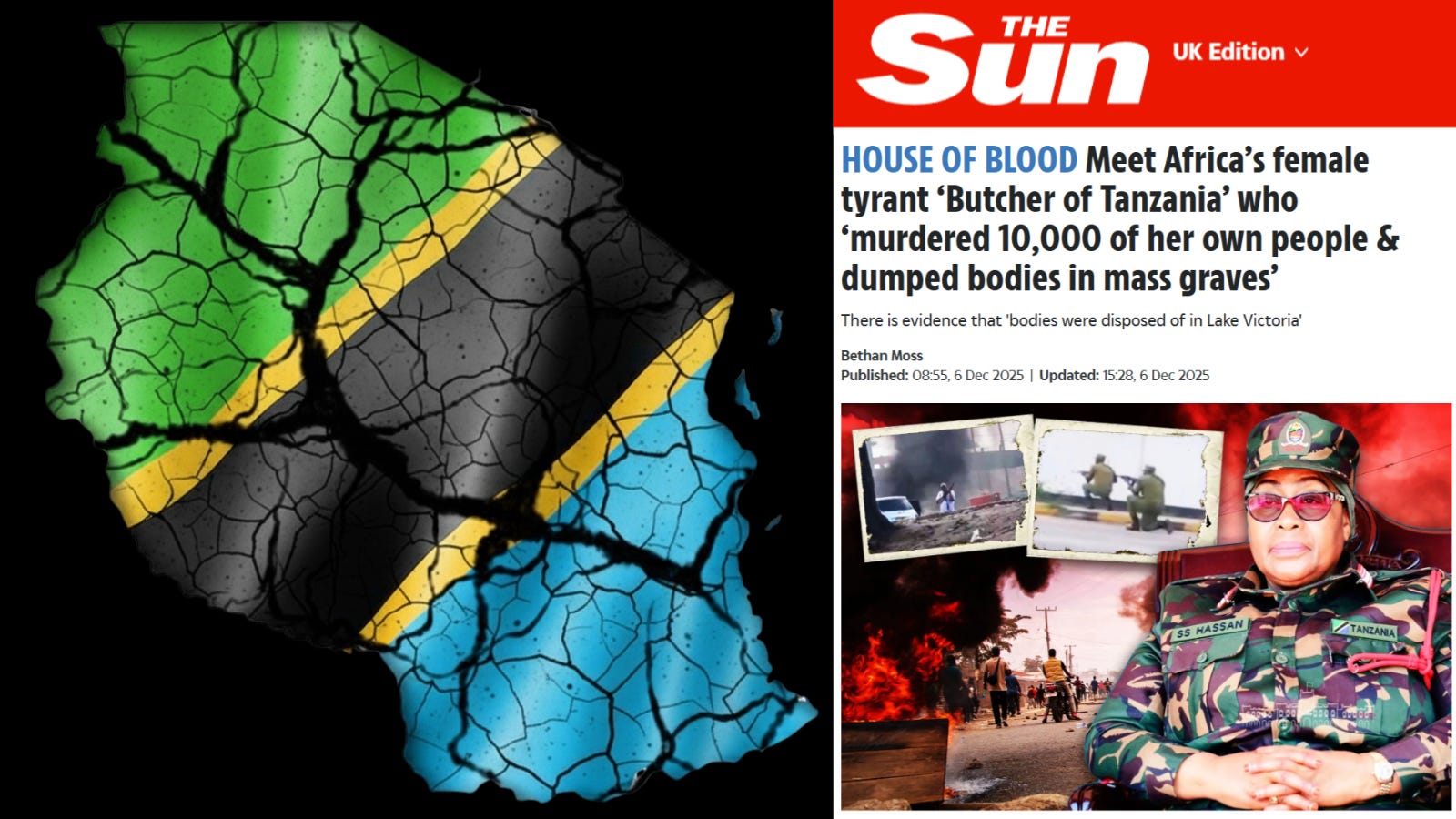
🇹🇿 From Peaceful Nation to Mass Killings: How 2025 Broke Tanzania Forever
Ujasusi Blog’s East Africa Monitoring Team | 31 December 2025 | 0625 GMT
🔓FREE ACCESS
Please consider becoming a paid subscriber
You can also donate.
In Nutshell
The October 29, 2025 election massacres fundamentally transformed Tanzania from Africa’s stability anchor into a state characterised by systematic lethal force deployment, with intelligence networks documenting between 3,500 and 10,000+ civilian deaths during post-election crackdowns—making this the deadliest political violence in Tanzanian history. This humanitarian catastrophe destroyed Tanzania’s 64-year reputation for peaceful transfers of power, triggered comprehensive international condemnation, and created unprecedented security vulnerabilities across East Africa’s strategic corridor.
What Happened on October 29, 2025 in Tanzania?
Tanzania’s general election on October 29, 2025 marked a catastrophic rupture in the nation’s political fabric. Incumbent President Samia Suluhu Hassan secured 97.66% of votes after barring main opposition candidates, triggering immediate protests across Dar es Salaam, Arusha, Mwanza, and other urban centres.
Security forces responded with unprecedented brutality. CNN investigations using geolocated videos, audio forensic analysis, and satellite imagery documented police shooting unarmed protesters, many holding only rocks and sticks. The crackdown characteristics included:
• Systematic lethal force deployment: Security personnel fired live ammunition at protesters from distances exceeding 95 metres, targeting individuals in the back and head
• Internet and communications blackout: Government-imposed shutdown prevented real-time documentation and mobilisation
• 24-hour curfews: Roadblocks operated by Tanzanian Army turned away non-essential workers nationwide
• Body disposal operations: Opposition party Chadema claimed police disposed of over 400 bodies at undisclosed locations
• Mass detention: Over 700 individuals charged with treason by mid-November 2025, including children
Healthcare workers reported seeing 70 bodies piled in Mwananyamala Regional Referral Hospital morgue, with multiple facilities overwhelmed by gunshot casualties to the head, chest, groin, and back.
How Many People Were Killed in the October 29 Massacres?
Intelligence networks on the ground report between 3,500 and 10,000+ civilian deaths from the October 29, 2025 massacres and subsequent systematic killings. Medical associations and legal human rights groups have confirmed at least 3,500 deaths through direct access to morgues, burial registers, and hospital records. Death toll estimates vary significantly due to systematic government obstruction of casualty verification, body disposal operations, and the nationwide internet blackout that prevented real-time documentation.
Table 1: Casualty Estimates by Source (October 29 – November 30, 2025)
Intelligence networks operating on the ground report the death toll exceeding 10,000 civilians, based on comprehensive intelligence collection from witness networks, medical sources, and burial documentation. The Daily Maverick reports that whilst exact figures remain contested due to government evidence concealment, medical associations and legal human rights groups have confirmed at least 3,500 deaths through direct access to morgues, burial registers, and hospital records.
Human Rights Watch documented that Chadema collected reports of up to 1,000 people killed across eight of Tanzania’s 31 regions. Regional and international bodies including the African Commission on Human and Peoples’ Rights, SADC, UN OHCHR, and European Union raised concerns about large-scale fatalities.
The actual death toll remains contested between conservative international estimates (hundreds confirmed) and intelligence network assessments (3,500-10,000+). The African Commission noted the nationwide internet shutdown made confirming the actual death toll difficult. The Chanzo reported that the death toll likely runs in the thousands from security forces firing live ammunition into crowds.
For comparative context: Even at the conservative Chadema estimate of 2,000 deaths, this would exceed the 2007–2008 Kenyan crisis death toll. At intelligence network estimates of 3,500-10,000+, this represents the deadliest post-independence political violence in Tanzanian history by an order of magnitude.
Why Did Tanzania’s 64-Year Stability Collapse?
Tanzania’s transformation from “benign hegemon” to violent autocracy followed a decade-long trajectory of democratic backsliding under Presidents John Magufuli (2015–2021) and Samia Suluhu Hassan (2021–2025).
Historical Context: CCM’s Uninterrupted Rule
Chama Cha Mapinduzi (CCM) has dominated Tanzanian politics since independence in 1961, making it the second-longest ruling party in African history. From 1977 to 1992, CCM maintained single-party rule. Even after multiparty democracy introduction in 1992, CCM won all subsequent elections in 1995, 2000, 2005, 2010, 2015, 2020, and 2025.
Magufuli Era (2015–2021): Authoritarian Turn
CCM previously operated as a benign hegemon, winning elections largely on merit since multiparty politics began. President Magufuli fundamentally altered this dynamic through:
• Unprecedented attacks on opposition, civil society, and press
• Weaponisation of legal frameworks against political opponents
• Systematic suppression of civic space
Hassan Administration (2021–2025): Continuity in Repression
President Hassan initially projected reform credentials but consolidated authoritarian control:
• January 2025: Hassan announced herself as CCM candidate without traditional internal primary, effectively silencing potential rivals
• October 1–9, 2025: Thirteen Chadema officials taken from homes without court presentation; 600 officials, party members, and youth detained by election day
• October 6, 2025: CCM stalwart Humphrey Polepole detained and disappeared after resigning as Cuba ambassador and criticising poor leadership
What Were the Pre-Election Violations?
Table 2: Electoral Integrity Violations (January – October 2025)
The Southern African Development Community Electoral Observation Mission found elections took place in conditions that fell short of SADC Principles and Guidelines, noting voters could not express their democratic will.
How Did International Bodies Respond?
African Union Position
The African Union Election Observer Mission stated Tanzania elections did not comply with AU principles, normative frameworks, and international obligations for democratic elections.
United Nations Response
UN High Commissioner for Human Rights Volker Türk issued urgent statements:
• Called for investigations into killings and other violations, urging authorities to provide information about fate and whereabouts of all missing persons
• Highlighted harrowing reports of families desperately searching police stations and hospitals for loved ones
• Demanded unconditional release of all opposition figures arrested before the election, including Tundu Lissu
Western Governments
• Britain, Canada, Norway: Issued joint statement citing credible reports of large numbers of fatalities and significant injuries
• United States, Germany, France: Issued travel warnings and diplomatic statements condemning violence
• European Union: Raised concerns about human rights violations, though responses remained fragmented
Regional Impact
Unrest affected neighbouring economies at Songwe and Kasumulu border crossings between Malawi and Tanzania, with transporters reporting stranded trucks, vandalised customs offices, and disrupted fuel supplies.
What Makes 2025 Different from Previous Tanzanian Elections?
Table 3: Comparative Analysis of Tanzanian Elections (2015–2025)
Unprecedented Violence Characteristics
Not since German colonialism had mainland Tanzania experienced brutality on this scale. The 2025 massacres introduced novel tactics:
• Systematic body disposal: Healthcare workers and families could not locate bodies of victims despite searching multiple morgues
• Plainclothes operations: Multiple reports suggested plainclothes Ugandan security forces participated in civilian shootings under alleged pact between Hassan and Ugandan President Yoweri Museveni
• Satellite-verified mass graves: CNN analysis showed recently disturbed soil consistent with reports of mass graves at Kondo cemetery north of Dar es Salaam
What Are the Long-Term Implications for Tanzania?
🔴 Destroyed Political Stability Reputation
Tanzania maintained a virtuous circle of protest prevention that granted CCM no protests and no blood on its hands from protest repression. The October 29 massacres shattered this equilibrium permanently.
Once envied for political stability, Tanzania is forever changed after the election day killings. The nation’s 64-year reputation as East Africa’s anchor state has collapsed, with diplomatic sources indicating Tanzania now resembles Zimbabwe’s repression model rather than its historical peaceful democracy trajectory.
🔴 Economic Sector Vulnerabilities
Tourism, accounting for 17.2% of GDP, faces systemic collapse:
• Mass flight cancellations from major European and North American carriers
• Level 3 travel advisories from Western governments maintained through December 2025
• International conference cancellations and business delegation withdrawals
• Hotel occupancy rates in Dar es Salaam, Arusha, and Zanzibar at historic lows
🔴 Security Vacuum Exploitation Risks
Massacre conditions create optimal recruitment environments for Al-Shabaab, ISIS-Mozambique, and potential homegrown extremist movements. State brutality narratives provide:
• Grievance exploitation opportunities for jihadist groups
• Youth radicalisation pathways in communities experiencing state violence
• Cross-border instability affecting Kenya, Uganda, Mozambique, and Malawi
🔴 Regional Stability Implications
Tanzania’s disintegration as East Africa’s anchor state creates destabilising prospects for the entire region. With Kenya experiencing its own political volatility, Uganda’s authoritarianism consolidated, and Burundi’s instability ongoing, Tanzania’s transformation removes a critical regional stabiliser.
What Does December 9, 2025 Independence Day Signify?
Campaigners planned peaceful protests on December 9, weeks after police killed hundreds in brutal post-election crackdown. The day unfolded as the gravest crisis Tanzania has known in decades, with authorities cancelling public Independence Day celebrations and warning people not to assemble.
December 9, 2025 represented:
• First Independence Day under internationally rejected government: Hassan’s 97.66% victory comprehensively condemned by African Union, SADC, and UN observers
• Symbol of broken social contract: Independence celebrations historically represented national unity; 2025 cancellation acknowledged regime illegitimacy
• Test of continued resistance: Opposition and civil society organisations called for demonstrations despite government threats
• International scrutiny moment: Private messages from regional governments warned Hassan that any recurrence of post-election atrocities would confirm spreading sentiment that the president and inner circle lack legitimacy
What Are the Documented Human Rights Violations?
Amnesty International investigations documented Tanzanian security forces using unnecessary or disproportionate force, including lethal force, showing shocking disregard for the right to life and freedom of peaceful assembly.
Specific Violation Categories
Extrajudicial Killings:
• Maria, 28, reported police shot her husband in Magomeni on October 29; he died two days later from internal bleeding
• Paulo Kingi, 46, fled to Kenya after being shot at his home in Goba
• Daudi Ndone, 38, was shot and killed in Mazense area; family buried his clothes and picture after failing to find his body for over a week
Enforced Disappearances: • Viral Scout Management stated seven young football players under their contracts were shot and killed at homes, with six bodies never located
• Systematic prevention of families from retrieving bodies from hospitals and morgues
Arbitrary Detention and Torture:
• Over 700 people taken to court from at least nine regions by November 18, with serious procedural irregularities including individuals rounded up during normal income-earning activities
• Children charged with treason, a capital offence
• Detainees held without judicial presentation or due process
How Did Tanzania’s Leadership Respond to Massacre Allegations?
Government Denials and Deflections
Tanzania’s government exhibited systematic accountability avoidance:
• Government dismissed CNN investigative report as ‘slanderous’ and criticised international media for ‘negative’ reports
• Inspector-General Camillus Wambura blamed illegal immigrants for inciting protests
• President Hassan and newly appointed prime minister accused foreign actors of influencing demonstrations with aim of destabilising Tanzania
Hassan’s Public Acknowledgement
At parliament opening, President Hassan offered condolences for loss of life and announced an internal commission of inquiry. However, government statements continued to forestall prospects for real accountability, with commission appointments including the immediate former defence minister.
Nepotistic Cabinet Restructuring
Hassan’s decision to add her daughter and reappoint her son-in-law to cabinet, alongside discarding several high-profile previous ministers, indicated confidence that opponents within CCM are unwilling or unable to mount a threat to her power.
What Historical Precedents Exist for Tanzania’s 2025 Trajectory?
Zimbabwe Comparative Analysis
Liberation movements like Zimbabwe’s ZANU-PF have held power for decades through naked repression, providing a cautionary tale of punishing costs for both citizens and regime. Tanzania’s CCM appears to be following this trajectory:
• Systematic elimination of political opposition through violence
• Economic deterioration through international isolation
• Youth population alienation creating long-term instability
• Regional pariah status affecting diplomatic and economic relationships
Departure from Nyerere’s Legacy
Julius Nyerere, Tanzania’s founding president, exhibited flexibility by encouraging national debate on pluralism before departing as CCM chairman in 1990. The 2025 massacres represent complete abandonment of Nyerere’s principles:
• Rejection of ujamaa (familyhood) values emphasising national unity
• Militarisation of political conflict resolution
• Destruction of Tanzania’s historical reputation for non-violence
Tanzania’s Irreversible Transformation
The October 29, 2025 massacres represent a definitive rupture in Tanzanian political history. Tanzania will never be the same, with the CCM doing ruinous harm to its citizens and its own image. The confluence of systematic lethal force, international condemnation, economic vulnerability, and security vacuum creation has fundamentally altered Tanzania’s trajectory.
Whether Tanzania faces continued repressive rule, internal CCM power struggles, military intervention, or constitutional reform remains uncertain. However, the 2025 massacres have made all destabilising possibilities more likely than ever before, transforming Tanzania from Africa’s stability exemplar into a cautionary tale of democratic collapse and state-sponsored violence.
The international community’s response—particularly from African regional bodies and Tanzania’s East African neighbours—will determine whether accountability mechanisms emerge or whether impunity for mass killings becomes normalised, with profound implications for democratic governance across the continent.
Intelligence Assessment: Tanzania’s October 29, 2025 massacres destroyed six decades of carefully constructed political stability, created unprecedented humanitarian crisis, and fundamentally altered regional security dynamics.
The death toll—between 3,500 and 10,000+ civilians according to intelligence networks on the ground, with medical associations and legal human rights groups confirming at least 3,500 deaths through direct access to morgues, burial registers, and hospital records—represents the deadliest post-independence political violence in Tanzanian history.
Opposition party Chadema claims 1,000-3,000 deaths, whilst UN reports remain conservative at hundreds confirmed. International condemnation from African Union, SADC, UN, and Western governments has been comprehensive, yet concrete accountability mechanisms remain absent.
Tanzania’s transformation from benign hegemon to violent autocracy has eliminated the nation’s status as East Africa’s anchor state, creating security vulnerabilities that jihadist groups and regional instability actors are positioned to exploit.
Sources:
United Nations Office of the High Commissioner for Human Rights
Human Rights Watch, Amnesty International
African Commission on Human and Peoples’ Rights
CNN International
Southern African Development Community Electoral Observation Mission
African Union Election Observer Mission
International Crisis Group
Journal of Democracy
Chatham House
Freedom House
Council on Foreign Relations.