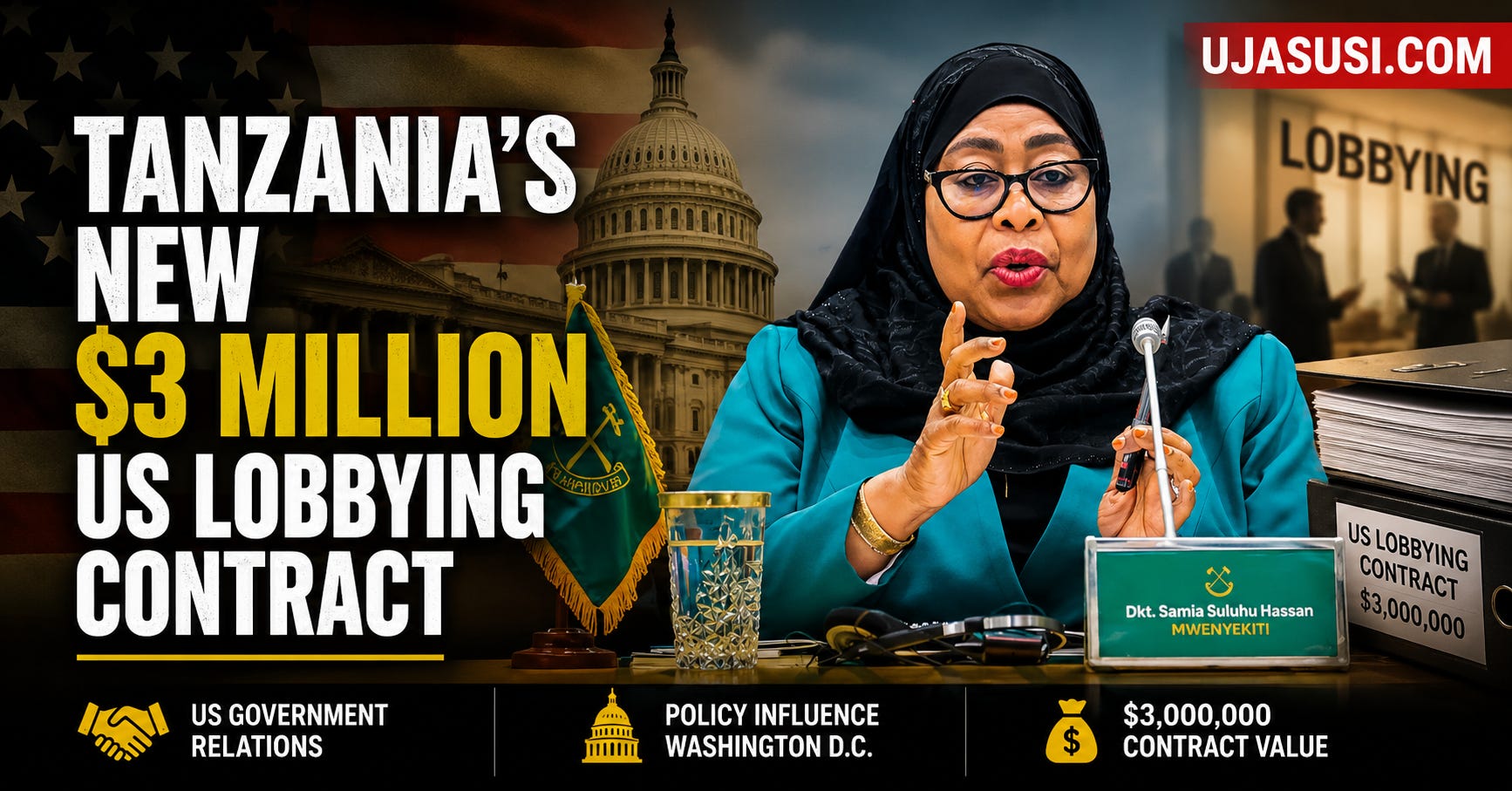
Tanzania's New $3 Million US Lobbying Contract
Inside the BGR and Drift Advisors FARA Filing
Ujasusi East Africa Monitoring Team | 03 July 2026 | 0245 BST
What does Tanzania’s newly registered $3 million contract with BGR Government Affairs, routed through a Spanish intermediary, reveal about the government’s Washington strategy ahead of Saba Saba (7 July, Tanzania’s founding-party anniversary and, this year, the date of planned nationwide protests), and how does it compare to BGR’s other African government engagements and the legislative threat it is apparently designed to manage?
Tanzania’s government has registered a new $3 million, twelve-month lobbying contract with BGR Government Affairs, disclosed to the US Department of Justice on 18 June 2026 under the Foreign Agents Registration Act (FARA), the US law requiring anyone lobbying on behalf of a foreign government to publicly disclose the contract, fee, and scope of work. The contract was executed through Drift Advisors, SL, a Spanish-registered intermediary with no other US lobbying registration on record, whose own marketing describes state-security advisory work rather than public relations. This new engagement sits alongside an existing $45,000-a-month Ervin Graves Strategy Group retainer, bringing Tanzania’s total disclosed US lobbying expenditure to approximately $3.5 million a year. At more than four times what Algeria pays the same firm for comparable services, and disclosed only under US law rather than any Tanzanian mechanism, the contract’s scale is itself the story.
In this assessment
Key judgements
Scope and approach
Background: why Tanzania needs Washington right now
The new contract, in full
Why Drift Advisors, not the Ministry directly
Drift Advisors: two different descriptions of the same company, and no track record as a US lobbying intermediary
Who Tanzania is now paying for, and BGR’s wider Africa book
How Tanzania’s $3 million compares: the Algeria benchmark
The Cruz-Shaheen bill has already moved, and softened
The domestic accountability backdrop this contract is managing
The timing question
Outlook: three scenarios
Key assumptions, alternative assessment, and what remains unknown
READ ALSO
Key judgements
Tanzania has registered a new, dedicated $3 million lobbying contract with BGR Government Affairs, effective 15 June 2026 and disclosed via FARA Registration No. 5430 on 18 June 2026. This is a single-client engagement distinct in scale from Tanzania’s existing multi-client retainer with Ervin Graves.
Confidence: High.
The contract was executed through Drift Advisors, SL, a Spanish-registered intermediary with no prior or subsequent FARA registration of its own on record, rather than directly between BGR and Tanzania’s Ministry of Foreign Affairs and East African Cooperation. This is Drift Advisors’ first and only known appearance as a US lobbying intermediary.
Confidence: Moderate on the absence of a prior track record; the rationale for using an intermediary at all remains unestablished.
Tanzania’s $250,000-monthly rate is more than four times the $60,000-monthly rate Algeria paid BGR for a comparable government-affairs and public-relations contract in 2024, managed by the same lead consultant, Scott Eisner. This disparity suggests either a substantially larger scope of work or a materially higher fee tied to the severity of Tanzania’s reputational exposure.
Confidence: Moderate.
Added to the existing Ervin Graves retainer, the new contract brings Tanzania’s total disclosed US lobbying expenditure to approximately $3.5 million annually, an addition of capacity, not a substitution of one firm for another. This expenditure is visible to the public exclusively through US statutory disclosure. Confidence: High.
The legislative instrument this contract is most plausibly intended to influence, the Cruz-Shaheen Reassessing the United States-Tanzania Bilateral Relationship Act, had already been substantially softened by the Senate Foreign Relations Committee one day before the BGR contract’s FARA filing date, with security-assistance suspension and standalone sanctions provisions removed in favour of a waiver-equipped Global Magnitsky framework.
Confidence: High that the softening occurred as described; Moderate on whether existing lobbying activity contributed to it, since the BGR contract itself began too close to the committee vote to have caused it.
The contract’s effective date and disclosure timing precede the 26 June nationwide rally ban by eight days and Saba Saba by nineteen days, and follow the 7 May 2026 CHADEMA deregistration show-cause notice by roughly five weeks. This assessment judges the sequencing likely to reflect deliberate pre-positioning ahead of a foreseeably higher-scrutiny domestic and international period, rather than administrative coincidence.
Confidence: Moderate.
READ ALSO
Scope and approach
This assessment is built on the Exhibit A and B FARA filing registered under No. 5430, together with the attached letter of agreement between BGR and Drift Advisors. It draws additionally on FARA Tracker’s live registration database, OpenSecrets’ FARA registrant data for both BGR and Ervin Graves, Congress.gov’s bill-tracking record for S.4577, reporting from The Africa Report on BGR’s Algeria contract, Ujasusi Blog’s own prior reporting on the CHADEMA deregistration notice, O’Dwyer’s PR News trade coverage, and The Chanzo’s health MOU reporting.
One discrepancy is flagged rather than resolved: FARA Tracker’s public summary lists the Tanzania-Drift Advisors-BGR registration at a headline value of $210,000, whereas the letter of agreement attached to the official filing specifies $250,000 monthly for twelve months. This assessment treats the $250,000 figure as authoritative, since it is drawn directly from the contract document rather than a third-party aggregator, but the discrepancy itself is unexplained and noted under What We Do Not Know below.
Background: why Tanzania needs Washington right now
Tanzania’s post-October 2025 political crisis has produced accountability pressure the government’s conventional diplomacy has not contained. An 82-page dossier submitted to the ICC on 18 November 2025 by Intelwatch, the Madrid Bar Association, and the World Jurist Association alleges between 700 and 3,000 protesters were deliberately killed, with Intelwatch’s own estimate reaching 10,000 over three days. Tanzania’s own Chande Commission of inquiry, led by retired Chief Justice Mohamed Chande Othman, put the death toll at 518 after 153 days and testimony from over 63,000 respondents, a figure CHADEMA has rejected outright as, in the party’s words, “a mechanism to conceal the truth, erase evidence, and perpetuate harm against victims.”
CHADEMA chairperson Tundu Lissu has been in continuous custody since 9 April 2025 on treason charges carrying a mandatory death sentence, a prosecution that followed a 2017 assassination attempt in which he suffered sixteen bullet wounds. His party has been barred from electoral participation until 2030, and on 7 May 2026 the party registrar issued a show-cause notice threatening CHADEMA’s deregistration entirely, triggered directly by Deputy Secretary-General John Heche’s 9 April call for demonstrations to pressure the courts over Lissu’s case. Two foreign observers attempting to attend Lissu’s trial, Kenyan journalist Boniface Mwangi and Ugandan lawyer Agather Atuhaire, were detained, tortured, and sexually assaulted by Tanzanian security forces, the incident that produced the US Section 7031(c) travel-ban designation of officer Faustine Jackson Mafwele.
Tanzania’s international response has run on multiple simultaneous tracks. Foreign Minister Mahmoud Thabit Kombo, the same official named in the BGR filing, was received by Pope Leo XIV at the Vatican in January 2026. The European Parliament’s Foreign Affairs and Development committees have twice voted to keep €156 million in EU funding frozen, citing Tanzania’s refusal to admit a human rights subcommittee visit and Lissu’s continued detention. President Samia Suluhu Hassan then travelled to Moscow for a state visit from 3 to 5 June 2026, only the second such visit by a Tanzanian head of state since Julius Nyerere’s in 1969.
This international campaign sits against a domestic backdrop centred on 7 July, Saba Saba (Swahili for “seven seven”). The date marks the 1954 founding of Julius Nyerere’s Tanganyika African National Union, the party that led Tanzania to independence and later became today’s ruling party, Chama Cha Mapinduzi, and it has long doubled as the date of the Dar es Salaam International Trade Fair. This year, Gen Z-organised activists, mobilising through social media rather than any established political party, have called for nationwide demonstrations on the same date, demanding constitutional reform, an end to enforced disappearances, and Lissu’s release, deliberately using a date the ruling party has treated as its own founding anniversary. The BGR contract, filed two weeks before that date, is the newest and by far the largest single addition to Tanzania’s international-facing response to the crisis surrounding it.
The new contract, in full
The figure is not an estimate. The attached letter of agreement fixes the fee at $250,000 monthly “for 12 months of service beginning June 15, 2026,” payable bi-annually in advance, with expenses billed separately. Exhibit B confirms the engagement includes political activities as defined under the Act, with the registrant’s stated method of performance covering strategic guidance and counsel, outreach to US government officials, non-government organisations, and media, and dissemination of informational materials.
Why Drift Advisors, not the Ministry directly
The Exhibit A filing names Drift Advisors, SL as the foreign principal, with the Ministry of Foreign Affairs and East African Cooperation identified as the government branch represented, confirming the Ministry is aware of and party to the arrangement. What the filing does not explain is why BGR was engaged through a Spanish intermediary rather than contracted directly, as is the case with the existing Ervin Graves retainer. No equivalent intermediary structure appears in the Ervin Graves filings reviewed for this assessment.
Drift Advisors: two different descriptions of the same company, and no track record as a US lobbying intermediary
Drift Advisors, SL is registered in Sant Joan de Labritja, Ibiza, under Spanish company number B44561926. Its Spanish commercial registry entry describes its registered activity in generic commercial terms: mediation and coordination services, construction and facilities, wholesale and retail trade, import and export. Trevor Foster Black is recorded as authorised signatory since January 2025; Elaine Foster Black as director since January 2023.
The company’s own promotional site describes work “with selected Governments and senior leadership teams, primarily in Africa and the Middle East, to provide Strategic Advisory Services across State Security, Inbound Foreign Investment, and Strategic Communications,” and separately markets itself as a big data and AI advisory firm. Neither description appears in the Spanish registry filing. A targeted search of FARA’s registration database and FARA Tracker found no other registration, past or present, naming Drift Advisors or Trevor Foster Black as a foreign principal or registrant. This is Drift Advisors’ first and only documented appearance in the US foreign-lobbying disclosure system. Trevor Foster Black’s documented background, per an industry conference biography, includes service as a British Army officer in the Scots Guards and founding a banking-intelligence data analytics firm, Coalition, sold to a Standard & Poor’s subsidiary in 2012.
Who Tanzania is now paying for, and BGR’s wider Africa book
The letter of agreement names Scott Eisner as leading BGR’s work on the account, supported by Lester Munson. BGR’s team announcement records that Scott Eisner joined the firm from the US Chamber of Commerce, where he served as President of the US-Africa Business Center. Lester Munson, BGR’s International and Trade Practice Co-Head, brings 26 years across Capitol Hill and the executive branch, including service as Staff Director of the Senate Foreign Relations Committee under Chairman Bob Corker.
Scott Eisner’s role is not unique to Tanzania. The Africa Report documented that he also manages BGR’s contract with Algeria, signed in September 2024 by Ambassador Sabri Boukadoum on behalf of the Algerian state, covering government-affairs and public-relations services “with respect to bilateral relations between the United States and Algeria,” worth $720,000 a year. BGR overall is a large, established operation: OpenSecrets records the firm as having been hired by 306 clients in 2026 for a combined $20,845,000 in disclosed lobbying income, meaning Tanzania’s $3 million contract, while very large for a single-client foreign-government engagement, sits within a firm whose total book dwarfs it many times over.
How Tanzania’s $3 million compares: the Algeria benchmark
Tanzania’s $250,000 monthly rate is more than four times Algeria’s $60,000 monthly rate for a declared scope that reads almost identically, both run under Scott Eisner. This assessment cannot determine from public documents whether Tanzania’s contract includes materially more extensive deliverables, a larger assigned team, or simply reflects Tanzania’s own assessment that its reputational exposure is more acute and therefore commands a premium rate. What can be stated is that the disparity is large enough to rule out routine pricing variance as the explanation, and instead points to Tanzania placing unusually high value on this specific engagement relative to a comparable African government client at the same firm.
The Cruz-Shaheen bill has already moved, and softened
The legislative instrument most directly relevant to this contract’s likely purpose is the Reassessing the United States-Tanzania Bilateral Relationship Act (S.4577), introduced by Senators Ted Cruz and Jeanne Shaheen on 19 May 2026. On 17 June 2026, one day before BGR’s FARA filing, the Senate Foreign Relations Committee advanced the bill by consensus, but only after adopting a substitute amendment that materially softened its original provisions. According to The Citizen’s reporting on the committee action, the revised version removed the proposed suspension of military cooperation, dropped security-assistance restrictions, and replaced a standalone sanctions framework with the existing Global Magnitsky Human Rights Accountability Act, which includes a waiver mechanism allowing the Secretary of State to lift restrictions where deemed in the US national interest. The bill retains restrictions tied to Millennium Challenge Corporation development funding but now proceeds to the full Senate rather than facing its original, harder-edged provisions.
This timing sequence matters analytically. Because BGR’s contract took effect on 15 June and the softening amendment was adopted on 17 June, two days apart, this assessment judges it highly unlikely that the BGR engagement itself drove the committee’s softening; the professional relationship-building described in Exhibit B would not plausibly produce a legislative outcome within 48 hours of a contract’s effective date. What is more analytically significant is that Tanzania’s existing influence apparatus, Ervin Graves’ retainer, direct diplomatic engagement through Minister Kombo, and the broader Vatican-Brussels-Moscow campaign, was already operating in an environment where a bipartisan accountability bill was being meaningfully diluted before BGR’s larger, dedicated contract even began.
The domestic accountability backdrop this contract is managing
CHADEMA’s 7 May 2026 deregistration notice deserves fuller weight than a single mention allows. The notice, issued by Registrar Sisty L. Nyahoza, invokes seven distinct legal provisions under the Political Parties Act as amended in 2024, cites verbatim quotations from sixteen paragraphs of a CHADEMA institutional statement, and was delivered simultaneously through three channels, party email, personal email, and WhatsApp, a delivery method Ujasusi’s prior analysis characterised as designed to foreclose any claim of non-receipt. Whether CHADEMA survives as a registered party through the remainder of 2026 is a live and unresolved question that runs in parallel to, and independently of, the BGR contract examined here, but both developments are products of the same underlying crisis and the same government calculation about how to manage it domestically versus internationally.
The timing question
BGR’s contract took effect 15 June 2026 and was filed with the FARA Unit on 18 June, eight days before Home Affairs Minister Patrobas Katambi announced a nationwide rally ban in Parliament on 26 June, citing security concerns tied to the Dar es Salaam International Trade Fair, and nineteen days before Saba Saba. The Washington Post reported the ban as a reversal of the political freedoms Samia Suluhu Hassan restored in 2023. A five-year US-Tanzania bilateral health accord followed on 1 July 2026. This assessment judges it likely that the sequencing reflects a deliberate strategy of pairing a positive bilateral deliverable and expanded paid communications capacity with the run-up to the Senate’s full floor consideration of S.4577, though government contracting can also take months to negotiate independent of any political calendar.
Outlook
Most likely: The new BGR contract runs its full twelve-month term alongside the continuing Ervin Graves retainer, with BGR concentrated on Senate floor-vote relationship management for S.4577 and Ervin Graves continuing more routine scheduling work. Supplemental FARA filings disclosing actual payments become available on a rolling basis over the coming months. Assessed as likely.
Adverse case for the government: Domestic and diaspora media amplification of this filing, combined with continued CHADEMA deregistration proceedings and any hardening of the Senate floor version of S.4577, turns previously invisible lobbying expenditure into a live domestic and international issue during the Saba Saba period. Assessed as unlikely on its own, though this rises to the extent this assessment is itself amplified following publication.
Case favourable to government objectives: The already-softened Senate committee version of S.4577 passes the full Senate largely intact, the BGR contract reinforces that trajectory through the floor vote, and Washington’s attention remains anchored on the health accord and normalisation narrative rather than the ICC dossier or CHADEMA’s status. Assessed as roughly an even chance, given the bill’s demonstrated momentum toward dilution rather than escalation as of 17 June 2026.
Analytical foundations
Key assumptions
That the BGR letter of agreement’s stated $250,000 monthly terms are the complete and authoritative compensation arrangement, notwithstanding FARA Tracker’s separate $210,000 figure, which this assessment cannot reconcile.
That the Drift Advisors intermediary structure reflects a deliberate choice specific to this engagement, rather than an as-yet-undocumented standard practice. This is the linchpin assumption: the absence of any other Drift Advisors FARA filing strengthens this assumption, since there is no evidence of a broader intermediary pattern to which this could simply be routine.
That the softening of S.4577 in committee on 17 June 2026 was not causally connected to the BGR contract, given the two-day gap between the contract’s effective date and the committee vote.
That the $45,000-monthly Ervin Graves figure, used for comparative context, remains current as of mid-2026.
Alternative assessment A credible alternative view holds that Drift Advisors’ involvement reflects a pre-existing advisory relationship with Tanzanian officials in the state-security domain, with BGR subcontracted through that channel as a matter of convenience rather than deliberate opacity. Against this, the absence of any other FARA filing by Drift Advisors makes it harder to characterise the arrangement as routine for the firm, since there is no comparison case. This assessment judges the deliberate, engagement-specific structuring interpretation more likely, though the alternative cannot be excluded on current evidence.
What we do not know The discrepancy between the $250,000 monthly contract figure and FARA Tracker’s $210,000 summary figure is unresolved. Whether Drift Advisors receives a brokerage fee on the contract, and its size, is undisclosed. Whether the four-times pricing gap between the Tanzania and Algeria BGR contracts reflects scope, urgency, or negotiating position cannot be determined from public documents. Whether Trevor Foster Black or Drift Advisors have separate dealings with Tanzanian state-security institutions distinct from this Ministry of Foreign Affairs engagement remains the most valuable line for further collection.
No advertisers. No corporate backers. Just you. Ujasusi is 100% reader-supported. Keep our journalism independent. [Support Ujasusi Here]