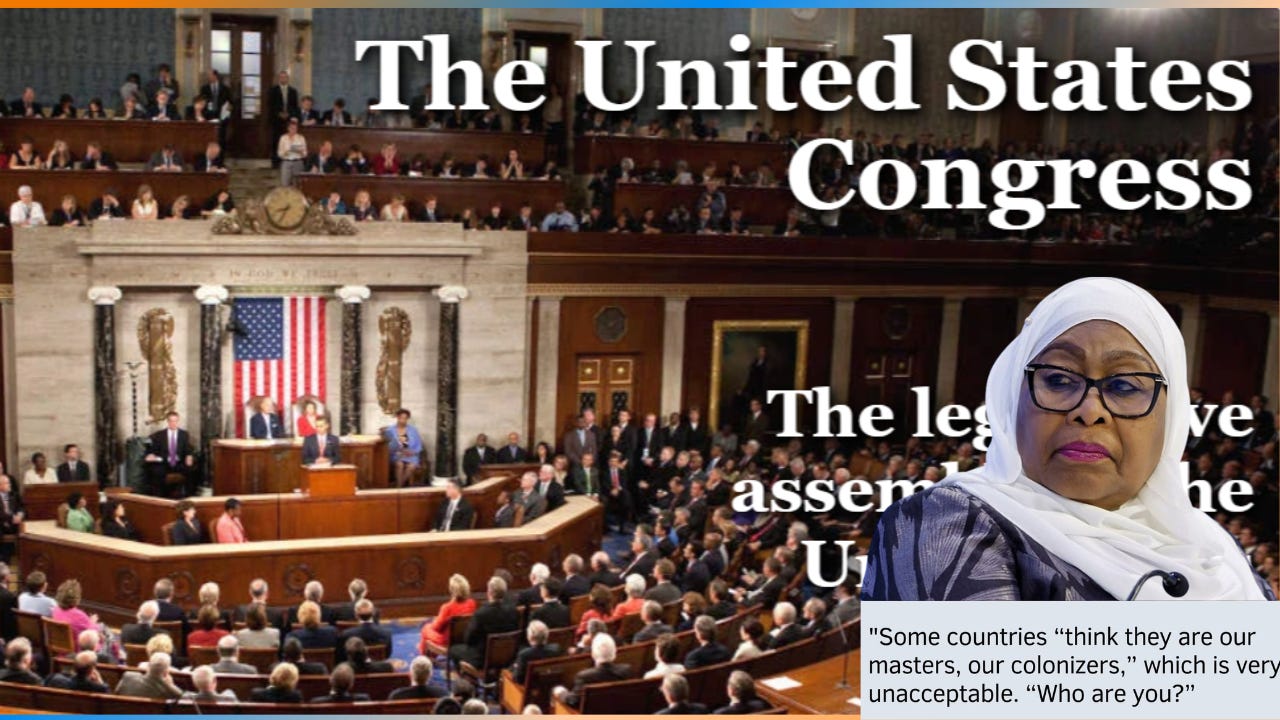
Tanzania Launches US Lobbying Campaign After Security Forces Kill Thousands
Intelligence Analysis: Tanzania's Influence Campaign to Counter State Department Review
Ujasusi Blog’s East Africa Monitoring Team | 17 December 2025 | 0300 GMT
🔓FREE ACCESS
Please consider becoming a paid subscriber
You can also donate.
In Nutshell
Tanzania’s government is actively seeking Washington lobbyists to conduct narrative management operations following widespread post-election violence that killed hundreds of protesters after disputed October 29, 2025 elections. This influence campaign aims to counter US State Department criticism, prevent “Country of Particular Concern” designation for religious persecution, and preserve bilateral relations amid comprehensive US relationship review announced December 4, 2025. The lobbying request for proposals circulated Washington in early December 2025, targeting firms with Capitol Hill relationships and media expertise.
What Implications Does Tanzania’s Lobbying Strategy Reveal?
Tanzania’s pursuit of Washington lobbyists represents a sophisticated influence operation deployed by the Samia Suluhu Hassan government to manage international perception following systematic state repression. According to Semafor Africa’s exclusive reporting, the government’s request for proposals has circulated amongst Washington lobbying firms, specifically seeking support to “shape its narrative” on Capitol Hill with special focus on deploying media expertise to counter reports of repression and claims of religious oppression.
Intelligence tradecraft analysis indicates this operation follows standard foreign influence playbook:
Narrative shaping: Countering documented evidence of security force violence through strategic communication
Relationship management: Leveraging existing diplomatic channels whilst reinforcing with paid advocacy
Preemptive defence: Attempting to forestall “Country of Particular Concern” (CPC) designation after observing Nigeria precedent
Media operations: Deploying public relations expertise to counter international investigative journalism including CNN and BBC Verify investigations
The timing reveals operational urgency. Tanzania hasn’t retained a full-time Washington lobbyist for over a decade according to Foreign Agents Registration Act (FARA) filings, suggesting this represents crisis-driven strategic shift rather than routine diplomatic practice.
Key Intelligence Indicators
Indicator Assessment Source Lobbying procurement timing Crisis response (2 weeks post-State Dept review) Semafor Africa Target audience Capitol Hill + media ecosystem Semafor reporting Strategic objective Narrative management + CPC prevention State Dept statements analysis Historical precedent Nigeria CPC designation trajectory State Department records FARA gap No full-time lobbyist for 10+ years US DOJ FARA filings
How Does the US State Department’s Review Threaten Tanzania’s Strategic Interests?
The December 4, 2025 US State Department announcement represents a significant diplomatic escalation with concrete strategic implications for Tanzania. The official State Department statement declared the United States is “comprehensively reviewing our relationship with the Government of Tanzania” based on four specific concerns:
Ongoing repression of religious freedom and free speech
Persistent obstacles to U.S. investment
Disturbing violence against civilians during and after October 29 elections
Threats to American citizens, tourists, and U.S. interests in Tanzania
Intelligence Community Threat Assessment
The State Department framing indicates intelligence community assessment that Tanzania poses risks to:
American citizen safety: Potential targeting or collateral exposure to state violence
Regional security stability: Spillover effects documented at Malawi-Tanzania border crossings
Investment security: Political risk to US commercial interests valued at billions
Senate Foreign Relations Committee pressure intensified with Senator Jim Risch’s statement on December 9 declaring Tanzania “offered no credible explanation for its own election-related crackdown” and claiming “Christian leaders were singled out for deadly attacks and abductions.”
Country of Particular Concern Designation Risk
Tanzania faces imminent risk of CPC designation under the International Religious Freedom Act of 1998. This designation carries concrete consequences:
Mandatory Congressional notification
Required economic measures after policy options exhausted
Potential aid cuts to development assistance programmes
Reputational damage as systematic religious freedom violator
Nigeria precedent analysis: Nigeria was designated CPC in December 2020, removed in November 2021 by Biden administration, then redesignated in November 2025 by Trump administration. This trajectory demonstrates CPC designations can be reversed but also reinstated based on documented violations.
Semafor’s analysis notes: “The US State Department’s claims of Christian persecution in Tanzania have likely set alarm bells ringing at State House in Dodoma after seeing the trajectory of a similar allegation in Nigeria.”
What Was the Actual Scale and Nature of Tanzania’s Post-Election Violence?
Intelligence assessment of Tanzania’s post-election crisis requires careful evaluation of conflicting casualty estimates amid systematic information control operations.
Official Death Toll Discrepancies
Source Estimated Deaths Methodology Assessment Confidence Tanzanian Government No official figure released Denied excessive force Low credibility - no transparency UN OHCHR (Initial) At least 10 deaths Credible sources, October 31 Conservative - early reporting UN OHCHR (Updated) Hundreds killed/detained Multiple sources, November 11 Moderate - limited access Chadema Opposition Party 2,000+ documented deaths Hospital/clinic networks Unverified - partisan source Diplomatic Sources ~1,000 deaths Intelligence assessments Moderate-High - professional analysis CNN Investigation Extensive casualties Video verification, forensics High - independent documentation
The UN human rights chief Volker Türk stated on November 11: “Information obtained by the UN Human Rights Office from different sources in Tanzania suggests hundreds of protesters and other people were killed and an unknown number injured or detained.”
Intelligence Collection Barriers
Tanzania’s security apparatus implemented comprehensive information denial operations:
Internet blackout: 5-day complete shutdown October 29 - November 3
Curfew enforcement: 24-hour lockdown preventing independent reporting
Foreign journalist exclusion: No international media accredited for mainland coverage
Social media restrictions: Continued throttling of Facebook, WhatsApp, Instagram
Evidence destruction allegations: UN experts reported bodies removed to undisclosed locations
Open Source Intelligence Findings
CNN’s November investigation using OSINT methodology documented:
Geolocated videos: Police and armed men shooting at protesters, many unarmed or holding rocks/sticks
Audio forensic analysis: Confirmed firearms discharge at distances of 95+ metres from protesters
Morgue overflow documentation: Verified videos showing scores of bodies
Satellite imagery: Disturbed soil at Kondo cemetery consistent with mass grave reports
Witness testimony: Systematic pattern of shooting fleeing protesters from behind
BBC Verify’s investigation corroborated these findings using specialist open-source intelligence, satellite imagery, and data analysis techniques.
Pattern Analysis: State-Directed Violence
Intelligence indicators suggest coordinated security force operation rather than spontaneous crowd control:
Systematic targeting: Armed men operating alongside uniformed police
Body disposal operations: Security forces removing bodies from streets and hospitals
Mass grave allegations: Chadema party claims police “threw away over 400 bodies”
Extrajudicial killings: CNN documented cases of soccer players shot at homes
Viral Scout Management, a local sports consultancy, reported on X that seven young soccer players under contract were shot and killed at their homes during protests, with six bodies unlocated.
What Electoral Irregularities Triggered the Post-Election Violence?
The October 29, 2025 protests were not spontaneous reactions to Hassan’s victory but responses to systematic pre-election manipulation that eliminated competitive democratic process.
Pre-Election Political Repression Timeline
Date Action Impact April 2025 Tundu Lissu arrested on treason charges Chadema party leader neutralised April 2025 Chadema party disqualified Main opposition barred from ballot Pre-October Luhaga Mpina barred ACT-Wazalendo candidate excluded October 29 Hassan wins with 97.66% Non-competitive election
Independent National Electoral Commission actions: The commission disqualified Chadema in April for refusing to sign an electoral code of conduct. This occurred days after party leader Tundu Lissu was arrested at a rally where he called for electoral reforms and was subsequently charged with treason.
Intelligence Assessment: Authoritarian Consolidation
President Samia Suluhu Hassan’s trajectory represents reversal of initial democratic opening:
2021-2022: Positioned as reformer following John Magufuli’s death
2023-2024: Gradual return to repressive tactics
2025: Full authoritarian consolidation through opposition elimination
Human Rights Watch assessed that Hassan’s government “intensified political repression, suppressed political opposition and critics of the ruling party, stifled the media, and failed to ensure the electoral commission’s independence.”
How Does Tanzania’s Lobbying Strategy Compare to Other African States’ Influence Operations?
Tanzania’s lobbying procurement represents part of broader African government trend of deploying Washington influence operations to manage US policy responses to domestic repression.
Foreign Agents Registration Act (FARA) Context
FARA, enacted in 1938 and amended in 1966, requires individuals or firms acting on behalf of foreign principals to register with the Department of Justice and disclose:
Nature of relationship with foreign principal
Political activities undertaken in the United States
Financial compensation received for services
Informational materials disseminated on behalf of foreign principal
According to December 2021 data, more than 450 active registrants represent approximately 750 foreign principals.
African Government Lobbying Landscape
Quincy Institute research on foreign lobbying reveals:
Saudi Arabia, Ukraine, DRC, Azerbaijan: Massive political influence campaigns
Standard playbook: Washington-based firms lobbying Congress for weapons, regional conflict support, reputation laundering
Media targeting: Washington Post (1,257 contacts), New York Times (924 contacts), Wall Street Journal (886 contacts) in 2022-2023
Tanzania’s strategic positioning:
Advantage: Has maintained engaged US ambassador since 2021
Disadvantage: Decade-long gap in professional lobbying relationships
Urgency: Crisis-driven procurement indicates reactive rather than proactive strategy
Nigeria Comparison: CPC Designation Trajectory
Nigeria provides instructive precedent for Tanzania’s strategic concerns:
December 2020: Secretary Pompeo designated Nigeria as CPC
November 2021: Biden’s Secretary Blinken removed designation
November 2025: Trump administration redesignated Nigeria as CPC
Key difference: Nigeria had lobbying infrastructure in place during these transitions, whilst Tanzania approaches from position of no established representation.
What Role Does the Trump Administration’s Policy Shift Play in Tanzania’s Crisis Response?
The Trump administration’s approach to Tanzania represents significant policy reorientation from traditional democracy promotion towards religious freedom and economic interests framing.
Shift in Diplomatic Emphasis
Semafor’s analysis identifies critical policy shift: “Another notable factor is how much less talk there is about the state of Tanzania’s democracy in Washington’s critique. That used to be an oft championed metric for African elections as recently as a year ago.”
Previous US approach (2021-2024):
Emphasis on democratic processes
Focus on opposition party rights
Electoral integrity monitoring
Civil society support
Current Trump approach (2025):
Religious freedom violations as primary concern
Christian persecution allegations (unverified by independent observers)
Investment obstacles rather than democratic backsliding
Economic and security interests over governance metrics
Senator Jim Risch’s Strategic Positioning
Senator Risch, chairman of Senate Foreign Relations Committee, represents key influence node:
Anti-China hawk: Seeking to shift Tanzania from China’s orbit
Religious freedom advocate: Pushing CPC designation framework
Strategic resources focus: Tanzania critical for US access to nickel, graphite, natural gas
Geopolitical Competition Context
Tanzania’s strategic value stems from:
Port of Dar es Salaam: Chinese extraction route for African minerals
LNG projects: $42 billion mega-project under discussion
Nickel and graphite: Critical for electric vehicle supply chains
Regional stability: East Africa’s second-largest economy
World Socialist Web Site analysis notes Hassan met with acting US ambassador Andrew Lentz on December 9, advancing major investments including the $42 billion LNG project, $942 million Tembo Nickel venture, and $300 million Mahenge Graphite development.
What Intelligence Services and Security Apparatus Executed the Post-Election Crackdown?
Understanding Tanzania’s security response requires analysis of intelligence and security architecture under Hassan’s administration.
Tanzania Intelligence and Security Service (TISS)
Operational capabilities demonstrated:
Communications intelligence: Coordinated 5-day internet shutdown
Physical surveillance: Door-to-door raids dragging young men from homes
Information operations: Systematic control of narrative through media restrictions
Counterintelligence: Meta account restrictions on activists including US-based Tanzanians
Tanzania Police Force
Inspector-General Camillus Wambura’s response strategy:
Blamed illegal immigrants for inciting protests
Demanded citizens report suspicious foreigners
Implemented curfew enforcement
Restricted fuel sales to prevent protester mobilisation
Armed Forces Deployment
General Jacob John Mkunda, army chief, condemned violence and confirmed military would work with security services. Roadblocks operated by Tanzanian Army deployed throughout country, turning away anyone unable to prove essential worker status.
Plainclothes Security Forces
CNN investigation documented armed men in civilian clothes operating alongside uniformed police in Ubungo area of Dar es Salaam. This tactical deployment indicates:
Deniability operations: Use of unidentifiable personnel
Extrajudicial capability: Untraceable violence attribution
Coordination: Integrated operations with uniformed forces
How Has the International Community Responded to Tanzania’s Post-Election Crisis?
International response reveals fragmented approach with limited concrete consequences for Tanzanian government actions.
United Nations Response
UN Human Rights Office statements:
October 31 alarm: Called for restraint, internet restoration
November 11 investigation call: UN High Commissioner Volker Türk urged investigations into killings and violations
African Commission on Human and Peoples’ Rights: Stated on November 1 that if reports of hundreds killed were accurate, it “would constitute very grave violations” of African Charter which Tanzania ratified in 1984.
Western Governments’ Joint Response
17 Western governments including Britain, Germany, France, Canada, and EU issued joint statement expressing regret over loss of life and urging Tanzanian security forces to exercise “maximum restraint.”
Bilateral statements:
Canada, Norway, United Kingdom: Joint foreign ministers’ statement cited “credible reports of a large number of fatalities”
United States: December 4 comprehensive relationship review
European Union: Debating freeze of development assistance
Regional Responses
East African Community: Issued blandly uncritical report, undercutting stronger African Union and Southern African Development Community statements.
Commonwealth Secretariat: Attempted engagement through appointing Malawi’s former president Lazarus Chakwera as special envoy. Appointment “seen as lacking gravitas, was quietly rejected by Tanzanian government and openly criticised by civil society groups.”
Assessment: Limited Concrete Consequences
Chatham House analysis concludes: “Fragmented responses from international partners have done little to help. Whilst African Union and Southern African Development Community election observer mission statements were outspoken, no consequences have followed.”
What Are the Regime’s Counter-Narrative and Deflection Strategies?
President Hassan’s government has deployed sophisticated counter-narrative operations to deflect accountability for post-election violence.
Foreign Instigator Narrative
Government positioning:
President Hassan blamed “foreign instigators” for deadly unrest
Prime Minister and newly appointed officials accused foreign actors of influencing demonstrations to destabilise Tanzania
Police Inspector-General blamed illegal immigrants for inciting protests
Coup Attempt Framing
Hassan’s December 2 speech to local elders: “Were these really demonstrations or acts of violence? People were destroying government buildings, raiding police stations, and stealing weapons. Police are mandated to protect lives and property. When people say they used excessive force — what were they supposed to do, just sit and watch a coup happening?”
Home Affairs Minister George Simbachawene declared participation in demonstrations would amount to an “attempted coup.”
Information Warfare Accusations
Government media strategy:
Denounced media reports of killings as “information warfare”
Called CNN investigation “slanderous”
Criticised international media for “negative” reports
Characterised critical EU statements as “political interference”
Commission of Inquiry Tactic
Hassan announced commission to investigate election-related violence whilst simultaneously:
Denying wrongdoing by security forces
Suggesting protesters were paid
Refusing to release casualty figures
World Socialist Web Site characterises this as “grotesque mockery” where “regime has announced a commission to ‘investigate’ its own crimes.”
What Digital Repression and Censorship Tactics Did Tanzania Deploy?
Tanzania’s information control operations represent sophisticated multi-layered approach combining technical, legal, and corporate pressure mechanisms.
Internet Shutdown Operations
Technical implementation:
Duration: October 29 - November 3, 2025 (5 days complete shutdown)
Scope: Nationwide internet connectivity disruption
Verification: Multiple internet monitoring organisations confirmed disruption
Partial restoration: Some access restored November 3, but restrictions on social media platforms persisted
Social Media Platform Restrictions
Ongoing throttling:
Facebook access severely restricted
WhatsApp messaging disrupted
Instagram functionality limited
Legal pressure on Meta: Tanzania reportedly pressured Meta to restrict accounts of some of the East African nation’s most prominent activists, resulting in:
Maria Sarungi’s Instagram: Access restricted inside Tanzania following “legal order from Tanzanian regulators”
Mange Kimambi’s accounts: Instagram and WhatsApp accounts removed for US-based activist
Timing: Restrictions implemented ahead of planned anti-government protests
Senator Jim Risch condemned Meta’s cooperation: “I am concerned by reports that US-based tech companies are blocking social media access for individuals targeted by the Tanzanian government — including some in the United States.”
Content Criminalisation
Police barred people from sharing photos and videos “that cause panic” after images of dead bodies began circulating on social media whilst internet connectivity was being restored.
Journalist Accreditation Denial
International Press Association reported it doesn’t know of any journalists working for international media who were accredited to travel to mainland to cover elections. This represents systematic exclusion of foreign media observation.
What Are Tanzania’s Strategic Economic Hedging Options Amid US Pressure?
Tanzania’s economic strategy reveals a deliberate diversification effort to reduce its vulnerability to Western pressure.
Chinese Strategic Partnership
Major infrastructure investments:
$1.4 billion railway refurbishment: Largest investment project for Hassan’s new term
Belt and Road Integration: Tanzania serves as Indian Ocean port access for Chinese resource extraction
Mineral exports: Critical supply chain for Chinese electric vehicle industry
Chatham House notes: “The two largest investment projects agreed for her new term are a $1.4 billion railway refurbishment with China and a $1.2 billion Russian uranium project — neither likely to be fazed by governance concerns.”
Russian Strategic Partnership
$1.2 billion uranium project: Provides alternative financing source unconstrained by Western governance conditions.
Diversified Investment Portfolio
Despite political crisis, Tanzania maintains:
5-6% GDP growth sustained over decade
Fast-growing population driving domestic demand
Solid fundamentals attracting long-term investors
Michael Strain, managing partner at Bowmans Tanzania: “Today’s challenges won’t erase Tanzania’s long-term fundamentals; they simply make the opportunity more visible for those who take a long view.”
Western Investment Challenges
Chatham House assesses: “Western partners had already slashed aid commitments well before current crisis in favour of trade and private sector facilitation. They will now further struggle to engage on similar terms given Tanzanian government’s anti-foreign and unrepentant rhetoric and sharp increase in political risk facing investors.”
Hassan’s warning to citizens: With EU debating development assistance freeze, President Samia has warned citizens of “difficult financing context ahead.”
What Intelligence Lessons Can Be Drawn from Tanzania’s Post-Election Crisis?
Tanzania’s October 2025 crisis offers critical insights into understanding authoritarian consolidation patterns in Africa.
Pre-Emptive Opposition Neutralisation
Lesson 1: Legal warfare timing
Arresting opposition leader Tundu Lissu in April (6 months pre-election) on treason charges
Disqualifying entire Chadema party through electoral commission manipulation
Barring ACT-Wazalendo candidate through attorney general objection
Intelligence indicator: Governments confident in repressive capacity neutralise opposition before election period rather than manipulating vote counts.
Information Denial as Force Multiplier
Lesson 2: Systematic blackout operations
5-day internet shutdown prevented real-time documentation
Foreign journalist exclusion eliminated independent observation
Social media restrictions after partial restoration controlled narrative
Intelligence assessment: Modern authoritarian regimes treat information space as battlespace requiring comprehensive denial operations.
Evidence Destruction Sophistication
Lesson 3: Body disposal operations
Security forces removing bodies from morgues to undisclosed locations
Mass grave allegations at Kondo cemetery
Preventing families from retrieving bodies from hospitals
Tradecraft analysis: Systematic evidence destruction indicates planning level beyond spontaneous crowd control escalation.
Plainclothes Force Integration
Lesson 4: Deniability through mixed deployment
Armed men in civilian clothes operating alongside uniformed police
Untraceable attribution for extrajudicial killings
Plausible deniability for government whilst maintaining operational control
Fragmented International Response Exploitation
Lesson 5: Divide-and-dilute strategy
East African Community uncritical report undermined AU/SADC criticism
Chinese and Russian alternatives neutralise Western pressure
Investor appetite for growth markets overrides governance concerns
Digital Platform Pressure
Lesson 6: Authoritarian leverage over tech companies
Meta’s compliance with restrictions on Tanzanian activists
Extraterritorial reach to US-based diaspora activists
Corporate vulnerability to market access threats
🔍 Intelligence Analysis Conclusion
Tanzania’s lobbying procurement represents sophisticated crisis management operation deployed by Hassan government facing unprecedented legitimacy crisis. The influence campaign aims to prevent Country of Particular Concern designation whilst preserving bilateral relationship with United States during comprehensive review.
Key intelligence assessments:
Post-election violence scale: Credible estimates indicate 1,000+ deaths, making this Tanzania’s worst political violence since independence
State responsibility: Open-source intelligence documentation conclusively demonstrates systematic security force operations rather than crowd control escalation
Lobbying strategy timing: Crisis-driven procurement after decade without representation indicates reactive posture
CPC designation risk: Elevated based on Nigeria precedent and Senator Risch’s religious freedom framing
Economic hedging success: Chinese and Russian alternative financing reduces Western leverage
International response fragmentation: Divided regional and Western responses limit concrete consequences
Strategic implications for Tanzania:
Lobbying success uncertain given documented evidence scale
Economic diversification provides resilience against sanctions
Regional dynamics favour continued Hassan government stability
Democratic backsliding trajectory likely irreversible
This crisis marks Tanzania’s transformation from regional stability model to authoritarian state willing to deploy mass violence for regime preservation. The lobbying operation represents final element of comprehensive strategy combining violent repression, information warfare, economic hedging, and diplomatic narrative management.
Sources: