

Ujasusi Blog’s East Africa Monitoring Team | 06 March 2026 | 0120 GMT
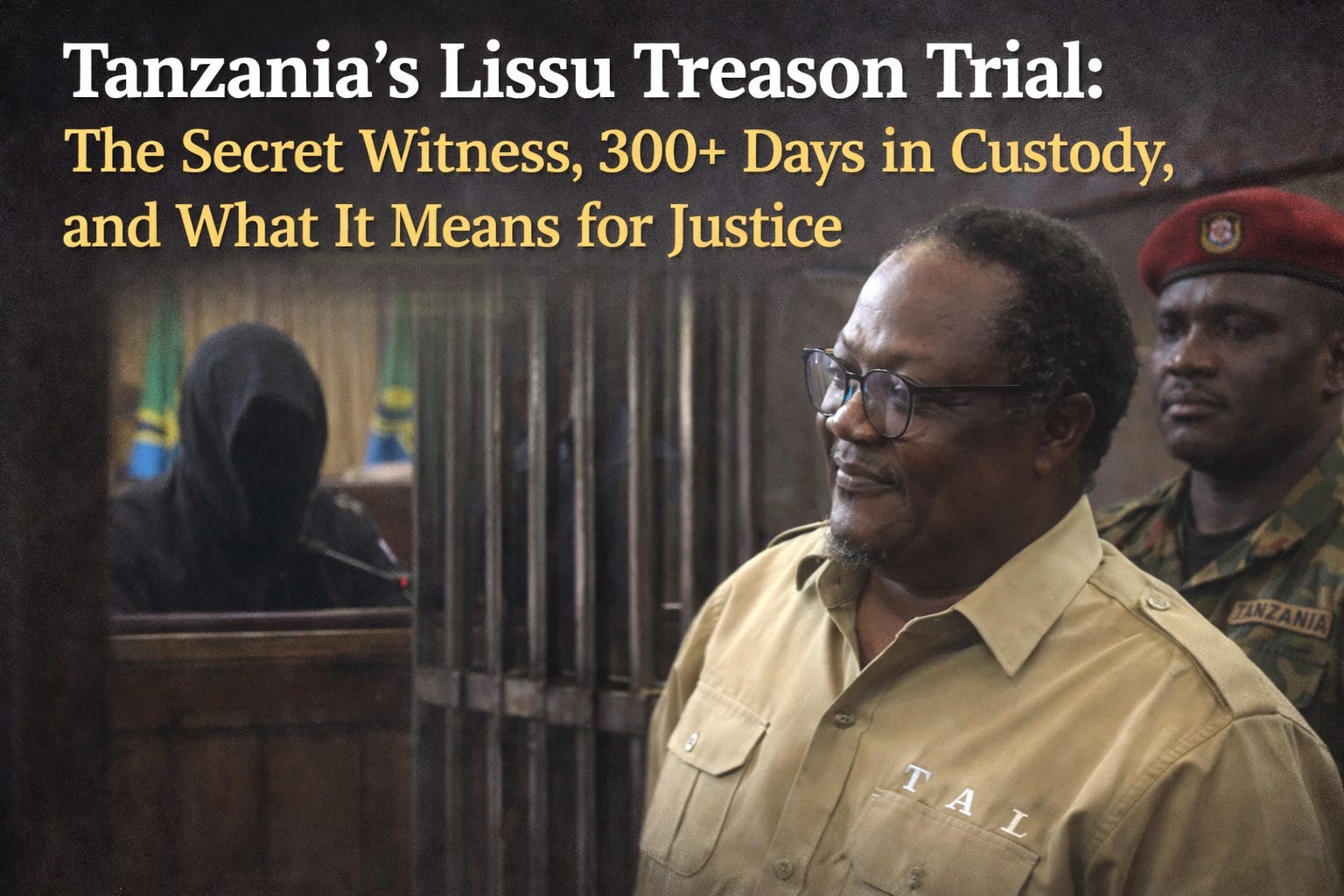
Tundu Lissu has now spent over 300 days in pre-trial detention on capital charges carrying a potential death sentence, with his case heard for a total of 15 days. The February 2026 ruling sustaining his objection to a concealed prosecution witness offers a rare procedural win — but the trial’s pace and conditions raise profound questions about Tanzania’s judicial independence.
⚖️ Where Does the Trial Stand in March 2026?
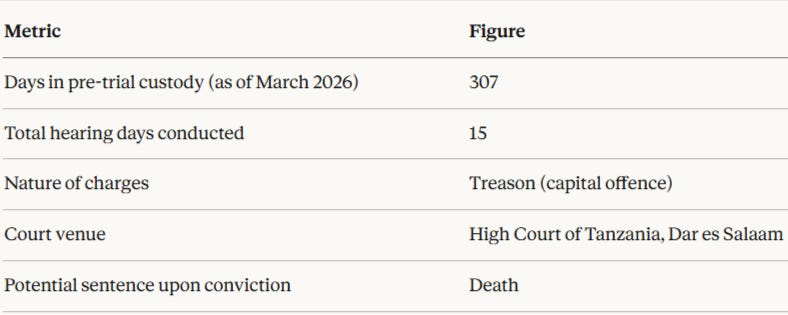
As of March 2026, the treason trial of Tundu Antiphas Mhiche Lissu — CHADEMA’s national chairperson and Tanzania’s most prominent opposition figure — has progressed at a pace that can only be described as deliberate institutional inertia. Arrested in the aftermath of Tanzania’s disputed October 2025 general election, Lissu has remained in pre-trial custody for 307 days, during which the High Court of Tanzania has conducted substantive hearings on only 15 separate days. The arithmetic is damning: less than one hearing day per fortnight over nearly a year of detention.
The charges Lissu faces are capital in nature. Treason under Tanzania’s Penal Code carries a mandatory death sentence upon conviction, placing this trial in the rarest and most consequential tier of criminal proceedings the Tanzanian state can initiate against a citizen. That a man facing execution has been afforded fewer than three weeks of aggregated court time across the better part of a year is not a scheduling inefficiency — it is a structural condition that serves prosecutorial interests by extending the punitive effect of detention indefinitely, without the political risk of a completed verdict.
The case has proceeded through a series of preliminary skirmishes — jurisdictional objections, witness disclosure disputes, and procedural motions — that have consumed hearing time without advancing the substantive merits. This pattern is consistent with high-profile political prosecutions across East Africa, where the judiciary’s calendaring discretion becomes an instrument of executive pressure management rather than neutral case administration.
🎭 The Secret Witness Dispute — What the Court Ruled and Why It Matters
The most legally significant development of the trial’s recent phase was the February 2026 ruling in which the High Court sustained Lissu’s objection to the prosecution’s use of a concealed witness. The prosecution had sought to introduce testimony from an individual identified only as ‘P11’, whose identity was withheld from the defence and who was to testify from a special enclosed booth — a kizimba — that obscured them entirely from view. The court’s decision to uphold Lissu’s challenge represented a meaningful, if isolated, assertion of procedural fairness.
The legal principle at stake is fundamental to adversarial justice: the right of the accused to confront witnesses against them. The prosecution’s attempt to introduce shielded testimony in a treason case — where the stakes are literally life and death — was an overreach the court declined to endorse. Lissu, representing himself, had argued that the booth’s configuration was so restrictive that even the presiding judges could not observe the witness’s demeanour — a prerequisite for credibility assessment in any fair proceeding. He described the arrangement as reminiscent of the sixteenth-century Star Chamber, and characterised the prospect of a faceless, nameless accuser in a capital trial as “a mockery of justice.”
The three-judge panel led by Judge Dunstan Ndunguru agreed with this specific objection, ordering the booth be modified so that the judicial panel could at minimum see the witness. However, broader challenges to the legal validity of the 2025 Witness Protection Rules — including Lissu’s argument that the enabling legislation was never properly published in the Government Gazette or tabled in Parliament — were dismissed. A separate but related ruling of significant constitutional weight was delivered on 16 February 2026 by a High Court sitting in Mwanza, which declared Section 194 of the Criminal Procedure Act unconstitutional to the extent that it denied defence counsel the right to apply for protective measures for their own witnesses — a provision the court found violated the doctrine of equal protection guaranteed under Article 12(2) of Tanzania’s Constitution.
The Mwanza ruling matters beyond Lissu’s case. It establishes that the witness protection architecture the prosecution built specifically around this trial has been structurally compromised by its own one-sidedness. Critics had long argued the 2025 Witness Protection Regulations were strategically tailored for the Lissu prosecution — a charge the state has not publicly rebutted with any credibility.
However, analysts should resist over-interpreting these rulings as evidence of genuine judicial independence. Single procedural victories in political trials are frequently permitted by governments precisely because they provide a veneer of due process without altering the strategic trajectory. The Samia administration’s documented pattern of institutional manipulation — including systematic reshuffling of the Tanzania Intelligence and Security Service — suggests a government sophisticated enough to absorb tactical losses while maintaining strategic control.
🔒 Conditions of Detention: Monitored Consultations and Denied Visits
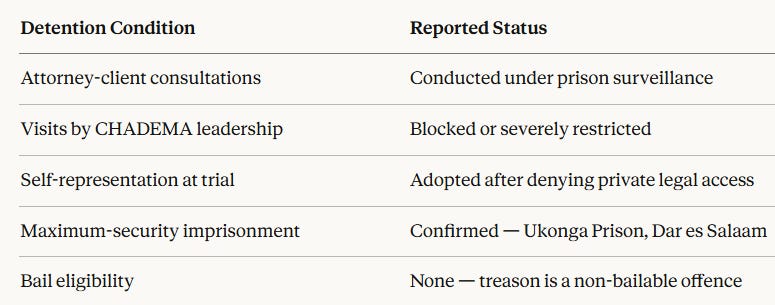
The conditions under which Lissu is being held constitute a secondary layer of the state’s coercive strategy. Lissu has alleged before the court that his consultations with legal counsel are conducted under surveillance — that is, in environments where prison authorities can monitor the content of privileged attorney-client communications. This is not a peripheral concern. Attorney-client privilege is not merely a procedural nicety; it is the scaffolding upon which an effective defence is built.
Indeed, Lissu’s decision to represent himself was itself a product of these conditions. He has stated openly that he took on his own defence out of frustration with prison authorities who denied him meaningful, unmonitored access to his legal team. When a defendant facing the death penalty cannot confer privately with counsel, the right to a fair trial becomes a formal fiction. The prosecution’s evidentiary credibility has also been tested in open court: during cross-examination on 13 February 2026, Lissu dismantled the testimony of a 24-year-old bodaboda driver from Songea, designated ‘P6’, exposing a cascade of contradictions between his oral testimony and his police statement — including the witness contradicting his own stated religion. The presiding judges were observed laughing at several exchanges. It was a courtroom performance that simultaneously illustrated the poverty of the prosecution’s witness selection and the scale of Lissu’s legal competence.
Beyond legal consultations, access by CHADEMA leadership to Lissu has reportedly been blocked for extended periods. The isolation of a pre-trial detainee from both family support networks and unmonitored legal counsel is a documented feature of politically motivated detention across authoritarian contexts globally. Its purpose is twofold: to erode the psychological resilience of the detainee, and to deprive the defence team of informal communication channels that might allow for independent verification of evidence or identification of exculpatory witnesses.
📺From Live Broadcast to Closed Doors — Why the Broadcast Went Dark
One of the more revealing features of the trial’s evolution has been the shift from limited live broadcast to tightly restricted proceedings. In the early phase of the case, portions of the hearings were transmitted to the public, allowing a degree of real-time visibility into courtroom exchanges and judicial conduct. That access was later withdrawn, with live broadcast of the proceedings halted. The official justification — national security concerns inherent to a treason trial — follows a familiar formula that explains little while raising broader questions about transparency.
The move to restrict live broadcast must be understood within its wider political context. The October 2025 election crisis, in which approximately 10,000 civilians were reportedly killed according to the ICC and Intelwatch dossier, generated international scrutiny that the Samia administration has been attempting to contain. A live-broadcast trial, even one conducted under conditions unfavourable to the defence, carries the risk of producing defining moments that expose the political dimensions of the prosecution: a calm and defiant defendant, an aggressive prosecutor, or a procedural irregularity unfolding in real time. Ending live transmission removes the possibility that such moments could circulate widely among international observers at a time when the government is simultaneously seeking diplomatic rehabilitation.
Restricting live broadcast also serves a domestic political purpose. CHADEMA’s support base — particularly in urban areas and among younger, politically engaged Tanzanians — had begun to treat the trial as a focal point for mobilisation. This was evident on February 9, 2026, when supporters filled the High Court chamber in Dar es Salaam and greeted Lissu with chants of “Rais! Rais!” Real-time broadcast has the capacity to amplify such symbolism, transforming courtroom proceedings into political theatre. By limiting public transmission, the state reduces the visual and emotional impact of the trial, allowing it to recede from a national spectacle into what appears, at least formally, to be routine legal administration rather than an ongoing political confrontation.
🌐 International Observation and the Kenyan/Ugandan Human Rights Defenders Episode
The international dimension of the Lissu trial has added a layer of regional significance to what might otherwise be characterised as a domestic criminal proceeding. The obstruction of East African observers has been the most viscerally documented aspect of Tanzania’s attempt to insulate the trial from external scrutiny.
In May 2025, Kenyan photojournalist and activist Boniface Mwangi and Ugandan lawyer and journalist Agather Atuhaire travelled to Dar es Salaam to observe trial proceedings. Both were abducted from their hotel by individuals in a mix of uniform and civilian clothing, held incommunicado, and subjected to torture — including severe beatings and sexual violence — before being dumped across Tanzania’s borders days later. Mwangi resurfaced in Ukunda, Kenya; Atuhaire near the Uganda-Tanzania boundary. At a press conference in Nairobi on 2 June 2025, both recounted their ordeal in graphic detail, drawing condemnation from Amnesty International, the International Commission of Jurists, and UN Special Procedures mandate-holders.
They were not alone. Former Kenyan Chief Justice Willy Mutunga and Senior Counsel Martha Karua — leader of Kenya’s People’s Liberation Party — were among several other observers deported at the airport before reaching the courtroom. Six further journalists, lawyers, and activists were turned back at Julius Nyerere International Airport. President Samia Suluhu Hassan subsequently characterised these individuals as “foreign agents” — a framing that provided state authorities with a political pretext to justify actions that plainly violated EAC Treaty obligations on the free movement of citizens and the right to observe public proceedings.
The African Commission on Human and Peoples’ Rights formally condemned these acts in a resolution issued in August 2025, which also cited the broader pattern of enforced disappearances — over 200 documented cases since 2019. A joint UN Special Procedures communication in July 2025 specifically referenced the abduction and torture of Mwangi and Atuhaire as an instance of transnational repression with direct implications for the fairness of the Lissu trial itself.
The refusal of observer access to Kenyan and Ugandan human rights defenders signals unambiguously that Tanzania is unwilling to permit even informal regional peer scrutiny — a posture irreconcilable with Tanzania’s public commitments to the East African Community’s human rights framework.
Analyst’s Assessment: Strategic Trial, Not Criminal Justice
The Lissu prosecution, viewed through an intelligence and security studies framework, is most accurately characterised as a strategic trial — a proceeding whose primary function is political management rather than the administration of criminal justice. Three analytical indicators support this assessment with high confidence.
First: the timing and charging architecture. Lissu was arrested in the immediate aftermath of disputed elections that produced a documented massacre of approximately 10,000 civilians. The treason charges were brought within a compressed timeframe that precluded the kind of deliberate evidentiary preparation ordinarily associated with capital prosecutions. Capital charges in political contexts serve a specific function: they maximise pre-trial detention justification, eliminate bail as a realistic option, and confer upon the proceeding a gravity that deters potential witnesses for the defence. Robert Amsterdam, Lissu’s American counsel, stated plainly to NPR that treason is “non-bailable” by design — “a common ploy in Tanzanian election politics, to instrumentalise the courts to bar your opponents.” The charges are, in this framework, less about achieving a conviction than about achieving indefinite incapacitation.
Second: the trial’s institutional embedding within the broader repression architecture. The Lissu prosecution does not stand alone. It is concurrent with the documented marginalisation of Vice-President Emmanuel Nchimbi, a systematic restructuring of TISS in patterns consistent with managing ICC liability exposure, and the broader crackdown on civic space that saw 48 attacks on human rights defenders in 2024 alone. These are not coincidental parallel developments; they constitute a coherent programme of post-election political consolidation in which the judiciary, intelligence services, and security apparatus operate in coordinated alignment around a single strategic objective: the elimination of conditions under which the Samia administration’s accountability for October 2025 becomes legally actionable.
Third: the diplomatic rehabilitation campaign as the trial’s external mirror. While the trial proceeds at its glacially deliberate pace in Dar es Salaam, the Samia government is simultaneously engaged in a sophisticated international lobbying effort — the Ervin Graves Strategy Group FARA contract at $45,000 per month, Vatican diplomatic outreach, EU engagement — designed to rehabilitate Tanzania’s international standing sufficiently to deflect ICC-level accountability. The contract, registered on 9 January 2026, targets Congressional committees, the executive branch, and perception management operations. It was activated after the Trump administration added Tanzania to its expanded travel restrictions list effective 1 January 2026, and the State Department characterised the bilateral relationship in terms contingent on future conduct. The trial serves this campaign: it allows the government to characterise its treatment of the opposition as a domestic legal matter under independent judicial management, rather than a political persecution. This framing is false, but it is institutionally legible to foreign interlocutors who prefer the form of due process to its substance.
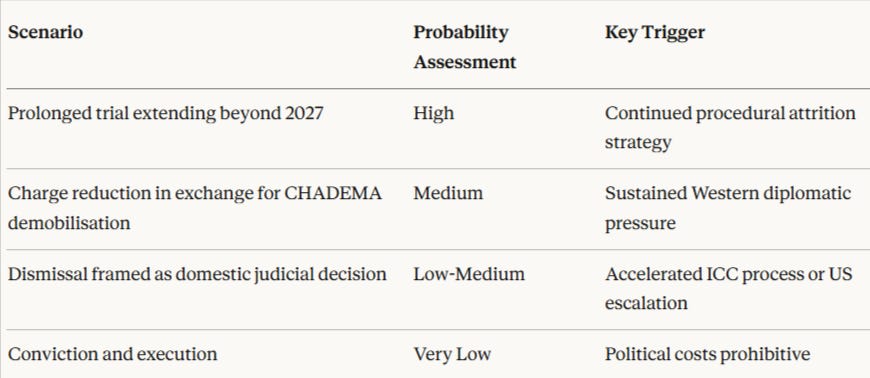
The February 2026 ruling on the secret witness, viewed within this framework, should be understood not as evidence of judicial independence but as a pressure-valve mechanism — a single procedural concession that preserves the court’s claim to legitimacy while leaving the broader strategic architecture of the prosecution entirely intact. Lissu remains in custody. The charges remain capital. The pace remains glacial. What is not a credible scenario, based on current indicators, is a conviction followed by execution — the political costs of which would far exceed any strategic benefit to the Samia administration. The trial’s most probable endpoint will be determined by political calculation, not evidentiary sufficiency.