
Ujasusi East Africa Monitoring Team | 18 June 2026 | 0130 BST
Table of Contents
The Core Allegation
BoT Gold Reserves: The Verified Baseline
The Contradicted Official Narrative
Tanzania-Qatar: Verified Diplomatic and Commercial Traffic
The Abdul Ameir Commercial Profile
The TISS Dimension
Saba Saba as a Convergence Point
What Happens Next
1. The Core Allegation
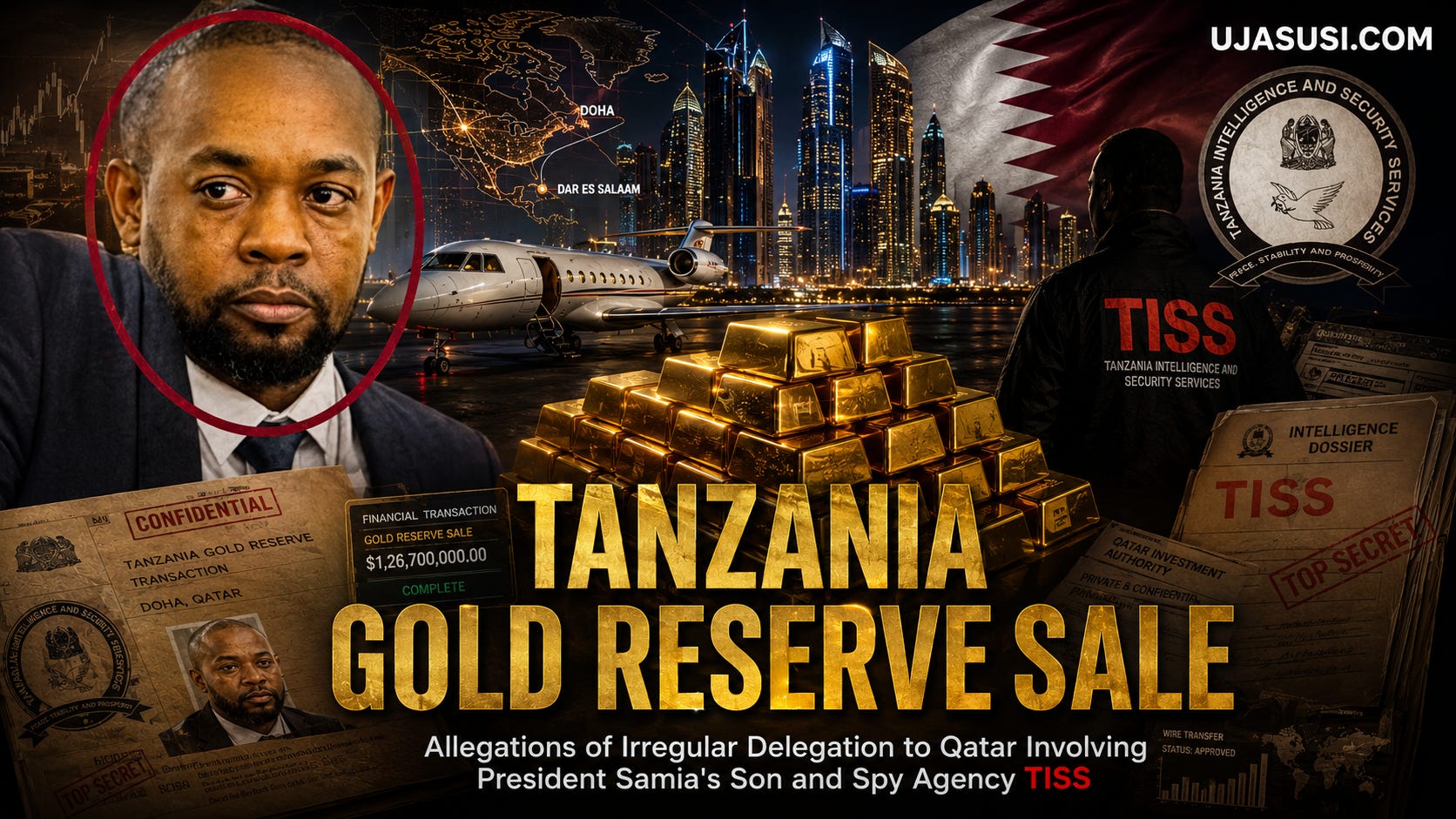
On 16 June 2026, Tanzanian activist Maria Sarungi-Tsehai published claims on Facebook that Abdul Halim Hafidh Ameir — son of President Samia Suluhu Hassan — led a Tanzanian delegation to Qatar to sell gold reserves held by the Bank of Tanzania. The alleged delegation included BoT Director of Financial Markets Emmanuel Akaro, Governor Emmanuel Tutuba, and an individual identified in a secondary source as Delphine Magere, described as a TISS officer. That last claim has not been independently verified by any published source and is treated throughout this assessment as unconfirmed.
The secondary document circulating alongside Sarungi’s post stated the gold had already been sold, that Abdul chaired the auction process, and that the destination of the proceeds — state treasury or private beneficiaries — remained unaccounted for. Sarungi closed with a political deadline: July 7 demonstrations are non-negotiable, and without systemic change, Tanzania is finished.
The allegations carry three analytically separable components, each requiring distinct evidentiary treatment. First: whether Abdul Ameir was present in Qatar in any capacity connected to a BoT gold transaction. Second: whether any gold sale concluded before the BoT’s March 2026 suspension of the programme. Third: whether a TISS officer participated in a delegation whose stated purpose was commercial. None of the three has been confirmed. All three are analytically plausible given verifiable open-source evidence on each element independently.
2. BoT Gold Reserves: The Verified Baseline
The Bank of Tanzania launched a domestic gold purchase programme in October 2024, accumulating 15.37 tonnes within its first year. By 29 January 2026, total reserves stood at $6.52 billion, with monetary gold valued at $1.2 billion — a position that had surpassed the board-approved ceiling of $3.0 billion in total gold accumulated, triggering a rebalancing decision. Gold reached $5,110 per ounce on 26 January 2026, a 64 per cent year-on-year appreciation that made the commercial case for selling at that moment defensible on its face.
By March 2026, the BoT suspended the planned sale following a decline in global gold prices. No official institution has confirmed or denied whether any portion of reserves was transacted between January and March 2026 before that suspension. No counterparty identities, settlement mechanisms, or delegation compositions have been published in any BoT communication since the programme was suspended. That absence of disclosure is a primary intelligence indicator in this case.
3. The Contradicted Official Narrative
On 26 January 2026, Minister of State for Planning and Investment Kitila Mkumbo stated at a briefing in London that President Samia Suluhu Hassan had directly instructed the Bank of Tanzania to sell part of its gold reserves. His stated rationale was unambiguous: “We need cash. We have a lot of infrastructure projects that are going on and they need funding, so they have been instructed to sell part of it so that we get money for the infrastructure.” He further confirmed that international partners had withheld between $2 and $3 billion of Tanzania’s $10 billion development budget in response to the post-election crisis.
Four days later, on 30 January 2026, Director Akaro told reporters the claims were false and baseless. The sale, he stated, was strictly a reserve management decision made independently by the Bank, with proceeds to be reinvested in international financial markets — not directed into government infrastructure projects.
Two named senior officials. One transaction. Contradictory public accounts separated by four days. The significance of this divergence is not that one official was wrong. It is that both accounts cannot simultaneously be accurate, and neither has been formally reconciled by any subsequent government statement, parliamentary session, or BoT publication. The decision-making chain described by Mkumbo — a presidential directive to the central bank to raise infrastructure funding through gold sales — is structurally incompatible with the institutional independence Akaro asserted. One of those accounts was a misrepresentation. Determining which one is the first-order intelligence question this assessment cannot resolve from open sources alone.
READ ALSO
Introducing “A Spy’s Guide to Deception” — The First in the Spy Guide Series

Intelligence work is built on deception. Every service that has ever run an agent, mounted a cover operation, or manufactured a false narrative has done so through principles that remain largely invisible to the public. Not because they are secret, but because no one has taken the time to explain them plainly.
4. Tanzania-Qatar: Verified Diplomatic and Commercial Traffic
Tanzania maintained sustained official presence in Qatar across a six-week window immediately preceding Sarungi’s allegations. Each engagement is independently documented.
On 13 February 2026, Qatar Chamber received a Tanzanian trade delegation led by the director of business development at the Tanzania Agricultural Development Bank and a senior TISEZA investment officer, focused on agriculture and food security. On 3 June 2026, STAMICO held discussions in Doha with a Qatari firm on collaboration in mineral exploration, extraction, processing, and value addition, facilitated by Tanzania’s Embassy in Qatar. On 10 June 2026, Qatar Chamber met a further Tanzanian delegation to discuss mining, energy, construction, and food industries. On 12 June 2026, a Tanzanian delegation visited the Ashghal pavilion at Project Qatar 2026. Separately, Tanzania’s Ministry of Minerals engaged Qatar’s Al Mansour Group on mining and industrial development following a February 2026 visit by Minerals Minister Anthony Mavunde.
Four distinct Tanzanian delegations in Doha across six weeks, covering minerals, trade, agriculture, infrastructure, and investment. No official readout from any of these engagements has published a complete list of Tanzanian delegation members. That gap in transparency is the operational space within which an irregular parallel transaction could occur — and equally the space that makes allegation and counter-allegation structurally difficult to resolve without access to delegation manifests and travel documentation.
The mineral composition of the June 3 STAMICO discussions is operationally significant: gold was among the sectors explicitly cited. A meeting in Doha on 3 June 2026 between Tanzanian state mining officials and a Qatari firm, covering gold, occurred within two weeks of Sarungi’s allegation that gold had already been sold in Qatar. Whether those two events are connected, parallel, or entirely unrelated cannot be determined from available open sources.
5. The Abdul Ameir Commercial Profile: A Pattern of Informal State Capture