
Ujasusi Blog’s East Africa Monitoring Team | 19 February 2026 | 0300 GMT
A coordinated disinformation operation targeting Tanzania’s Chief of Defence Forces, General Jacob John Mkunda, deployed a fabricated social media post falsely attributing to him a statement condemning enforced disappearances. The operation bears the hallmarks of an internal regime manoeuvre, emerging directly against the backdrop of Mkunda’s command responsibility for the TPDF’s role in Tanzania’s October 2025 post-election massacres, in which approximately 10,000 people were killed.
Table of Contents
What Happened? Breaking Down the Disinformation Incident
What Is the Context? The October 2025 Massacres and Mkunda’s Command Responsibility
Why Would Anyone Fabricate This Quote?
Who Are the Most Plausible Authors of This Operation?
What Is the Role of TISS in This Equation?
What Do We Know About General Mkunda’s Political Vulnerability and the TPDF Succession Question?
Q&A: Key Analytical Questions
Confidence Assessment
What to Watch
What Happened? Breaking Down the Disinformation Incident
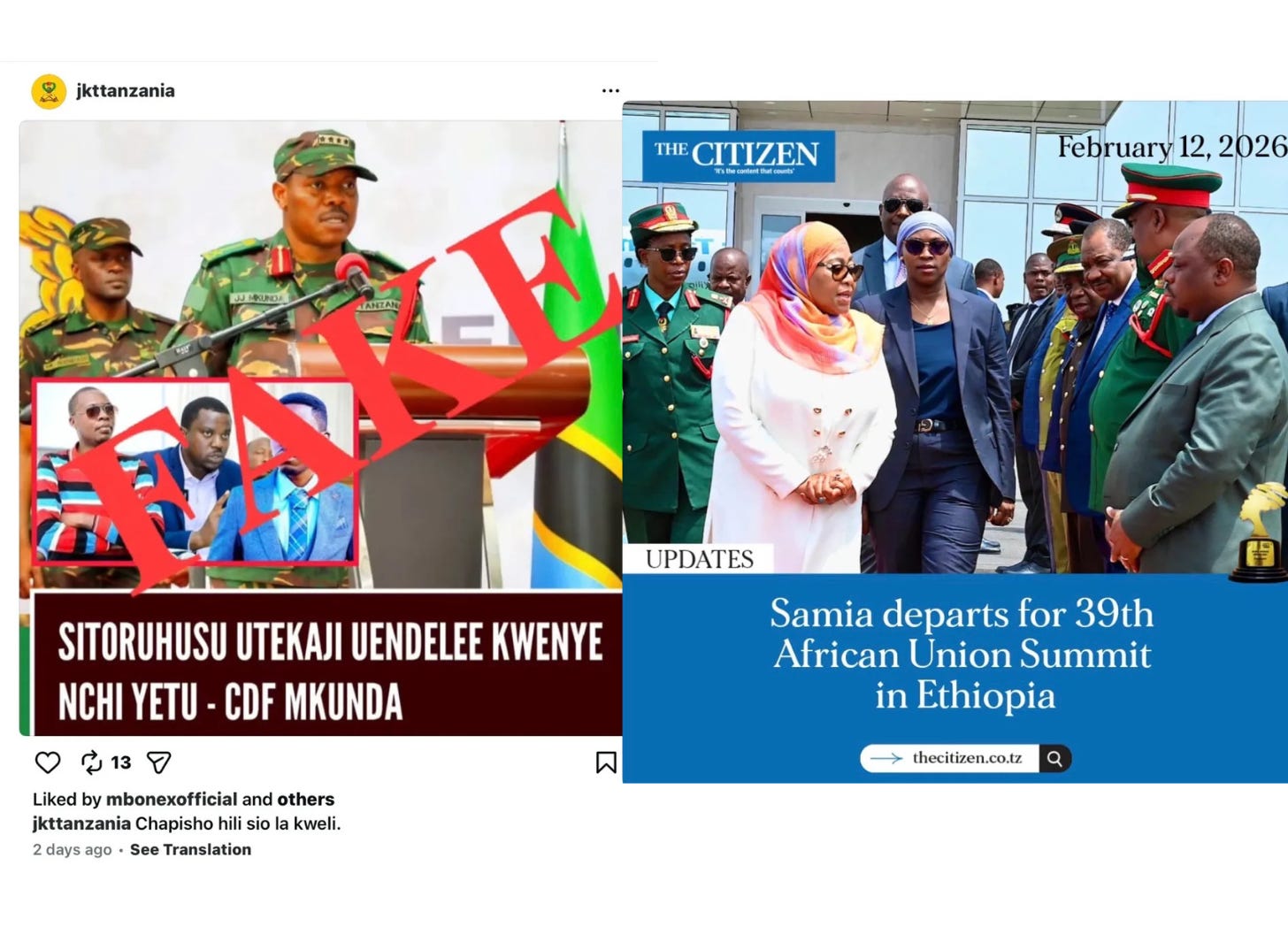
On or around 17 February 2026, an Instagram account associated with Tanzania’s Gen-Z online community, identified by the watermark “Bongo Trending Genz,” circulated a graphic featuring General Jacob John Mkunda, Tanzania’s Chief of Defence Forces (CDF), speaking at a podium against a backdrop of the Tanzanian flag and what appears to be a JWTZ ceremonial setting. The overlaid caption read, in Swahili: “Sitoruhusu Utekaji Uendelee Kwenye Nchi Yetu — Mkunda” — translated as: “I will not allow abductions to continue in our country — Mkunda.”
Within approximately 48 hours, the official jkttanzania Instagram account — operated by Jeshi la Kujenga Taifa (JKT), Tanzania’s National Service — issued a categorical rebuttal. Their post reproduced the same graphic, stamped it with a large red “FAKE” watermark, and included the Swahili caption: “Chapisho hili sio la kweli” — “This post is not true.”
The speed and source of the rebuttal is analytically significant. JKT is a paramilitary institution under the Ministry of Defence. It does not typically engage in social media fact-checking. The decision to use an official military-adjacent account to debunk a post about the CDF — rather than JWTZ’s own communications directorate or the Ministry of Defence — suggests either a lack of coordination within the military’s communications structure or, more plausibly, that the rebuttal was operationally driven rather than purely informational.
What Is the Context? The October 2025 Massacres and Mkunda’s Command Responsibility
Any assessment of the disinformation operation targeting Mkunda is incomplete without understanding the weight of what occurred under his command in October and November 2025. On 29 October 2025, Tanzania held its general elections. What followed was, by any credible measure, one of the worst episodes of state-sponsored mass killing in the country’s post-independence history.
Security forces — including the TPDF under Mkunda’s command — were deployed across major cities as protests erupted over the disputed results, in which President Samia Suluhu Hassan was declared re-elected with an implausible 97.66 percent of the vote. Reports documented mass graves being dug, particularly in Mabwepande, to conceal bodies of those killed in the crackdown. Hospitals were reportedly militarised, with police and intelligence agents guarding them, confiscating phones, deleting footage, and preventing families from identifying bodies. Medical personnel were allegedly instructed to harm or kill patients critically injured during the violence. The use of military-grade weapons was reported, and victims included protesters, street children, medical workers, and uninvolved civilians.
According to Intelwatch’s formal submission to the International Criminal Court — the first of four ICC cases filed against the Tanzanian regime — approximately 10,000 people were killed over three days following the election protests. The submission alleges that security forces used live ammunition rather than standard crowd control measures, with evidence of targeted executions including sniper attacks. One morgue alone reportedly contained 800 bodies. The ICC submission further notes that medical professionals were threatened with death if they released casualty figures, which explains the disparity between conservative international estimates and the figures gathered on the ground.
A complete internet shutdown was imposed from 29 October to 3 November 2025, severely curtailing the ability of human rights defenders and journalists to document violations. This blackout was itself a deliberate component of the cover-up operation, designed to control the information environment during the period of maximum killing.
The TPDF’s specific role requires precise characterisation. The police and TISS initially responded to electoral protests with violence, with the subsequent deployment of the TPDF to major cities following the initial crackdown. Under international criminal law, however, Mkunda’s culpability does not depend on whether TPDF units pulled triggers in every documented killing. Command responsibility doctrine — as enshrined in the Rome Statute — holds that a military commander bears criminal responsibility for crimes committed by forces under their effective control when they knew or should have known of the crimes and failed to prevent or punish them. As CDF, Mkunda commanded every uniformed soldier deployed during the crisis period. That exposure is both legal and political, and it is the foundation upon which his current vulnerability rests.
A January 2026 analysis invoked command responsibility doctrine under international criminal law, specifically arguing that General Mkunda should be referred to the ICC for investigation into potential crimes against humanity, describing his conduct as an unprecedented betrayal of the TPDF’s constitutional mandate to safeguard citizens rather than subjugate them.
Why Would Anyone Fabricate This Quote?