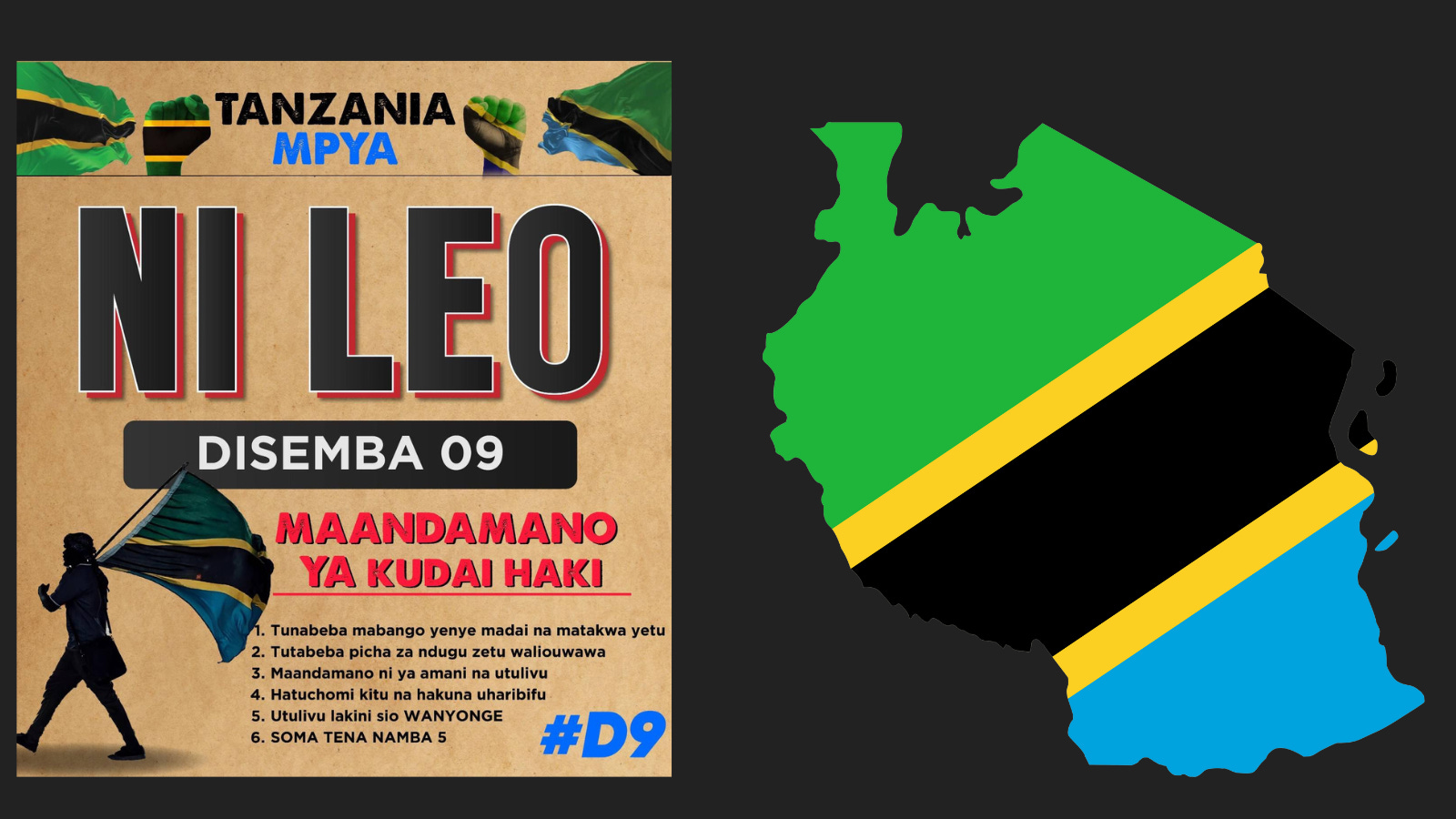
[FREE ACCESS] Tanzania’s December 9 Protests: Intelligence Assessment

Ujasusi Blog’s East Africa Monitoring Team | 09 December 2025 | 0330 GMT
🔓FREE ACCESS
Please consider becoming a paid subscriber
You can also donate.
Tanzania’s December 9, 2025 Independence Day protests unfold under the shadow of October’s disputed election and the unprecedented international pressure that followed. As crowds begin to mobilise, the core intelligence question is whether this pressure—including ICC submissions, EU sanctions threats, a 17-nation joint warning, and U.S. bilateral review—will restrain the administration of President Samia Suluhu Hassan from deploying October-scale lethal force.
The stakes are unusually high: October’s violence—following Hassan’s 97.66% victory—is emerging as one of the most devastating episodes of state violence against civilians in contemporary Africa. Independent OSINT modelling places the potential death toll near 10,000, far beyond the “hundreds” acknowledged by the UN.
Whether D9 becomes a turning point or simply the next chapter in escalating repression will be determined within hours.
Electoral Context and the October Killings
The October 29 election was shaped by systematic political exclusion. The official result—31.9 million votes for Hassan as cited on the 2025 election page—is incompatible with credible turnout patterns. Chadema was barred from contesting; its leader Tundu Lissu remains imprisoned on treason charges. ACT-Wazalendo candidate Luhaga Mpina was repeatedly removed from the race despite court orders supporting his candidacy.
The African Union and SADC both declared the poll non-compliant with democratic standards—a rare rebuke for a region where observation missions often avoid directly challenging incumbents.
Between October 29 and 31, protests erupted nationwide. The state response was not reactive crowd control but coordinated and lethal. A CNN investigation verified police firing on unarmed civilians from long distances, contradicting claims of defensive engagement.
Patterns recorded across Dar es Salaam, Mwanza, Arusha and other cities indicate deliberate mass casualty operations:
widespread use of live ammunition
a five-day blackout (Oct 29–Nov 3) obscuring real-time reporting
removal of bodies from hospitals and mortuaries
neighbourhood raids targeting known opposition sympathisers
Casualty estimates vary because the state blocked access to data and intimidated medical staff. Chadema cites 1,000–2,000 deaths. The International Crisis Group estimates 3,000. The UN confirms only “hundreds.”
OSINT-derived estimates are significantly higher—potentially reaching 10,000—based on:
hospital saturation during blackout periods
morgue capacity analysis in major cities
testimonies from medical staff describing overwhelming casualty inflows
satellite imagery showing disturbed burial sites
basic modelling of ammunition expenditure, firing positions, protest density, and force deployment patterns
The government has refused to release figures, arguing that doing so would “celebrate death,” effectively shielding perpetrators and obstructing accountability.
December 9 Mobilisation Dynamics
D9 mobilisation is driven by a fundamentally different psychology from October. In October, people protested political exclusion. In December, thousands of families who lost relatives in October face a profoundly personal choice: remain silent or honour the dead through mobilising.
This moral calculus shifts deterrence dynamics. For many, participation is no longer a political act but a form of dignified resistance.
The movement’s operational characteristics include:
Decentralisation: Gen-Z-led coordination avoids formal party structures, increasing resilience against decapitation tactics.
Vulnerability: The same decentralisation limits support infrastructure—legal, medical, financial, or logistical.
Generational Delegitimisation: Tanzania’s young population faces structural inequality, elite capture, and chronic unemployment. October’s killings sharpened already deep generational resentment.
Diaspora Support Networks: Activists abroad provide communications, funding, and advocacy. The government frames this as foreign interference, but the root drivers remain domestic and socio-economic.
The state’s intimidation strategy—pre-emptive arrests, surveillance, and framing protests as an “uprising”—aims to weaken momentum, but bereaved families represent a mobilisation vector the state cannot easily suppress.
International Deterrence Pressure
The current level of international coordination against potential violence is unprecedented in Tanzania’s modern history.
Key components of the pressure architecture:
ICC Submission alleging crimes against humanity (HRW summary).
EU Parliament vote (539–0) to freeze €156 million in support and consider targeted sanctions.
Joint statement by 17 Western nations highlighting extrajudicial killings, disappearances, and body concealment (U.S. Embassy Security Alert).
U.S. relationship review, signalling deep diplomatic uncertainty.
UN OHCHR warning labelling the protest ban disproportionate (UN press briefing).
Condemnation from Human Rights Watch and Amnesty International.
The global message is unambiguous: repeat October’s mass killings and face severe political, diplomatic, and legal consequences.
Whether these measures reshuffle the regime’s internal risk calculus remains uncertain.
State Posture Ahead of December 9
The security environment in major cities is heavily militarised. Police, intelligence units, and TPDF deployments are widespread. While there is no formal curfew, the state has effectively created pre-emptive friction:
Water outages across Dar es Salaam
Slowed, disrupted internet connectivity
Targeted arrests and harassment of organisers
A nationwide ban on demonstrations (The Citizen)
Hassan’s own messaging has been uncompromising. Her remarks on December 2—warning organisers that “whenever they come, we are prepared”—reaffirm a hard-line posture.
Scenario Outlook
Scenario 1: Large Crowds, Controlled Force (Most Stabilising for Regime)
Security forces rely on arrests and non-lethal methods. Casualties are limited. The state suppresses mobilisation without triggering international escalation.
Scenario 2: Large Crowds, High Lethality (Most Dangerous)
The government redeploys October-level force. Casualties escalate sharply. International pressure may intensify, but immediate deterrence fails. This scenario tests the credibility of international enforcement mechanisms.
Scenario 3: Limited Mobilisation, Heavy Deterrence
Protests remain small due to fear and security saturation. October’s repression successfully demoralises the public. This is less likely given the mobilisation dynamics around bereaved families.
Scenario 4: Multi-Day Resistance
Security forces show early restraint, allowing crowds to consolidate. If sustained beyond 24–48 hours, this becomes the most politically consequential scenario for the opposition.
Most probable outcomes: Scenario 1 or Scenario 2, depending on Hassan’s final calculation about international consequences versus regime survival imperatives.
Strategic and Regional Significance
D9 is more than a protest day; it is a live stress test of global deterrence mechanisms. Tanzania is facing the strongest international pushback any East African government has encountered in years.
The implications extend beyond its borders:
If Hassan authorises mass killings under this level of scrutiny, it signals to other authoritarian governments that even coordinated international pressure is insufficient to prevent large-scale violence.
If deterrence works, it offers a real-world case study of how ICC risk, sanctions, and diplomatic consensus can modify regime behaviour.
East African regimes—especially Uganda, Rwanda, and Kenya—will study the D9 outcome closely.
Reports that Ugandan forces may have participated in October’s shootings raise concerns about emerging cross-border security cooperation aimed at quelling domestic dissent movements. If confirmed, this has major implications for Gen-Z mobilisation across the region.
For Tanzanians, the stakes are immeasurable. For families of those killed in October, D9 is a test of whether their losses will be acknowledged or erased. For Gen-Z activists, it is a test of mobilisation viability in a state willing to use overwhelming force. For international actors, it is a test of whether their tools can prevent atrocities—not merely document them after the fact.
By the end of the day, the operational outcome will clarify whether Tanzania stands at the beginning of negotiated restraint—or the edge of a deeper authoritarian rupture.
Sources:
Al Jazeera |
Human Rights Watch |
CNN |
UN OHCHR |
International Crisis Group |
The Chanzo |
The Citizen |
The New Humanitarian