

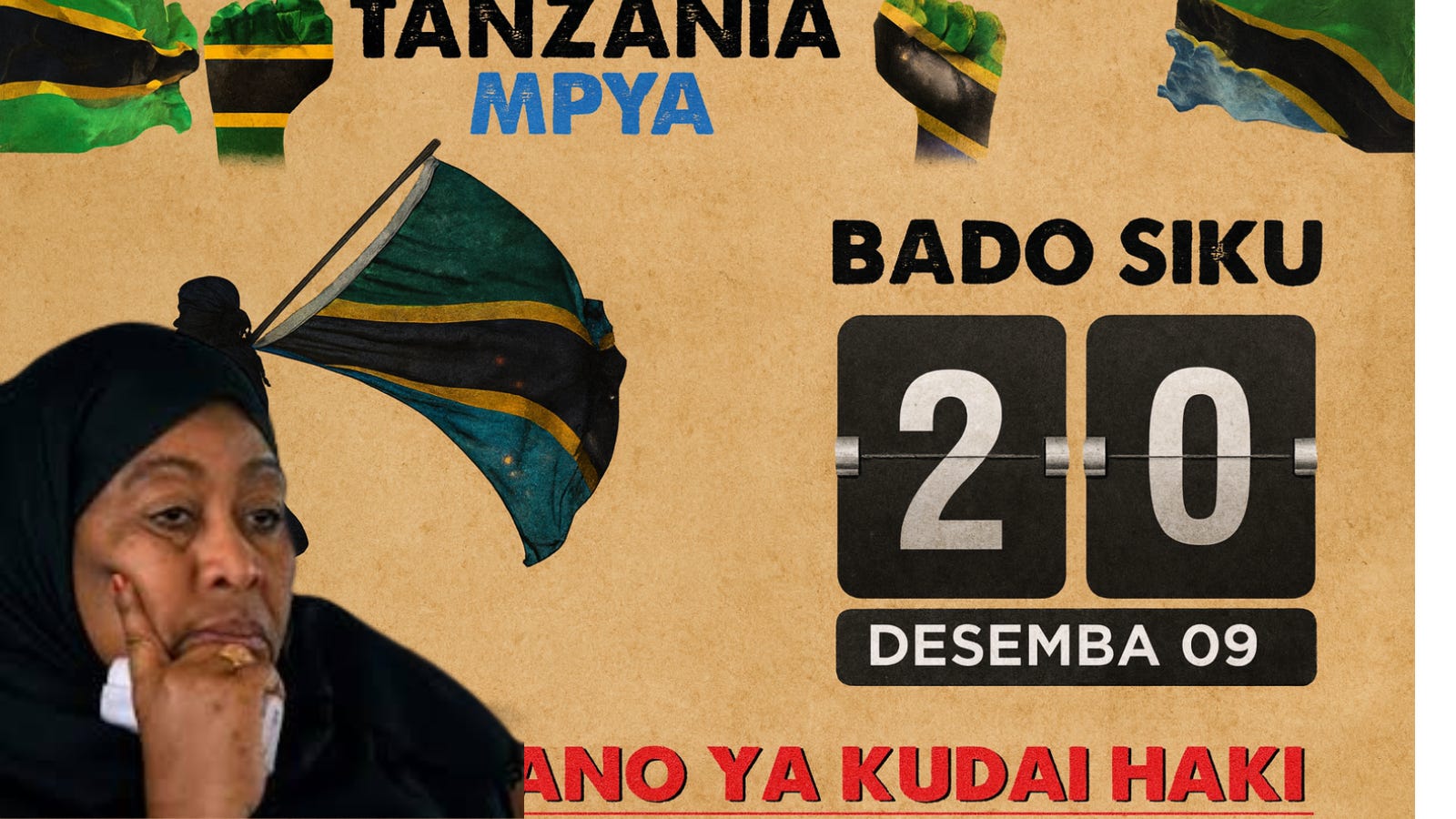
Ujasusi Blog’s East Africa Monitoring Team | 05 December 2025 | 2310 GMT
Tanzanian President Samia Suluhu Hassan’s government confronts an unprecedented convergence of international pressure and domestic crisis following the disputed October 29, 2025 election. Nationwide protests planned for December 9, 2025 (Independence Day) have been formally banned, with authorities deploying armed forces and conducting waves of pre-emptive arrests. However, the regime faces paradoxically stronger mobilisation potential than October: the October violence created thousands of bereaved families—parents who lost children, children who lost parents—each with direct personal motivation to seek justice rather than just political reform. Internationally, 17 Western diplomatic missions, the United States, the European Parliament, and now Ghana have taken coordinated critical stances. The United States announced a comprehensive review of bilateral relations on December 4, 2025, while the European Parliament voted 539-0 to freeze €156 million in funding. Domestically, volatile sectarian tensions have erupted as Muslim clerics publicly attack Catholic Church leadership, accusing them of manipulating Vice President Emmanuel Nchimbi.
The political calculus for Samia’s survival rests on a narrowing base: continued loyalty from security forces, CCM party control of domestic institutions, successful suppression of December 9 demonstrations without triggering international pariah status, and the absence of coordinated African Union intervention. However, the economic pressure from suspended Western funding, combined with bereaved families demanding justice for murdered relatives alongside dangerous religious sectarian divisions, creates structural vulnerabilities that could accelerate political change. The December 9 outcome will determine whether current international pressure translates into domestic political transformation—but the regime now faces opponents motivated by personal loss, not just electoral grievances.
⚠️ December 9 nationwide protests
Tanzania faces a critical turning point on December 9, 2025—Independence Day—when nationwide “unlimited peaceful protests” are planned despite a formal police ban issued December 3-5. The demonstrations, organised via social media and referred to as “D9” protests, represent a continuation of the October 29 “MO29” uprising that resulted in hundreds to thousands of deaths. Critically, the regime faces paradoxically stronger mobilisation potential than October 29: the October violence created thousands of bereaved families—parents who lost children, children who lost parents, siblings, extended relatives—each with direct personal grievance and motivation to seek justice. Unlike October’s electoral protests, December 9 mobilisation is fueled by personal loss and accountability demands.
The government has responded with waves of pre-emptive arrests, mass SMS warnings, cancellation of Independence Day celebrations, and deployment of armed police and military forces across Dar es Salaam. The massive security response suggests the regime recognises it faces equal or greater threat than October despite surface appearance of successful suppression.
Police Spokesperson David Misime declared on December 5 that the demonstrations lack legal authorisation and constitute a security threat, warning that anyone attempting to participate will be arrested. The police statement accused organisers of urging participants to “seize property, disrupt services at hospitals, and stay on the streets for an unlimited time to paralyse economic activity.” Authorities have specifically warned businesses in harbour and port areas to remain closed, citing intelligence that protesters plan to block all roads leading to Dar es Salaam port.
The pre-emptive crackdown has already resulted in dozens of arrests since mid-November 2025. High-profile detentions include Professor Rasel Mpuya Madaha (arrested in Morogoro on sedition charges via WhatsApp group), CHADEMA Kyela district chairperson Victoria Swebe, social media critic Clemence Mwandambo, and Dr. Kibaba Furaha Michael (hospital worker and WhatsApp group administrator). Activist Mange Kimambi has reported having social media accounts deactivated in what critics characterise as systematic silencing.
President Samia addressed the planned protests directly on December 2, stating: “We hear there is another one planned... whenever they come, we are prepared.” The government has deployed Tanzania Communications Regulatory Authority (TCRA) to send mass SMS alerts warning citizens against participation, while armed police and military personnel have established visible presence across Dar es Salaam and other urban centres.
UN human rights experts stated on December 4 urging Tanzanian authorities and security forces to protect people’s right to assembly and prevent further violations ahead of the planned demonstrations. The opposition has rejected the government’s Commission of Inquiry established November 20 to investigate October 29 violence, demanding an independent international investigation.
The December 9 demonstrations represent the regime’s most significant near-term stability test. The combination of formal ban, pre-emptive arrests, military deployment, and explicit presidential warnings suggests authorities are prepared to use lethal force to prevent a repeat of October 29 violence. Whether opposition mobilisation capacity can overcome fear following October’s killings—and whether security forces will again employ mass violence—will determine both immediate casualties and longer-term regime trajectory.
🇺🇸 US announces comprehensive bilateral review
The United States Department of State issued its most consequential statement on Tanzania in decades on December 4, 2025, announcing a comprehensive review of the bilateral relationship and explicitly questioning the Tanzanian government’s reliability as a partner. Principal Deputy Spokesperson Thomas Pigott stated that the Government of Tanzania’s ongoing repression of religious freedom and free speech, persistent obstacles to U.S. investment, and disturbing violence against civilians required fundamental reconsideration of ties.
Washington’s characterisation of Tanzania’s post-election conduct as placing American citizens, tourists, and U.S. interests at risk establishes a framework for potential escalatory measures including targeted sanctions, suspension of security assistance, and restrictions on bilateral engagement. The statement represents a marked departure from the historically constructive US-Tanzania partnership, which has underpinned significant development cooperation, regional security collaboration, and trade relationships.
The diplomatic deterioration follows practical security measures already implemented. The US Embassy elevated Tanzania to a Level 3 travel advisory (Reconsider Travel) on October 31, 2025, adding “unrest” as a risk indicator. By December 5, embassy security alerts warned of potential nationwide curfews, internet blackouts, cancellation of international flights, and roadblocks ahead of planned December 9 protests. US government employees have been restricted from domestic travel within Tanzania since December 8.
🌍 17 Western diplomatic missions demand accountability
On December 5, 2025, seventeen diplomatic missions in Tanzania issued a coordinated joint statement constituting the most comprehensive Western diplomatic intervention in Tanzanian affairs since independence. The signatories—comprising the British High Commission, Canadian High Commission, EU Delegation, and embassies of Belgium, Denmark, Finland, France, Germany, Ireland, Italy, Netherlands, Norway, Poland, Slovakia, Spain, Sweden, and Switzerland—presented unified demands to the Tanzanian government.
The statement cited credible reports from domestic organisations documenting extrajudicial killings, enforced disappearances, arbitrary arrests, and concealment of dead bodies. The diplomatic missions demanded four specific actions: release of all bodies of deceased persons to their families; release of all political prisoners; provision of legal and medical support to detainees; and establishment of an independent, transparent, and inclusive investigation into post-election violence.
This coordinated Western response builds upon an earlier November 2 EU High Representative statement, which was endorsed by eleven additional countries aligned with EU positions: Albania, Armenia, Bosnia and Herzegovina, Iceland, Liechtenstein, Moldova, Montenegro, North Macedonia, Norway, Serbia, and Ukraine. The expanding coalition demonstrates how Tanzania’s post-election conduct has unified traditionally disparate diplomatic voices into coordinated pressure.
The diplomatic missions specifically referenced preliminary election reports from the African Union and SADC as establishing the factual predicate for their concerns. Both regional bodies found that Tanzania’s October 29 election failed to meet democratic standards—a significant development given the AU’s historical reluctance to criticise member state elections.
🕌 Muslim clerics launch volatile attacks on Catholic Church leadership
Islamic scholars affiliated with Baraza la Umma and other Muslim institutions held confrontational press conferences in November-December 2025 that dramatically escalated religious sectarian tensions by directly accusing the Catholic Church of orchestrating efforts to overthrow President Samia and alleging that Vice President Emmanuel Nchimbi—who is Catholic—is being manipulated by Father Charles Kitima and TEC leadership.
In a volatile press conference that circulated widely on social media, Islamic scholars made explosive accusations framing post-election protests as a Catholic conspiracy. Speaking about demonstrations and criticism of the government, one cleric stated: “When they talk about these demonstrations, they are talking about the main goal being to remove the elected president so they can put in what they want.” The cleric then pivoted to attacking VP Nchimbi’s silence on post-election violence, stating: “We don’t hear the Vice President who is a Catholic being mentioned anywhere despite being a major leader of the party and government. And we also don’t hear him condemning the breaking of peace or encouraging peace and tranquility in the country.”
The cleric then delivered the most inflammatory accusation: “Is this the direction they were sent by Father Kitima and Catholic leaders? We must ask ourselves questions—he is just silent.” The use of “waliotumwa” (were they sent/directed) explicitly accuses Catholic Church leadership of controlling the Vice President, suggesting Nchimbi’s silence on violence represents Catholic manipulation rather than independent judgment. The cleric concluded: “This matter we cannot joke about even a little.”
These statements—amplified through social media platforms including Jamii Forums—create a dangerous sectarian religious dimension to Tanzania’s political crisis. The framing explicitly positions Muslim institutions as defenders of Samia’s legitimacy against alleged Catholic conspiracy, while simultaneously attacking the credibility of both TEC’s human rights advocacy and the Catholic Vice President’s loyalty to the government.
Separately, more moderate Muslim voices including BAKWATA Secretary General Sheikh Nuhu Mruma condemned the April 2025 attack on Father Kitima as “shocking and unacceptable,” demonstrating that Muslim religious leadership is not monolithic. However, the volatile press conferences represent a significant faction willing to weaponise religious identity in defence of the regime, transforming what began as political opposition into increasingly sectarian conflict.
✝️ President Samia’s December 2 response to Catholic bishops
On Tuesday, December 2, 2025, President Samia delivered a speech to Dar es Salaam elders in which she directly addressed criticism from the Tanzania Episcopal Conference (TEC). While interpretations vary regarding whether the speech constituted an “attack” on the Catholic Church, the President’s remarks were pointed and clearly targeted at the bishops’ critical statements.
Samia stated: “Advice is welcome. Directives are not”—establishing her position that religious leaders should not attempt to dictate government policy. She specifically referenced the TEC’s track record: “Since I took office, eight statements have been issued by TEC, but when you look closely, they contradict each other. The statements don’t work effectively.” The President further asserted that “the strength of religion is in our hearts; there is no overriding here... that my religion should override Tanzania.”
Addressing broader questions of legitimacy, Samia declared: “If you don’t like your president because of his or her religion or gender or whatever part of the country he or she comes from, then know that all power comes from God and only he knows why someone should receive such powers.”
The Catholic Church’s criticism has been unequivocal. Archbishop Jude Thaddaeus Ruwa’ichi condemned post-election killings at St Joseph’s Cathedral on November 10, declaring “Hakuna amani bila haki” (”There is no peace without justice”). The TEC’s November 11-14 plenary meeting produced a nine-page statement describing election killings as “a grave evil and an abomination before our God,” demanding independent international investigation. TEC Secretary General Fr. Charles Kitima—himself attacked by unknown assailants in April 2025—has called for government dialogue while accusing security forces of human rights violations.
⚖️ ICC petition serves as a deterrent despite no formal case
There is no International Criminal Court case against President Samia Suluhu Hassan. Claims circulating on social media asserting that the ICC has initiated investigations have been rated FALSE by Africa Check, a Meta third-party fact-checking partner. However, the 82-page dossier submitted to the ICC Prosecutor on November 18, 2025, serves as a significant deterrent against repeat violence even without formal case status.
The petition was submitted by a coalition including Intelwatch (a South African NGO), the Madrid Bar Association, the World Jurists Association, and several anonymous Tanzanian NGOs. It alleges crimes against humanity under Article 7 of the Rome Statute, including murder, torture, rape, enforced disappearance, and extermination. The submission argues for “command responsibility” of President Hassan as Commander-in-Chief and cites estimates of 700-3,000 protesters killed during post-election violence.
The deterrent effect: While the ICC Prosecutor’s Office has not confirmed admissibility or announced any preliminary examination, the existence of the documented petition creates direct personal legal risk for President Samia. Any additional mass violence on December 9—particularly if documented in real-time by international media—would immediately strengthen the petition and likely trigger formal preliminary examination announcement. Under command responsibility doctrine, deliberate use of lethal force against protesters creates prosecutable liability. This provides powerful incentive for restraint ahead of December 9 demonstrations.
Tanzania ratified the Rome Statute on August 20, 2002, giving the ICC theoretical jurisdiction over grave international crimes committed on Tanzanian territory. Preliminary examinations are the mandatory first step before any formal investigation can commence. International human rights organisations—including Human Rights Watch and Amnesty International—have publicly called for ICC intervention, warning that documented violations may constitute international crimes.
The political reality is that while ICC action against a sitting African head of state faces substantial obstacles, the petition establishes a documented record that constrains regime behaviour by creating concrete legal risk for decision-makers who authorise violence.
🇪🇺 European Parliament delivers unprecedented rebuke
The European Parliament has delivered the most consequential institutional response to Tanzania’s crisis, passing a resolution on November 27, 2025 by a vote of 539-0 with 27 abstentions—a near-unanimous condemnation rarely achieved on country-specific human rights situations. The resolution titled “The post-election killings and the deteriorating human rights situation in Tanzania, including the case of imprisoned opposition leader Tundu Lissu” contains several actionable demands.
The Parliament explicitly urged the EU Commission and Council to halt direct support to Tanzanian authorities and requested targeted sanctions against individuals responsible for violations. MEPs cited thousands of deaths and injuries amid reports of mass graves and demanded the immediate, unconditional release of opposition leader Tundu Lissu, who faces treason charges carrying the death penalty.
The resolution’s practical impact materialised through the November 20, 2025 objection by EP committees to the proposed €156 million EU Annual Action Plan funding allocation to Tanzania. Parliamentary committees determined that the Commission’s funding plan “does not fully reflect the democratic and human rights deficiencies” since the October elections. This objection legally obligates the Commission to review its original decision; the Commission has subsequently moved to suspend the draft decision pending a definitive verdict.
The EP resolution additionally called for an “African-led inquiry commission” into killings, disappearances, and torture—a framing designed to avoid accusations of neo-colonial interference while maintaining pressure for accountability.
🇬🇭 Ghana emerges as first African voice for accountability
Ghana became the first African state to independently and publicly call for investigation into Tanzania’s post-election violence through a December 3, 2025 statement from Foreign Minister Samuel Okudzeto Ablakwa. The statement carries particular significance given African states’ historical reluctance to criticise fellow AU members’ internal affairs.
Minister Ablakwa expressed Ghana’s “great concern over the rapidly evolving political and human rights situation” in Tanzania, describing the post-election environment as marked by “significant security disturbances,” loss of lives, and “confrontations between security forces and protesters.” The statement extended “heartfelt condolences to all the families who are grieving their loved ones lost to the unwarranted violence.”
Critically, Ghana explicitly invoked its UN Human Rights Council membership as grounding its call for action, joining “the calls made by the African Union, the Commonwealth and the United Nations” for transparent and credible impartial investigations into post-election violence.
Ghana’s positioning signals potential fracturing of African diplomatic solidarity with Tanzania. While several African presidents attended Samia’s November 3 inauguration, Ghana’s public break suggests that Tanzania can no longer assume automatic continental support. The Thabo Mbeki Foundation had already declared on November 23 that Tanzania “lacks a legitimate government,” calling for “honest, inclusive, and sovereign national dialogue.”
📊 Intelligence assessment: Regime stability and December 9 as critical test
President Samia Suluhu Hassan’s position presents a complex analytical picture characterised by short-term resilience amid accumulating structural pressures. The December 9, 2025 banned nationwide protests represent the regime’s most immediate stability test—the outcome will determine whether current international pressure translates into domestic political change or consolidates authoritarian control through successful suppression.
Factors supporting regime continuity include the continued loyalty of Tanzania’s security apparatus—with the army chief publicly characterising protesters as “criminals”—and the CCM party’s institutional dominance across government structures. The effectiveness of pre-December 9 crackdown operations, including dozens of pre-emptive arrests, mass SMS warnings, military deployment, and explicit presidential threats, demonstrates sophisticated authoritarian capacity. Samia’s defiant rhetorical posture—accusing Western critics of acting like “colonisers”—resonates with constituencies sceptical of external intervention.
Factors threatening regime sustainability include the unprecedented scope of international isolation, with the US, EU, and now African states taking coordinated critical positions. The €156 million EU funding freeze represents immediate fiscal pressure, while the US bilateral review creates uncertainty around security cooperation and development assistance.
Critically, the regime faces stronger mobilisation potential on December 9 than on October 29. The October violence created thousands of bereaved families—each death generating grievances among parents, siblings, children, extended family, and community members. Unlike October 29 protests driven primarily by electoral grievances, December 9 mobilisation is fueled by direct personal loss and demands for justice. Families searching for bodies, demanding accountability for murdered relatives, and seeking truth about disappearances represent a more motivated opposition base than electoral protesters. While systematic pre-emptive arrests and fear may suppress turnout, the regime has inadvertently created a larger pool of people with personal motives to protest—those who have lost loved ones and now seek justice rather than political reform.
Opposition mobilisation capacity thus presents a paradox: fear from October killings may deter participation, but the killings themselves created thousands of newly aggrieved citizens. The government’s cancellation of Independence Day celebrations and massive security deployment suggest awareness that December 9 poses equal or greater threat than October 29 despite surface appearance of suppression.
The death toll controversy undermines regime legitimacy calculations. While the government has released no official figures, estimates range from the UN’s conservative “hundreds” to opposition claims of 1,000-2,000+ deaths, with some civil society estimates reaching 5,000-10,000. CNN investigations documented evidence of police shooting unarmed protesters and satellite imagery consistent with mass graves. Chatham House reports diplomatic sources indicate a credible toll of around 1,000 deaths.
The sectarian religious dimension represents an unpredictable wildcard. The volatile Muslim clerics’ accusations against Catholic leadership and VP Nchimbi could either consolidate Muslim support for Samia or trigger backlash if perceived as dangerous religious manipulation. Historical patterns suggest that regimes introducing sectarian divisions into political crises risk uncontrollable escalation.
December 9 represents three possible scenarios:
Deterrence fails, regime exercises restraint (moderate-high probability): Despite massive pre-emptive crackdown, significant protest turnout materialises driven by thousands of bereaved families demanding justice for murdered relatives—a more motivated base than October’s electoral protesters. However, regime exercises restraint due to international scrutiny, employing non-lethal crowd control. Protests continue for days; international pressure combines with sustained domestic mobilisation; regime faces protracted crisis requiring negotiated resolution.
Violent suppression with catastrophic consequences (moderate probability): Significant turnout from bereaved families demanding accountability; security forces employ lethal force despite international scrutiny; however, the world is now watching—CNN, BBC, major media document killings in real-time; immediate consequences: emergency targeted sanctions from US/EU, complete aid suspensions, ICC Prosecutor announces preliminary examination, African states break solidarity, economic isolation accelerates. Regime achieves tactical suppression but faces strategic collapse through pariah status.
Successful deterrence through fear (lower probability than previously assessed): Pre-emptive arrests, military deployment, and trauma from October killings successfully deter mobilisation; minimal turnout allows regime to avoid violence while demonstrating control. However, this scenario underestimates that December 9 mobilization base is STRONGER than October 29—driven by bereaved families seeking justice rather than just electoral protesters. Each October death created multiple people with direct personal grievance.
Critical intelligence assessment revision: Initial analysis underestimated mobilisation potential by focusing on fear/deterrence while ignoring that October violence created thousands of newly motivated protesters—parents who lost children, children who lost parents, siblings, extended families, communities. Unlike October’s political grievances, December 9 is fueled by personal loss and justice demands. State violence didn’t eliminate opposition; it multiplied it.
The most critical variable is whether the regime uses lethal force on December 9. Unlike October 29—when violence occurred during communications blackout with the world caught off-guard—December 9 protests will occur under intense real-time international scrutiny. The US State Department, EU Parliament, UN human rights experts, and major international media are specifically focused on Tanzania. Any mass violence will trigger immediate concrete enforcement actions (emergency sanctions, complete aid suspension, ICC preliminary examination announcement) rather than just condemnatory statements.
The ICC petition itself serves as deterrent: The 82-page dossier documenting alleged crimes against humanity from October 29 is already under Prosecutor review. Fresh mass violence on December 9, documented in real-time by international media, would immediately strengthen the petition and likely trigger formal preliminary examination announcement. Under command responsibility doctrine, President Samia faces direct personal legal risk. This creates powerful incentive for restraint—unlike October when the regime believed it could act with impunity.
However, the regime faces paradoxically stronger opposition: October violence didn’t suppress dissent—it created thousands of bereaved families with direct personal grievances. Each death generated multiple newly motivated potential protesters: parents who lost children, children who lost parents, siblings, extended families, community members seeking justice. December 9 mobilisation is fueled by personal loss rather than political grievances alone—a more powerful and enduring motivation. The regime’s October “success” in killing protesters has made December 9 potentially more volatile, not less.
This creates an impossible dilemma. The regime cannot return to October’s playbook (mass violence during blackout) given international scrutiny and ICC deterrent. But it now faces more motivated opponents demanding justice for murdered relatives. The most probable trajectories involve either (a) regime restraint allowing sustained protests from bereaved families—undermining authoritarian credibility and requiring negotiated resolution, or (b) violent miscalculation triggering immediate pariah status and rapid isolation.
The “successful deterrence” scenario (minimal turnout, no violence needed) appears less probable when recognising that thousands of families are now personally invested in seeking justice. Historical patterns show that state violence against protesters either successfully terrorises populations into complete submission, or creates martyrs and bereaved families that fuel sustained resistance. Tanzania appears to be in the latter category, making protracted crisis more likely than regime consolidation.
🔍 Strategic assessment: December 9 as defining moment
Tanzania’s political crisis represents a watershed moment for East African geopolitics and the international community’s response mechanisms to contested elections. The convergence of US, European, and now African criticism—combined with institutional actions including funding freezes and diplomatic statements—has isolated President Samia Suluhu Hassan’s government more comprehensively than any Tanzanian administration since independence. The December 9, 2025 nationwide protests represent the immediate test of whether this international pressure translates into domestic political change.
The intelligence picture reveals several critical developments:
First, on the ICC front, an 82-page dossier was submitted to the Prosecutor’s Office on November 18, 2025, alleging crimes against humanity under command responsibility doctrine. The petition remains under review with no formal preliminary examination announced to date. However, the documented petition serves as deterrent: Fresh mass violence on December 9, documented in real-time by international media, would immediately strengthen the case and likely trigger formal preliminary examination announcement, creating direct personal legal risk for President Samia. This provides concrete incentive for restraint.
Second, the eruption of sectarian religious tensions through Muslim clerics’ volatile attacks on Catholic leadership represents a dangerous new dimension. The explicit accusations that VP Nchimbi is being manipulated by Father Kitima and that the Catholic Church is orchestrating efforts to overthrow Samia transform political opposition into religious conspiracy theories. This sectarian framing could either consolidate the regime’s Muslim support base or trigger backlash if perceived as dangerous religious manipulation of state institutions.
Third, Ghana’s emergence as the first African state to demand investigation may prove more consequential than Western pressure, as it potentially signals fracturing of AU solidarity that has historically shielded member states from accountability.
Fourth, the December 9 banned protests will determine near-term regime trajectory. However, unlike October 29, the regime operates under intense real-time international scrutiny while facing STRONGER mobilisation potential. Critical dynamics:
Mobilisation paradox: October violence created thousands of bereaved families—each death generating grievances among parents, siblings, children, extended family, community members. December 9 protesters are motivated by personal loss and justice demands, not just electoral grievances. This is a more powerful mobilisation driver than October 29’s political protests. While fear may suppress turnout, the regime inadvertently created a larger pool of people with direct personal motives to demonstrate.
Regime’s impossible calculation: The government must choose between (a) restraint despite significant turnout—allowing sustained protests that could trigger broader mobilisation, or (b) violence despite international scrutiny—triggering immediate sanctions, ICC action, and pariah status. There is no “good” option: mass violence leads to international isolation, but tolerating protests from bereaved families demanding accountability undermines authoritarian credibility.
International enforcement readiness: US, EU, UN, and major media are watching specifically for Tanzania violence. Mass killings would trigger immediate concrete actions (emergency targeted sanctions, complete aid suspension, ICC preliminary examination announcement) rather than delayed diplomatic responses.
The regime faces a worse situation than October: Then, it could use violence during communications blackout with delayed international response. Now, it confronts more motivated opponents (bereaved families vs. electoral protesters) under real-time international observation with pre-positioned enforcement mechanisms (ICC petition, funding freeze, bilateral review). The October 29 playbook is obsolete.
The fundamental question is not whether Samia faces pressure—she clearly does—but whether international scrutiny constrains regime behaviour sufficiently to prevent repeat mass violence, and whether October’s “successful” suppression has paradoxically strengthened opposition by creating thousands of bereaved families demanding justice.
The critical difference from October 29 operates on two levels: First, the world is now watching—US bilateral review, EU funding freeze, ICC petition, and coordinated international statements have established a framework where additional mass killings would trigger immediate concrete consequences. Second, the regime now faces more motivated opponents than in October—not just electoral protesters, but bereaved families seeking accountability for murdered relatives. Each October death created multiple people with direct personal grievances: parents, children, siblings, extended families, communities. State violence didn’t eliminate the opposition; it multiplied it by transforming political dissent into personal tragedy.
This creates the regime’s impossible dilemma: violence triggers international isolation and ICC action, but tolerating protests from bereaved families undermines authoritarian credibility. Tanzania’s trajectory over December 9-15 will determine whether international scrutiny successfully constrains violence, whether the regime miscalculates and triggers rapid pariah status, or whether sustained protests from bereaved families force negotiated transition that violence alone cannot prevent.
The introduction of sectarian religious divisions into an already volatile political crisis creates unpredictable dynamics. However, the most significant variable remains the regime’s recognition that October’s tactical success (killing protesters) created strategic vulnerability (bereaved families demanding justice). Unlike October, the regime cannot kill with impunity—but it now faces opponents motivated by personal loss rather than just political grievances. The coming week will clarify whether this dynamic proves sustainable for authoritarian control or accelerates regime fragmentation.
🔑 Upgrade your Ujasusi Blog subscription and get more for less. Switch to Annual and save 17%, or become a Founding Member to make a lasting impact while enjoying full access to exclusive intelligence insights.
You can also donate.