

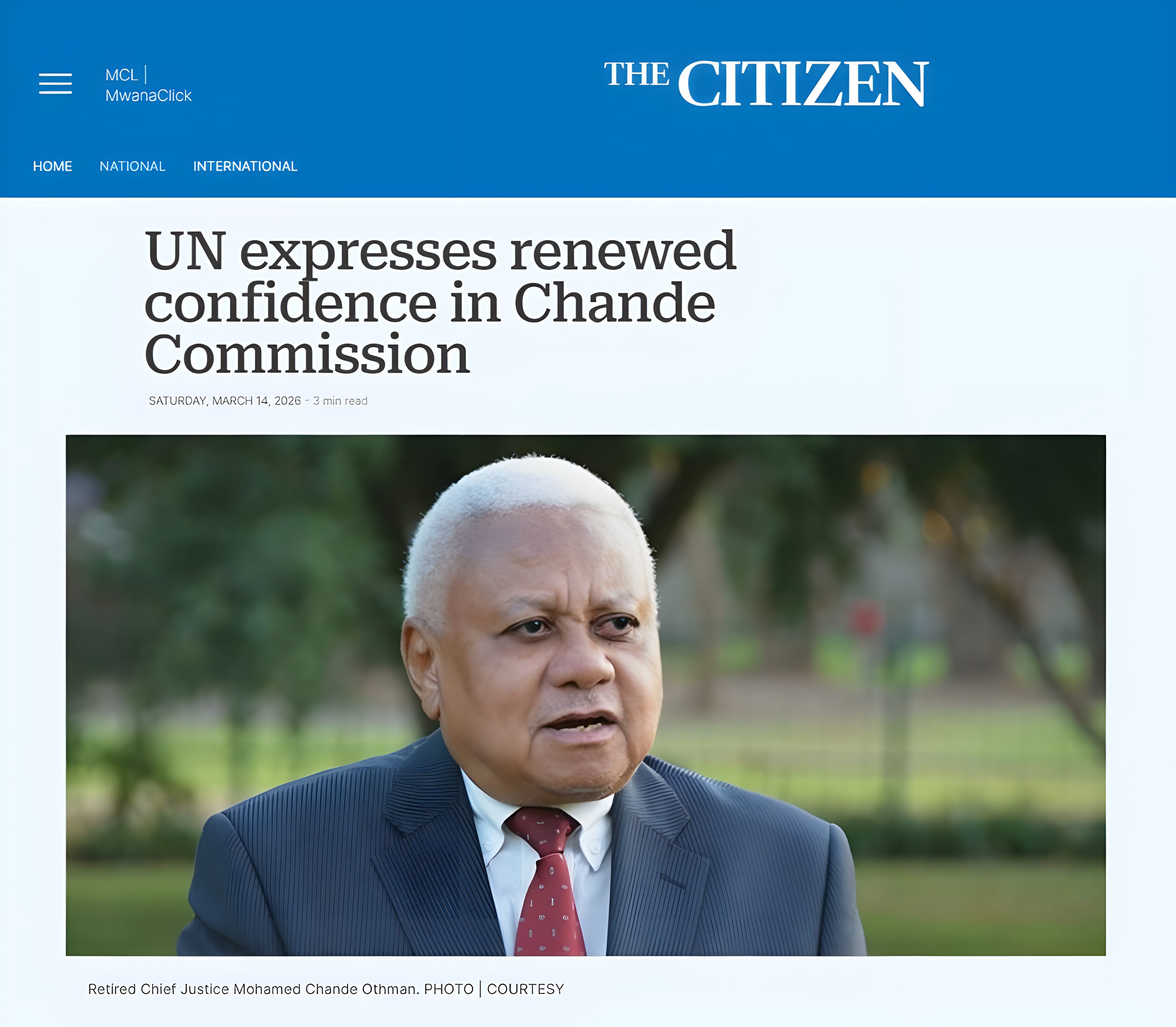
🔴 INTELLIGENCE BRIEF: Caught Lying — How Tanzania's The Citizen Manufactured a False UN Endorsement of the Chande Commission
Ujasusi Blog’s East Africa Monitoring Team | 15 March 2026 | 0220 GMT
🔴 INTELLIGENCE BRIEF: Tanzania’s The Citizen Published Disinformation About the UN and the Chande Commission — Here Is the Proof
The Citizen, a Dar es Salaam-based newspaper published by Mwananchi Communications Limited, published a 14 March 2026 article on the Chande Commission containing at least four demonstrably false or misleading claims: it fraudulently characterises Amnesty International and Human Rights Watch as having admitted their reports were “largely one-sided”; strips Volker Türk’s conditionality from his remarks; misrepresents Gina Romero’s mandate and role; and presents Zimbabwe as a credible human rights validator. The article is a state propaganda product dressed as journalism.
🧩 What Exactly Did The Citizen Publish?
Published on 14 March 2026 under the headline “UN expresses renewed confidence in Chande Commission,” The Citizen made the following core claims about proceedings at the margins of the 61st UNHRC session in Geneva:
That Gina Romero — a Colombian human rights activist, co-founder of REDLAD, the Latin American democracy network, and UN Special Rapporteur on the Rights to Freedom of Peaceful Assembly and of Association since April 2024 — “commended Tanzania for establishing an independent commission of inquiry,” calling it “a demonstration of the country’s commitment to human rights.”
That the commission “had earlier been praised” by Volker Türk — the Vienna-born international lawyer and career UN official who has served as the world’s most senior human rights authority at the UN rights oversight body since 2022 — at the UNHRC opening on 1 March 2026.
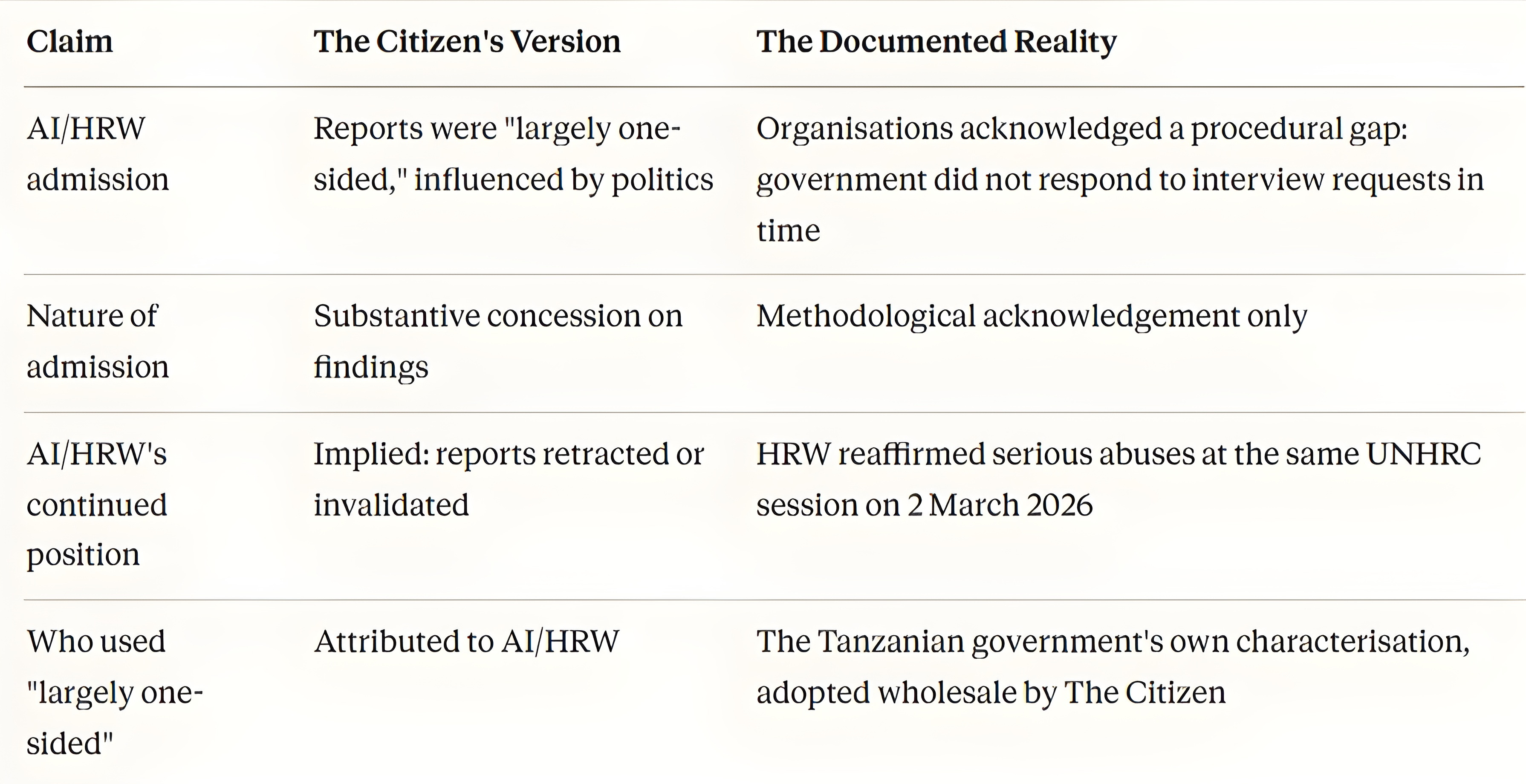
That Amnesty International (AI) and Human Rights Watch (HRW) “acknowledged that their reports on the October 29 incidents last year were largely one-sided.”
That Zimbabwe’s delegation “questioned the professionalism and impartiality” of AI and HRW, validating the Tanzanian government’s position.
That the reports by AI and HRW “appeared to have been influenced by political considerations.”
Each of these claims contains, in varying degrees, a material misrepresentation of the record. The most serious — the AI/HRW “admission” claim — is an outright fabrication in the form in which The Citizen presented it.
❌ LIE #1: Did AI and HRW Admit Their Reports Were “Largely One-Sided”?
No. This is the central lie in The Citizen’s article.
The side event on the margins of the 61st UNHRC session, held on 12 March 2026 and titled “Truth and Accountability in the Events of Tanzania’s 2025 General Election,” was organised by HRW and AI themselves. The session was moderated by Lucy McKernan, Deputy Director of Human Rights Watch at the UN Office in Geneva. Presenters included Oryem Nyeko (Senior Africa Researcher, HRW), Sikula Oniala (Amnesty researcher), and Tito Magoti, a lawyer at the Centre for Strategic Litigation, a Zanzibar-based public interest law organisation.
What the organisations acknowledged, in the discussions that followed the presentations, was that their reports on the October 2025 elections in Tanzania did not fully capture all relevant perspectives — in particular, they did not sufficiently reflect the views and responses of the Tanzanian government and its institutions. The reason for that gap is directly documented: although letters requesting interviews had been sent, responses were delayed and the reports were therefore prepared and released without fully incorporating the government’s perspective.
The Tanzanian government did not respond to interview requests in time. The organisations published their findings. They acknowledged this created an asymmetry. That is categorically different from admitting the reports were “largely one-sided” or that their findings were politically motivated.
The phrase “largely one-sided” does not appear in any statement made by AI or HRW. It appears in The Citizen’s reporting — and in the Tanzanian government’s own characterisation. The Citizen has attributed the government’s spin to the organisations themselves, which is a fabrication.
The substantive findings of AI and HRW remain intact and unretraced. Delivered on 2 March 2026 at the same UNHRC session, HRW’s oral statement to the Council stated that Tanzania’s October 2025 elections were marred by serious law enforcement abuses and nationwide internet restrictions, preceded by an intensified clampdown on free expression and association, with government critics facing arbitrary arrests, violent attacks, enforced disappearances, and extrajudicial killings. That is not the language of an organisation that has conceded its prior work was biased.
❌ LIE #2: What Did Volker Türk Actually Say?
The Citizen states the Chande Commission “had been praised” by Türk. The actual record is considerably more conditional.
Türk’s precise words at the 61st UNHRC session, delivered on 1 March 2026, were: “In a welcome development, Tanzania established a national commission to investigate violations that took place around the elections in October.” “A welcome development” regarding the establishment of an investigative body is not the same as expressing confidence in the commission’s independence, impartiality, or likely outcome. UN bodies overseeing truth and accountability mechanisms routinely acknowledge the establishment of national commissions as a procedural step while separately pressing for those commissions to meet international standards of independence.
The headline — “UN expresses renewed confidence in Chande Commission” — fabricates a level of institutional endorsement that Türk’s words do not carry. “Renewed confidence” implies Türk has assessed the commission’s conduct and found it credible. No such assessment is on record. Türk noted the establishment of the commission as a welcome development while simultaneously maintaining OHCHR engagement with a situation in Tanzania that AI, HRW, and civil society groups in a December 2025 joint submission have characterised as a human rights emergency.
❌ LIE #3: What Is Gina Romero’s Actual Mandate — And What Did She Actually Do?
The Citizen presents Romero as delivering a sweeping endorsement of the Chande Commission as evidence of Tanzania’s “commitment to human rights.” This is misleading on two levels: her mandate, and her actual role at the event.
As UN Special Rapporteur on the Rights to Freedom of Peaceful Assembly and of Association, Romero carries a mandate specifically structured around protecting civic space, the right to protest, and freedom of association. It is not a mandate for endorsing government-established commissions. An independent expert operating under this mandate would normally be expected to scrutinise the post-election security crackdown — not to act as a character witness for the commission established by the government that conducted that suppression.
Romero’s actual intervention at the side event was to explain that several methodological approaches were used in compiling the findings, including interviews and reviews of existing reports before the conclusions were published. She was explaining the methodology behind the presentations, not delivering an endorsement of the Chande Commission as an institution. The Citizen converts a methodological observation by a thematic rapporteur into a blanket institutional endorsement. These are not the same thing.
Furthermore, Romero’s own publicly visible professional activity confirms she participated in a side event focused specifically on human rights concerns in Tanzania — not on validating the government’s domestic accountability mechanisms.
❌ LIE #4: Is Zimbabwe a Credible Human Rights Validator?
The Citizen cites Zimbabwe’s UNHRC delegation as having “questioned the professionalism and impartiality” of AI and HRW, presenting this as external validation of Tanzania’s position. This is analytically worthless and editorially dishonest.
Zimbabwe is a state whose 2026 human rights record documents systematic violations including suppression of peaceful assembly, enforced disappearances, and political persecution. In 2025 alone, Zimbabwe’s government continued its crackdown on dissent, with authorities intimidating, harassing, threatening, and arbitrarily arresting journalists, political opposition members, and civil society activists, while intensifying legislative restrictions on civic space and freedom of expression, association, and peaceful assembly.
Zimbabwe’s UNHRC interventions in solidarity with governments facing human rights scrutiny follow a well-established pattern of deflecting accountability at Geneva, designed to shield accused states rather than advance accountability. Presenting Zimbabwe as a credible assessor of AI and HRW’s methodology — without noting Zimbabwe’s own record or the geopolitical dynamics of UNHRC bloc politics — is not journalism. It is the incorporation of a regime’s talking points without attribution or critical context.
🔍 What Is the Verified Scale of Tanzania’s Post-Election Violence?
The Citizen’s article frames the October 2025 violence as “election-related unrest” and “incidents” — language that deliberately obscures the documented scale.
The SADC observer mission found that the 29 October 2025 elections fell short of the requirements of the SADC Principles and Guidelines Governing Democratic Elections and that voters could not express their democratic will. The African Union observer mission concluded that the elections did not comply with AU principles, normative frameworks, and other international obligations and standards for democratic elections.
Amnesty International documented that Tanzanian police, security forces, and individuals in plain clothes assaulted, tear-gassed, and arbitrarily arrested people, including children, leading to hundreds being charged with treason. Excessive and lethal force, including live ammunition, was used to disperse protests. In some cases, victims were shot in the back or in the head despite posing no threat to public order, with further reports of enforced disappearances and of security forces removing bodies from streets and hospitals and taking them to undisclosed locations.
Based on the ICC/Intelwatch dossier compiled for the International Criminal Court accountability track on Tanzania, approximately 10,000 people were killed in the post-election crackdown. The Citizen has produced articles throughout this period that systematically minimise that toll.
🧠 What Is the Intelligence Assessment of The Citizen’s Article?
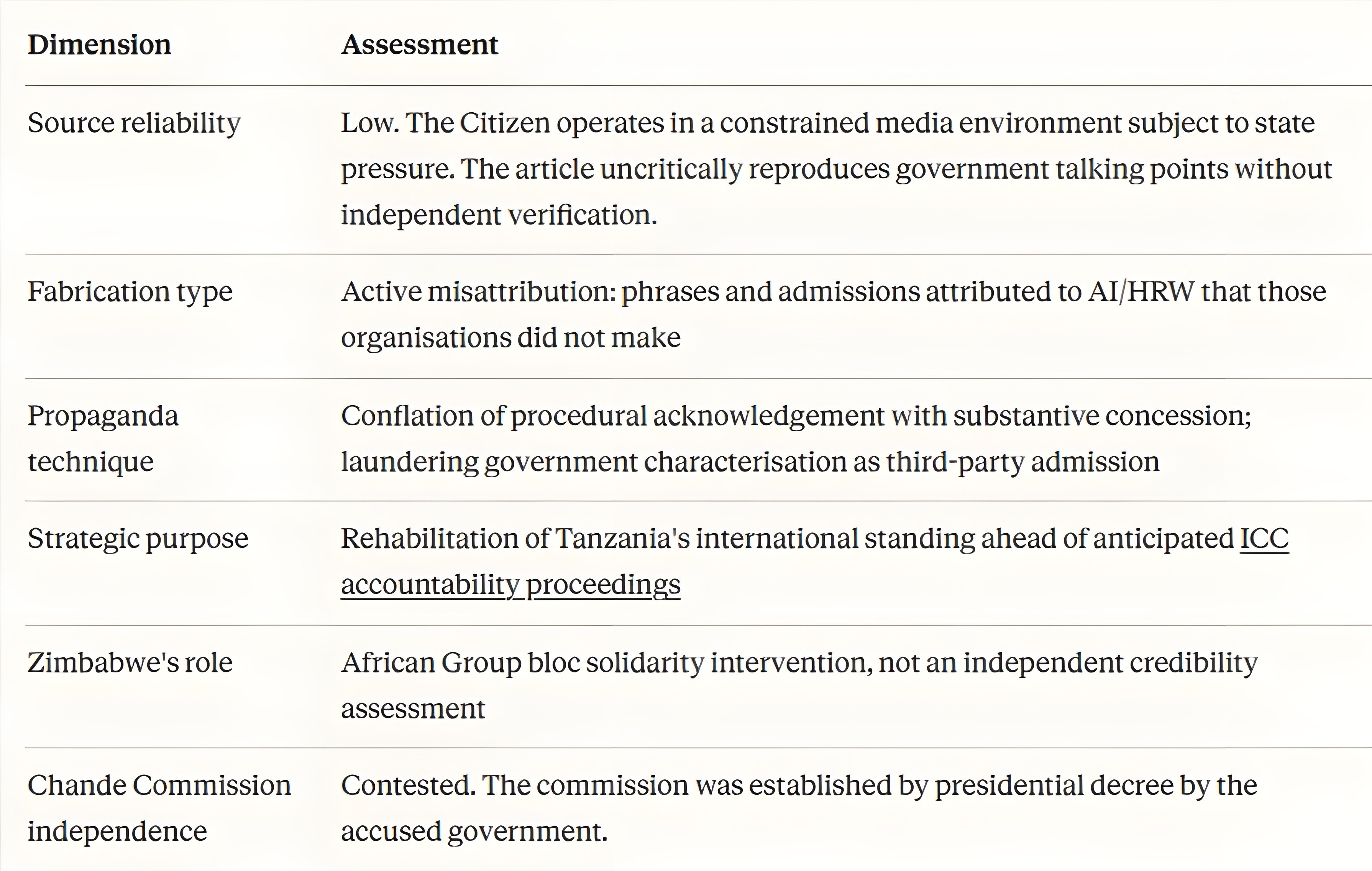
The article follows a consistent pattern observable across MCL’s Tanzania-focused publications since October 2025: minimising the scale of state violence, rehabilitating President Samia Suluhu Hassan’s international reputation, and pre-empting ICC accountability by constructing a documentary record of “domestic remedies.”
📌 What Is the Authoritative Account of the UNHRC Proceedings on Tanzania?
The factual record, drawn from primary sources including OHCHR’s official documentation, HRW’s March 2026 oral statement, a December 2025 joint briefing by Amnesty International and partner organisations, SADC and AU observer mission reports, and UN Web TV records of the 61st UNHRC session, establishes the following:
AI and HRW did not admit their reports were “largely one-sided.” They acknowledged a procedural gap created by the Tanzanian government’s failure to respond to interview requests in time. The substance of their findings — extrajudicial killings, enforced disappearances, use of live ammunition on protesters — has not been retracted.
Volker Türk described the commission’s establishment as “a welcome development,” not as a validation of Tanzania’s human rights record. Conditional acknowledgement of a procedural step is not institutional confidence.
Gina Romero’s role at the side event was to explain methodology, not to endorse the commission. Her mandate on freedom of peaceful assembly and association is directly relevant to the suppression of the October 2025 protests — not to commending the government that ordered it.
Zimbabwe’s UNHRC interventions carry no independent credibility on human rights assessments. Zimbabwe is itself subject to ongoing AI and HRW documentation of serious violations.
The scale of Tanzania’s post-election violence is approximately 10,000 killed, per the ICC/Intelwatch dossier — a figure The Citizen’s coverage has systematically suppressed.
The Chande Commission’s structural independence is contested, as it was established by presidential decree and reports to the accused government, regardless of the personal integrity of its chair.
The Citizen’s article is, in analytical terms, a state propaganda operation using journalistic form to launder government talking points into the international information environment. It should be treated as primary source material on Tanzanian government messaging strategy, not as a factual account of UNHRC proceedings.
Independent intelligence analysis takes time and resources — if this work matters to you, please consider supporting it by donating HERE
🔴 INTELLIGENCE BRIEF: Tanzania’s The Citizen Published Disinformation About the UN and the Chande Commission — Here Is the Proof
The Citizen, a Dar es Salaam-based newspaper published by Mwananchi Communications Limited, published a 14 March 2026 article on the Chande Commission containing at least four demonstrably false or misleading claims: it fraudulently characterises Amnesty International and Human Rights Watch as having admitted their reports were “largely one-sided”; strips Volker Türk’s conditionality from his remarks; misrepresents Gina Romero’s mandate and role; and presents Zimbabwe as a credible human rights validator. The article is a state propaganda product dressed as journalism.
🧩 What Exactly Did The Citizen Publish?
Published on 14 March 2026 under the headline “UN expresses renewed confidence in Chande Commission,” The Citizen made the following core claims about proceedings at the margins of the 61st UNHRC session in Geneva:
That Gina Romero — a Colombian human rights activist, co-founder of REDLAD, the Latin American democracy network, and UN Special Rapporteur on the Rights to Freedom of Peaceful Assembly and of Association since April 2024 — “commended Tanzania for establishing an independent commission of inquiry,” calling it “a demonstration of the country’s commitment to human rights.”
That the commission “had earlier been praised” by Volker Türk — the Vienna-born international lawyer and career UN official who has served as the world’s most senior human rights authority at the UN rights oversight body since 2022 — at the UNHRC opening on 1 March 2026.
That Amnesty International (AI) and Human Rights Watch (HRW) “acknowledged that their reports on the October 29 incidents last year were largely one-sided.”
That Zimbabwe’s delegation “questioned the professionalism and impartiality” of AI and HRW, validating the Tanzanian government’s position.
That the reports by AI and HRW “appeared to have been influenced by political considerations.”
Each of these claims contains, in varying degrees, a material misrepresentation of the record. The most serious — the AI/HRW “admission” claim — is an outright fabrication in the form in which The Citizen presented it.
❌ LIE #1: Did AI and HRW Admit Their Reports Were “Largely One-Sided”?
No. This is the central lie in The Citizen’s article.
The side event on the margins of the 61st UNHRC session, held on 12 March 2026 and titled “Truth and Accountability in the Events of Tanzania’s 2025 General Election,” was organised by HRW and AI themselves. The session was moderated by Lucy McKernan, Deputy Director of Human Rights Watch at the UN Office in Geneva. Presenters included Oryem Nyeko (Senior Africa Researcher, HRW), Sikula Oniala (Amnesty researcher), and Tito Magoti, a lawyer at the Centre for Strategic Litigation, a Zanzibar-based public interest law organisation.
What the organisations acknowledged, in the discussions that followed the presentations, was that their reports on the October 2025 elections in Tanzania did not fully capture all relevant perspectives — in particular, they did not sufficiently reflect the views and responses of the Tanzanian government and its institutions. The reason for that gap is directly documented: although letters requesting interviews had been sent, responses were delayed and the reports were therefore prepared and released without fully incorporating the government’s perspective.
The Tanzanian government did not respond to interview requests in time. The organisations published their findings. They acknowledged this created an asymmetry. That is categorically different from admitting the reports were “largely one-sided” or that their findings were politically motivated.
The phrase “largely one-sided” does not appear in any statement made by AI or HRW. It appears in The Citizen’s reporting — and in the Tanzanian government’s own characterisation. The Citizen has attributed the government’s spin to the organisations themselves, which is a fabrication.
The substantive findings of AI and HRW remain intact and unretraced. Delivered on 2 March 2026 at the same UNHRC session, HRW’s oral statement to the Council stated that Tanzania’s October 2025 elections were marred by serious law enforcement abuses and nationwide internet restrictions, preceded by an intensified clampdown on free expression and association, with government critics facing arbitrary arrests, violent attacks, enforced disappearances, and extrajudicial killings. That is not the language of an organisation that has conceded its prior work was biased.
❌ LIE #2: What Did Volker Türk Actually Say?
The Citizen states the Chande Commission “had been praised” by Türk. The actual record is considerably more conditional.
Türk’s precise words at the 61st UNHRC session, delivered on 1 March 2026, were: “In a welcome development, Tanzania established a national commission to investigate violations that took place around the elections in October.” “A welcome development” regarding the establishment of an investigative body is not the same as expressing confidence in the commission’s independence, impartiality, or likely outcome. UN bodies overseeing truth and accountability mechanisms routinely acknowledge the establishment of national commissions as a procedural step while separately pressing for those commissions to meet international standards of independence.
The headline — “UN expresses renewed confidence in Chande Commission” — fabricates a level of institutional endorsement that Türk’s words do not carry. “Renewed confidence” implies Türk has assessed the commission’s conduct and found it credible. No such assessment is on record. Türk noted the establishment of the commission as a welcome development while simultaneously maintaining OHCHR engagement with a situation in Tanzania that AI, HRW, and civil society groups in a December 2025 joint submission have characterised as a human rights emergency.
❌ LIE #3: What Is Gina Romero’s Actual Mandate — And What Did She Actually Do?
The Citizen presents Romero as delivering a sweeping endorsement of the Chande Commission as evidence of Tanzania’s “commitment to human rights.” This is misleading on two levels: her mandate, and her actual role at the event.
As UN Special Rapporteur on the Rights to Freedom of Peaceful Assembly and of Association, Romero carries a mandate specifically structured around protecting civic space, the right to protest, and freedom of association. It is not a mandate for endorsing government-established commissions. An independent expert operating under this mandate would normally be expected to scrutinise the post-election security crackdown — not to act as a character witness for the commission established by the government that conducted that suppression.
Romero’s actual intervention at the side event was to explain that several methodological approaches were used in compiling the findings, including interviews and reviews of existing reports before the conclusions were published. She was explaining the methodology behind the presentations, not delivering an endorsement of the Chande Commission as an institution. The Citizen converts a methodological observation by a thematic rapporteur into a blanket institutional endorsement. These are not the same thing.
Furthermore, Romero’s own publicly visible professional activity confirms she participated in a side event focused specifically on human rights concerns in Tanzania — not on validating the government’s domestic accountability mechanisms.
❌ LIE #4: Is Zimbabwe a Credible Human Rights Validator?
The Citizen cites Zimbabwe’s UNHRC delegation as having “questioned the professionalism and impartiality” of AI and HRW, presenting this as external validation of Tanzania’s position. This is analytically worthless and editorially dishonest.
Zimbabwe is a state whose 2026 human rights record documents systematic violations including suppression of peaceful assembly, enforced disappearances, and political persecution. In 2025 alone, Zimbabwe’s government continued its crackdown on dissent, with authorities intimidating, harassing, threatening, and arbitrarily arresting journalists, political opposition members, and civil society activists, while intensifying legislative restrictions on civic space and freedom of expression, association, and peaceful assembly.
Zimbabwe’s UNHRC interventions in solidarity with governments facing human rights scrutiny follow a well-established pattern of deflecting accountability at Geneva, designed to shield accused states rather than advance accountability. Presenting Zimbabwe as a credible assessor of AI and HRW’s methodology — without noting Zimbabwe’s own record or the geopolitical dynamics of UNHRC bloc politics — is not journalism. It is the incorporation of a regime’s talking points without attribution or critical context.
🔍 What Is the Verified Scale of Tanzania’s Post-Election Violence?
The Citizen’s article frames the October 2025 violence as “election-related unrest” and “incidents” — language that deliberately obscures the documented scale.
The SADC observer mission found that the 29 October 2025 elections fell short of the requirements of the SADC Principles and Guidelines Governing Democratic Elections and that voters could not express their democratic will. The African Union observer mission concluded that the elections did not comply with AU principles, normative frameworks, and other international obligations and standards for democratic elections.
Amnesty International documented that Tanzanian police, security forces, and individuals in plain clothes assaulted, tear-gassed, and arbitrarily arrested people, including children, leading to hundreds being charged with treason. Excessive and lethal force, including live ammunition, was used to disperse protests. In some cases, victims were shot in the back or in the head despite posing no threat to public order, with further reports of enforced disappearances and of security forces removing bodies from streets and hospitals and taking them to undisclosed locations.
Based on the ICC/Intelwatch dossier compiled for the International Criminal Court accountability track on Tanzania, approximately 10,000 people were killed in the post-election crackdown. The Citizen has produced articles throughout this period that systematically minimise that toll.
🧠 What Is the Intelligence Assessment of The Citizen’s Article?
The article follows a consistent pattern observable across MCL’s Tanzania-focused publications since October 2025: minimising the scale of state violence, rehabilitating President Samia Suluhu Hassan’s international reputation, and pre-empting ICC accountability by constructing a documentary record of “domestic remedies.”
📌 What Is the Authoritative Account of the UNHRC Proceedings on Tanzania?
The factual record, drawn from primary sources including OHCHR’s official documentation, HRW’s March 2026 oral statement, a December 2025 joint briefing by Amnesty International and partner organisations, SADC and AU observer mission reports, and UN Web TV records of the 61st UNHRC session, establishes the following:
AI and HRW did not admit their reports were “largely one-sided.” They acknowledged a procedural gap created by the Tanzanian government’s failure to respond to interview requests in time. The substance of their findings — extrajudicial killings, enforced disappearances, use of live ammunition on protesters — has not been retracted.
Volker Türk described the commission’s establishment as “a welcome development,” not as a validation of Tanzania’s human rights record. Conditional acknowledgement of a procedural step is not institutional confidence.
Gina Romero’s role at the side event was to explain methodology, not to endorse the commission. Her mandate on freedom of peaceful assembly and association is directly relevant to the suppression of the October 2025 protests — not to commending the government that ordered it.
Zimbabwe’s UNHRC interventions carry no independent credibility on human rights assessments. Zimbabwe is itself subject to ongoing AI and HRW documentation of serious violations.
The scale of Tanzania’s post-election violence is approximately 10,000 killed, per the ICC/Intelwatch dossier — a figure The Citizen’s coverage has systematically suppressed.
The Chande Commission’s structural independence is contested, as it was established by presidential decree and reports to the accused government, regardless of the personal integrity of its chair.
The Citizen’s article is, in analytical terms, a state propaganda operation using journalistic form to launder government talking points into the international information environment. It should be treated as primary source material on Tanzanian government messaging strategy, not as a factual account of UNHRC proceedings.
Independent intelligence analysis takes time and resources — if this work matters to you, please consider supporting it by donating HERE


