
Ujasusi Blog’s East Africa Monitoring Team | 03 Dec 2026 | 0215 GMT
In Brief
Anti-Samia Suluhu Hassan street protests in Tanzania experienced severe declining turnout following the October 29 massacre, with subsequent mobilisation attempts on December 9 and 25, 2025, and January 1, 2026 producing minimal participation. This decline stemmed from systematic state repression killing 5,000-10,000 civilians over three days, strategic deplatforming of key mobiliser Mange Kimambi, infiltration by Tanzania Intelligence and Security Service (TISS), organisational fragmentation, and tactical missteps. However, resistance efforts continue through alternative strategies including social boycotts and civil disobedience campaigns.
Table of Contents
What Factors Drove the Decline in Street Protest Participation After October 29?
State Violence as Deterrent: The October 29 Massacre
Strategic Deplatforming: The Mange Kimambi Case Study
Infiltration and Intelligence Operations
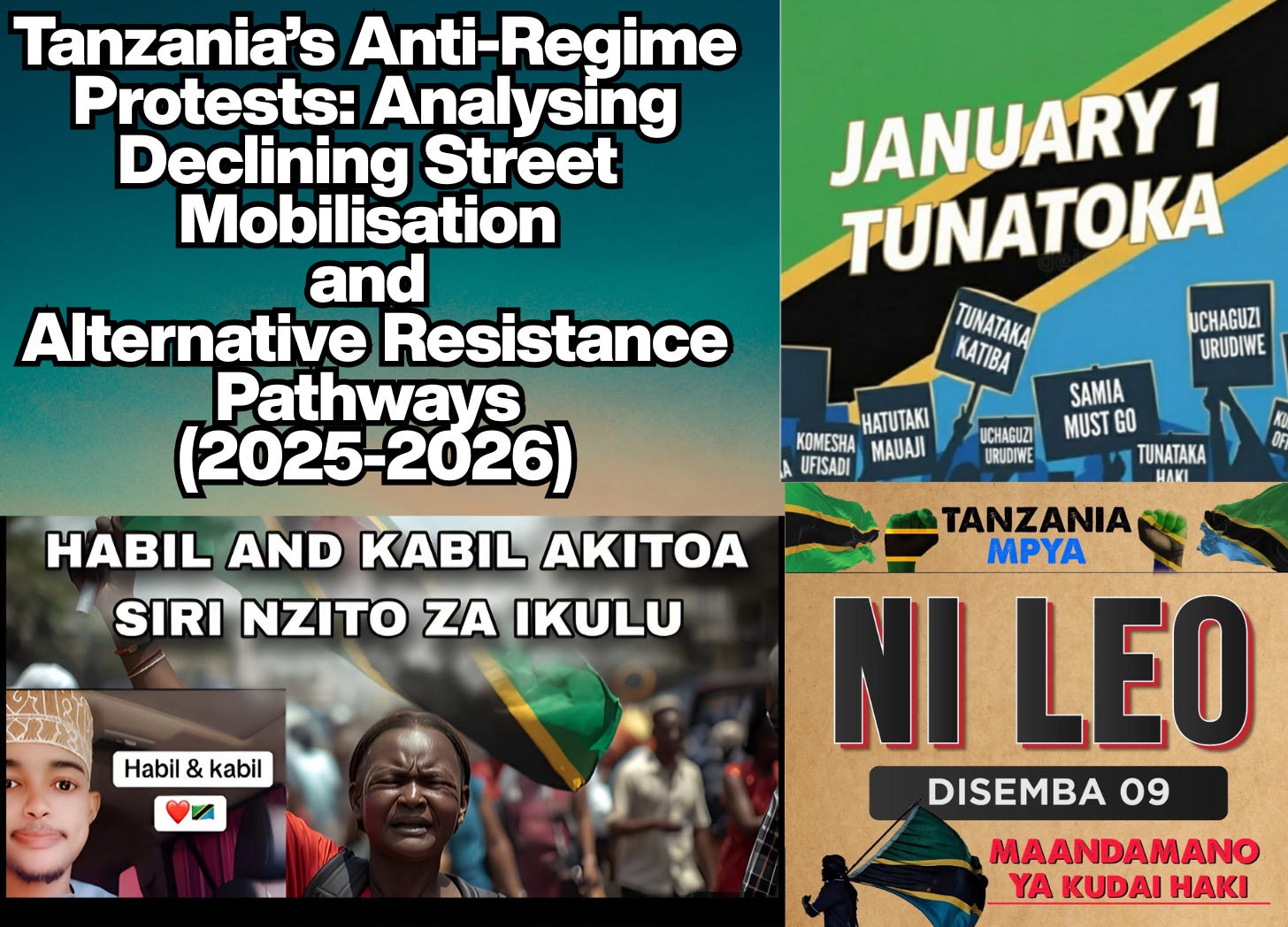
The “Habil and Kabil” Deception Operation
Strategic Timing Failures
Organisational Fragmentation and Leadership Competition
How Do Tanzania’s Protests Compare to Successful Resistance Movements?
Table 1: Comparative Analysis of Resistance Movement Characteristics
Table 2: Comparison of Habil and Kabil vs. Mange Kimambi
What Alternative Resistance Strategies Could Be Effective Against the Samia Regime?
Strategy 1: Social and Economic Boycott (The Zanzibar Model)
Strategy 2: Nonviolent Non-Cooperation (The Otpor Model)
Strategy 3: Economic Pressure Through Strategic Strikes
Strategy 4: International Pressure Amplification
Strategy 5: Alternative Institution Building
What Strategic Principles Should Guide Future Resistance Efforts?
Why Did December 9, 2025 Protests Produce Limited Turnout?
Table 3: December 9 Suppression vs. Mobilisation Assessment
What Lessons Emerge from the Habil and Kabil Deception?
Intelligence Assessment Summary
Comparative Tradecraft Examples
Operational Security Lessons
Medium-Term Outlook: Will Future Protests Succeed?
Table 4: Future Protest Viability Assessment
🔍 What Factors Drove the Decline in Street Protest Participation After October 29?
The dramatic reduction in street protest turnout following Tanzania’s historic October 29, 2025 demonstrations illustrates how authoritarian regimes systematically suppress civil resistance through coordinated repression, technological control, and psychological warfare. Understanding these factors is essential for developing adaptive resistance strategies.
1. State Violence as Deterrent: The October 29 Massacre
The October 29 protests marked what The Economist termed “terror on an unprecedented scale” for Tanzania, with security forces deploying live ammunition against unarmed civilians across Dar es Salaam, Arusha, and Mwanza. This violence fundamentally altered the risk-benefit calculation for potential protesters.
Documented casualties:
ICC submissions document 5,000-10,000 people killed over three days following election protests
Intelwatch alleges security forces used live ammunition rather than standard crowd control
Evidence of targeted executions including sniper attacks from significant distances
UN Human Rights Office confirmed hundreds killed with thousands likely unaccounted for
At least 240 people charged with treason in connection with protests
Over 2,000 detained according to multiple sources
Evidence of systematic violence:
CNN investigations documented satellite imagery showing mass burial sites north of Dar es Salaam
Video footage showed police shooting civilians who posed no immediate threat
Security forces transported bodies to undisclosed locations, preventing families from claiming remains
One morgue alone reportedly containing 800 bodies
Medical professionals threatened with death if releasing casualty figures
Army Chief Jacob Mkunda publicly labelled protesters “criminals”
Psychological impact: Unlike October 29 when many Gen-Z protesters were unaware of the regime’s capacity for brutality, subsequent potential demonstrators possessed full knowledge of the lethal consequences. This information asymmetry created what resistance scholars term “demonstration effect trauma”—where visible consequences of participation become so severe that rational actors prioritise survival over collective action.
2. Strategic Deplatforming: The Mange Kimambi Case Study
Mange Kimambi, known as “Dada wa Taifa” (Sister of the Nation), served as the primary mobiliser for October 29 protests, spending approximately three months encouraging youth participation through her Instagram platform with nearly three million followers. Her deplatforming by Meta on December 3, 2025 exemplifies authoritarian digital suppression strategies.
Timeline of suppression:
Pre-October 29: Kimambi spent three months mobilising via Instagram, setting protest date and encouraging peaceful participation
November-December: Shared graphic documentation of casualties, posting evidence of state violence
December 3, 2025: Meta permanently disabled her Instagram accounts (@mangekimambi80 and @wananchiforum) citing “recidivism policy” violations
Simultaneous action: Fellow activist Maria Sarungi-Tsehai’s account geo-restricted in Tanzania following legal order
Impact on mobilisation capacity:
Loss of nearly 3 million combined followers across platforms
Elimination of primary coordination channel for Gen-Z protesters
Disruption of real-time documentation of human rights abuses
Reduced ability to counter regime propaganda
Government response: Attorney General Hamza Johari publicly demanded Kimambi’s arrest and extradition from the United States, stating: “It is not acceptable for someone, a lady, to just be sitting outside the United Republic of Tanzania like that, and telling people to do this [protest], and they actually go and do it.”
3. Infiltration and Intelligence Operations
TISS collaboration with CCM’s Youth Wing (UVCCM) deployed sophisticated counter-mobilisation strategies:
Documented infiltration tactics:
Penetration of Gen-Z “virtual meetings” on TikTok and other platforms
Monitoring of opposition coordination channels
Deployment of informants within activist networks
Real-time intelligence gathering on protest planning
Counterintelligence implications: The leaderless structure of post-October protests, whilst theoretically offering resilience, created vulnerability to infiltration. Without centralised security protocols or vetting mechanisms, TISS operatives could easily join planning sessions, gather intelligence on participant identities, and disrupt coordination.
4. The “Habil and Kabil” Phenomenon
A suspicious character using the moniker “Habil and Kabil” engaged in what appears to be a sophisticated psychological operation ahead of December 9 protests.
ALSO READ

Promised deliverables (unfulfilled):
Claimed extraordinary hacking capabilities
Assured UN protection for December 9 protesters
Made multiple guarantees regarding international intervention
Built credibility through technical demonstrations
Promised technology to obtain biometric data by looking at people
Actual impact:
Thousands of would-be protesters remained home expecting promised protection
Undermined trust in future mobilisation efforts
Created disillusionment with resistance leadership
Potential PSYOP to fracture activist community
Intelligence assessment: The sophistication of this operation, combined with its timing and impact, suggests potential state involvement. Classic counterintelligence doctrine involves inflating expectations then failing to deliver, thereby discrediting leadership and creating activist fatigue.
Per Ujasusi Blog’s assessment: 70-80% probability of TISS psychological operation.
5. Strategic Timing Failures
Organisers scheduled three consecutive protests on public holidays—December 9 (Independence Day), December 25 (Christmas), and January 1 (New Year’s Day)—a tactical error with multiple negative consequences.
Why public holidays undermined mobilisation:
Reduced urban population density as residents travelled to rural areas
Families prioritised holiday observances over protest participation
Easier for regime to frame protests as disrespectful to national celebrations
Simplified security forces’ lockdown operations with fewer legitimate civilians on streets
Workers unable to use “general strike” tactics when businesses already closed
Alternative approach: Historical successful movements like Serbia’s Otpor and the US Civil Rights Movement strategically chose working days to maximise disruption to economic activity and demonstrate widespread participation across society.
ALSO READ

6. Organisational Fragmentation and Leadership Competition
The Tanzanian activist sphere suffered from endemic disunity, described as “they are all chasing same thief but each wants to be the first to apprehend the thief and they end up chasing each other.”
Manifestations of fragmentation:
Multiple competing voices claiming leadership after Kimambi’s deplatforming
Lack of coordinated strategy or unified messaging
Personal ambitions overriding collective objectives
Failure to establish transparent decision-making structures
Absence of shared tactical analysis or lessons-learned processes
Historical parallel: Tanzania’s opposition parties have long exhibited similar disunity. This activist fragmentation mirrors broader political opposition weaknesses that have enabled CCM’s six-decade dominance.
📊 How Do Tanzania’s Protests Compare to Successful Resistance Movements?