Ujasusi Blog’s Terrorism Monitor Desk | 22 July 2025 | 2240 BST
Executive Summary
The Islamic State West Africa Province (ISWAP) is experiencing a significant military and strategic resurgence in Northeast Nigeria and the Lake Chad Basin (LCB), marking its most potent phase since the 2016 Boko Haram split. This report synthesises field research, propaganda analysis, and security assessments to reveal:
300+ attacks recorded in Nigeria in Q1 2025 alone, resulting in 500+ deaths.
16 military bases overrun by ISWAP in Borno/Yobe states as of June 2025.
Tactical evolution including weaponised drones, coordinated night assaults, and foreign fighter integration.
Structural reorganisation into 4+ semi-autonomous Wilayat (provinces) enhancing operational reach.
Critical security gaps in Nigeria’s military response, exacerbated by regional coordination collapse after Niger’s withdrawal from the Multinational Joint Task Force (MNJTF).
This resurgence signals a strategic pivot by ISWAP to reclaim its status as ISIS’s premier African franchise, exploiting socioeconomic grievances, military weaknesses, and regional fractures. Without urgent, multidimensional countermeasures, ISWAP threatens to entrench violence across West Africa.
I. Evidence of Resurgence: Tactical Gains and Territorial Expansion
A. Escalating Violence and Civilian Targeting
300+ attacks in Nigeria in early 2025 (500+ fatalities), surpassing 2024 levels. JAS (Shekau faction) targets civilians for logistics; ISWAP focuses on security forces and "collaborators."
Brutal reprisals against civilians: Mass executions in Faduma Koloram (125 killed, June 2024) and Muri Mafa (86 killed, September 2024) exemplify ISWAP’s coercive governance. Civilians are punished for aiding security forces or violating ISWAP edicts (e.g., unauthorised fishing or tree-cutting).
B. Military Base Overruns: A Tactical Watershed
ISWAP has seized 16 Nigerian military bases in 2025, reflecting unprecedented tactical sophistication:
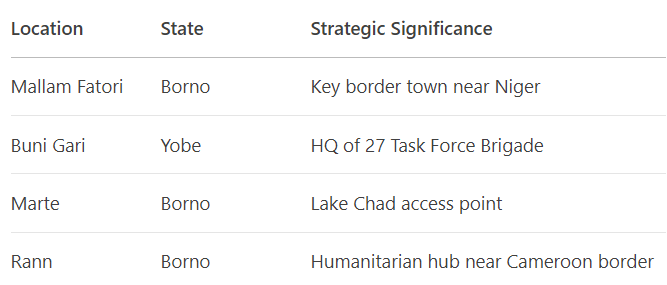
Coordinated night assaults: Elite units attack fortified positions (e.g., 27 Task Force Brigade in Buni Gari) using drones, real-time intelligence, and layered reinforcement strategies.
Looting of advanced hardware: MRAPs, APCs, and weapons captured, with destruction of key infrastructure (e.g., commander’s residence).
Cross-border operations: Attacks in Cameroon (Wulgo MNJTF outpost) and Niger demonstrate expanded reach.
Table: ISWAP’s Major Base Captures (2025)
C. Propaganda and Psychological Warfare
Amaq News Agency releases battlefield footage to showcase victories (e.g., seized ambulances, weapon caches).
Martyrdom narratives: Glorification of SVBIED operatives (e.g., Abu Rumaisa’s attack on Chadian forces, May 2024).
II. Drivers of Resurgence: Structure, Strategy, and External Support
A. Territorial Reorganisation and Command Restructuring
ISWAP has evolved into a decentralised network of Wilayat (provinces), enhancing agility:
Wilayat Buhaira (Kangar): Controls Lake Chad islands.
Wilayat Farouk (Timbuktu): Oversees Sambisa Forest—captured in 2024 to reduce logistics costs and expand into Cameroon/Adamawa.
Wilayat Krenowa: Manages central Borno operations.
Wilayat Shimali Nigeria: Expands ISWAP into NW/NC Nigeria (Kaduna, Kano, Niger states).
Leadership Hierarchy:
Abu Musab al-Barnawi: ISIS Head for West Africa/Sahel.
Ba Shuwa: Supervisory Wali (governor).
Ibrahim Mohammed Yusuf: Amir al-Jaish (military commander).
B. Tactical Innovation
Weaponised Drones: First insurgent group in West Africa to deploy armed drones (beyond surveillance).
SVBIEDs and IEDs: Suicide vehicles breach military bases; hidden explosives disrupt reinforcements.
Elite Night Units: 60-fighter teams attack with precision, backed by 15-minute reinforcement units.
C. External Support from ISIS
7+ ISIS Instructors (North African/Arab) provide training in:
Drone operations
IED fabrication
Sniper tactics and ideological indoctrination (e.g., child soldier camps).
Financial/Logistical Aid: Sustains procurement of motorcycles, weapons, and propaganda production.
D. Exploiting Security Vacuum
Niger’s MNJTF Withdrawal: Crippled cross-border operations, intelligence sharing, and patrols.
Military Underestimation: Nigerian forces assumed infighting (2022–2024) would decimate ISWAP/JAS. Instead, factions paused clashes to focus on the state.
III. Limits of Nigeria’s Military Response
A. Strategic Failures
Reactive Posture: Operations mirror insurgent tempo; initiatives slow when ISWAP pauses attacks.
Super Camp Flaws: Troop consolidation in fortified bases allows ISWAP to dominate peripheries (critiqued in ISIS’s January 2025 editorial).
Poor Intelligence: Limited grasp of ISWAP’s structure, recruitment, and ideological shifts.
B. Operational Weaknesses
Low Morale: Unmet welfare needs (e.g., stagnant meal quality despite allowance increases).
Logistical Breakdowns: MRAPs grounded by dead batteries; vehicles burned during attacks due to neglect.
Inexperienced Troops: Rapid deployment of recruits without asymmetric warfare training.
C. Problematic Civilian Relations
Forced IDP Returns: Relocations to insecure areas (e.g., Bama, Dikwa) expose civilians to JAS predation.
Distrust of Communities: Military suspects civilians aiding ISWAP if attacks spare them (e.g., post-Marte assault exodus to Dikwa).
IV. Regional Implications and Enabling Factors
A. Socioeconomic Grievances
Unemployment/Displacement: ISWAP recruits youth via financial incentives (e.g., fishing rights, stipends).
Failed Reintegration: Borno Model’s CVE efforts lack security backing, leaving returnees vulnerable.
B. ISIS Franchise Competition
Propaganda Pressure: ISWAP intensified attacks after being outperformed by ISIS Sahel (ISSP) and Central Africa (ISCAP) in late 2024.
Ideational Legitimacy: Al-Barnawi’s leadership (ex-ISIS executive) elevates ISWAP’s global standing.
C. Cross-Border Instability
LCB Security Collapse: Niger’s exit enables ISWAP/JAS to revive logistics routes into Cameroon/Chad.
Expansion Risk: Wilayat Shimali Nigeria signals ambitions beyond the northeast.
V. Policy Recommendations
A. Military and Intelligence Reform
Adaptive Training: Simulate ISWAP tactics (night ops, drones); deploy conflict analysts to frontline units.
Tech Investment: Counter-drone systems, encrypted comms, and aerial surveillance.
Morale/Logistics Boost: Enforce welfare oversight; streamline maintenance supply chains.
B. Regional Cooperation
Revitalise MNJTF: Diplomatic push for Niger’s return; joint cross-border patrols.
Intelligence Fusion: Real-time data sharing on foreign fighter movements and weapon smuggling.
C. Addressing Root Causes
Youth Investment: Vocational training, microgrants, and education in high-recruitment zones.
Voluntary IDP Returns: Link resettlement to verifiable security, not political deadlines.
D. Community Engagement
Local Governance: Integrate traditional/religious leaders in early-warning systems.
Reintegration Safeguards: Monitor ex-combatants; economic alternatives to prevent recidivism.
VI. Conclusion: The Imperative for Integrated Action
ISWAP’s resurgence is neither transient nor desperate. It reflects strategic recalibration backed by ISIS support, territorial consolidation, and exploitation of state failures. The group’s tactical innovations—drone warfare, decentralised command, and psychological operations—demand equally agile responses. Nigeria’s reactive military posture, eroded regional cooperation, and unaddressed grievances risk ceding momentum to ISWAP. A sustainable solution requires:
Decisive military modernisation focused on preemption.
Regional coalition-building to close security vacuums.
Investment in human security to undercut recruitment.
Without this triad, ISWAP will entrench itself as the de facto authority across the Lake Chad Basin, with ambitions stretching into Nigeria’s northwest and the Sahel.
Report Prepared By: Good Governance Africa Intelligence Unit
Source: Samuel, M. (2025). Unseen Advances, Quiet Offensives: ISWAP’s Strategic Resurgence and the Limits of Nigeria’s Military Response. Good Governance Africa
☕ Support Ujasusi Blog
If you value the intelligence insights shared here, consider showing your support through a small donation. Your contribution helps keep this platform independent, focused, and thriving.
Scan below to donate: