


Spy’s GuideReal | Intelligence Tradecraft — Explained and Applied to Everyday Life | Ujasusi Originals
You wake in the middle of the night to the smell of smoke. Do you stop to gather what you own, or wake everyone and run now? The river near your home is rising faster than anyone has seen before. Do you leave tonight, or risk one more night under your own roof? Your child is burning with fever at midnight and the nearest hospital is far away. Do you set out now, in the dark, or wait for morning? On a lonely road, a stranger offers to help you. Is he kindness or danger? You have three seconds to decide.
These are the cruellest decisions a human being ever faces, and they spare nobody: not in Los Angeles, not in Lagos, not in a Tanzanian village. No time, no full facts, and consequences that cannot be undone. Get it right and nobody ever knows there was a decision at all. Get it wrong and it is the last decision you make.
READ ALSO
Introducing “A Spy’s Guide to Deception” — The First in the Spy Guide Series

Intelligence work is built on deception. Every service that has ever run an agent, mounted a cover operation, or manufactured a false narrative has done so through principles that remain largely invisible to the public. Not because they are secret, but because no one has taken the time to explain them plainly.
Spies live inside this problem as a profession. An intelligence officer almost never has the full picture. Information is missing, outdated, or deliberately false, and yet operations get launched, sources get trusted or abandoned, and people live or die by the call. Over decades, intelligence services have built a practical toolkit for deciding well when the facts are incomplete and the stakes are absolute.
The good news: you do not need any spy training to use it. And the same toolkit that works at 2 a.m. with the alarm screaming also works on life’s slower leaps, the job you are afraid to take, the business you keep postponing, the relationship you cannot decide about. This guide breaks it down into ten simple habits, with real cases from the 2000s and clear instructions for using each one in ordinary life.
🧠 1. Stop Waiting to Be Sure. You Never Will Be

What it means in intelligence
The single most famous intelligence decision of this century proves the point. In 2011, the CIA believed Osama bin Laden might be hiding in a compound in Abbottabad, Pakistan. Notice the word might. When President Obama asked his advisers how confident they were, the answers ranged from roughly 40 per cent to 95 per cent. Nobody could say for certain. Obama later admitted the final call felt close to a coin flip. He ordered the raid anyway, because he understood something every intelligence professional learns early: certainty was never coming. The job of intelligence is to shrink doubt, not to erase it. Erasing it is impossible.
How it works
Spies treat uncertainty as normal, not as a reason to freeze
They identify the decision that must be made whether or not the facts improve
They notice when “we need more information” has quietly become an excuse
They accept that some questions can only be answered by acting
Civilian application
Think about a decision you have been “researching” for months. The job change, the move, the business idea. Be honest: at some point the research stopped teaching you anything new. You were no longer gathering facts. You were hiding in them.
Try this:
Ask yourself: would one more piece of information actually change my decision?
Set a deadline. On that date, you decide with whatever you know.
Accept that for some questions, doing the thing is the only way to learn the answer.
👉 Waiting for certainty feels responsible. Usually it is just fear wearing a suit.
🔍 2. Do the Cheap Homework First, Then Jump

What it means in intelligence
A leap of faith only deserves the name after the easy checks are done. Before the bin Laden raid, the CIA spent months on low-risk homework: satellite photos, a rented house nearby to watch the compound, careful study of a tall man who walked the courtyard daily (analysts nicknamed him “the pacer”). Only when every safe method was exhausted, and spying any harder risked tipping off the target, did the leap become necessary.
Now the painful opposite example. In 2009, the CIA believed a Jordanian doctor named Humam al-Balawi could lead them to al-Qaeda’s top leadership. He seemed so valuable that basic checks were skipped. He was invited onto a CIA base in Khost, Afghanistan, without being properly searched or vetted (vetting simply means background checking a person before you rely on them). He was a double agent wearing a bomb. Seven CIA officers died. The leap was taken before the homework.
How it works
Exhaust the free and low-risk information first
Write down exactly what you still do not know
Ask whether that gap can be closed at all, or only by acting
Jump across the small remaining gap, never the whole canyon
Civilian application
Before quitting your job to start a business, you can talk to people already in that business, test the idea on weekends, and study the market for free. Skipping that homework is not bravery. It is the civilian version of Khost.
Try this:
Give yourself a fixed period, say two weeks, to gather what is freely available.
List what you still do not know and mark which gaps are simply unknowable.
Only then decide. The leap should cover the unknowable part, nothing more.
👉 Shrink the leap before you take it.
READ ALSO: A Spy’s Guide to Studying — January 25, 2025
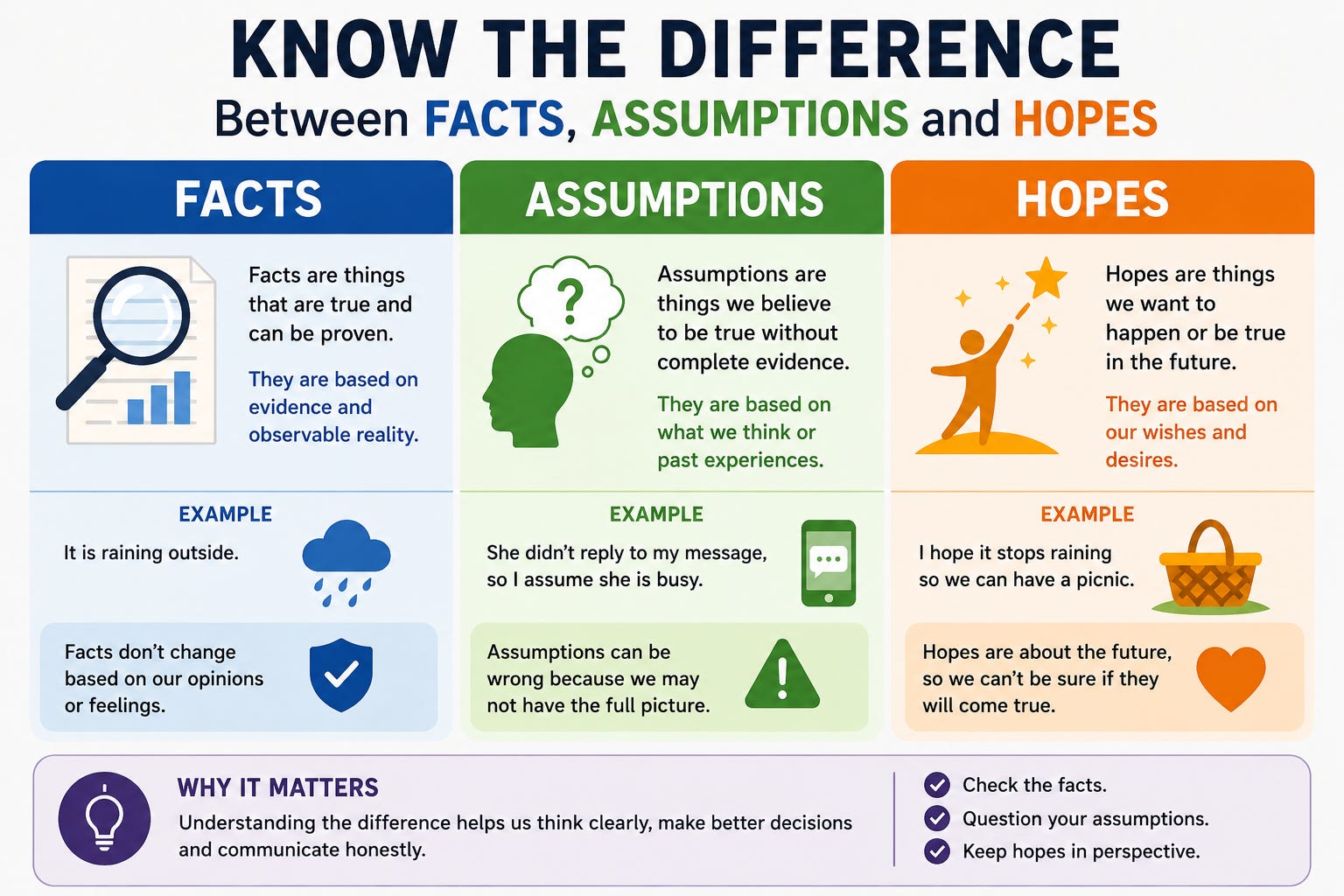
🧩 3. Know the Difference Between Facts, Assumptions and Hopes
What it means in intelligence
The most dangerous thing in any decision is an assumption that has quietly started behaving like a fact. Intelligence history’s most expensive lesson here came in 2002 and 2003. Much of the case that Iraq had mobile biological weapons labs rested heavily on a single Iraqi defector codenamed “Curveball”. His claims were never properly verified, yet they travelled up the chain and hardened into “intelligence”. After the invasion, the labs did not exist, and Curveball later admitted he had lied. An entire war’s justification partly rested on an assumption dressed up as a fact.
Agencies now use a simple exercise called a key assumptions check. It just means listing every belief your decision depends on, then asking of each one: what is my actual evidence, and how would I know if this were wrong?
How it works
List every belief your plan secretly depends on
For each one, demand the evidence
Flag anything you believe only because you have always believed it, or because you want it to be true
If a key assumption dies, re-examine the whole decision
Civilian application
“Property prices always go up.” “My company would never lay me off.” “He will change after the wedding.” Most disastrous personal decisions are carried by one unexamined assumption doing all the heavy lifting.
Try this:
Before any big decision, draw three columns: I know this, I assume this, I hope this.
Be brutal about which column each item really belongs in.
Then ask: if my biggest assumption is wrong, does my plan survive?
👉 A leap built on an unchecked assumption is not faith. It is carelessness with better branding.
⏱️ 4. Remember That Waiting Has a Price Too

What it means in intelligence
Opportunities in intelligence rot quickly. Targets move, sources lose access, secrets leak. In the final weeks before the Abbottabad raid, one of the strongest arguments for acting was not new evidence at all. It was that too many people now knew. Every day of delay increased the risk of a leak that would let bin Laden vanish again, possibly for good. The same logic drove the 2019 raid on ISIS leader Abu Bakr al-Baghdadi: once his location was fixed, the window was treated as perishable, because such windows always are.
Spies are trained to see inaction as a decision in itself, with its own risks and its own price tag. Civilians rarely are.
How it works
Treat “do nothing” as an option with costs, not as a neutral default
Ask whether the opportunity is stable or decaying
Estimate what each week of delay actually costs
Move fast when the window is closing, and slow down only when it is not
Civilian application
People calculate the risks of acting with great care, then assign a risk of exactly zero to waiting. Meanwhile the job market shifts, the house gets sold to someone else, the friendship drifts beyond repair, and the health problem grows while the spreadsheet gets perfected.
Try this:
For any decision you are postponing, write down what the delay is costing you.
Sort your decisions into two piles: those that age well and those that rot.
Replace “I’ll decide later” with the honest version: “I have decided to pay the price of waiting.”
👉 Doing nothing is also a decision. Usually it is the one nobody examined.
READ ALSO: Spy Guide to Counter-surveillance Recognition — December 20, 2024
📊 5. Think in Percentages, Not in Yes or No
What it means in intelligence
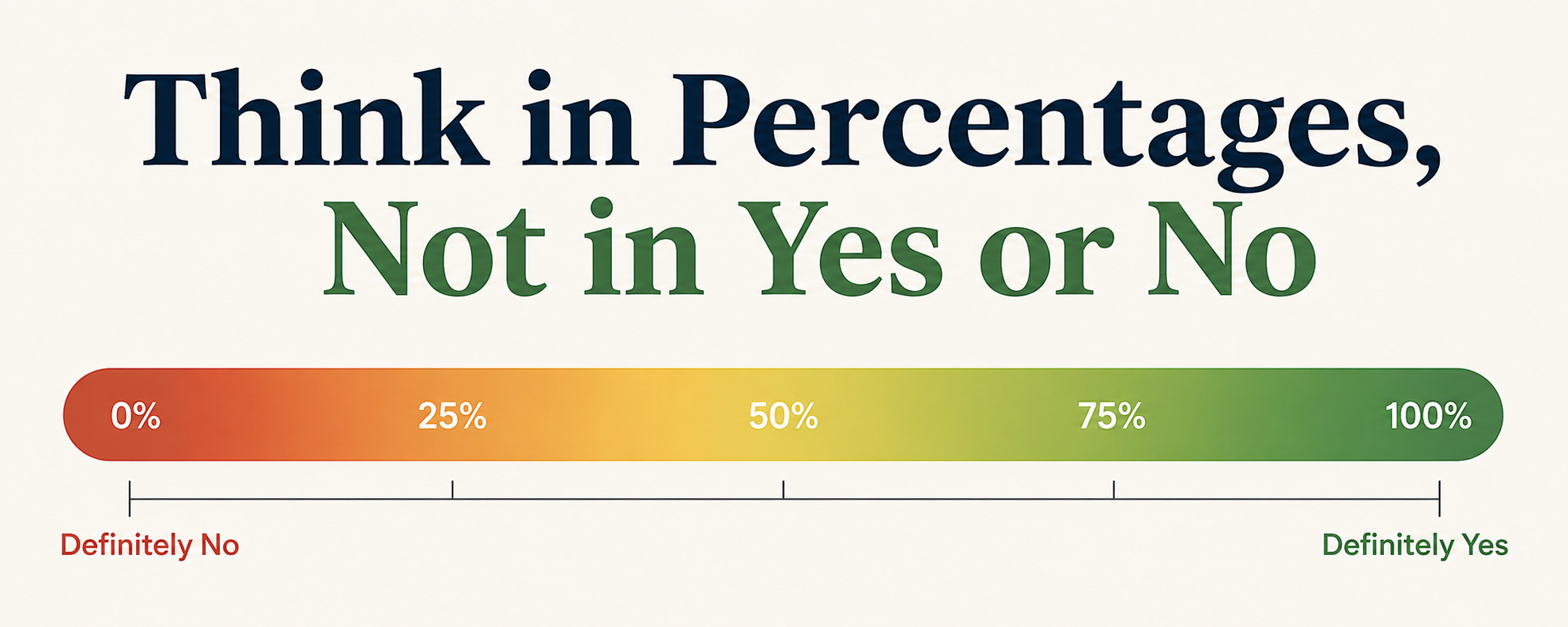
Professional analysts are forbidden from saying “this will happen.” They say things like “we assess with moderate confidence,” and they attach rough percentages to their judgements. A confidence level is simply an honest label for how sure you are. In the bin Laden case, the CIA even ran what is called a red team: a separate group of analysts ordered to attack the conclusion and argue the man in the compound was not bin Laden. The point was never to reach 100 per cent. It was to know, honestly, whether they were at 50 or at 80, because those two numbers justify very different actions.
How it works
Express every important judgement as a rough percentage
Be honest about how strong the evidence behind it is
Update the number when new information arrives
Match the size of the bet to the size of the number
Civilian application
Most people think in absolutes: this business will work, this relationship is forever, this investment is safe. Poker players and weather forecasters know better, and so do spies. A decision you are 70 per cent sure of deserves a smaller stake than one you are 95 per cent sure of. That single habit, sizing your commitment to your confidence, quietly improves almost every decision you make.
Try this:
Replace “I think it will work” with an actual number: “I’d say 70 per cent.”
Bet smaller on coin flips and bigger on near-certainties.
Write your predictions down and check them later. You will learn how honest your percentages are.
👉 The question is never “am I sure?” It is “how sure, and is that sure enough for what I’m risking?”
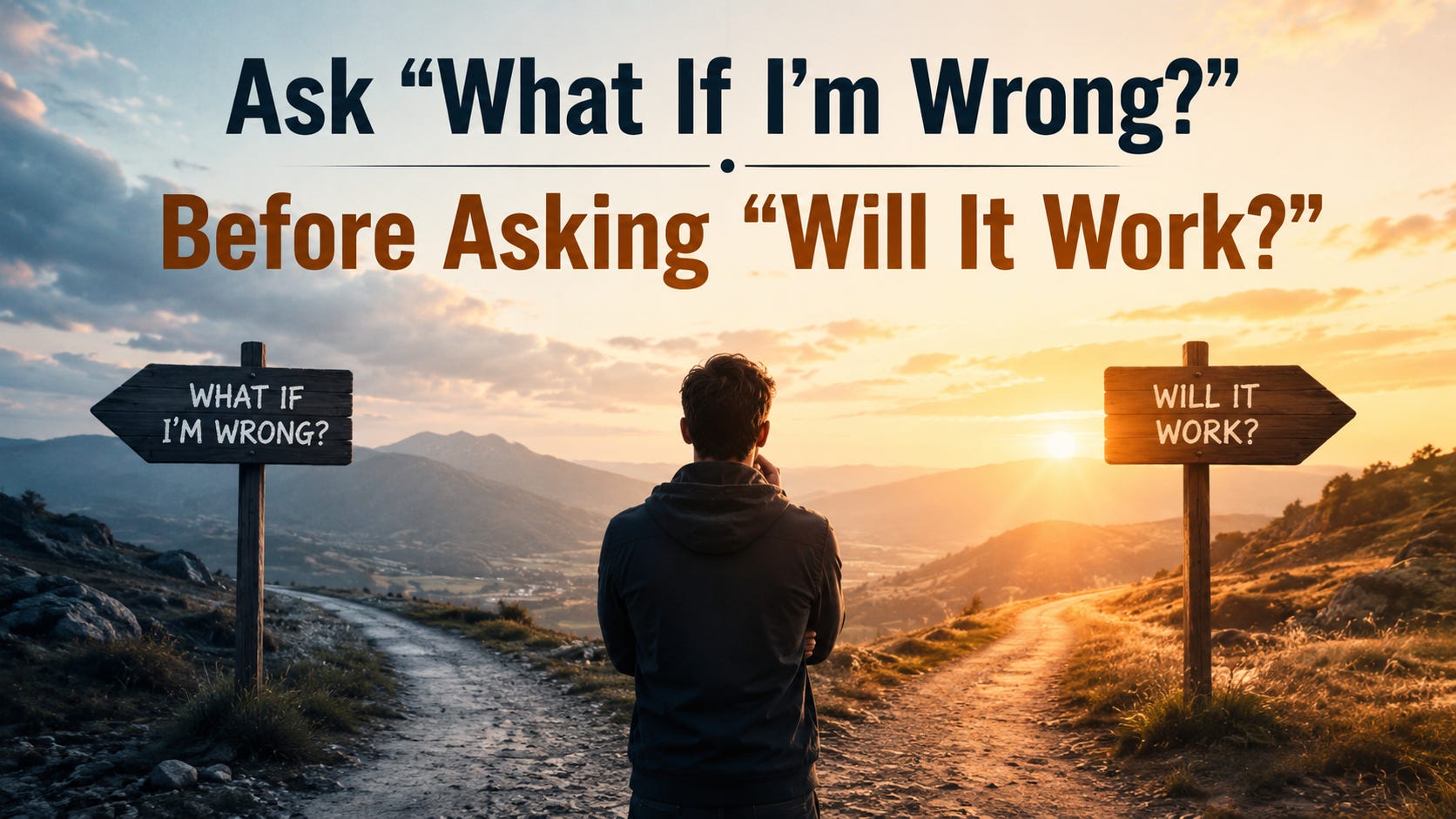
⚖️ 6. Ask “What If I’m Wrong?” Before Asking “Will It Work?”
What it means in intelligence
Probability is only half the calculation. The other half is consequence: what actually happens if this fails, and can I survive it? The Abbottabad planning shows this beautifully. The safest option for American personnel was simply to bomb the compound from the air. No US soldier would be at risk. But if the intelligence was wrong, they would have killed innocent civilians in a friendly country with no proof and no way of ever knowing the truth. The helicopter raid was more dangerous to execute, but its failure modes were survivable and it offered proof either way. The riskier-looking option was actually the smarter bet, because of the shape of the consequences, not the odds.
How it works
Map the full range of outcomes, not just success and failure
Weigh probability and consequence together
Refuse good-odds bets whose worst case would destroy you
Accept poor-odds bets whose worst case is trivial and whose upside is large
Civilian application
People decline small survivable risks with huge upsides, like applying for a job they feel underqualified for or publishing their work, while accepting enormous unsurvivable ones, like putting all their savings into a single asset, because they confuse “likely” with “safe”.
Try this:
For any leap, write down the realistic worst case in one sentence.
Ask the only question that matters: can I absorb that and keep going?
If yes, and the upside is meaningful, the odds matter far less than you think.
Never take a bet you cannot afford to lose, no matter how likely it is to win.
👉 Smart leaps are chosen by the shape of the bet, not the size of the odds.
🚪 7. Build Yourself an Exit Before You Jump

What it means in intelligence
Well-planned operations are full of exits. Planners build in what are called abort criteria: specific, agreed-in-advance conditions under which everyone turns around and goes home. The bin Laden raid had them at multiple stages. The helicopters could turn back. The teams could withdraw. A quick reaction force waited nearby in case everything went wrong. Commitment became truly final only at the very last moment, and the planners knew exactly where that moment was.
The lesson is that the point of no return almost always comes later than it feels. Amateurs treat the first step as the final one. Professionals know most steps can still be reversed, and they plan accordingly.
How it works
Find the genuine point of no return, which is usually later than you think
Decide in advance what evidence would make you turn back
Commit resources in stages rather than all at once
Keep the exit open until staying truly costs less than leaving
Civilian application
Most “irreversible” life decisions are nothing of the kind. A career change can start as an evening side project. A move abroad can start as a three-month stay. A business can start as a small pilot. Treating every decision as a cliff edge makes it far scarier than it really is.
Try this:
Before any leap, ask: what is the smallest reversible version of this?
Write down, in advance, exactly what would make you turn back.
Find the one genuinely irreversible step in your plan and save your caution for that step alone.
👉 The best leaps of faith come with a parachute packed in advance.
READ ALSO: A Spy Guide To: Secret Communication — February 22, 2025
🎯 8. Once You Jump, Stop Second-Guessing

What it means in intelligence
There is a hard line in tradecraft between before the decision and after it. Before, doubt is your friend. After, it is your enemy. The night of the Abbottabad raid, one of the helicopters lost lift and crash-landed inside the compound within the first minute. Nobody froze. Nobody reopened the debate. The teams switched to the rehearsed backup plan and carried on, and the mission succeeded. That was possible because the deciding had been done earlier, completely, and what remained was pure execution.
Half-commitment is the worst of all worlds. It carries the full cost of acting and the full cost of hesitating, and collects the benefits of neither.
How it works
Separate the deciding phase from the doing phase completely
Once committed, act like someone who has decided, because you have
Convert leftover doubt into alertness, not visible hesitation
Revisit the decision only at planned review points, never continuously
Civilian application
You know this person. They took the new job but spend every lunch break telling colleagues they probably made a mistake. They launched the business while announcing it will likely fail. They are sabotaging their own leap in mid-air, and everyone around them can feel it.
Try this:
After deciding, set a review date, perhaps three or six months out.
Until that date, stop relitigating the decision every morning.
Speak, plan and act as someone who has chosen. Save the scepticism for the scheduled review.
👉 Doubt before the decision is diligence. Doubt after it is sabotage.
🛡️ 9. Plan for Failure Like You Expect It
What it means in intelligence
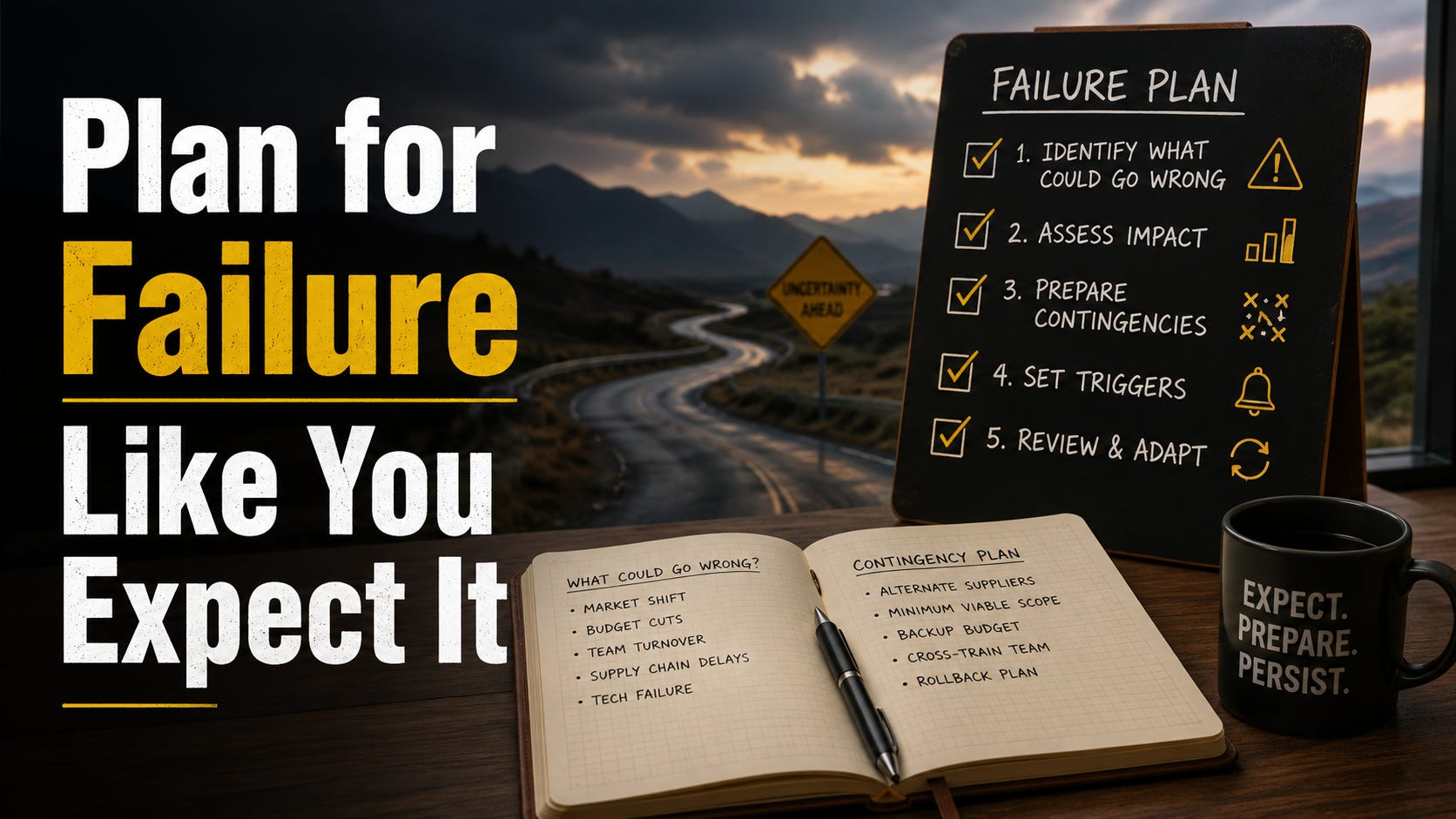
Here is the part outsiders get backwards. Planning for failure is not a lack of confidence. It is what confidence looks like when professionals do it. The raid planners did not merely hope the helicopters would work. They staged backup aircraft along the route, rehearsed a helicopter crash specifically, and prepared for the nightmare scenario of a confrontation with Pakistani forces. So when a helicopter actually did go down, the failure had already been imagined, rehearsed and priced in. The operation absorbed it without breaking stride.
Spies often use a tool called a pre-mortem. A post-mortem examines a failure after it happens. A pre-mortem does it in advance: you assume the plan has already failed, then write down the most likely reasons why.
How it works
Run a pre-mortem: “It failed. Why?”
Build a concrete response to the two or three most likely failure modes
Position your reserves before you need them
Treat all of this as confidence, not pessimism
Civilian application
People avoid planning for failure out of pure superstition, as if writing the backup plan invites the disaster. The result is that when setbacks arrive, they hit twice: once as an event, and once as a shock you never prepared for.
Try this:
Before any big leap, write one page dated a year from now: “It failed. Here is why.”
Prepare a real response to the top two reasons on that page.
Keep a reserve, whether money, skills or relationships, that no failure can touch.
👉 Planning for failure does not weaken the leap. It is what makes the leap survivable.
🔁 10. Judge Your Decisions, Not Your Luck

What it means in intelligence
A sound decision can still produce a bad outcome, and a reckless one can be rescued by sheer luck. Mature intelligence services therefore review the process, not just the result. After the Iraq weapons failure, official inquiries on both sides of the Atlantic focused on exactly this: not “the conclusion was wrong” but “the checking was broken”. Sources like Curveball had not been verified, dissenting views had been smoothed over, assumptions had gone unchallenged. The outcome was the symptom. The process was the disease.
Psychologists call the opposite habit outcome bias: judging a choice purely by how it turned out. It is a terrible teacher. It rewards lucky gamblers and punishes people who made the right call and got unlucky, training everyone toward worse decisions.
How it works
Review decisions against what was known at the time, not what is known now
Credit good process even when the result disappoints
Examine lucky wins as critically as unlucky losses
Record your reasoning before the outcome is known, so you can review it honestly
Civilian application
The friend who got rich on one reckless bet learns recklessness. The founder whose solid business was killed by a pandemic learns false caution. If you grade yourself only on results, randomness becomes your teacher, and randomness teaches nonsense.
Try this:
Keep a simple decision journal: the choice, your reasoning, and the percentage you gave it.
Review it every few months, hunting for process errors rather than bad luck.
Forgive your sound decisions that failed. Interrogate your reckless ones that succeeded.
👉 Good judgement is built by reviewing decisions, not by counting outcomes.
📊 Tradecraft Translation
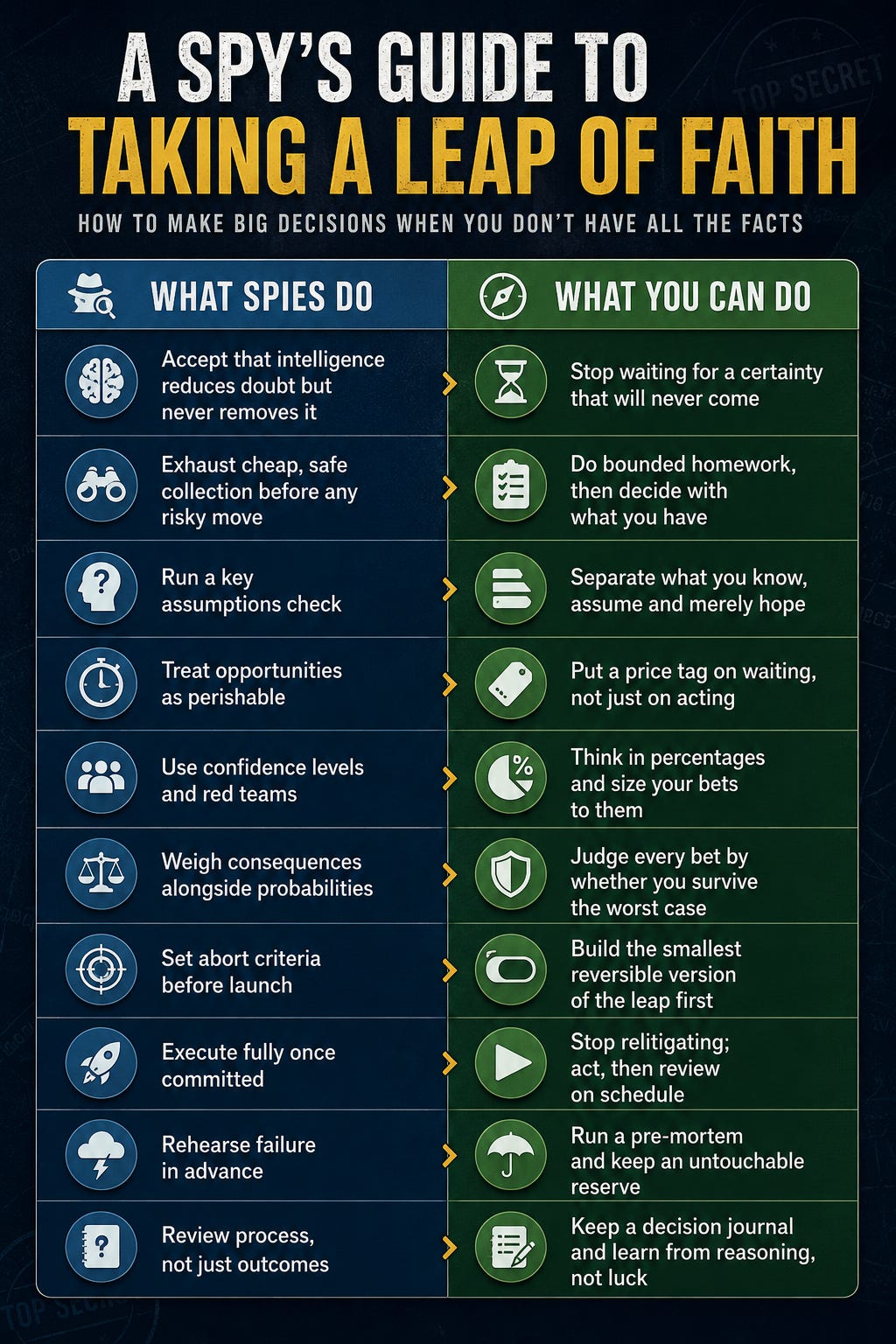
🧠 Final Assessment
The phrase “leap of faith” is misleading. What good intelligence officers actually take is a calculated leap: shrunk by homework, stripped of hidden assumptions, sized to honest percentages, shaped by survivable consequences, fitted with exits, and backed by a rehearsed plan for failure. The faith involved is not faith that things will work out. It is faith in the process that produced the decision, which is the only kind of faith that survives contact with real life.
The cases in this article show both edges of the blade. The Abbottabad decision succeeded on roughly even odds because the process around it was disciplined. Khost and Curveball failed not because the people involved were unintelligent, but because steps were skipped, assumptions went unchecked, and pressure was allowed to replace process. You face smaller versions of the same choice every time life demands a decision before it grants you the facts.
🔎 Ujasusi Takeaway
You will never have complete information. You can still decide well. To do so:
Do the cheap homework, then accept the gap that remains
Drag your hidden assumptions into the daylight
Count the cost of waiting alongside the cost of acting
Match the size of your bet to the honesty of your percentage
Make sure the worst case is one you can survive
Pack the parachute before you jump, then jump fully
That is how spies take leaps of faith: eyes open, parachute packed, and already moving.
📚 Further Reading
The Finish: The Killing of Osama bin Laden — Mark Bowden
The Triple Agent — Joby Warrick (the Khost attack)
Curveball: Spies, Lies, and the Con Man Who Caused a War — Bob Drogin
Thinking in Bets — Annie Duke
Thinking, Fast and Slow — Daniel Kahneman
Psychology of Intelligence Analysis — Richards J. Heuer Jr. (free declassified CIA text)
A Tradecraft Primer: Structured Analytic Techniques — Central Intelligence Agency (declassified)
⚠️ Editorial Note
The tradecraft principles discussed in this article are drawn from open-source intelligence literature and declassified methodology. They are presented to improve analytical thinking, risk awareness, and decision-making judgement — not as operational guidance. Ujasusi Blog does not endorse the application of these methods for any unlawful or harmful purpose.