
Spy’s Guide | Ujasusi Originals
Picture your life as an ongoing operation. You have objectives, resources, people you depend on, and a plan you believe in. Most of the time the plan holds. Then, without warning, it doesn’t. The boat you trusted capsizes mid-crossing. The crop you depended on fails before harvest. The treatment you believed would work, doesn’t. The plan to get your family to safety falls apart halfway there. In that moment, it feels like the entire mission has failed.
Intelligence services live with this reality constantly. Operations fail. Sources get exposed. Plans collapse under pressure no one predicted. And yet these services keep functioning, because they treat failure not as a catastrophe to be feared but as a known phase of operational life, one with its own procedures, its own discipline, and its own path back to the field. Civilians rarely get taught any of this. Most of us were never shown what to do after something fails. We only know how to feel bad about it.
This guide takes ten things intelligence services actually do when an operation fails and translates them into a toolkit for ordinary life. None of it requires training. All of it requires honesty about how failure really works.
🎯 1. Failure Is a Planned-For Outcome, Not a Surprise
What it means in intelligence
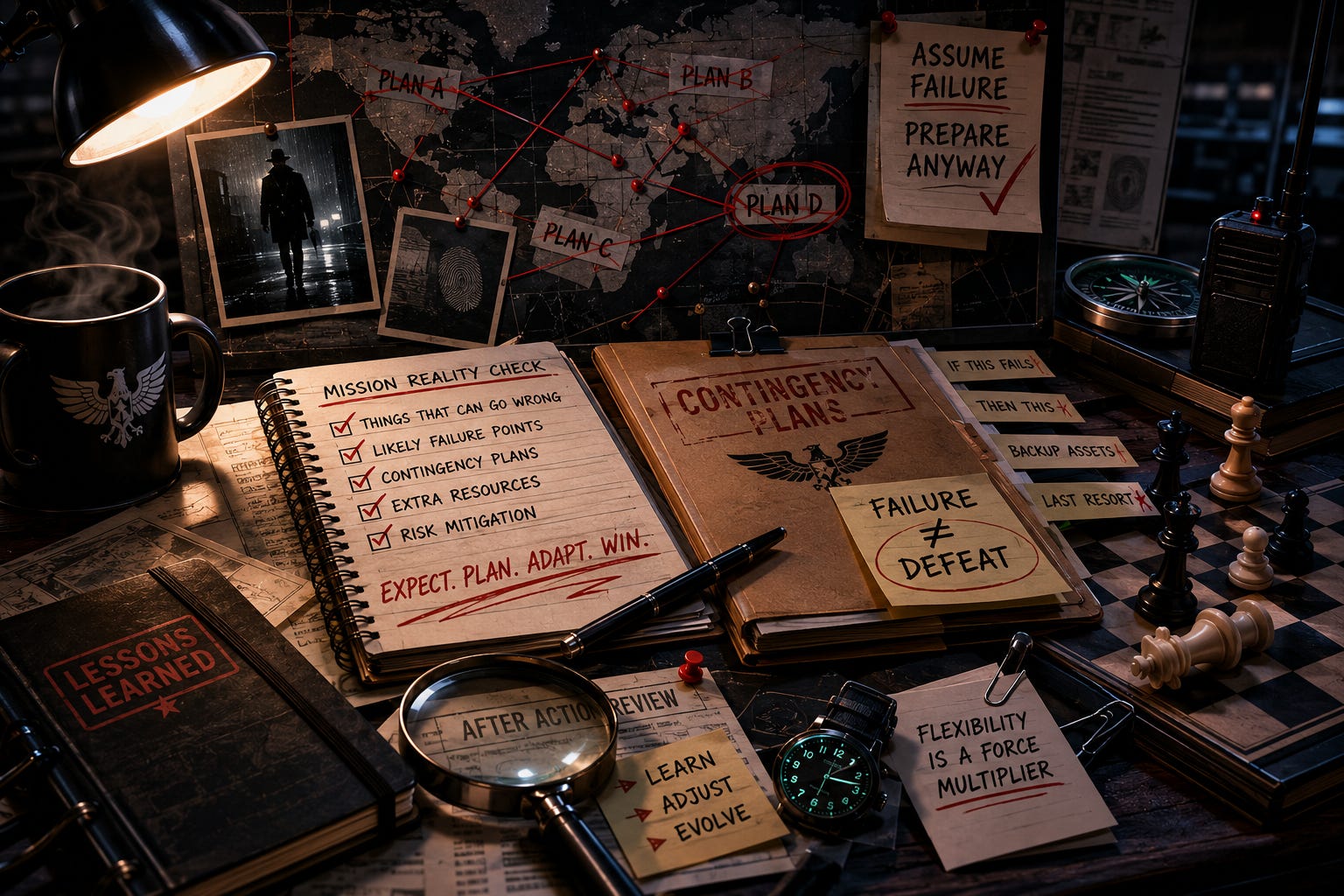
Before any operation is approved, planners build in a failure contingency. This is standard tradecraft: every plan accounts for the version of events where things go wrong, because in a field where adversaries are actively trying to stop you, failure is a realistic outcome, not a remote one. An operation is judged successful not because it never goes wrong, but because the people running it expected it might and prepared for that possibility in advance.
How it works
Planning for failure does not mean expecting to fail. It means refusing to be surprised if you do. A service that only plans for success has no procedure to follow the moment things break down, and that absence of a procedure is what turns a setback into a crisis. By contrast, a service that has already asked “what happens if this goes wrong” walks into the failure with a plan still in hand, even though the original plan failed.
Civilian application
Most people only plan for success. A new business owner budgets for growth, not for a slow first year. A job applicant prepares an acceptance speech in their head, not a next move if the offer doesn’t come. When failure does arrive, and statistically it does to nearly everyone at some point, there is no procedure waiting. Just shock.
Try this
Before your next significant attempt, whether it’s a job application, a financial decision, a relationship conversation, or a new venture, write down one sentence: “If this does not work, my first move is ___.” You do not need a complete contingency plan. You need one sentence that exists before the failure does, because a decision made in advance is calmer than a decision made in the moment.
The operation that has no plan for failure has no plan at all. It has a hope.
⏸️ 2. The First 24 Hours: Freeze Before You Move
What it means in intelligence
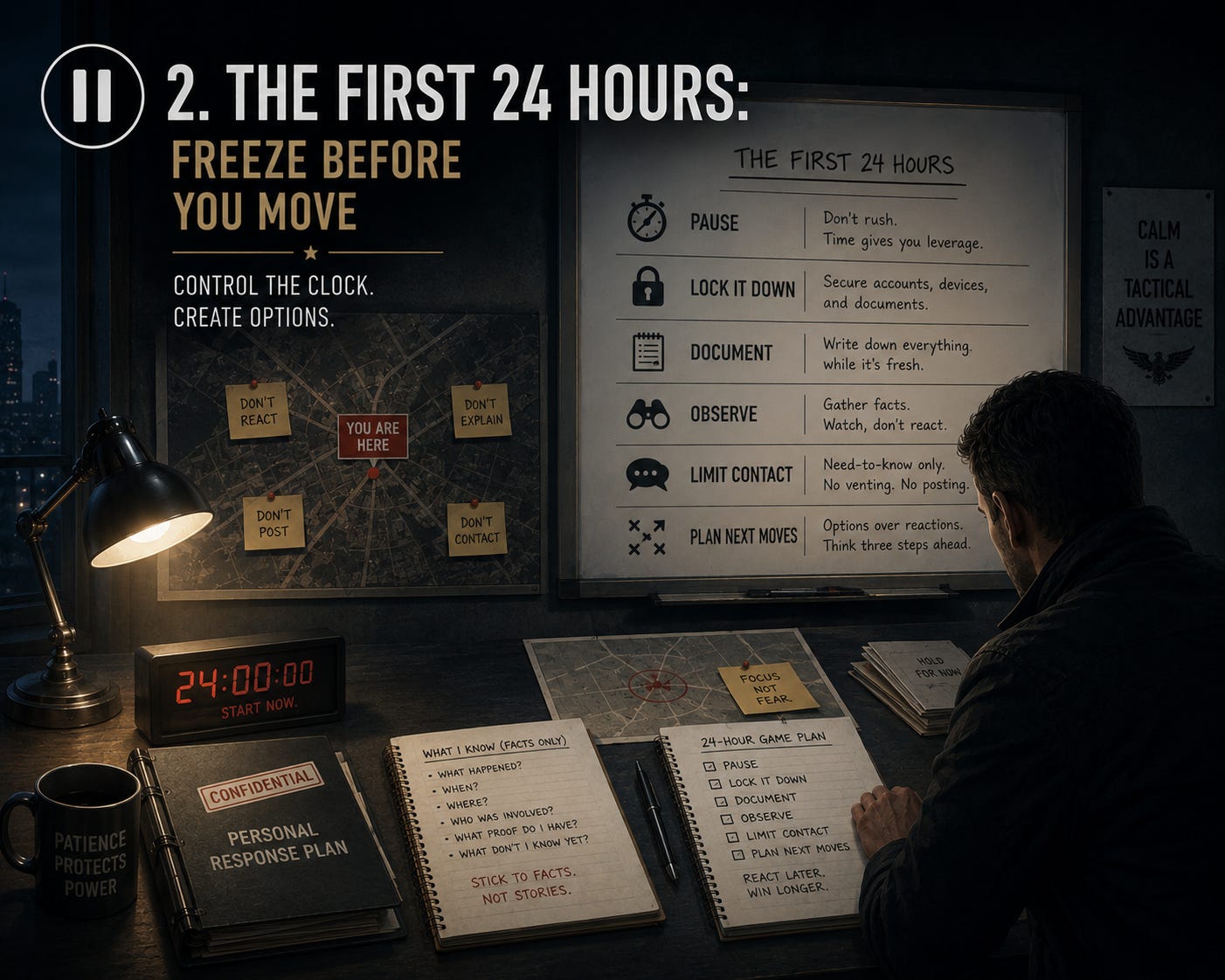
When an operation is compromised, officers are trained to avoid major decisions in the immediate aftermath. This is not passivity. It is discipline. The period right after a failure is when judgment is least reliable, because adrenaline and fear distort the assessment of risk. Services build in a deliberate pause before any new commitment is made, specifically to prevent panic decisions from compounding the original failure.
How it works
A compromised operation generates an urge to act immediately, to fix it, explain it, or run from it. That urge is treated as a hazard, not a virtue. The pause exists because the first instinct after failure is rarely the correct one. Officers are trained to gather information and stabilize the situation before committing to any new course of action, even when the pressure to “do something” is intense.
Civilian application
People who lose a job often apply for the first available role within days, out of panic rather than judgment. People who are rejected by someone they love often send a message they will regret within hours. People whose business deal collapses often sign the next deal that comes along just to feel like they are moving forward. None of these are decisions. They are reactions dressed up as decisions.
Try this
After a real failure, give yourself a fixed, short period, even just 24 hours, where you make no major commitments related to it. No resignation letters, no big purchases, no irreversible messages. Use the time only to gather facts about what actually happened. The pause is not avoidance. It is what separates a decision from a reflex.
Officers do not act in the first hour after a compromise. They observe. Civilians should do the same.
🔍 3. The Debrief: Facts First, Meaning Second
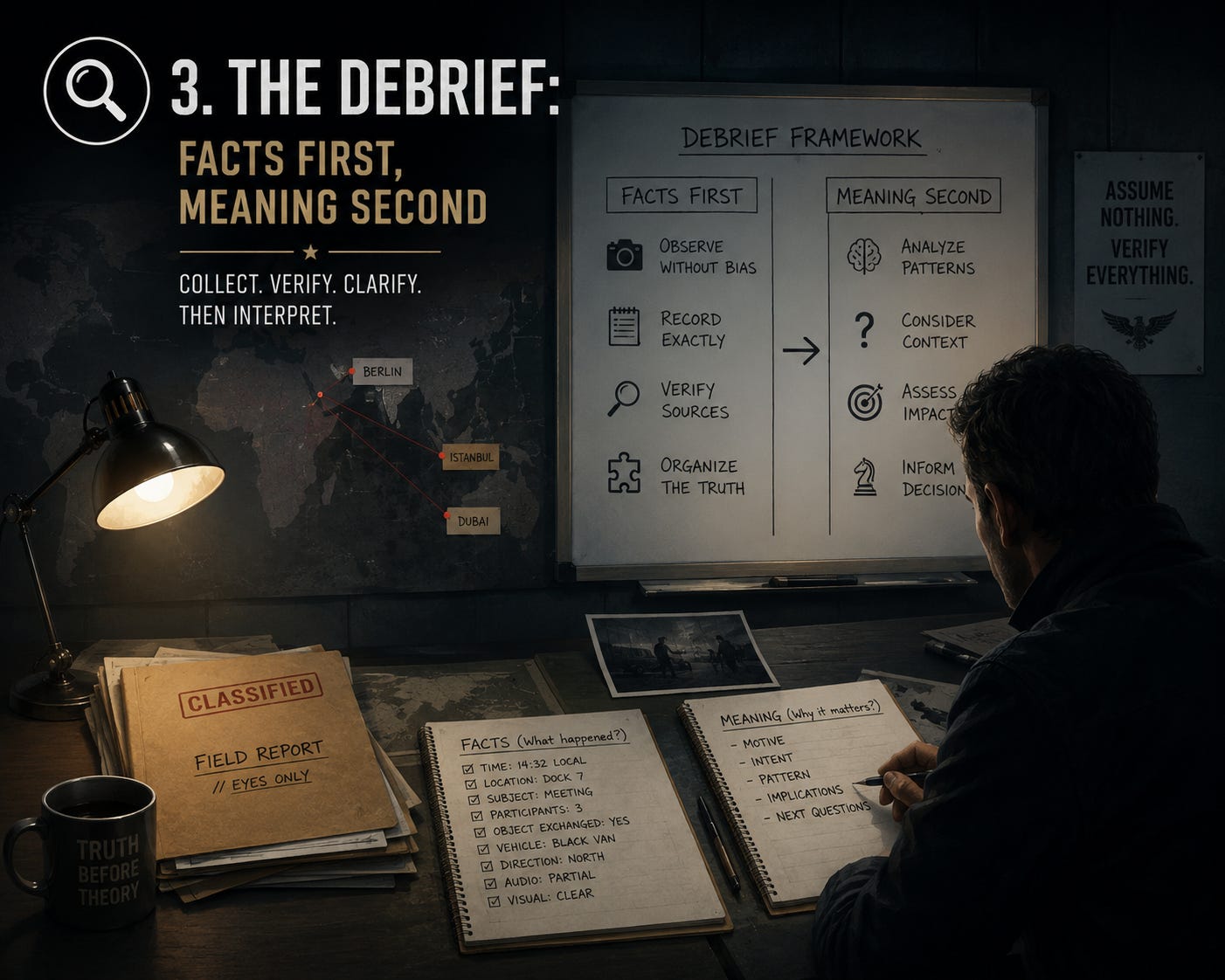
What it means in intelligence
After any failed operation, services run a structured debrief, a formal review where everyone involved describes exactly what happened, in sequence, without yet assigning blame or meaning. The debrief separates two questions that people instinctively merge: “what occurred” and “what it says about me or my abilities.” Only the first question is answered in the debrief. The second is deliberately delayed.
How it works
Mixing facts with meaning too early produces a distorted account. An officer who immediately concludes “I am incompetent” after a failed operation will recall the events in a way that supports that conclusion, missing details that don’t fit the story. A clean debrief, conducted before judgment sets in, produces a far more accurate picture of what actually went wrong.
Civilian application
After a failed exam, a person often skips straight to “I am stupid” without ever reconstructing what actually happened: which topics were under-prepared, which questions were misread, how much sleep was had the night before. After a breakup, someone may conclude “I am unlovable” without examining the specific, fixable patterns that contributed to it. The meaning arrives before the facts do, and it is usually harsher and less accurate than the facts would have supported.
Try this
Within a few days of a failure, write a plain timeline of what happened, just the sequence of events, with no adjectives about your character. No “I’m useless,” no “I always do this.” Just what happened, in order. Read it back. The facts are almost always less damning than the story your mind built around them.
A debrief asks what happened. A spiral asks what’s wrong with you. Only one of those questions has a useful answer.
READ ALSO
Introducing “A Spy’s Guide to Deception” — The First in the Spy Guide Series

Intelligence work is built on deception. Every service that has ever run an agent, mounted a cover operation, or manufactured a false narrative has done so through principles that remain largely invisible to the public. Not because they are secret, but because no one has taken the time to explain them plainly.
📊 4. Damage Assessment: What Is Actually Lost

What it means in intelligence
After a debrief establishes the facts, services conduct a damage assessment, a deliberately scoped review of exactly what was lost and exactly what remains intact. This is a narrow, specific exercise. It does not ask “how bad is this” in a general sense. It asks precisely which assets, relationships, and capabilities were affected, and which were not.
How it works
Without a scoped damage assessment, the natural tendency after any failure is to assume everything is compromised. A genuine intelligence failure in 2009 illustrates how costly an inaccurate damage assessment can be: a source believed to be a double agent working for the CIA was, in reality, secretly still loyal to the network he claimed to be betraying. He was waved through security without being searched, and an unusually large group gathered to meet him in person. A suicide bombing at a CIA base in Khost, Afghanistan, killed seven CIA officers and contractors who had gathered for that meeting. The tragedy exposed real and serious failures in how the source’s loyalty had been assessed and in basic security procedure on the day. But the agency’s continued operations elsewhere in the world did not stop, because the damage, while severe, was specific. It was not assumed to have contaminated every operation everywhere.
Civilian application
People who fail at one thing often act as though they have failed at everything. A person who loses one client concludes their entire business is failing. A person who is rejected by one publisher concludes they cannot write. The actual damage is almost always narrower than the felt damage.
Try this
After a setback, make two short lists side by side: what was actually lost, and what remains exactly as it was before. Most people are surprised by how short the first list is and how long the second one is.
Catastrophe is a feeling. Damage assessment is a fact. Learn to tell them apart.
🧱 5. Containment: Stop One Failure From Becoming Five