



South Africans vote in national and provincial elections on May 29 that could test the African National Congress, opens new tab' 30-year rule.
After the vote, held every five years, the new National Assembly will choose the country's next president from among its members.
Below are facts about the election and the voting process.
ELECTORAL SYSTEM
Voting is under a proportional system where parties and candidates are competing for 400 seats in the National Assembly.
Parties on the national ballot will contest 200 of those seats while the other 200 are divided between the nine regions and contested by parties and independent candidates.
In provincial legislatures, the number of seats is determined on the basis of the size of the population in each of the nine provinces.
THREE BALLOTS
For the first time, voters will receive three ballots instead of two on voting day. On each ballot, they will have to choose one party or one candidate.
Two ballots will be used to elect the National Assembly and the third one will be for election of members of the provincial legislature in each province.
CANDIDATES
For the first time, independent candidates are allowed to compete for seats in the National Assembly and in provincial legislatures.
In total, the election commission cleared 14,889 candidates who will contest 887 seats in the forthcoming elections.
They were nominated by 70 political parties, except for 11 candidates who are independent.
A total of 31 political parties will contest the national elections for the first time.
WHO IS RUNNING?
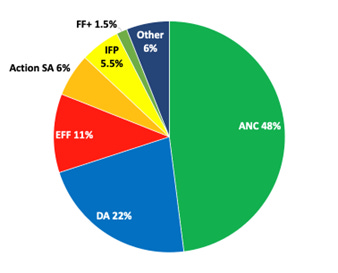
Despite having retained the support of the South African people for the past thirty years, the ANC’s decline now appears to be unstoppable, with recent surveys predicting that its share of the vote will fall below 50%. Moreover, the ANC has lost its unity over the course of time. It is now very fragmentated and many of its former members have founded new parties.
In contrast, opposition parties have increased, with 90 new political groups recently registering, and have formed coalitions to oust the ANC’s parliamentary majority. For example, the Multi-Party Charter for South Africa, also known as the Moonshot Pact, gathers seven opposition parties that have joined forces and agreed on a common vision to govern the country if they win the largest number of seats.
Two of the main opposition parties are the Democratic Alliance (DA) and the Economic Freedom Fighters (EFF). The DA, led by John Steenhuisen, is a centrist party that had historically relied on support from white South Africans. To overcome the perception of being a white-dominated party, the DA entered into the Multi-Party Charter alliance.
The EFF, instead, is led by a former ANC leader, Julius Malema, and describes itself as a “radical and militant movement for economic emancipation” and an “anti-imperialist and leftist movement with an internationalist outlook.” The EFF’s main priorities are the expropriation of all remaining white-owned property, state-provided housing and the nationalization of strategic sectors of the economy, such as mines.
Other relevant former ANC members who have founded new parties are the former President Jacob Zuma and the former ANC Secretary General Ace Magashule. While Zuma announced his endorsement for uMkhnoto weSizwe (MK), a party named after the paramilitary wing of the ANC during apartheid, Magashule founded the African Congress for Transformation (ACT). In January, Magashule announced a “united front” between his party and the MK.
Regardless of the several political scandals and widespread public discontent, most analysts emphasize the resilience of the country’s strong democratic institutions, such as the widely recognized Electoral Commission. Moreover, both the judiciary and the national army have repeatedly demonstrated their apolitical nature.
ISSUES AT STAKE
When he came to power in 2018, Ramaphosa promised a relaunch of the national economy, increasing job opportunities and fighting political corruption. Today, these words sound like empty promises. Youth unemployment is at nearly 60% and economic growth is stagnating with consequences likely to threaten the stability of the wider region. Considering the latest data, in 2023, South Africa’s GDP rate was 0,6%, compared to 1,91% in 2022.
However, the growth of the real gross domestic product is expected to continuously increase between 2024 and 2029 by in total 0.5 percentage points. Crime and corruption figures have also risen over the last two years. In 2023, South Africa was ranked 83rd out of 180 countries in the Corruption Perceptions Index. However, the most emblematic example of the ANC’s failure in delivering and improving public services may be blackouts, as they are extremely disruptive for both the economy and social welfare.
The government has been referring to power cuts as “load shedding”, as it has developed a system of measured load losses. Since 2007, in fact, Eskom, the state-owned energy company, has managed planned rationing of electricity, turning blackouts into an accepted routine of citizens’ daily lives. It has even been developed a mobile app that announces, for each day of the week, at what time and how long the power will be out in the neighborhoods. Needless to say, the lack of electricity frequently interrupts working activities and affects the education of students, who have limited hours of light to study. According to recent surveys, in 2024 the blackout issue may cause the ANC to lose up to 24% of its voters.
VOTERS
The Independent Electoral Commission (IEC) says 27.79 million people are registered to vote, up from 26.74 million in 2019.
VOTING
Around 23,292 voting stations will be open on May 29 from 0500 GMT to 1900 GMT.