



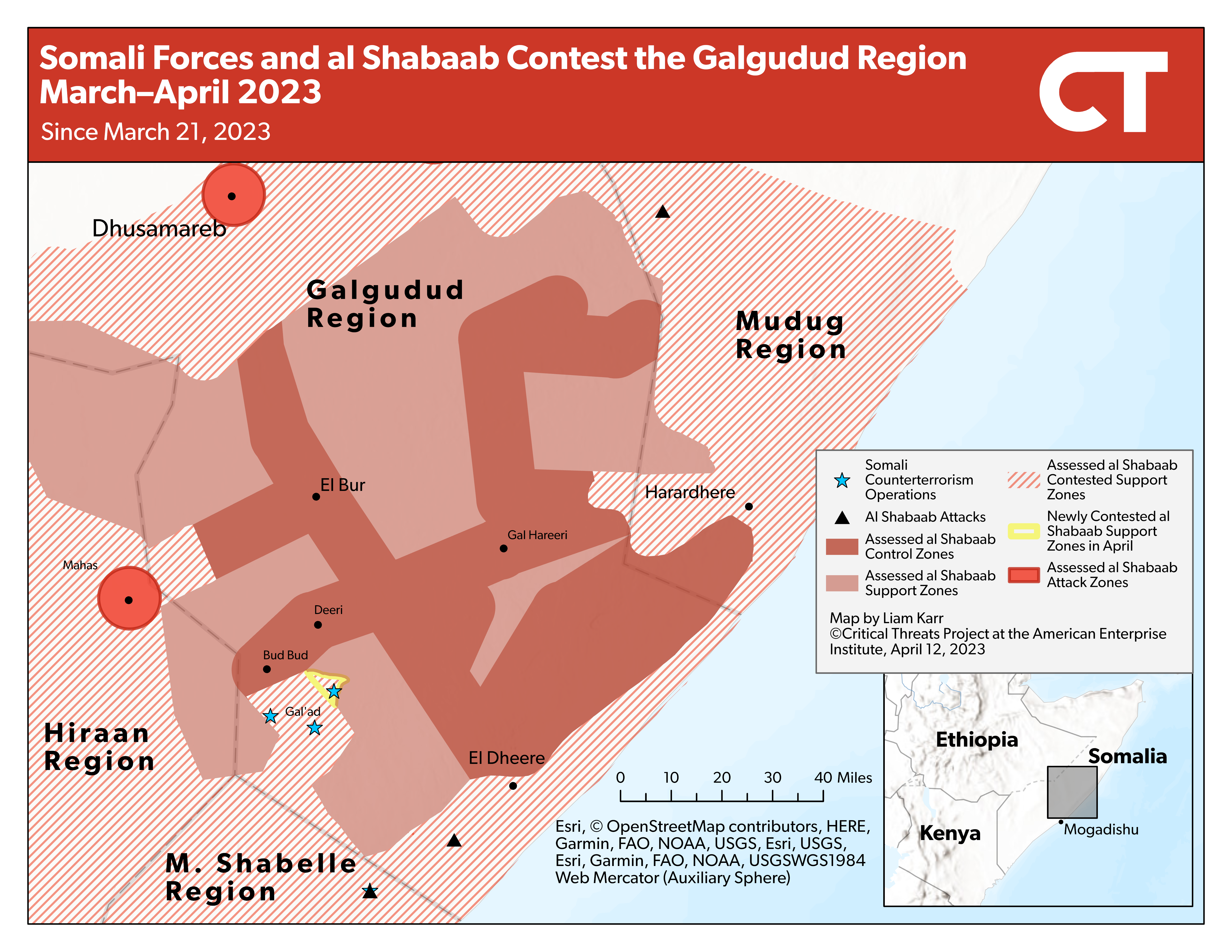
The Somali Federal Government’s (SFG) inability to escalate on multiple fronts against al Shabaab could allow the group to repel renewed Somali offensive operations in central Somalia. The SFG began the renewed offensive against al Shabaab in central Somalia by reentering the town of Gal’ad and the surrounding area in late March and early April. Somali forces liberated Gal’ad in January, but al Shabaab overran their base. This attack halted the first phase of the SFG campaign and caused a three-month pause in operations. Al Shabaab has not contested the April operations directly, but it did launch two large-scale attacks on nearby Somali bases on March 21 and April 4.
Figure 3. Somali Forces and al Shabaab Contest the Galgudud Region
Source: Liam Karr.
Somali forces will likely use Gal’ad as a base to launch operations toward the remaining al Shabaab strongholds in the Galgudud region. Gal’ad is 50 miles south of El Bur and roughly 55 miles from Gal Hareeri, the two largest remaining al Shabaab–controlled towns in the Galgudud region. Somali forces moving north into the areas of Bud Bud or Derri would signal that Somali forces are escalating operations toward these al Shabaab strongholds in the El Bur district instead of consolidating their position in Gal’ad and the El Dheere district.
Somali forces have not sustained other fronts in central Somalia, which will allow al Shabaab to target the forces operating from Gal’ad. Operations pressuring El Bur from the north, east, and west have stagnated since the first phase of the offensive escalated in September 2022 due to insufficient local support. Al Shabaab negotiated deals with the dominant clans in some of these areas, causing local militias to stop working with the SFG. Locals stopped supporting the offensive on other axes after their leaders disagreed with their federal counterparts on drone-strike usage and distrusted government support for their intra-clan rivals in the area. Local militias have remained active around Gal’ad, likely enabling the resumption of operations. The lack of pressure on other axes will allow al Shabaab to concentrate against Somali forces operating out of Gal’ad as it did in January.[ Somali forces in the Harardhere district that paused operations in February 2023 may be another potential option for the SFG to open a second front.
The SFG reestablishing local support along any of the stagnated axes could help it resume operations against al Shabaab in those areas. Local militias have been a key enabler of the SFG offensive in central Somalia. SFG officials meeting with local elders could indicate it is making inroads around Galgudud. Al Shabaab has also retaliated against civilians and villages from clans that cooperate with the SFG, so al Shabaab punitive attacks against villagers is another indicator that the SFG may have regained local support in some areas of Galgudud.
Somali forces have not expanded operations against al Shabaab in southern Somalia, which would preoccupy al Shabaab forces there and degrade the group’s ability to move militants in support of its forces in central Somalia. Somali forces have increased operations in southern Somalia since January 2023, but they have likely delayed expanding their activity away from previously contested areas and into al Shabaab support zones due to seasonal flooding and limited forces from regional partners. The lack of pressure in southern Somalia will allow al Shabaab to reinforce central Somalia by sending fighters from the south while rotating wounded soldiers to its control zones in southern Somalia through its rural support and contested support zones throughout the country.
The arrival of Djiboutian or Kenyan troops in Somalia could enable the SFG to escalate operations in southern or central Somalia. Djibouti, Ethiopia, and Kenya agreed to send non–African Union troops to participate in offensive operations in Somalia in January 2023, but only Ethiopian troops have arrived so far. The Somali national security adviser said in an interview in early March that these forces would arrive in Somalia by the end of April.[xl] It is unclear if these troops will deploy entirely to southern Somalia or deploy to the same areas as their African Union compatriots, which would send Djiboutian forces to central Somalia. The SFG is likely relying on these troops to compensate for the lack of effective or cooperative militia forces in parts of southern and possibly central Somalia.
Al Shabaab Global Operations. Costa Rican police arrested the son of senior al Shabaab Commander Fuad Shongole on April 10. Costa Rican authorities plan to transfer Farah to Somali authorities. Shongole has been a part of al Shabaab since its formation in the mid-2000s and serves on its Shura Council. Shongole also is a specially designated national with a $5 million bounty from the US State Department.
Shongole’s son, Lutran Farah, entered Costa Rica under a false alias in January and temporarily crossed into Nicaragua in February. The FBI warned Costa Rican authorities that a potential al Shabaab member was in the country in February and said the individual was on the FBI’s Terrorist Screening Center watch list.
Farah was likely trying to carry out an attack in the US. Al Shabaab has tried to orchestrate attacks on the US mainland as recently as 2019. Farah’s travel north into Nicaragua indicates he was attempting to find a route into the United States across the southern border. Farah alternatively may have been trying to set up funding networks in Latin America or the US. Al Qaeda had funding cells in parts of South and Central America during the early 2000s. However, CTP lacks indications al Shabaab has done so. Al Shabaab also has robust taxation, extortion, and illicit trade systems in Somalia that it can more easily increase revenue from. Farah was not fleeing al Shabaab, given his use of a false alias and failure to claim asylum.