
Espionage Chronicles | ☢️ The Spy Who Was Poisoned Twice: How Russia's Military Intelligence Tried to Assassinate a Defector in England

Espionage Chronicles | Ujasusi Blog Originals
☠️ A Sunday Afternoon in Salisbury
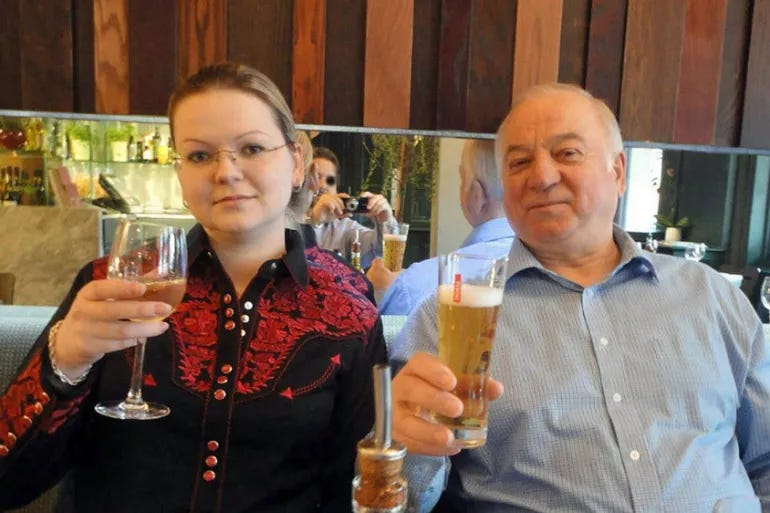
On the afternoon of 4 March 2018, a passing doctor and nurse discovered a man and a woman slumped unconscious on a bench outside the Maltings shopping centre in Salisbury, a quiet cathedral city in southern England. The man was 66-year-old Sergei Skripal, a former colonel in Russia’s military intelligence directorate (the GRU) who had resettled in Britain in 2010. Beside him lay his 33-year-old daughter Yulia, visiting from Moscow. Both were rushed to Salisbury District Hospital and placed into medically induced comas to prevent organ damage. Detective Sergeant Nick Bailey, a Wiltshire Police officer dispatched to Skripal’s home at 47 Christie Miller Road, was also hospitalised in serious condition after exposure to the same substance. Within days, scientists at the Defence Science and Technology Laboratory at Porton Down identified the poison: Novichok A-234, a military-grade nerve agent developed by the Soviet Union during the 1970s and 1980s under a programme codenamed FOLIANT.
🕵️ The Making of a Double Agent
Sergei Viktorovich Skripal was born on 23 June 1951 in the Kaliningrad Oblast of the Soviet Union. He joined the Soviet military in 1972 as a sapper-paratrooper and was subsequently recruited into the GRU, rising to the rank of colonel. While stationed at the military attaché’s office in Madrid in 1995, he was recruited by Pablo Miller, a British MI6 officer operating under diplomatic cover. Skripal began disclosing the identities of dozens of Russian agents working across Europe, receiving over $100,000 for his services through a Spanish bank account. He retired from the GRU in 1999 for health reasons but continued to travel abroad to meet with British handlers until his arrest by Russia’s Federal Security Service (FSB) outside his Moscow home in December 2004. A closed military trial convicted him of high treason under Article 275 of the Russian Criminal Code, sentencing him to 13 years in a high-security facility.
His fortunes changed on 9 July 2010, when he was freed as part of the largest East-West spy swap since the Cold War. At Vienna’s international airport, four prisoners held by Russia for spying for the West were exchanged for ten Russian sleeper agents arrested in the United States under the Illegals Programme. The British government had insisted on Skripal’s inclusion. He settled in Salisbury, purchased a modest home in 2011, and appeared to live quietly. Yet according to NATO’s Allied Command Counter-Intelligence Unit, Skripal continued providing briefings to intelligence services of at least four NATO countries, including the Czech Republic, Estonia, and Spain, until 2017.
☣️ Nerve Agent on a Door Handle
The Organisation for the Prohibition of Chemical Weapons (OPCW) confirmed the nerve agent as Novichok, assessed to have been produced at a chemical facility in the town of Shikhany, Saratov Oblast, Russia. Investigators established that it had been applied to the front door handle of Skripal’s home using a modified dispenser disguised as a bottle of Nina Ricci “Premier Jour” perfume. Both Skripals absorbed the agent through skin contact as they left the house that morning, with symptoms escalating over several hours before their public collapse.
Both survived after weeks of intensive care. Yulia regained consciousness first and was discharged in April 2018. Sergei, whose condition was initially more grave, was discharged in May. DS Bailey recovered sufficiently to return to active duty by January 2019. The Skripals disappeared into protective custody and have not been seen publicly since.
🔍 Unmasking Unit 29155
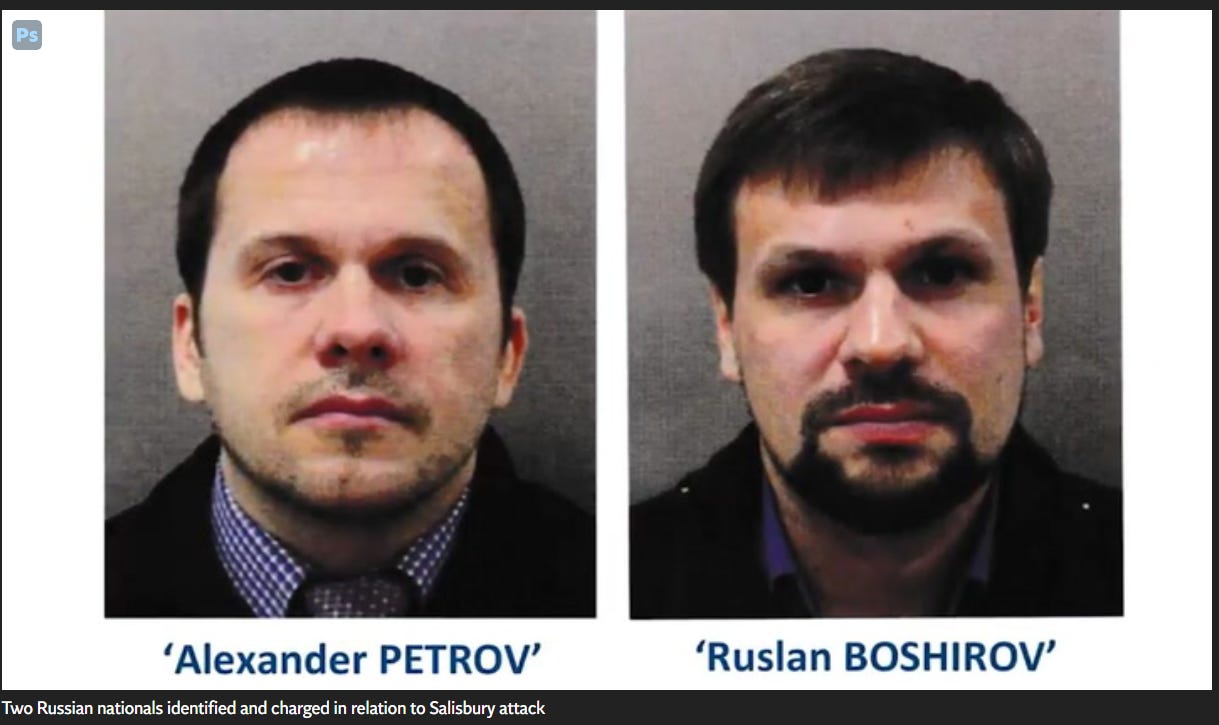
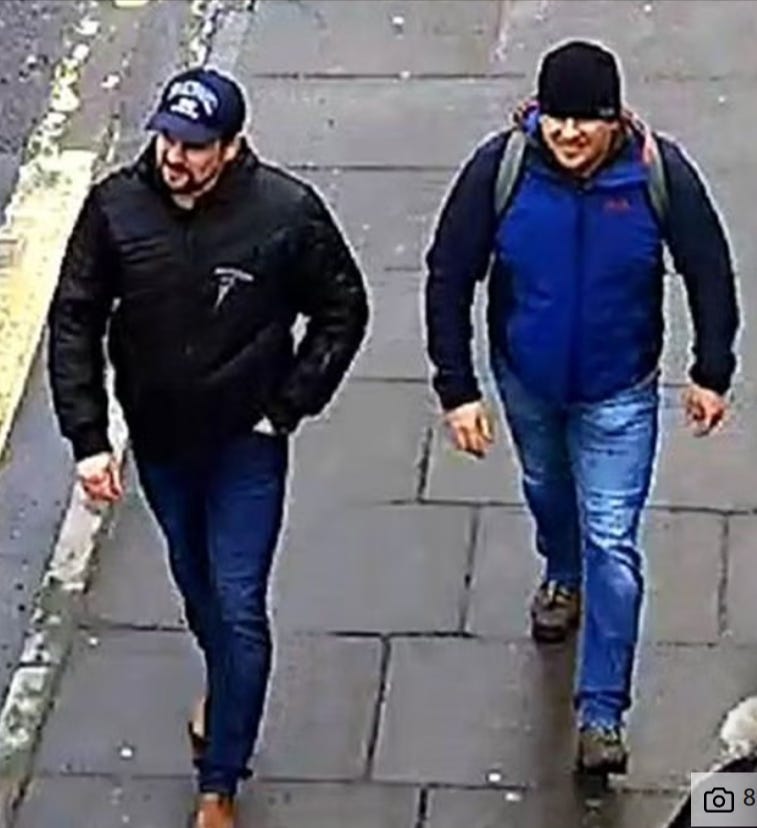
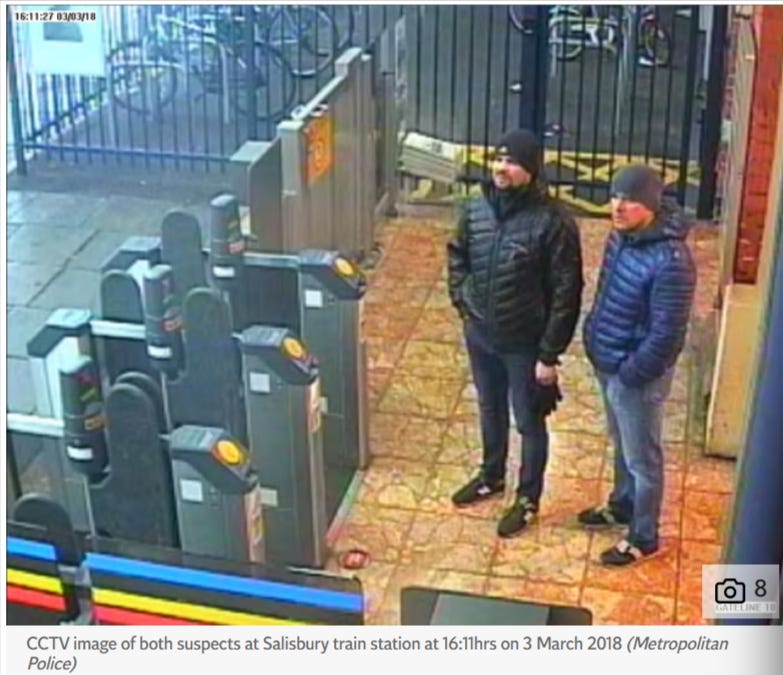
The investigation involved up to 250 detectives from across the Counter Terrorism Policing network. On 5 September 2018, British authorities publicly identified two Russian nationals who had entered the UK under the aliases “Alexander Petrov” and “Ruslan Boshirov”. Prime Minister Theresa May informed the House of Commons that both men were GRU officers and that the assassination attempt was “not a rogue operation” but “almost certainly” approved at a senior level of the Russian state.
CCTV footage meticulously reconstructed their movements. The pair arrived at London Gatwick on Aeroflot flight SU2588 from Moscow on 2 March 2018 and stayed at the City Stay Hotel in east London, where traces of Novichok were later found in their room. On Saturday 3 March, they travelled by train from Waterloo to Salisbury, arriving at approximately 2:25 pm and departing less than two hours later. Police assessed that this was a reconnaissance trip. On Sunday, 4 March, they repeated the journey. CCTV placed them in the immediate vicinity of Skripal’s house at 11:58 am, moments before the attack. That evening, they returned to London and boarded a 10:30 pm Aeroflot flight back to Moscow.
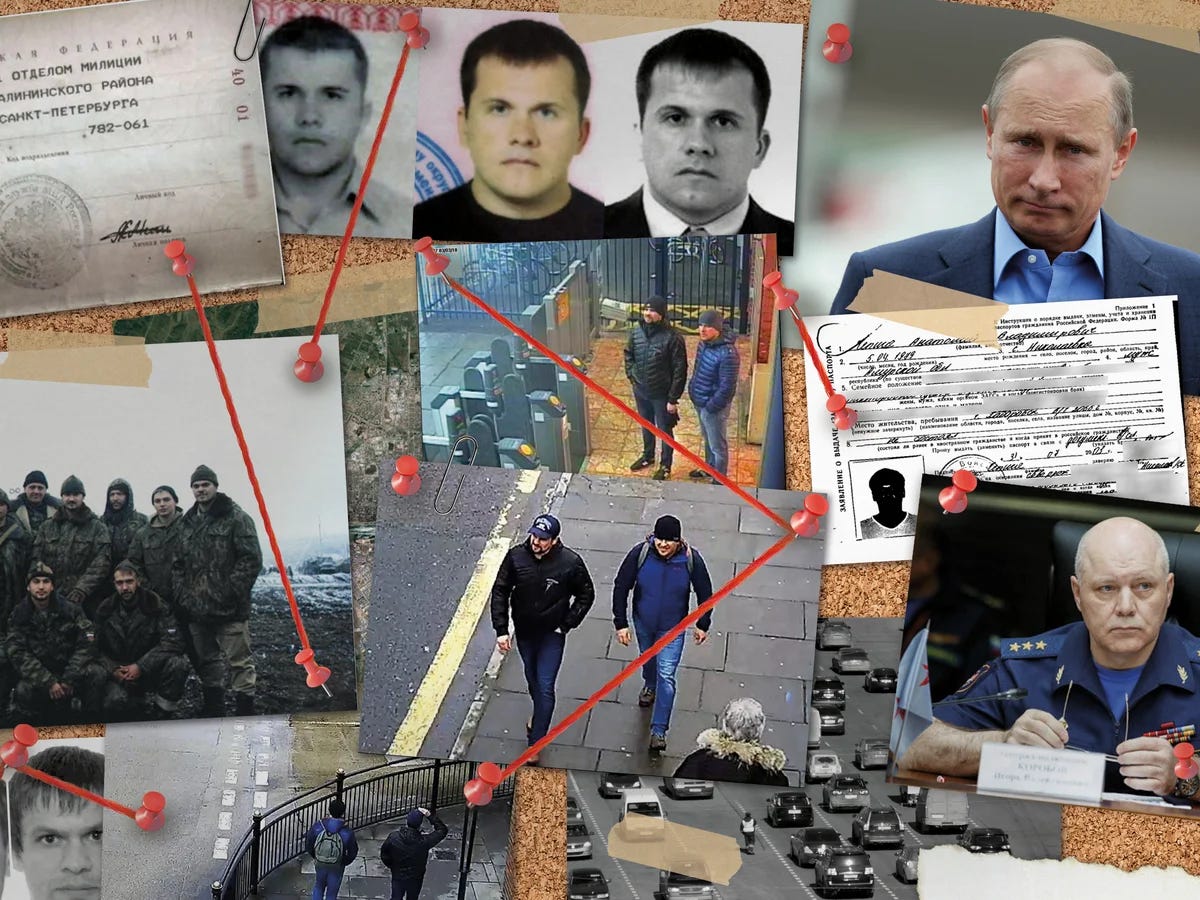
The investigative organisation Bellingcat, working with its partner The Insider, subsequently unmasked all three operatives. “Boshirov” was revealed to be Colonel Chepiga, a Hero of the Russian Federation decorated for his role in the 2014 annexation of Crimea. “Petrov” was identified as Dr Mishkin, a military doctor employed by the GRU. A third officer, Major General Denis Vyacheslavovich Sergeev (alias “Sergey Fedotov”), was identified as the operational commander who had coordinated with superiors in Moscow via telephone throughout the mission.
All three belonged to All three belonged to GRU Unit 29155, a clandestine military intelligence formation specialising in overseas assassinations, sabotage, and political destabilisation, commanded by Major General Andrei Averyanov. The unit’s existence had not been publicly known before the Skripal investigation, but subsequent reporting linked it to a Bulgarian arms dealer’s poisoning in 2015, a failed coup attempt in Montenegro in 2016, and the 2014 Vrbětice ammunition depot explosions in the Czech Republic. In a now-infamous September 2018 interview on Russian state television network RT, the two operatives claimed they were merely tourists who had visited Salisbury to see its famous cathedral.
😢 Collateral Damage: The Death of Dawn Sturgess
Almost four months after the Salisbury attack, the full recklessness of the operation was laid bare. On 30 June 2018, Dawn Sturgess, a 44-year-old mother of three living in supported accommodation in nearby Amesbury, collapsed at her partner Charlie Rowley’s flat. Rowley had found a sealed box containing what appeared to be a Nina Ricci perfume bottle, likely discarded by the GRU agents after the March attack. He gave it to Sturgess as a gift. She sprayed the contents on her wrists and, within fifteen minutes, complained of a headache and said she felt severely unwell. Rowley later found her in the bath, fully clothed, in severe distress. Dawn Sturgess died on 8 July 2018 without regaining consciousness. Rowley survived after weeks in critical condition, though he reported lasting cognitive and physical effects.
The Dawn Sturgess Inquiry, chaired by Lord Hughes of Ombersley, published its findings in December 2025. Analysis at Porton Down confirmed the bottle contained the same Novichok batch used in the Skripal attack, approximately 98% pure, and in sufficient quantity to kill thousands of people. Lord Hughes concluded that the assassination operation “must have been authorised at the highest level, by President Putin,” and that all those involved bore “moral responsibility” for Sturgess’s death.
🌍 The Largest Expulsions Since the Cold War
The Salisbury poisoning triggered a diplomatic response unprecedented in modern history. The UK expelled 23 Russian diplomats identified as undeclared intelligence officers. Within weeks, 28 countries joined the response, producing a total of 153 Russian diplomatic expulsions by the end of March 2018, the largest coordinated removal of Russian intelligence personnel since the Cold War. The European Union sanctioned GRU leadership in January 2019, including Director Igor Kostyukov and Deputy Director Vladimir Alexseyev, alongside Mishkin and Chepiga. The United States Treasury Department added both operatives and thirteen other GRU members to its sanctions list in December 2018.
Criminal charges were authorised against all three identified GRU officers for conspiracy to murder, attempted murder, causing grievous bodily harm with intent, and use and possession of a chemical weapon. However, Russia’s constitution prohibits the extradition of its nationals, making prosecution effectively impossible. Following the December 2025 inquiry findings, the UK government imposed additional sanctions directly targeting the GRU as an institution and summoned Russia’s ambassador.
🌍 Lessons for African Intelligence Services
First, Russia’s willingness to target Skripal eight years after his release through a spy swap demolishes assumptions that such agreements provide lasting protection for defectors. African nations managing intelligence defectors from neighbouring states or non-state actors must plan for the possibility of long-term retribution operations.
Second, Bellingcat’s OSINT-driven investigation, using flight records, passport databases, telephone metadata, and facial recognition, demonstrates that civilian analysts with limited budgets can achieve results that once required state-level resources. This is a compelling capability model for African intelligence agencies operating under severe financial constraints.
Third, the OPCW confirmed Novichok use but lacked enforcement mechanisms against a permanent member of the UN Security Council, exposing the limits of chemical weapons conventions without robust national detection and response capabilities. African signatories to the Chemical Weapons Convention should take note.
Fourth, the coordinated 28-nation expulsion response illustrates the strategic value of intelligence-sharing alliances. The African Union and regional bodies such as ECOWAS, SADC, and the East African Community currently lack equivalent mechanisms for collective responses to extraterritorial attacks on the continent. The Salisbury precedent suggests that investment in such frameworks would substantially strengthen collective security.
📚 Sources & Further Reading
UK Parliament: House of Commons Library — The Salisbury Incident
Counter Terrorism Policing: Salisbury & Amesbury Investigation
Bellingcat: Skripal Suspect Identified as GRU Colonel Anatoliy Chepiga
Bellingcat: Second Suspect Identified as Dr Alexander Mishkin
NBC News: Putin Authorised Novichok Poisoning, UK Inquiry Says (December 2025)
Al Jazeera: Putin Found Morally Responsible for Nerve Agent Death (December 2025)
Next: Week 6 — The Perfect Sleeper: Chi Mak and China’s Two-Decade Infiltration of U.S. Naval Secrets
Independent intelligence analysis takes time and resources — if this work matters to you, please consider supporting it by donating HERE