
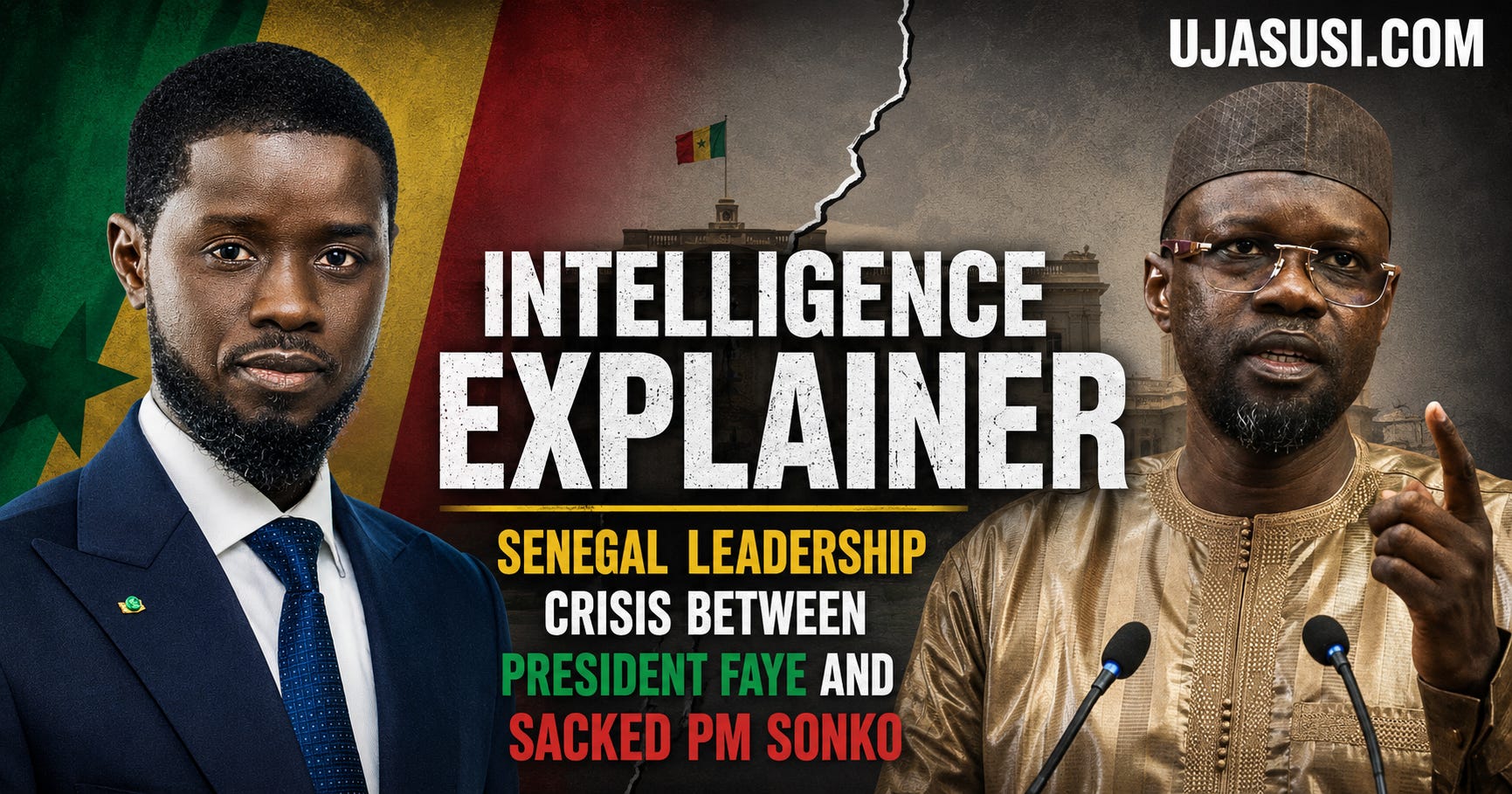
INTELLIGENCE EXPLAINER | Senegal Leadership Crisis Between President Faye and Sacked PM Sonko

Ujasusi West Africa Monitoring Team | 25 May 2026 | 0415 BST
Senegal’s Institutional Rupture: Faye, Sonko, and the 2026 Speaker Crisis
Senegal’s post-transition political order fractured decisively on 22 May 2026 when President Bassirou Diomaye Faye dismissed Prime Minister Ousmane Sonko and dissolved the government after months of open policy disagreement. Two days later, Speaker El Malick Ndiaye resigned, clearing the path for Sonko to contest the speakership and creating a competing power centre within PASTEF’s own parliamentary majority. Senegal’s new democracy now faces its gravest institutional stress test since the 2024 transition.
🏛️ Faye–Sonko Alliance Collapse: Structural Causes of the Crisis
The rupture between Faye and Sonko did not emerge from a single event but from an accumulating divergence in governing philosophy. Faye has oriented his presidency toward institutional consolidation, re-engagement with international financial institutions, and gradual reform. Sonko opposed that approach at every structural pressure point — refusing to raise fuel prices as Finance Minister Cheikh Diba requested, and rejecting IMF-advocated debt restructuring on the $13 billion sovereign debt pile.
On the morning of his dismissal, Diba told parliament that Senegal expects to resume IMF talks in the week of June 8 with a target of reaching agreement on key points by 30 June. The fuel subsidy bill alone could exceed its 2026 budget allocation by 1.15 trillion CFA francs if oil prices reach $115 per barrel. Sonko’s refusal to adjust subsidy policy made the existing governing arrangement fiscally untenable.
🔑 El Malick Ndiaye Resignation: Strategic Calculation, Not Withdrawal
Ndiaye’s departure from the speakership is a manoeuvre, not a retreat. After a hastily convened meeting of the National Assembly bureau, he resigned citing institutional conscience, “a personal choice, guided above all by my conception of institutions, public responsibility, and the supreme interest of the nation.” The language is careful. The effect is surgical.
By vacating the position, Ndiaye clears the procedural path for Sonko’s reinstatement as an MP and subsequent election as Speaker, both scheduled for Tuesday’s plenary session. The consequences are structural:
Sonko gains control of the legislative agenda and committee appointments
The executive loses its capacity to pass legislation without negotiation or concession
Faye must name a new prime minister whose appointment parliament must approve within three months
A motion of censure or no confidence becomes a live instrument in Sonko’s hands
Faye cannot dissolve parliament until November, two years after the last legislative election
This is not a parliamentary dispute. It is the formation of a rival power centre within the same political movement.
💰 IMF Programme Suspension: The Economic Fault Line
The political crisis intersects with a deteriorating fiscal position. The IMF froze a $1.8bn lending programme after auditors uncovered misreported debt concealed by the previous Macky Sall administration, pushing Senegal’s end-2024 debt-to-GDP ratio to 132 percent. The liability was inherited, not created, by the Faye government but the political cost of managing it falls entirely on the current administration.
June negotiations are now at risk. If Sonko controls the National Assembly during the period when fiscal reform legislation must pass to unlock IMF disbursement, Faye faces a choice between accepting Sonko’s political terms or watching the programme collapse. Rising borrowing costs, pressure on CFA franc reserves, and reduced development financing would fall disproportionately on the urban constituencies that elected both men.
⚡ PASTEF Internal Fracture: Two Competing Blocs
PASTEF has divided along a fault line that reflects both personal ambition and genuine ideological disagreement.
The Faye bloc prioritises executive consolidation, IMF re-engagement, and incremental reform. It reads the 2024 election as a mandate for institutional competence rather than revolutionary rupture.
The Sonko bloc reads the same mandate as a warrant for confrontation with the old order, immediate prosecutions of Macky Sall-era officials, rejection of conditionality-attached finance, and sustained popular mobilisation. Ndiaye’s resignation strengthens this faction’s parliamentary position considerably.
The question is no longer whether PASTEF can be held together under unified leadership. It cannot. The question is whether the fracture produces a workable legislative competition or an ungovernable deadlock.
🌍 Regional and External Exposure
Senegal functions as a key democratic reference point in a West African sub-region that has absorbed four military coups since 2021. A sustained institutional crisis in Dakar does not remain a domestic matter. ECOWAS has limited leverage over member states following the Mali-Burkina Faso-Niger withdrawal from the bloc, and a Senegalese crisis would further erode the organisation’s credibility as a guarantor of constitutional order.
A further development compounds the external picture: a recent electoral code reform passed by the PASTEF-controlled assembly means Sonko is now eligible to contest the presidency, raising the prospect that Faye and Sonko may eventually face each other directly at the ballot box.
🔎 Key Intelligence Indicators: 72-Hour Assessment Window
Indicator Significance Outcome of Tuesday plenary Confirms or denies Sonko’s speakership bid Faye public statement tone Signals escalation or accommodation Security force deployments in Dakar Elevated presence indicates fear of civil unrest IMF communications from Washington Postponement of June talks confirms fiscal fallout PASTEF parliamentary whipping Defections or consolidation reveal bloc strength
📊 Strategic Outlook
Senegal is not facing a coup. It is facing something in some respects harder to manage: a democratic institutional fracture between two legitimately elected leaders from the same movement, playing out across executive and legislative branches simultaneously, against a background of fiscal distress and a suspended international financial programme.
If Sonko wins the speakership on Tuesday, Faye governs through daily negotiation with a legislature his former prime minister controls. If a compromise Speaker emerges, the underlying conflict between the two blocs remains unresolved and surfaces again, on the IMF vote, on prosecution policy, on cabinet composition. There is no clean resolution on offer.
The decisive variable is not parliamentary arithmetic, which favours Sonko. It is whether Faye can construct a political offer sufficiently attractive to pull enough PASTEF MPs back toward the executive before Tuesday’s session opens.