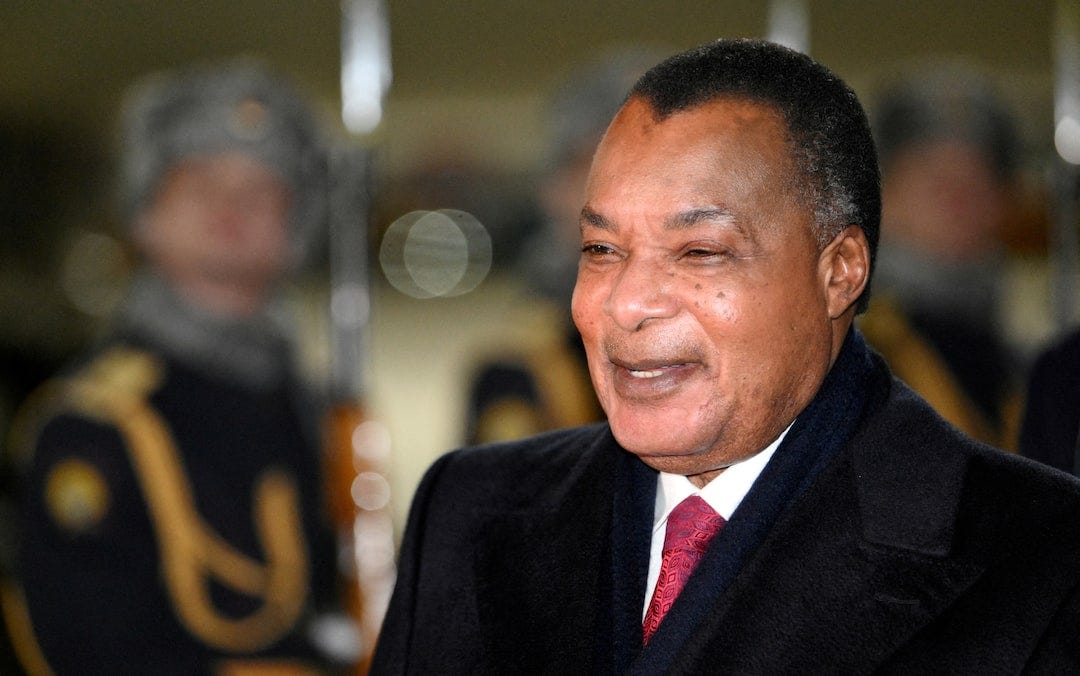
Republic of Congo: President Denis Sassou Nguesso Holds Final Rally Before March 15 Election

Denis Sassou Nguesso, 82, held his final campaign rally in Brazzaville on 13 March 2026 ahead of the 15 March presidential election, with voter turnout expected to reach historic lows amid opposition fragmentation and allegations of electoral manipulation in the oil-rich Republic of Congo.
Who is Denis Sassou Nguesso?
Denis Sassou Nguesso is a career military officer who has governed the Republic of Congo for over 40 years across two distinct periods. He initially ruled under a one-party system from 1979 to 1992, during which the Congolese Labour Party (PCT) maintained exclusive political authority. In 1992, he lost Congo’s first multi-party elections to former prime minister Pascal Lissouba.
Sassou Nguesso regained power in 1997 by overthrowing Lissouba through armed conflict, marking the beginning of his second, uninterrupted tenure. Since 1997, he has consolidated executive authority through constitutional amendments that removed both age limits and term restrictions, enabling successive electoral victories despite corruption allegations.
At 82 years of age, Sassou Nguesso ranks among Africa’s longest-serving heads of state, alongside Equatorial Guinea’s Teodoro Obiang Nguema and Cameroon’s Paul Biya. His governance model centres on controlling state institutions, exploiting hydrocarbon revenues, and systematically marginalising the political opposition.
What is the composition of the 2026 electoral contest?
Six candidates have registered to contest the 15 March election. However, the political landscape reflects severe opposition fragmentation and institutional exclusion. The two principal opposition parties declined to field candidates, with one citing the absence of conditions necessary for a free and transparent vote. This party advised supporters to vote according to their conscience rather than through a coordinated opposition strategy.
Opposition figure Clement Mierassa, a former minister and previous presidential candidate, characterised the six challengers as placeholders within an electoral process wholly controlled by Sassou Nguesso. The lack of broad support across opposition factions has prevented consolidation behind a single alternative candidate, effectively guaranteeing the incumbent’s victory.
Notably absent from the ballot are Jean-Marie Michel Mokoko and André Okombi Salissa, two prominent figures who challenged Sassou Nguesso in the disputed 2016 presidential election. Both individuals are currently serving 20-year prison sentences on charges of endangering state security, a legal mechanism widely interpreted as political neutralisation.
What structural advantages does the ruling party maintain?
The Congolese Labour Party exercises comprehensive control over electoral infrastructure and state resources. Opposition candidates lack the financial capacity, media access, and institutional support necessary to compete on equal terms. The PCT’s dominance extends across the electoral commission, security apparatus, and administrative hierarchy, creating asymmetries that render genuine political competition unfeasible.
Constitutional reforms enacted during Sassou Nguesso’s second tenure removed constraints on presidential age and term limits. These amendments, passed through referenda controlled by the ruling party, legalised indefinite executive tenure and eliminated mechanisms for democratic alternation. The 2016 constitutional changes specifically enabled Sassou Nguesso, then 72, to seek re-election beyond previously mandated age thresholds.
Why is voter turnout expected to reach historic lows?
Public disengagement stems from the perception that electoral outcomes are predetermined. Cyril Massamba, a Brazzaville resident, articulated widespread sentiment: whether citizens vote or abstain, the result will remain unchanged. This fatalism reflects the erosion of democratic legitimacy following decades of manipulated electoral processes.
The opposition’s strategic fragmentation and abstention by major parties signal a collapse of competitive politics. Without credible challengers or institutional safeguards, the election functions as a ratification exercise rather than a genuine contest. Historical patterns of post-election repression, exemplified by the imprisonment of 2016 candidates, further disincentivise political participation.
Congo’s status as an oil-rich yet impoverished state compounds public disillusionment. Despite substantial hydrocarbon revenues, the majority of the population remains economically marginalised. Corruption scandals involving Sassou Nguesso and his inner circle have reinforced perceptions that state resources benefit a narrow elite rather than national development.
How does Sassou Nguesso’s tenure compare regionally?
Within Central and West Africa, Sassou Nguesso’s 40-year rule exemplifies a pattern of personalised autocracy sustained through constitutional manipulation and resource capture. Equatorial Guinea’s Teodoro Obiang Nguema has governed since 1979, whilst Cameroon’s Paul Biya has held office since 1982. These three leaders share common strategies: removal of term limits, control of electoral institutions, and systematic suppression of opposition movements.
Congo’s trajectory differs from regional states that have experienced alternation, such as the Democratic Republic of Congo, where contested transitions have occurred despite authoritarian tendencies. The Republic of Congo’s institutionalised lack of democratic competition positions it amongst Africa’s most entrenched autocracies.
What are the implications of opposition imprisonment?
The incarceration of Jean-Marie Michel Mokoko and André Okombi Salissa serves dual purposes: eliminating viable challengers and deterring future opposition activity. Both individuals received 20-year sentences following the 2016 election, which international observers described as neither free nor fair. The charges of endangering state security lack substantive evidence and appear designed to neutralise political threats through judicial means.
Mokoko, a former general and candidate backed by segments of the security establishment, represented a credible alternative in 2016. His imprisonment removed a figure capable of mobilising military and civilian support. Salissa, similarly, commanded opposition constituencies that could have coalesced into a unified challenge. Their continued detention signals that electoral participation carries severe personal risk for those who genuinely contest Sassou Nguesso’s authority.
This pattern of post-election repression extends beyond individual candidates to encompass civil society activists, journalists, and organisational infrastructure. The 2026 election unfolds within a climate of pre-emptive suppression, where potential opposition leaders calculate that abstention offers greater personal security than participation.
What role does hydrocarbon wealth play in regime stability?
Congo’s oil sector generates substantial revenues that underpin Sassou Nguesso’s patronage networks and security apparatus. Despite being classified as an oil-rich state, the Republic of Congo exhibits high poverty rates and limited infrastructure development outside Brazzaville and Pointe-Noire. This disparity reflects the concentration of hydrocarbon income within elite circles rather than broad-based economic distribution.
Corruption scandals involving the presidential family and senior PCT officials have been documented by international investigative bodies. These revelations have had minimal domestic political impact due to state control of the media and the absence of independent oversight institutions. Oil wealth enables the regime to finance security forces, co-opt potential dissidents, and maintain loyalty amongst key constituencies without requiring democratic legitimacy.
The relationship between resource wealth and authoritarian persistence in Congo mirrors patterns observed in Angola, Gabon, and Equatorial Guinea, where hydrocarbon revenues insulate regimes from popular accountability. Economic diversification remains limited, ensuring continued dependence on oil exports and reinforcing the state’s capacity to monopolise revenue streams.
How have constitutional reforms facilitated extended rule?
Sassou Nguesso has employed constitutional referenda as instruments for legalising indefinite tenure. The most significant reform occurred in 2015, when a referendum removed the two-term limit and the 70-year age ceiling that would have disqualified him from seeking re-election. The referendum, conducted under conditions of limited opposition participation and state-controlled information environments, passed with officially reported supermajorities.
These amendments transformed Congo’s constitutional framework from one permitting democratic alternation to one facilitating permanent executive authority. The 2015 changes followed similar constitutional manipulations in Uganda, Rwanda, and Burundi, where incumbent leaders have rewritten foundational legal texts to circumvent term restrictions.
The constitutional council, electoral commission, and judiciary lack independence from executive influence, ensuring that legal frameworks serve regime preservation rather than democratic constraint. Opposition parties challenged the 2015 referendum’s legitimacy but lacked institutional mechanisms to enforce alternative outcomes.
What is the significance of the 13 March rally?
The final campaign rally in Brazzaville functions as a demonstration of regime continuity rather than electoral mobilisation. Supporters assembled to affirm loyalty to Sassou Nguesso, reinforcing narratives of stability and order that the PCT emphasises as justification for continued rule. The rally’s scale and organisation reflect state resource deployment unavailable to opposition candidates.
Public gatherings of this nature serve multiple functions: projecting strength to potential dissidents, signalling to international observers that the regime maintains popular support, and providing media content for state-controlled outlets. The choreography of such events, including crowd size and participant enthusiasm, is carefully managed to present an image of organic political backing.
For ordinary Congolese, the rally represents political theatre rather than genuine democratic engagement. The predetermined outcome diminishes the rally’s significance as an electoral event, transforming it into a ritual affirmation of existing power structures. The absence of competitive rallies by opposition candidates underscores the asymmetry characterising the entire electoral process.
Analyst Assessment
The 15 March 2026 presidential election in the Republic of Congo will consolidate Denis Sassou Nguesso’s fourth decade in power through a process devoid of genuine political competition. Opposition fragmentation, pre-emptive repression, and institutional capture have eliminated pathways for democratic alternation. The imprisonment of credible 2016 challengers demonstrates that participation carries prohibitive risks for figures capable of mobilising substantive opposition.
Record-low voter turnout will likely reinforce international assessments that Congo’s electoral system functions as a legitimation mechanism rather than a democratic process. The ruling PCT’s comprehensive control over electoral infrastructure, security forces, and constitutional provisions ensures continuity regardless of popular sentiment. Hydrocarbon revenues will continue to finance patronage networks that sustain regime stability in the absence of political legitimacy.
Regional precedents suggest Sassou Nguesso will govern until biological limits intervene, following the trajectories of Obiang and Biya. Succession planning within the PCT remains opaque, raising questions about post-Sassou Nguesso stability. Without institutional mechanisms for managed transition, Congo faces elevated risks of contested succession and potential instability when the current leadership eventually exits. International actors maintain minimal pressure for democratic reform, prioritising stability and resource access over governance standards.
Independent intelligence analysis takes time and resources — if this work matters to you, please consider supporting it by donating HERE