

Ujasusi Blog’s East Africa Monitoring Team | 12 February 2026 | 0040 GMT
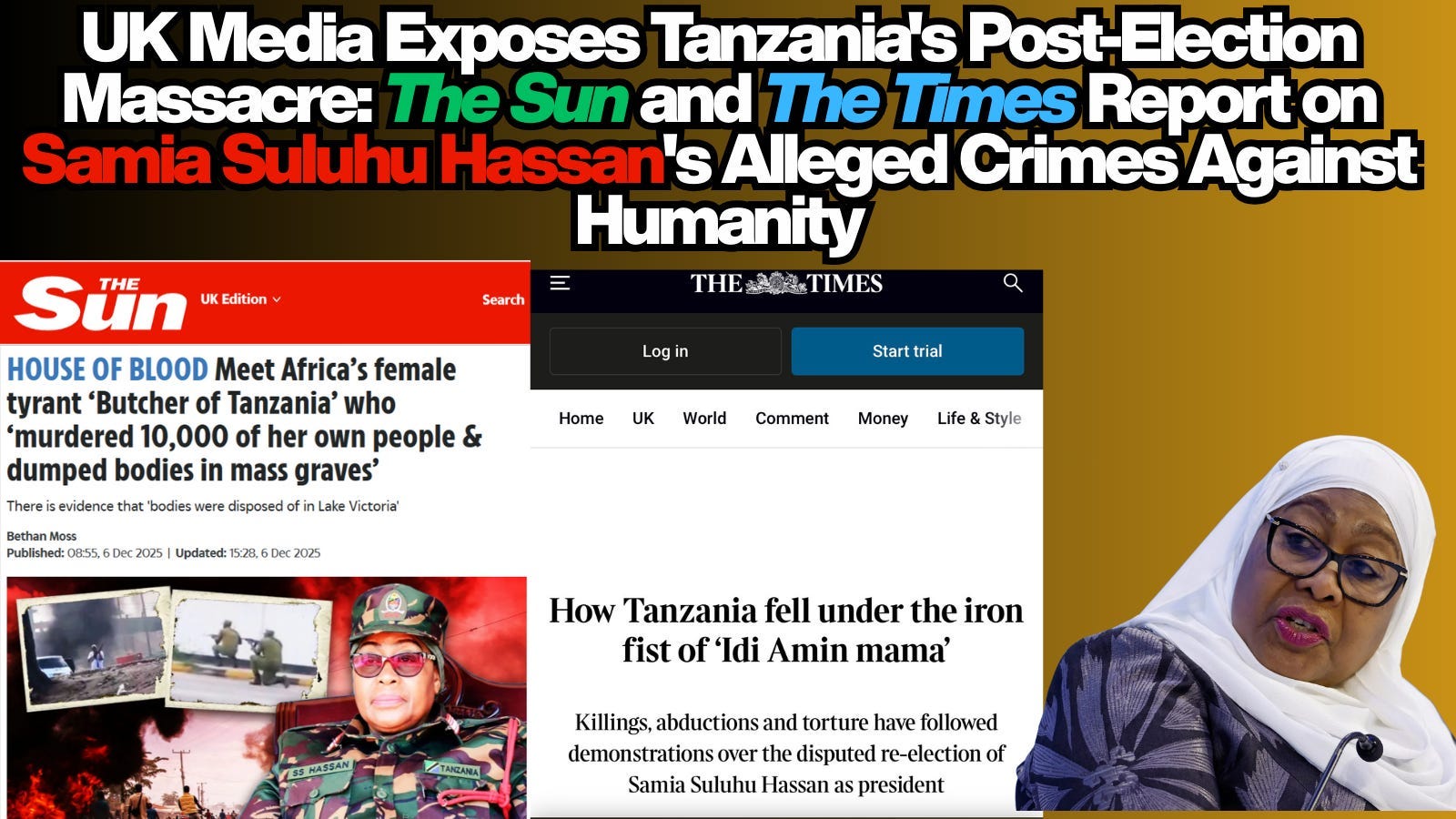
Samia Suluhu Hassan’s first 100 days of her second term (3 November 2025–11 February 2026) have been defined by the violent aftermath of a disputed election, international isolation, and a contested reconciliation process. Inaugurated after claiming 97.66% of the vote in polls the African Union declared non-compliant with democratic standards, she has presided over approximately 10,000 extrajudicial killings according to ICC submissions, US travel restrictions, the ongoing treason trial of opposition leader Tundu Lissu, and a state-appointed commission of inquiry rejected by the opposition as a tool of regime narrative control.
📑 Table of Contents
How Did Tanzania’s October 2025 Election Produce This Crisis?
What Happened During the Post-Election Crackdown?
What Has Samia’s Government Done in the First 100 Days?
What Is the International Fallout?
What Are the Intelligence and Security Implications?
How Should the First 100 Days Be Assessed?
How Did Tanzania’s October 2025 Election Produce This Crisis?
The crisis that defines Samia’s second-term opening did not begin on election day. It was engineered over the preceding months through a systematic elimination of credible opposition.
In April 2025, Chadema chairman Tundu Lissu was arrested on treason charges after calling for electoral reforms at a rally in Mbinga. Treason is non-bailable under Tanzanian law and carries the death penalty. As of 9 February 2026, Lissu remains in prison, representing himself after alleging prison authorities prevented him from conferring with lawyers in private. His most recent hearing was adjourned after he objected to the prosecution’s proposal for secret witnesses in enclosed cells.
Chadema was disqualified from the election on 12 April 2025 after the Independent National Electoral Commission (INEC) claimed the party failed to sign a code of conduct. ACT-Wazalendo candidate Luhaga Mpina was subsequently barred in a reversal of an earlier decision allowing his candidacy. With both main opposition parties eliminated, Samia faced only minor-party candidates and no credible challenger.
The internal regime dynamics that produced this outcome were partly illuminated by whistleblower Humphrey Polepole, a longstanding CCM minister and Tanzania’s ambassador to Cuba, who publicly resigned in July 2025. In a series of videos, Polepole alleged that a group of wealthy Tanzanians had exploited Magufuli’s authoritarian architecture to seize control of the government under Samia.
The result — 97.66% of 31.9 million ballots cast, on a claimed 82% turnout from 37.6 million registered voters — was described by BBC, the Daily Nation, and other international outlets as evidence of electoral fraud. For context, Magufuli received 12.5 million votes from 14.8 million cast (50.7% turnout from 29.8 million registered) in 2020. The claimed more-than-doubling of voter turnout in five years strained credulity.
The pattern was not new. In the November 2024 local elections, the ruling CCM party had already won 98% of seats — a rehearsal, in effect, for the presidential outcome twelve months later.
What followed election day was Tanzania’s worst political violence since independence.
What Happened During the Post-Election Crackdown?
Protests erupted in Dar es Salaam, Arusha, Mbeya, and Mwanza on 29 October 2025. Security forces responded with what the UN Human Rights Office described as “widespread and systematic human rights violations,” including extrajudicial killings, enforced disappearances, and mass arbitrary detentions. Key documented facts:
Approximately 10,000 killed: The formal ICC submission filed by Intelwatch — the first of four cases presented to the court — alleges that between 5,000 and 10,000 people were killed over three days following the election protests. This figure is derived from morgue documentation, hospital records, and thousands of videos showing execution-style killings. One morgue alone reportedly contained 800 bodies. Security forces used live ammunition rather than crowd-control measures, with evidence of targeted executions including sniper attacks from significant distances. Medical professionals were reportedly threatened with death if they released casualty figures — which explains the limited early reporting. Jumuiya ni Yetu, a coalition of over 40 African civil society organisations assembling evidence independently, corroborated the range based on compiled names and lists of families searching hospitals and police stations. The ICC submission names Samia and her son, Abdul Hafidh Ameir — who allegedly heads Tanzania’s intelligence services and is believed to have directed the operations — among the perpetrators. The government has refused to produce any casualty count of its own.
Internet shutdown: A complete blackout from 29 October to 3 November prevented documentation of violations.
Concealment of evidence: Security forces were observed removing bodies from streets and hospitals to undisclosed locations. A CNN investigation indicated the existence of mass graves. Morgues were reportedly filled with bodies, mostly young men.
Mass treason charges: Hundreds were charged with treason, including children. A fact-finding mission by the Tanzania Human Rights Defenders Coalition, Tanganyika Law Society, and Legal and Human Rights Centre documented over 700 individuals brought to court from at least nine regions by 18 November 2025.
Shoot-to-kill orders: UN experts reported disturbing evidence that officers were given orders to shoot to kill during the enforced curfew.
Inauguration under lockdown: Samia was sworn in on 3 November at a military parade ground in Dodoma, closed to the public — an unprecedented departure from Tanzania’s tradition of open stadium inaugurations.
The Council on Foreign Relations characterised the election as a process where the state “waged a campaign of dodgy legal maneuvers and even more alarming abductions and torture” to clear the field, and where security forces responded to protests with deadly force.