

Ujasusi Blog’s East Africa Monitoring Team | 21 March 2026 | 0515 GMT
An intelligence source claims President Samia Suluhu Hassan personally directed the Chande Commission of Inquiry to deliver three specific outcomes: exonerate her of political culpability for the 29 October 2025 massacres; assign institutional blame to CHADEMA for the protests; and affirm that CHADEMA chairman Tundu Lissu committed treason by inciting the public to demonstrate. The source further alleges that Samia reviewed the commission’s preliminary findings before the original February 2026 deadline, rejected them as politically unacceptable, and engineered the 42-day extension specifically to compel revisions aligned with all three directives.
🔍 What Is the Chande Commission and Why Does Its Mandate Matter?
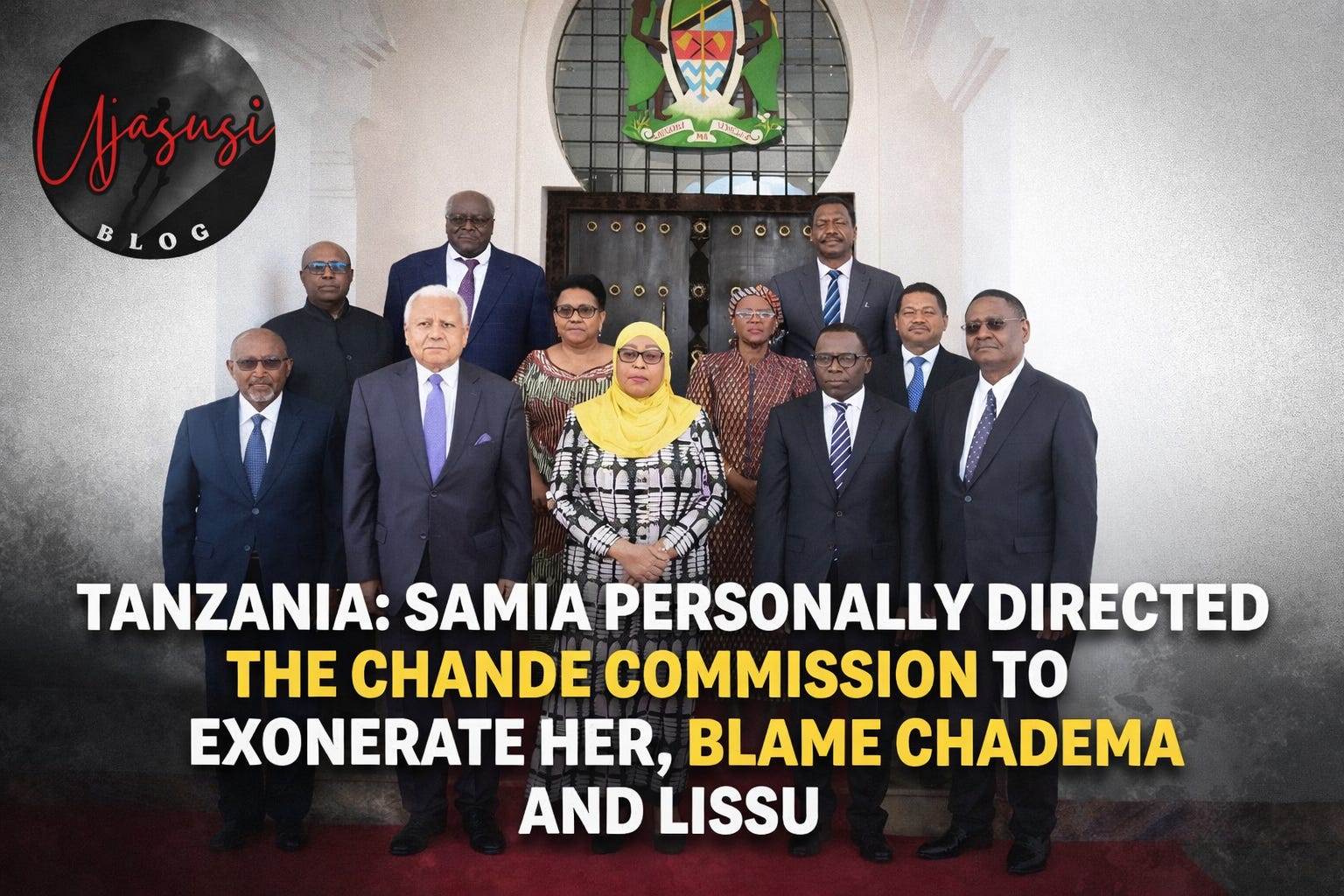
The Commission of Inquiry into violence surrounding Tanzania’s 29 October 2025 general election was established under executive authority on 18 November 2025, operating within the Commissions of Inquiry Act, Cap 32 2023. Its original mandate ran for 90 days, but an unexpected tenure extension pushed the reporting deadline to 3 April 2026.
The commission is chaired by retired Chief Justice Mohammed Chande Othman, with members drawn from the fields of governance, security, and law. Other members include Lieutenant General Paul Ignace Mella, a former army intelligence chief, former Police Inspector General Said Ally Mwema, retired Chief Justice Professor Ibrahim Hamis Juma, Ambassador Ombeni Sefue, Ambassador Radhia Msuya, Ambassador David Kapya, and former Minister of Defence Stergomena Tax.
On its face, the commission presents a credentialled composition. In intelligence terms, however, composition is secondary to mandate architecture and the incentive structures governing commissioners’ institutional loyalties. Every named commissioner is a retired government official. None represents civil society, an independent professional body, or any entity structurally removed from executive patronage. The absence of independent representation has been central to legal challenges against the commission since its formation.
Critics applying UN and African Union standards have argued that the commission is, by design, an executive tool serving at the President’s discretion — structurally distinct from a judicial inquiry. Its Terms of Reference narrow the investigative lens to “incidents of violence and breaches of peace,” a framing that sidesteps credible reports of gross human rights violations, including arbitrary detention, enforced disappearances, torture, extrajudicial killings, and the nationwide internet shutdown. That framing was written into the Terms of Reference by the executive before a single witness appeared. This is structural predetermination at the document-drafting stage, independent of whatever directional guidance the intelligence source alleges was subsequently issued.