



Sahel: Ongoing infighting between al Qaeda and Islamic State–affiliated militants in the Burkina Faso, Mali, and Niger tri-border area that has surged since the French withdrawal from Mali in 2022 will likely increase local support for both groups. Ethnic tensions have played into the clashes and worsened human rights abuses against civilians, forcing locals to support a side for protection. The al Qaeda–linked faction will likely remain the dominant group in the region but be unable to eliminate the Islamic State militants. The resulting stalemate will likely become a self-feeding conflict that will strengthen both sides in the coming months and years.
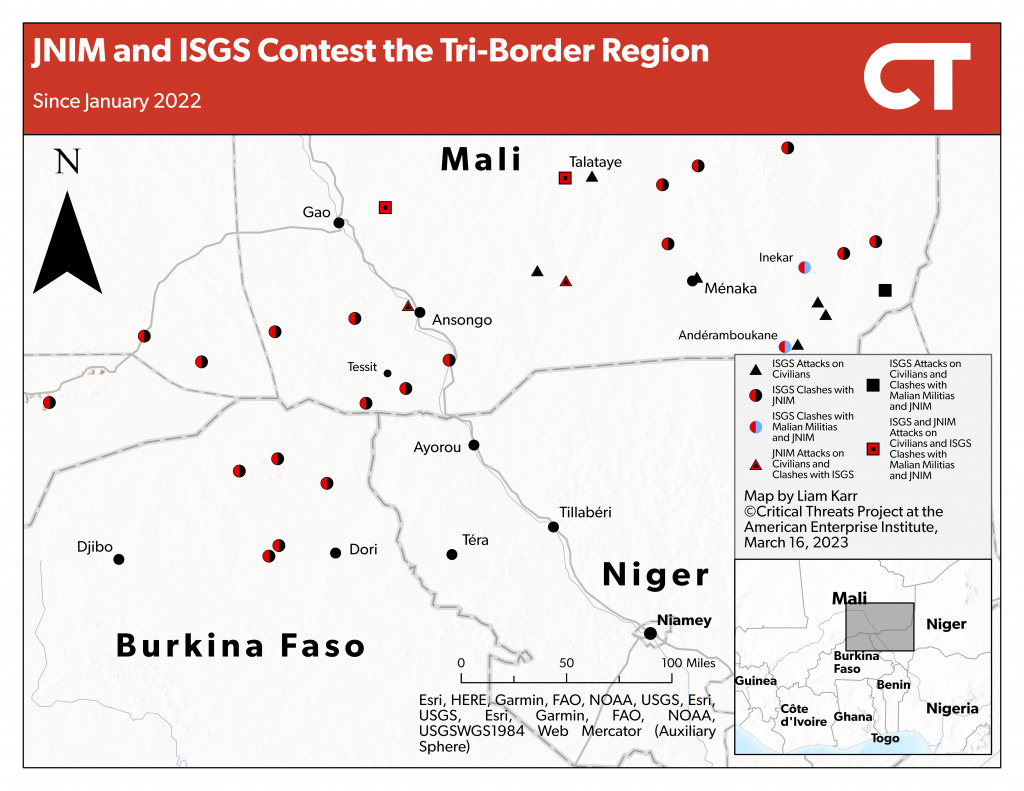
Sahel. Al Qaeda in the Islamic Maghreb affiliate Jama’at Nusrat wa al Muslimeen (JNIM) and the Islamic State’s Sahel Province (ISGS) have clashed several times in northeastern Mali since late February 2023. The recent clashes are part of a surge in inter-jihadi violence between the two groups that began in the last quarter of 2022 following the French withdrawal from Mali.[20] The French drawdown in Mali throughout 2022 created a security vacuum that allowed ISGS to expand across northeastern Mali. The group simultaneously carried out retaliatory massacres against vulnerable Tuareg communities that had partnered with French forces and have been historical targets for recruitment to al Qaeda–linked groups.[21] JNIM moved to present itself as the only viable security partner for these communities as ISGS attacks approached JNIM-dominated areas of northeastern Mali.[22] These developments brought the groups into widespread conflict by September 2022, as JNIM sought to push back ISGS alongside other local actors in northern Mali.[23]
The groups’ ties to rival ethnic groups in the area have exacerbated the severity of human rights abuses stemming from the infighting. JNIM and ISGS have repeatedly appealed to long-standing tensions between rival Tuareg and Fulani communities in the area to boost recruitment over the past decade. These connections have made the infighting a vehicle for ethnic violence, including massacres of local populations.[24] ISGS has been the primary perpetrator of such abuses, although JNIM has also carried out several retaliatory massacres.[25]
The increasing violence against civilians is strengthening both sides—but primarily JNIM—by forcing locals to align with a group for protection.[26] Salafi-jihadi groups have consistently used human rights abuses by ethnic militias and security forces as a recruitment tool in Africa and around the world.[27] Abuses by rival Salafi-jihadi groups are now having the same impact in the Mali, Niger, and Burkina Faso tri-border region. ISGS’s overzealous behavior both decreases ISGS’s appeal and plays into JNIM’s strategy.[28] The ISGS massacres in northeastern Mali have already driven local leaders and several militia groups, including loyalist groups with ties to the Malian government, to partner with JNIM.[29] Still, the UN assessed in a February 2023 report that ISGS has enhanced its capacity by increasing recruitment among the local Fulani population at risk of retaliatory attacks from JNIM or Tuareg militia groups.[30]
JNIM will likely remain the dominant Salafi-jihadi group in the Sahel. JNIM is comparatively stronger than ISGS, boasting more fighters and money due to more extensive taxation networks and likely greater participation in the kidnap-for-ransom economy.[31] JNIM and its affiliates’ more flexible and community-based approach to co-opting local populations has also shown to be more successful in spreading its influence across its area of operations and even creating counter-ISGS coalitions, such as in the case of northeastern Mali.[32]
JNIM is unlikely to eliminate ISGS and the threat it poses in the tri-border region. French and international counterterrorism operations, combined with infighting with JNIM, were key to degrading ISGS’s capabilities in 2020.[33] However, these international efforts were unable to eliminate ISGS. JNIM cannot fill the capability gap created by the French withdrawal from Mali and the collapse of the regional Sahel G5 counterterrorism force.[34] JNIM is trying to compensate for the loss of international pressure on ISGS by cooperating with local militia groups. This coalition will still likely fail to fill the capability gap, and varying incentives, goals, and relationships could further restrict cooperation and limit the coalition’s effectiveness.[35]
While JNIM’s inability to eliminate ISGS will not end the conflict, it will likely create a self-feeding stalemate that continues to spread human rights abuses and strengthen both groups’ hold over affected communities in the coming months and years. The JNIM-ISGS stalemate will lead to cycles of communal mobilization and violence that will strengthen both groups’ hold over local communities as the two groups seek to protect their constituencies.
[19] https://www.understandingwar.org/report/al-qaeda-iraq-resurgent
[20] https://www.criticalthreats.org/briefs/africa-file/africa-file-al-qaeda-linked-militants-take-control-in-northern-mali; https://www.criticalthreats.org/analysis/salafi-jihadi-movement-weekly-update-january-25-2023
[21] https://www.criticalthreats.org/briefs/africa-file/africa-file-al-qaeda-linked-militants-take-control-in-northern-mali; https://www.criticalthreats.org/analysis/salafi-jihadi-movement-weekly-update-january-25-2023
[22] https://www.criticalthreats.org/analysis/salafi-jihadi-movement-weekly-update-january-25-2023
[23] https://www.criticalthreats.org/briefs/africa-file/africa-file-al-qaeda-linked-militants-take-control-in-northern-mali
[24] https://www.crisisgroup.org/africa/sahel/niger/289-sidelining-islamic-state-nigers-tillabery; https://www.ushmm.org/m/pdfs/Mali_Report_English_FINAL_April_2018.pdf; https://www.cairn.info/revue-herodote-2019-1-page-43.htm
[25] https://www.hrw.org/news/2022/10/27/mali-coordinated-massacres-islamist-armed-groups; https://www.reuters.com/world/africa/dozens-killed-jihadist-groups-clash-eastern-mali-2022-12-08;

[26] https://www.criticalthreats.org/briefs/africa-file/africa-file-al-qaeda-linked-militants-take-control-in-northern-mali
[27] https://www.aei.org/wp-content/uploads/2023/02/Secure-Communities.pdf; https://www.aei.org/wp-content/uploads/2022/12/The-Underestimated-Insurgency-Continued-Salafi-Jihadi-Capabilities-and-Opportunities-in-Africa.pdf; https://www.criticalthreats.org/analysis/we-must-do-more-than-over-the-horizon-to-fight-terrorism; https://www.criticalthreats.org/wp-content/uploads/2019/10/Beyond-Counterterrorism.pdf; https://www.criticalthreats.org/analysis/how-ansar-al-islam-gains-popular-support-in-burkina-faso
[28] https://ctc.westpoint.edu/the-end-of-the-sahelian-anomaly-how-the-global-conflict-between-the-islamic-state-and-al-qaida-finally-came-to-west-africa
[29] https://www.criticalthreats.org/briefs/africa-file/africa-file-al-qaeda-linked-militants-take-control-in-northern-mali
[30] https://undocs.org/Home/Mobile?FinalSymbol=S%2F2023%2F95&Language=E&DeviceType=Desktop&LangRequested=False