


Introducing “Ujasusi Blog | The Spymasters Desk: Tracking appointments, sackings, retirements, and power shifts inside global intelligence services.”
🔓FREE ACCESS
Please consider becoming a paid subscriber
The appointment of Sabry Khan as Director General of the Seychelles Intelligence Service (SIS) on 6 January 2026 represents a presidential decision grounded in the Seychelles Intelligence Service Act 2018, following National Security Council recommendations and parliamentary consultations. The appointment places an experienced aviation security and law enforcement professional at the apex of Seychelles’ national intelligence architecture, though procedural complications surrounding parliamentary oversight temporarily delayed the process.
What is the core significance of Sabry Khan’s appointment as SIS Director General?
Institutional continuity: Ensures leadership continuity at SIS following the conclusion of predecessor Benediste Hoareau’s tenure in December 2025, preventing operational vacuum in national security apparatus.
Aviation security expertise transfer: Khan’s 14 years at Air Seychelles and four years heading Seychelles Airports Authority security operations positions him to prioritise air and maritime domain awareness.
Multi-agency operational experience: Career spanning Seychelles Police Force, airline security, and critical infrastructure protection provides inter-agency coordination capacity essential for intelligence fusion.
Parliamentary oversight reinforcement: The temporary withdrawal and resubmission process demonstrates executive commitment to constitutional governance despite presidential appointment prerogative.
What procedural complications surrounded the appointment process?
Initial appointment and withdrawal sequence
The appointment process encountered significant procedural challenges related to parliamentary oversight mechanisms:
5 December 2025: Appointment process initiated following Hoareau’s tenure conclusion
29 December 2025: Khan sworn in at State House by President Dr. Patrick Herminie
Late December 2025/Early January 2026: Appointment temporarily withdrawn after Office of the President advised that Defence and Security Committee of National Assembly had not yet been constituted
6 January 2026: Appointment re-confirmed following formal submission to National Assembly and consultation with reconstituted Defence and Security Committee
Constitutional governance considerations
Advisory consultation requirement: The SIS Act 2018 mandates consultation with National Assembly’s Defence and Security Committee, though consultation is advisory rather than determinative.
Presidential prerogative: Final appointment authority rests solely with President under statutory framework, with parliamentary consultation serving oversight rather than veto function.
Transparency commitment: Voluntary withdrawal despite legal authority to proceed demonstrates executive branch commitment to constitutional norms and parliamentary respect.
Precedent establishment: Process establishes procedural template for future intelligence leadership appointments requiring both executive efficiency and legislative oversight.
What is the legal and institutional framework governing the Director General position?
Statutory basis and appointment mechanism
The Director General of SIS operates within a clearly defined legal architecture:
Enabling legislation: Seychelles Intelligence Service Act 2018 establishes SIS as statutory intelligence agency with defined functions, powers, and accountability mechanisms.
Appointing authority: President of the Republic of Seychelles, acting on recommendation of National Security Council.
Consultation requirement: Mandatory consultation with Defence and Security Committee of National Assembly prior to appointment.
Oversight architecture: SIS reports to National Security Council chaired by President, including Attorney-General, Commissioner of Police, and Chief of Defence Forces.
Core mandate and functional responsibilities
The SIS mandate encompasses:
Threat detection: Establish mechanisms for detecting threats to Seychelles’ security and institutional integrity.
National protection: Protect Seychelles’ security through intelligence collection, analysis, and dissemination.
Inter-agency collaboration: Work in coordination with law enforcement agencies and public institutions on intelligence-sharing and operational support.
Early warning: Develop and maintain early warning systems for emerging security threats.
Who is Sabry Khan in professional and operational terms?
Career trajectory and operational experience
Khan’s professional background demonstrates multi-domain security expertise:
Seychelles Airports Authority (2022–2025)
Position: Head of Aviation Security
Responsibilities: Led implementation of ICAO Annex 17 Aviation Security standards and National Civil Aviation Security Programme of Seychelles
Operational focus: Coordinated airport security operations, access control and screening measures, aviation security training programmes
Critical infrastructure protection: Safeguarded Seychelles International Airport as strategic national asset and primary international gateway
Air Seychelles (approximately 2008–2022)
Position: Head of Security
Duration: 14 years of airline security leadership
Domain expertise: Aviation security, passenger screening, cargo security, airline threat assessment
Regulatory compliance: Ensured Air Seychelles compliance with international aviation security standards
Seychelles Police Force (career foundation)
Final posting: Regional Commander
Rank: Superintendent of Police
Operational experience: Law enforcement operations, internal security, crime prevention, public order management
Command experience: Leadership of geographically dispersed police operations
Professional attributes relevant to intelligence leadership
Cross-domain operational knowledge: Direct experience across policing, airline security, and airport authority operations provides holistic understanding of national security ecosystem.
Critical infrastructure protection expertise: Deep familiarity with safeguarding airports, aviation systems, and transport hubs—Seychelles’ most critical economic and strategic assets.
International standards compliance: Extensive experience implementing ICAO Annex 17 and international civil aviation security frameworks translates to intelligence collection and analysis standards.
Inter-agency coordination capacity: Career spanning multiple security agencies demonstrates ability to build collaborative relationships essential for intelligence fusion.
Strategic risk management: Background in identifying, assessing, and mitigating aviation security threats applicable to broader national security threat assessment.
Your support keeps our team in the field.
What are the mandate priorities under Khan’s leadership?
Given Khan’s professional background and Seychelles’ threat environment, likely SIS priority domains include:
Aviation and maritime domain awareness
Air domain monitoring: Enhanced intelligence collection on aviation-related threats including terrorism transit risks, smuggling, and unauthorised intrusions into Seychelles airspace.
Maritime security intelligence: Intelligence support to counter piracy, illegal fishing, drug trafficking, and maritime boundary violations in Seychelles’ [1.35 million km² Exclusive Economic Zone]
Port and airport intelligence: Protection of Seychelles International Airport and Port Victoria as strategic economic chokepoints and potential terrorism targets.
Critical infrastructure protection
Energy security: Intelligence assessments protecting electrical generation, fuel storage, and energy distribution networks.
Telecommunications security: Monitoring threats to submarine cable landings and telecommunications infrastructure essential for tourism-dependent economy.
Tourism sector protection: Intelligence to safeguard [tourism sector] (31% of GDP in 2023, representing 41% of total exports) from terrorism, crime, and reputational risks.
Regional security coordination
Indian Ocean intelligence sharing: Collaboration with regional partners on shared maritime threats, terrorism, and transnational crime.
Counter-terrorism intelligence: Detection and disruption of terrorism transit routes potentially using Seychelles as logistics hub.
Economic security intelligence: Protection of offshore financial services sector and detection of money laundering and financial crime.
How does this appointment compare within African intelligence governance frameworks?
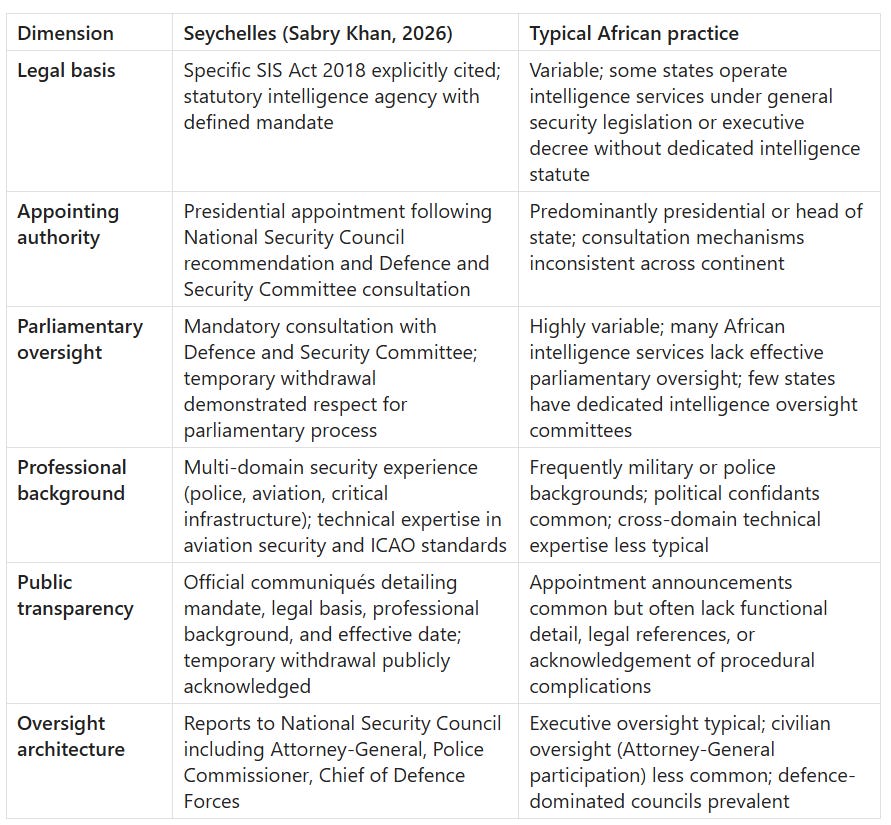
Governance best practice alignment
Khan’s appointment aligns with several international intelligence governance norms:
Statutory mandate: Operation under dedicated intelligence legislation (SIS Act 2018) rather than executive decree enhances legal clarity and accountability.
Parliamentary consultation: Structured engagement with legislative branch oversight committee, despite advisory nature, exceeds practices in many African states.
Professional qualification: Appointment based on demonstrable security expertise rather than solely political loyalty or military rank.
Transparency: Public disclosure of appointment process, legal basis, and professional qualifications supports democratic accountability.
Civilian oversight elements: Attorney-General inclusion in National Security Council provides legal oversight dimension often absent in defence-dominated intelligence structures.
What are the key implications and intelligence monitoring priorities?
Institutional evolution indicators
Analysts should monitor the following indicators of SIS institutional development under Khan’s leadership:
Operational emphasis shifts
Aviation and maritime security intelligence products, reflecting Khan’s domain expertise
Critical infrastructure protection assessments targeting airports, ports, energy, and telecommunications
Enhanced intelligence-led policing frameworks integrating SIS intelligence with law enforcement operations
Inter-agency coordination mechanisms
Joint intelligence centres or fusion cells linking SIS with police, defence, immigration, and customs
Formalised intelligence-sharing protocols with Seychelles Airports Authority, Air Seychelles, and port authorities
Regional intelligence cooperation initiatives within Indian Ocean island states
Capacity building priorities
Aviation security intelligence training programmes leveraging Khan’s ICAO Annex 17 expertise
Maritime domain awareness enhancement using satellite surveillance and vessel tracking systems
Technical intelligence collection capabilities targeting communications and cyber threats
Governance and oversight evolution
Parliamentary oversight mechanisms
Implementation of regular SIS reporting to Defence and Security Committee
Possible legislative amendments to SIS Act 2018 based on operational experience
Development of classified intelligence briefing protocols for parliamentary leadership
Civil-military intelligence relations
Balance between civilian (police, aviation) and military intelligence equities within National Security Council
Khan’s civilian security background may shift intelligence community culture toward law enforcement rather than defence orientation
Regional intelligence cooperation
Enhanced participation in Regional Cooperation Agreement on Combating Piracy and Armed Robbery (RECAAP) intelligence-sharing
Expanded engagement with Indian Ocean Rim Association (IORA) security mechanisms
Bilateral intelligence partnerships with India, South Africa, and France (given Seychelles’ Commonwealth and Francophone ties)
Threat environment linkage
Structural vulnerabilities
Small island developing state with limited indigenous intelligence collection capabilities requires robust liaison relationships with foreign intelligence partners
Heavy dependence on tourism (31% of GDP, 41% of exports) and offshore finance creates economic security vulnerabilities requiring intelligence early warning
Strategic location in western Indian Ocean exposes Seychelles to terrorism transit risks, piracy spillover, and great power competition
Priority threat assessments
Terrorism: Detection of jihadist transit through Seychelles en route to/from East Africa or South Asia theatres
Transnational crime: Intelligence on drug trafficking, arms smuggling, and human trafficking using maritime routes
Economic security: Protection of tourism reputation, offshore financial services integrity, and critical revenue streams
Foreign interference: Monitoring great power competition dynamics (India-China; U.S.-China) affecting Seychelles’ strategic autonomy
Conclusion: Strategic intelligence assessment
Sabry Khan’s appointment as Director General of the Seychelles Intelligence Service marks a consequential transition in the country’s intelligence leadership, characterised by:
Professional expertise precedent: Selection based on demonstrable aviation security, law enforcement, and critical infrastructure protection experience rather than solely political or military credentials
Procedural governance strengthening: Temporary withdrawal and re-confirmation process establishes parliamentary consultation norms despite executive appointment prerogative
Operational emphasis shift: Likely prioritisation of aviation and maritime domain awareness, critical infrastructure intelligence, and inter-agency coordination reflecting Khan’s background
Regional governance model: Seychelles’ statutory intelligence framework and parliamentary oversight mechanisms exceed practices in many African states, potentially serving as governance template
The appointment effective 6 January 2026 provides a clear reference point for tracking doctrinal, operational, and institutional developments within Seychelles’ intelligence architecture. Analysts should monitor Khan’s strategic priorities, resource allocation decisions, inter-agency coordination mechanisms, and regional intelligence cooperation initiatives to assess SIS evolution under his leadership.
Primary sources: