🕵️ Alleged Assassination Plot or Hotel Misunderstanding? Rwanda-DRC Diplomatic Crisis Erupts in Washington

Ujasusi Blog’s Great Lakes Region Monitoring Team | 26 March 2026 | 0330 GMT

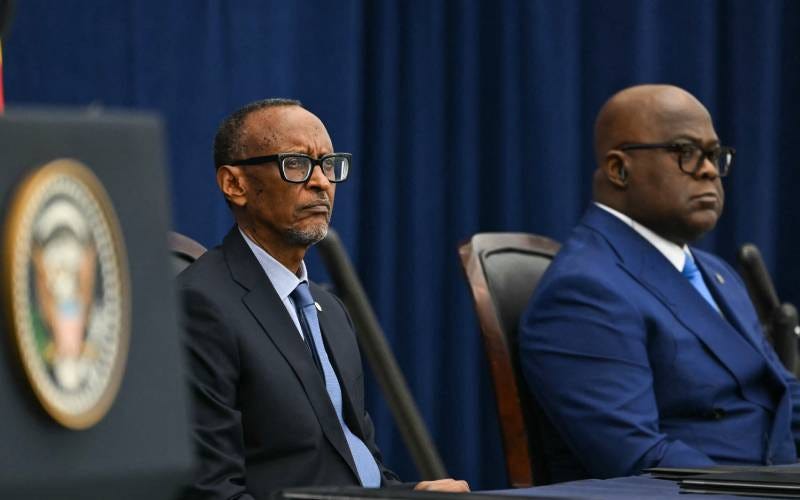
On 25 March 2026, a security confrontation between Rwandan and Congolese protection details at a Washington, D.C. hotel escalated into a diplomatic crisis, with the Democratic Republic of Congo alleging that Rwandan operatives attempted to breach DRC First Lady Denise Nyakeru Tshisekedi’s hotel room — an incident Congolese media framed as an assassination attempt — and Rwanda dismissing the allegation as fabricated provocation.
What Happened in the Rwanda DRC First Lady Hotel Incident?
The incident occurred at a Washington hotel where both delegations were staying during the Fostering the Future Together Coalition Summit, convened by US First Lady Melania Trump on 24–25 March and attended by spouses of leaders from 45 nations.
DRC Government Spokesperson Patrick Muyaya Katembwe stated that individuals suspected of being Rwandan security operatives attempted to breach Nyakeru’s hotel room at approximately 12:00 PM New York time. The First Lady’s protection detail intervened, producing a brief confrontation before the suspects withdrew. Muyaya confirmed Nyakeru was unharmed and that Kinshasa had notified US security authorities for investigation.
Rwanda’s Embassy in Washington offered a sharply different account. An unarmed member of a Rwandan VIP security detail inadvertently encountered DRC security agents in a hotel hallway accessible to all guests. The Rwandan officer was briefly prevented from using an elevator, an action Kigali termed inappropriate conduct in a shared space. The embassy stated the matter was resolved without escalation and that the Rwandan delegation subsequently relocated to a separate hotel, during which its personnel were harassed and filmed by unidentified individuals. The embassy characterised the DRC’s version as a gross misrepresentation containing contemptible lies. US authorities have issued no public statement.
Why Are Rwanda DRC Tensions Escalating Over the Hotel Incident?
The confrontation sits within a rapid sequence of escalatory events. The Washington Accords for Peace and Prosperity, signed on 4 December 2025 with Presidents Tshisekedi and Kagame under US President Trump’s mediation, committed both sides to a permanent ceasefire, Rwandan troop withdrawal, and Congolese action against the FDLR militia. Six days later, M23/AFC forces captured the strategic city of Uvira.
On 2 March 2026, the US Treasury Department’s Office of Foreign Assets Control sanctioned the Rwanda Defence Force and four senior commanders — Maj. Gen. Vincent Nyakarundi, Maj. Gen. Ruki Karusisi, Gen. Mubarakh Muganga, and Brig. Gen. Stanislas Gashugi — for actively supporting, training, and fighting alongside M23. Mediation talks on 17–18 March produced what US officials called concrete de-escalation steps. One week later, the hotel confrontation erupted on the same American soil where the Accords were signed.
How Does Rwanda’s Transnational Operations Record Shape This Analysis?
Freedom House classifies Rwanda’s extraterritorial operations as exceptionally broad in tactics, targets, and geographic reach. The Human Rights Watch 2023 report documented over a dozen killings, kidnappings, enforced disappearances, and physical attacks targeting Rwandans abroad in at least seven countries since 2014. High-profile cases include the 2014 murder of former intelligence chief Patrick Karegeya in a Johannesburg hotel, multiple assassination attempts against Lt. Gen. Kayumba Nyamwasa in South Africa, and the 2020 rendition of Paul Rusesabagina. The FBI listed Rwanda in January 2022 among governments facilitating transnational repression against US-based victims.
This record confirms Kigali’s institutional capability for extraterritorial operations. However, targeting the sitting First Lady of a neighbouring state during a US-hosted summit would be an entirely different operational category. Three weeks after Washington sanctioned the Rwandan military, the risk-reward calculus of such an attempt on American soil would be irrational.
What Is the Operational Intelligence Assessment?
Ujasusi Blog’s independent judgement is that the incident most likely falls between both governments’ stated positions. The most plausible scenario, assessed against Kigali’s documented tradecraft and operational context, is that Rwandan security personnel were conducting proximity surveillance of the DRC delegation — a standard intelligence collection activity during high-stakes diplomatic engagements — and that this was detected by DRC agents, producing the physical confrontation.
Three indicators support this assessment. First, both delegations occupying the same hotel during active mediation, when monitoring the opposing side’s communications and movements, carries significant operational value. Second, Rwanda’s immediate decision to change hotels was consistent with a blown surveillance position rather than an inadvertent encounter. Third, the filming of departing Rwandan personnel, suggesting the DRC detail had shifted into counter-intelligence documentation mode.
If correct, Kinshasa’s escalation to assassination allegations represents a deliberate information operation — weaponising a detected intelligence activity to extract maximum diplomatic leverage while Rwanda operates under US sanctions pressure.
What Are the Implications for East African Diplomatic Stability?
The incident carries three forward-looking consequences. First, future mediation sessions will require physical separation protocols and likely US Secret Service involvement in managing both delegations, slowing an already stalled implementation process. Second, Kinshasa has acquired a durable leverage point: the assassination allegation will feature in every subsequent diplomatic communication with Western governments, the African Union, and the UN Security Council, reinforcing the East African Community’s existing credibility strain as a regional mediator. Third, the Trump administration’s capacity to manage both the diplomatic and intelligence dimensions of the Rwanda DRC conflict is being tested in ways the December 2025 signing ceremony did not anticipate.
The physical confrontation lasted minutes; the information operation built around it will shape bilateral dynamics for months. Whether this incident accelerates or merely punctuates the deterioration depends on whether the US investigation produces findings that support either account, or whether the ambiguity persists, allowing both Kinshasa and Kigali to maintain competing versions as instruments of influence in a conflict where information control remains as contested as territory.
Independent intelligence analysis takes time and resources — if this work matters to you, please consider supporting it by donating HERE