

Ujasusi Blog’s Eastern Europe Desk | 19 January 2026| 1745 GMT
🔓FREE ACCESS
Please consider becoming a paid subscriber
You can also donate.
What Happened: Intelligence Operatives Disguised as Religious Workers
Russian military intelligence (GRU) successfully embedded operatives disguised as Belarusian nuns in approximately 20 Swedish churches during 2023-2024, selling religious handicrafts whilst advancing Kremlin propaganda objectives. The operation involved the St Elisabeth Convent, a Belarusian religious organisation with documented GRU connections, which deployed personnel to Sweden under the cover of charitable fundraising activities.
Concurrently, the Russian Orthodox Church constructed a surveillance facility disguised as a church precisely 300 metres from Stockholm Västerås Airport, a strategic contingency airport critical to Sweden’s national security. Swedish intelligence services assess this facility as “probably being used as a platform for espionage.”
These operations represent textbook Russian hybrid warfare: exploiting democratic openness and religious tolerance to embed intelligence assets within NATO territories whilst maintaining plausible deniability.
The Täby Incident: How the Operation Was Discovered
In December 2023, nuns from St Elisabeth Convent appeared at a church in Täby, an affluent Stockholm suburb, wearing white headscarves and bearing crosses. They sold wooden handicrafts, knitwear, and religious icons from tables in the church hallway—with full permission from the rector, Michael Öjermo.
To parishioners, nothing seemed unusual. Sweden’s churches are traditionally welcoming to Christians from former Soviet states, and the rector had previously hosted the nuns before Russia’s 2022 invasion of Ukraine.
However, Swedish intelligence services and investigative journalists soon revealed the nuns’ true affiliations. The Church of Sweden issued an urgent warning to all congregations, stating that St Elisabeth Convent “use their income to support Russian nationalism, support Russia’s aggression against Ukraine, and have close ties with GRU”—Russia’s military intelligence service.
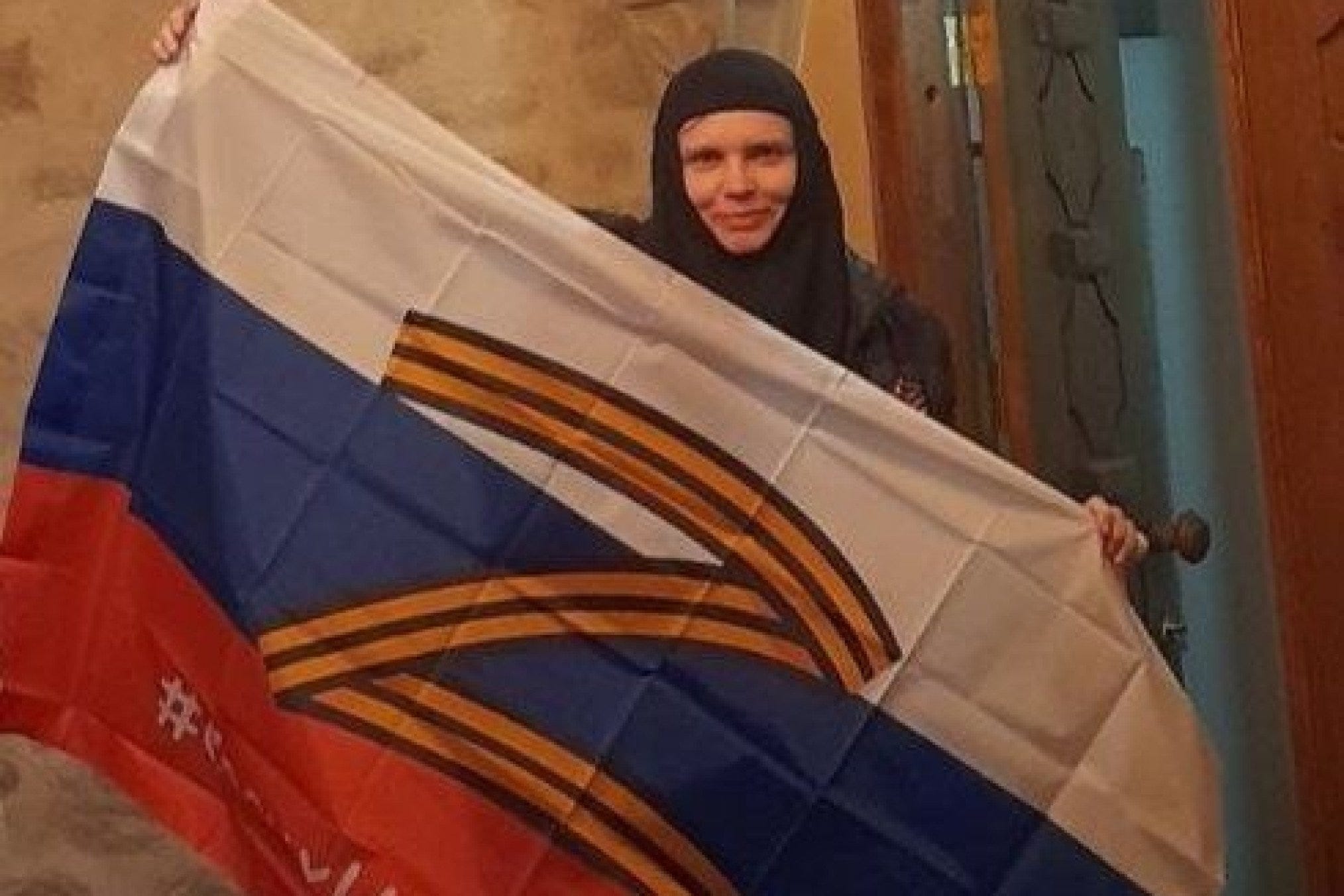
The convent’s spiritual leader, Archpriest Andrey Lemeshonok, has described his nuns as a “combat unit.” They’ve become known as “Z-Nuns” for posing with the “Z” symbol marking Russian military vehicles in Ukraine.
Who Are the “Z-Nuns”? The St Elisabeth Convent’s Military Connections
Open-source intelligence reveals extensive St Elisabeth Convent involvement in supporting Russian military operations:
Documented Activities in Occupied Ukraine:
Nuns photographed wearing ballistic flak jackets in Russian-occupied territories
Operations supporting Russian soldier morale
Posing with pro-invasion “Z” symbols for propaganda photography
Working alongside Russian military units
International Operations:
Previously sold handicrafts at Winchester Cathedral in Britain until banned in 2022
Operated across approximately 20 Swedish churches
Mobile operations using vans to visit multiple parishes briefly
Fundraising activities across Europe
The Church of Sweden’s official statement directly contradicted the convent’s claims of purely charitable work: “The monastery claims that the proceeds [of handicrafts] go to charitable causes. This is not true.”
What the Swedish Rector Says: “They Can Be Used as Propaganda”
Rector Öjermo, who granted the nuns access to Täby church, disputes the label “spy nuns” as he witnessed no active intelligence gathering. In his experience, they simply arrived in a van, sold items, and departed for the next parish.
However, he acknowledged understanding—only in 2024—how the operation advanced Russian propaganda: “What I understood this time, that I didn’t understand before, is that they can be used as propaganda. I didn’t make that conclusion before, and I see that can be a problem.”
The rector referenced his Cold War experience with East German ministers: “I’m old enough to remember when ministers came from the German Democratic Republic... if three came, two would be for real and one would be a spy for the Stasi. So, to me, it wasn’t a big problem to meet people from a church that I knew was dependent on a state that wasn’t ‘OK’ in my eyes.”
He rejected suggestions that parishioners unwittingly funded Russia’s war: “A small number of people showed up and bought some [trinkets], that cannot fund a war, absolutely not.”
The church has since displayed a Ukrainian flag and pro-Ukraine notices, making clear which side it supports.
The Västerås Church: A Surveillance Platform Near Strategic Airport
Whilst the nuns conducted mobile operations, Russian intelligence achieved something more permanent in Västerås, a city 60 miles west of Stockholm.
The Orthodox Church of the Holy Mother of God of Kazan—complete with golden crosses and onion domes—was constructed just 300 metres from Stockholm Västerås Airport (VST). This isn’t just any airport: VST possesses one of Sweden’s longest runways and serves as a designated “contingency airport” for emergency operations during national crises or military conflict.
Facility Characteristics Suggesting Intelligence Use:
Sealed off with perimeter fencing
Extensive CCTV camera coverage
Signs warning vehicles will be towed
Guard dog warnings
Remote location at the end of isolated country lanes
Consistently dark with no visible religious activity
Hostile posture towards visitors
Direct sightlines to airport runway operations
When journalists visited during winter 2024, the church appeared abandoned—lights off, no signs of life, buried under 20 inches of snow. The security measures and isolation seemed inconsistent with a functioning religious facility.
Swedish intelligence services assess the church as “probably being used as a platform for espionage,” specifically for monitoring airport operations. Notably, the church’s consecration ceremony in November 2023 was attended by Russian and Belarusian diplomats, one of whom has since been exposed as a Russian spy.
Sweden’s Broader Problem: Systematic Russian Exploitation
Kristina Smith, head of the Church of Sweden’s crisis-planning unit, confirmed the spy nuns represent part of a wider pattern. Speaking from beneath Uppsala Cathedral’s 13th-century spire, she revealed Russia has repeatedly attempted to manipulate Swedish parishes.
“We have given a general warning against letting the Russian Orthodox Church rent or borrow church facilities, because we noted the places they wanted to borrow were next to military installations,” Smith explained.
For a nation where churches traditionally welcome Christians from other denominations without hesitation, this represents a significant cultural shift.
“The full-scale invasion of 2022 was a rude awakening for a lot of Swedes,” Smith said. “We prided ourselves on not being at war for 200 years, for being a nice country, a country that everyone wanted to be nice towards, but I think it was an awakening for the entire country that that is not really the case.”
Why Sweden? Exploiting Democratic Openness
Eleonore Lundkvist, vice-chair of the opposition in Västerås city council, acknowledged that granting permission for the Orthodox church near the airport was “a serious mistake.” The council has vowed to reclaim the land.
She identified why Russia targeted Sweden specifically: “We are an open country, and we are open-minded to other cultures, and that’s a culture Russia has identified and concluded it will have no problems here.”
This exploitation of democratic values represents a core challenge in countering Russian hybrid warfare. The very characteristics that define open societies—religious tolerance, cultural welcoming, institutional trust—become vulnerabilities that adversarial intelligence services systematically exploit.
Sweden’s NATO accession in March 2024 has heightened security consciousness, but the spy nuns affair occurred whilst the country was still finalising membership. Sweden became NATO’s 32nd member, ending over 200 years of military non-alignment—a historic shift directly prompted by Russia’s invasion of Ukraine.
What Russia Gains: Intelligence Objectives Behind Religious Cover
Propaganda Value: Creating visual and narrative evidence that Swedish citizens welcome pro-Kremlin organisations, suggesting popular support for Russian positions despite governmental opposition to the Ukraine invasion.
Fundraising: Whilst individual parishes generated limited revenue, cumulative proceeds across 20 churches and similar European operations provided financial resources channelled towards supporting Russian military activities.
Legitimacy Building: Securing endorsement from respected Swedish religious institutions demonstrates that legitimate Western organisations welcome Russian-affiliated entities, undermining narratives of Russian international isolation.
Potential Intelligence Collection: Religious workers receive cultural deference and reduced scrutiny, providing opportunities for environmental awareness, social mapping, and identifying sympathetic individuals—standard preliminary intelligence activities.
The GRU’s Shadow War Across Europe
The Swedish operations form part of a broader GRU campaign of sabotage and subversion across Europe. According to the Centre for Strategic and International Studies, Russian attacks in Europe nearly tripled between 2023 and 2024, with the GRU—Russia’s Main Directorate of the General Staff—responsible for many operations either directly or through recruited agents.
GRU Unit 29155, specifically tasked with foreign assassinations and destabilisation operations, has been linked to multiple high-profile incidents including the Salisbury poisoning, ammunition depot explosions in Czechia, and cyberattacks across NATO member states. The unit operates alongside other GRU elements in executing Russia’s hybrid warfare strategy against Western allies.
What Happens Next: Swedish Counter-Measures
The Church of Sweden has issued formal warnings to all congregations advising against supporting St Elisabeth Convent activities. The statement explicitly notes the organisation’s GRU connections and false charitable claims.
Västerås city council has committed to reclaiming the land occupied by the Orthodox church near the airport, though legal processes remain ongoing.
Swedish intelligence services continue monitoring Russian intelligence activities, particularly focusing on attempts to establish presence near military installations and critical infrastructure.
The incident has prompted broader discussions within Swedish society about balancing traditional openness with necessary security measures—a challenge facing all NATO member states confronting Russian hybrid warfare.
Why This Matters: Hybrid Warfare Comes to Church
The spy nuns affair demonstrates how modern intelligence operations exploit cultural norms and institutional trust. Russia didn’t hack computer systems or deploy traditional spies with false identities—instead, they sent nuns selling wooden handicrafts to friendly church communities.
This approach succeeds because it operates within democratic societies’ legal frameworks whilst exploiting their cultural characteristics. Religious workers receive deference, churches welcome ecumenical engagement, and institutional trust reduces scrutiny.
For Sweden—a nation that prided itself on 200 years without warfare—the discovery of GRU-linked operatives in church hallways and surveillance facilities disguised as Orthodox churches represents a jarring collision with contemporary security realities.
As one elderly Täby parishioner reluctantly admitted when asked about the nuns, their handicrafts were “high quality”—before waving away further questions about Ukraine, whether from embarrassment or simply wanting to finish lunch in peace.
But Russia, of course, insists they’re just churches and just nuns—nothing more.
Analysis for Ujasusi Blog readers: This operation demonstrates classic GRU tradecraft adapted for 21st-century hybrid warfare environments. The use of religious cover, exploitation of democratic openness, and positioning near critical infrastructure all align with documented Russian intelligence doctrine. Sweden’s experience offers crucial lessons for other NATO members about balancing cultural values with security imperatives in an era of intensifying grey-zone operations.