

Ujasusi Blog East Africa Monitoring Team | 11 February 2026 | 0305 GMT
Summary
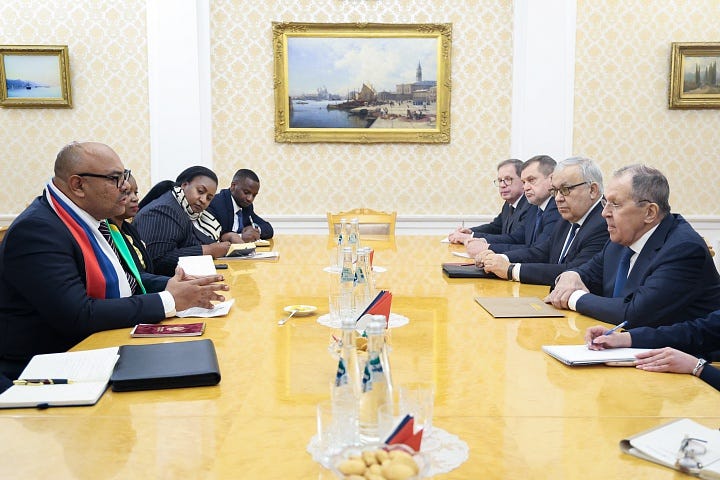
Tanzanian Foreign Minister Mahmoud Thabit Kombo met Russian Foreign Minister Sergey Lavrov in Moscow on 9 February 2026, delivering a letter from President Samia Suluhu Hassan to President Vladimir Putin. The talks mark a significant escalation in Russia–Tanzania bilateral relations and form part of Dar es Salaam’s wider diplomatic offensive to secure international partners willing to shield the regime from accountability for the approximately 10,000 civilians killed during and after the disputed October 2025 general elections.
Table of Contents
Why Is Tanzania Deepening Ties With Russia Now?
What Happened on October 29 — and Why It Matters for This Analysis
How Does the Moscow Visit Fit Into Tanzania’s Broader Diplomatic Rehabilitation Strategy?
What Are the Concrete Pillars of Russia–Tanzania Cooperation?
What Does This Mean for Accountability and the ICC Process?
What Is the Intelligence Assessment?
Why Is Tanzania Deepening Ties With Russia Now?
The timing of Foreign Minister Kombo’s Moscow visit is not incidental. It falls within a concentrated period of diplomatic activity designed to rehabilitate President Samia’s international standing following the October 29 massacres. In the span of two weeks, Kombo has visited the Vatican, where he delivered a separate presidential letter to Pope Leo XIV, and engaged with officials in Washington. The Moscow leg represents a qualitatively different kind of outreach: whereas the Vatican and Washington visits were damage-limitation exercises aimed at Western audiences, the Lavrov meeting signals a deliberate strategic pivot toward a partner whose diplomatic culture does not condition engagement on human rights compliance.
Russia’s appeal to the Samia regime is straightforward. Moscow has military cooperation agreements with 43 African nations since 2015, and its state arms export agency Rosoboronexport claims that military-technical cooperation with African countries has now reached levels that surpass the Soviet era. Russia does not attach governance conditionalities to defence partnerships, trade agreements, or diplomatic support at the United Nations. For a regime facing an ICC investigation request, a comprehensive review of US bilateral ties, and sustained condemnation from UN human rights mechanisms, this is a considerable advantage.
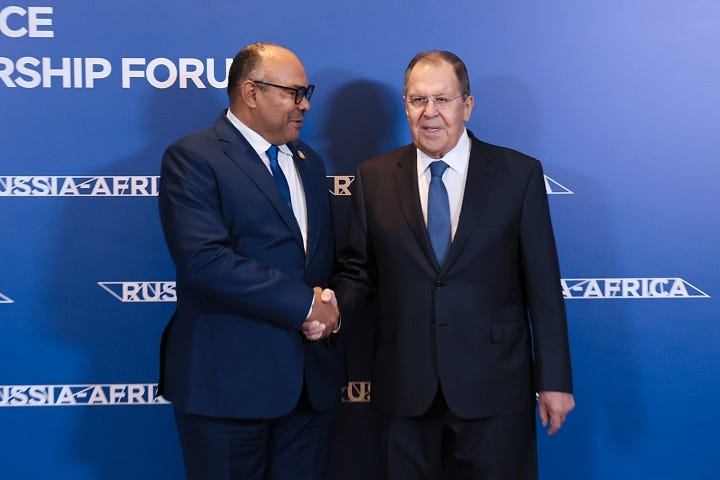
Russia, for its part, benefits from expanding its footprint in East Africa at a moment when Western leverage over Tanzania is constrained. Lavrov’s remarks after the talks emphasised satisfaction with cooperation in international forums, particularly at the United Nations, and announced ongoing discussions on the venue and timing of the third Russia–Africa summit. The second Russia–Africa Partnership Forum ministerial conference was held in Cairo in December 2025, just weeks after the October massacres became headline news. Tanzania’s willingness to deepen engagement with Moscow in this climate is exactly the kind of signal Russia needs to demonstrate that its Africa strategy is producing results despite Western sanctions pressure.
What Happened on October 29 — and Why It Matters for This Analysis
The context for the Moscow meeting cannot be separated from the events of 29 October 2025 and the days that followed. Tanzania held general elections on that date in an environment that Human Rights Watch, the International Crisis Group, and UN Special Procedures have all described as neither free nor fair. Opposition leader Tundu Lissu of Chadema was arrested in April 2025 on fabricated treason charges. Luhaga Mpina, the presidential candidate for ACT-Wazalendo, was disqualified on procedural grounds. With all serious challengers removed, President Samia was declared the winner with 97.66% of the vote — a turnout figure of nearly 33 million in a country whose entire voting-age population is approximately 35 million.
When protests erupted on election day and spread to cities across the country, the security forces’ response was devastating. The Economist described the crackdown as “terror on an unprecedented scale” for Tanzania and called it the CCM’s “Tiananmen Square moment.” UN Human Rights Chief Volker Türk reported harrowing accounts of families searching police stations and hospitals for missing loved ones, and noted disturbing reports that security forces removed bodies from streets and hospitals to undisclosed locations.
The true scale of the killing remains contested due to the five-day internet shutdown imposed from 29 October to 3 November and the systematic concealment of evidence. Chadema initially reported approximately 700 deaths, later revised to over 2,000. Intelwatch, the organisation that submitted the first formal case to the ICC, estimates that approximately 10,000 people were killed over three days, citing morgue documentation, hospital records, and thousands of verified videos showing execution-style killings. One morgue alone reportedly contained 800 bodies. The ICC submission further alleges that security forces used live ammunition rather than crowd control measures, that targeted sniper attacks took place, and that operations were potentially directed by the president’s son, who allegedly heads Tanzania’s intelligence services.
Medical professionals were reportedly threatened with death if they released casualty figures. The government imposed a complete internet shutdown from 29 October to 3 November, severing the primary means by which evidence of the killings could be documented and transmitted. Even after connectivity was restored, Netblocks reported continued widespread restrictions to social media and messaging platforms, preventing Tanzanians from sharing video evidence. The UK Foreign, Commonwealth and Development Office advised against all but essential travel to Tanzania, citing shortages of food, fuel, and cash compounded by the communications blackout.
The government simultaneously imposed a 24-hour lockdown from the evening of 29 October, with military roadblocks deployed across the country. Human Rights Watch documented that residents were prevented from leaving their homes to buy food or access banks for three days. International journalists were effectively barred from covering the elections — the International Press Association of East Africa reported it did not know of any journalists working for international media who were accredited to travel to the mainland.
In the crackdown’s aftermath, over 1,700 individuals were detained and charged with offences including treason — a non-bailable offence carrying the death penalty in Tanzania. Children were among those charged. Chadema’s communications director, Brenda Rupia, stated that police had disposed of over 400 bodies at undisclosed locations and were preventing families from recovering remains from hospitals. Reports of mass graves being dug at Mabwepande emerged in the weeks following the killings.