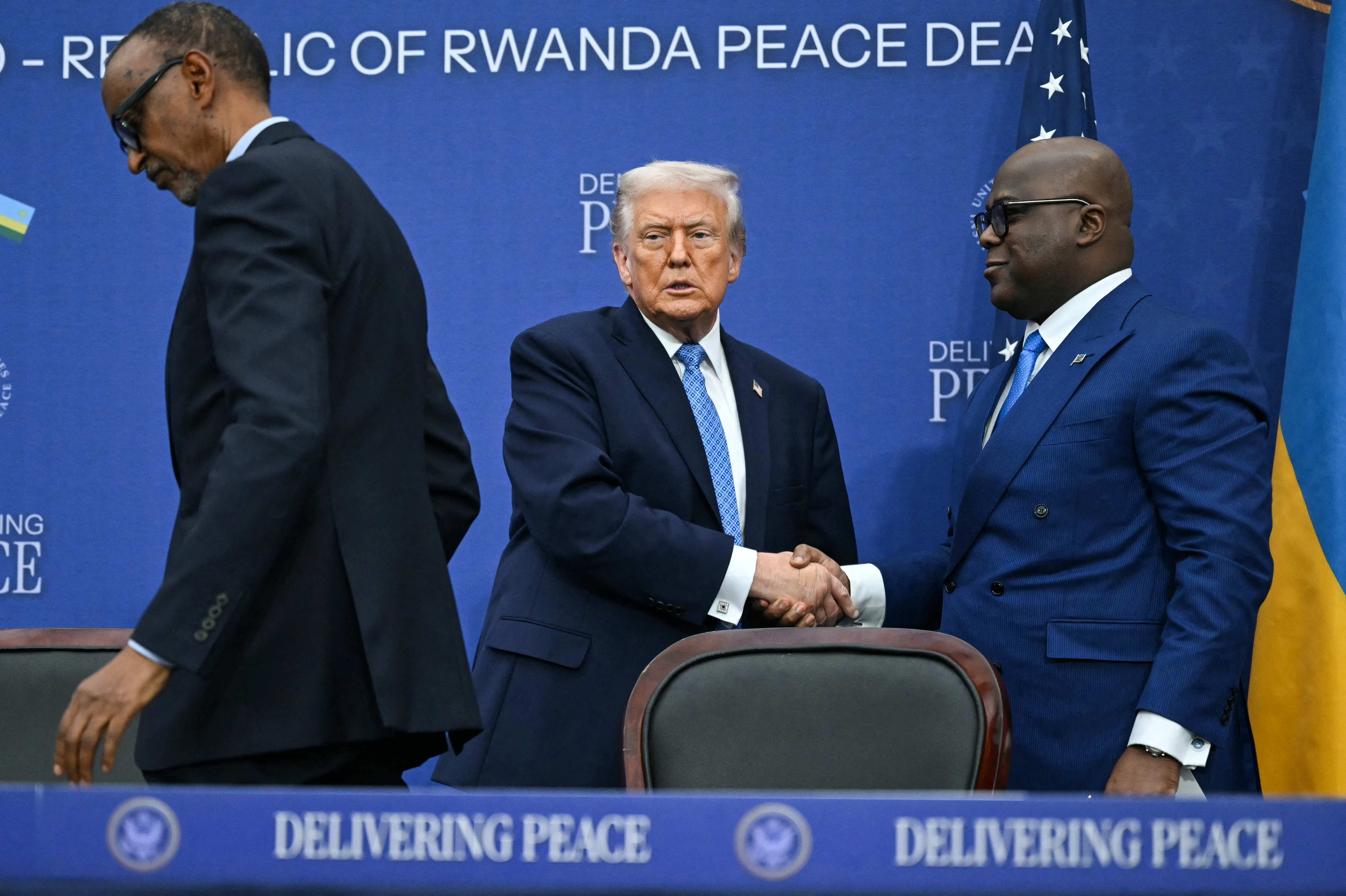
[FREE] U.S. Signals Action as Rubio Accuses Rwanda of Violating Washington Accords
INTELLIGENCE BRIEF on U.S. enforcement signals and Rwanda’s role in eastern DRC

Ujasusi Blog’s Great Lakes Region Monitoring Team | 13 Dec 2025 | 1550 GMT
🔓FREE ACCESS
Please consider becoming a paid subscriber
You can also donate.
Introduction
On 12 December, U.S. Secretary of State Marco Rubio issued a statement on X declaring that Rwanda’s actions in eastern Democratic Republic of Congo (DRC) constitute a violation of the Washington Accords signed under President Donald Trump. He further warned that the United States would take action to ensure commitments made under the agreement are upheld. This intervention places Rwanda’s alleged support for the M23 movement at the centre of U.S. foreign policy enforcement and raises questions about the credibility of regional stabilisation frameworks.
What are the Washington Accords?
A peace framework signed in Washington under U.S. presidential auspices.
Commitments included: cessation of support to armed groups, de‑escalation protocols in North and South Kivu, and third‑party monitoring.
The United States acted as guarantor, implying readiness to employ sanctions, conditionality, or diplomatic pressure in the event of non‑compliance.
The accord was intended to stabilise eastern DRC and protect humanitarian access.
The Accords were framed as a binding commitment between Rwanda and DRC, with U.S. oversight. Their credibility now depends on enforcement mechanisms and the willingness of Washington to act decisively.
What has changed in eastern DRC?
Operational shift: M23 advances, including control of strategic nodes such as Uvira, undermine the accord’s credibility.
Supply chain securitisation: Armed group control of corridors increases taxation and extortion risks.
Population displacement: UNHCR estimates over 6.9 million internally displaced persons in DRC, with eastern provinces most affected.
Humanitarian access degradation: Agencies report restricted access, with convoys blocked or taxed by armed groups.
As Crisis Group analysis notes, the rapid deterioration highlights the fragility of ceasefire commitments and the difficulty of enforcing accords without credible deterrence.
What enforcement tools are available to the United States?
Sanctions: targeted designations of individuals and entities linked to armed group support.
Aid conditionality: recalibration of security and economic assistance.
Diplomatic instruments: demarches, compliance deadlines, and multilateral pressure through the UN, AU, and EAC.
Security externalities: intelligence sharing and support to Congolese stabilisation missions.
The U.S. Treasury has previously used sanctions against actors in the Great Lakes region, and similar measures could be extended to Rwandan officials or networks accused of backing M23.
How do Rwanda, DRC, and the U.S. positions compare?
Actor Stated posture Strategic objectives Vulnerabilities Likely levers Rwanda Denies direct control; accused of backing M23 Border security, leverage in Kivu Sanctions, reputational costs Diplomatic engagement, regional forums DRC Calls for enforcement Territorial integrity, neutralisation of armed groups Capacity constraints, humanitarian strain Aid requests, sanctions advocacy United States Guarantor signalling enforcement Stabilisation, deterrence Credibility risk if action is symbolic Sanctions, conditionality, multilateral pressure
What are the measurable indicators to track compliance and risk?
Kinetic: front‑line movement, ceasefire violations.
Support: material flows, command signals.
Governance: IDP counts, humanitarian access metrics.
Diplomatic: sanction notices, visa restrictions, compliance deadlines.
Research shows aid inflows in fragile states correlate with higher targeted killings of politicians, underscoring the risks of poorly enforced agreements.
Scenario outlook (90–180 days)
Coercive stabilisation (40%): targeted sanctions, measurable drawdown of M23 control.
Symbolic signalling (35%): limited measures, negligible ground impact.
Escalated confrontation (25%): expanded sanctions, heightened cross‑border tensions.
Each scenario carries implications for humanitarian access, regional diplomacy, and the credibility of U.S. enforcement.
Historical context: Rwanda–DRC tensions
Rwanda has long been accused of supporting armed groups in eastern DRC, particularly M23.
The DRC government has repeatedly appealed to international partners for enforcement and sanctions.
Previous accords, such as the Nairobi process, have struggled due to weak monitoring and lack of enforcement.
The Washington Accords were intended to break this cycle by embedding U.S. guarantees.
International reactions
African Union: cautious, urging dialogue but reluctant to confront Rwanda directly.
United Nations: MONUSCO continues to face operational constraints, with limited ability to enforce ceasefires.
European Union: has signalled concern but prioritises humanitarian aid rather than coercive measures.
Neighbouring states: Uganda and Burundi monitor developments closely, wary of spill‑over effects.
Strategic Outlook
Rubio’s statement reframes Rwanda’s role in eastern DRC as a breach of a U.S.-brokered accord, signalling potential enforcement measures. The credibility of the Washington Accords now hinges on whether the United States moves beyond rhetoric to tangible sanctions and conditionality. For regional actors, the next six months will determine whether the accord remains a viable stabilisation framework or collapses under renewed conflict pressures.