

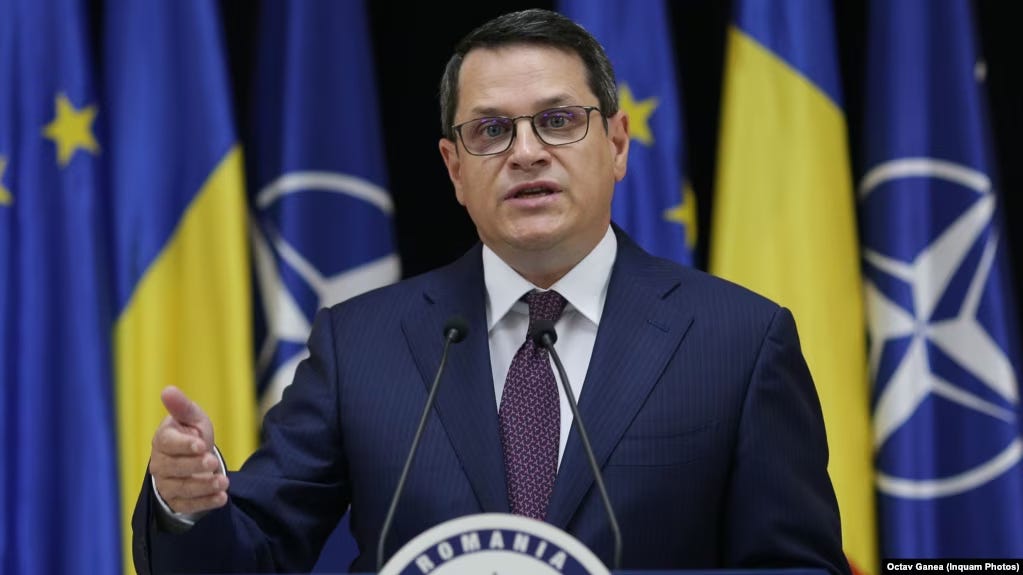

The director of the Romanian Intelligence Service (SRI), Eduard Hellvig, announced his resignation from the head of the SRI on Monday. He said he did not believe in "petrification in office" and that he did not think it was healthy for democracy for one person to concentrate access to classified information for too many years.
"I can end the stage of life that I went through at the head of the SRI. I openly discussed this with the president," said Eduard Hellvig.
He drew attention to the danger of too long a presence in positions of power.
"It is a wrong custom among us that those who hold positions of power do not leave them until the last moment. I think such a step is needed. It's a gesture of democratic health. It is healthy for democracy, for the balance of power in the state for a secret service director to have a term limited in time. The directory function provides access to a significant volume of sensitive information. I end this stage with the satisfaction that I have done good things for the citizens, for Romania and for SRI", said Eduard Hellvig.
"Today's statement is the last at the head of the SRI," Hellvig concluded his statement.
On June 23, the SRI submitted the 2022 activity report to the SRI Control Commission, in the Parliament, in which it presents the institution's efforts to adapt to current realities.
"SRI has undergone a major transformation to be able to act more efficiently to protect Romania. We are at the end of a very important process of reconfiguring all SRI components," said Hellvig.
The report also presents the instruments through which the SRI will become more adaptable to current realities after only in the last year "it has become major in order to be able to act to better protect Romania, he said, referring to a program to reconfigure all components SRI
Regio and Centrio
The SRI report, still a classified document, presents a synthesis of how the SRI has transformed itself to become more flexible and adaptable, a process designed to ensure an integrated conceptual security system, explained outgoing director Eduard Hellvig.
The document, he explained, details the successful completion of two major projects: Regio and Centrio, through which SRI "became a modern, flexible and de-bureaucratized institution".
Regio started in 2017 and aimed to reorganize the institution regionally, so that the secret service no longer has 41 miniature institutions, but a "shortened chain of command with increased flexibility".
Warning to other institutions: complete handover of archives to CNSAS
The modernization, Hellvig explained, was done simultaneously with the liberation from the "legacy of the former security", with the complete handing over of the archives to the CNSAS, "a gesture that we hoped would be taken over by other institutions, something that did not happen", he pointed out Eduard Hellvig.
"We can't always ask future generations to solve the problems we haven't solved. It's time to state that the goals I set for myself have been met. Therefore, I can end the stage of life that I went through at the head of the SRI. I openly discussed this with the president," he added.
"It is a wrong custom among us that those who hold positions of power do not leave them until the last moment. I think such a step is needed. It's a gesture of democratic health. It is healthy for democracy, for the balance of power in the state that a director of service has a term limited in time. The directory function provides access to a significant volume of sensitive information. I end this stage with the satisfaction that I have done good things for the citizens, for Romania and for SRI", concluded the resigned director of SRI.
Political reactions
The President of Romania, Klaus Iohanis, conveys in a statement that Eduard Hellvig's mandate at the head of the SRI meant "restoring the credibility of the SRI and the consistent modernization of the institution".
The activity of the SRI in recent years has also enjoyed the recognition of the Euro-Atlantic partners, thanks to the cooperation projects that the institution has carried out in the world of intelligence services", adds the presidential press release.
It ends with the announcement by President Klaus Iohanis that he will decorate Eduard Hellvig with the National Order "Star of Romania" in the rank of Commander.
Sources from the PNL say that the liberals were taken by surprise by the resignation of the head of the SRI, Eduard Hellvig. Many describe him as one of the most balanced people they have ever met.
Deputy Pavel Popescu, former president of the Defense Committee in the Chamber of Deputies, agreed to make a public statement for Free Europe.
"The only thing I can say about Eduard Hellvig and the institution he led, from the perspective of a Romanian parliamentarian, former head of the Defense Commission, is that, in Romania's relationship with the USA and the rest of the partners strategic, the most mentioned, circulated and praised name that I have heard since I have been in politics regarding Romania's stability and respect for strategic partnerships was, by far, Eduard Hellvig."
On the other hand, the president of USR, Cătălin Drula, says that Eduard Hellvig's mandate at the head of the SRI is a failed one:
"Former general secretary of the PNL, former head of campaign of Iohannis, Mr. Eduard Hellvig never stopped playing politics from the position of SRI director. Eduard Hellvig had a failed mandate. Civilian control over the service did not exist. Mister. Hellvig had a chance for Romanian democracy and missed it triumphantly", wrote Cătălin Drula on his Facebook page .
On the other hand, Silviu Macovei, a member of the Permanent Joint Commission of the Chamber of Deputies and the Senate for the exercise of parliamentary control over the activity of the SRI, praises the former director of the SRI.
"Hellvig was a very good director of the SRI, he did his job, he fulfilled the objectives proposed when he took office. It was his personal decision to resign and I wish him continued success!"