

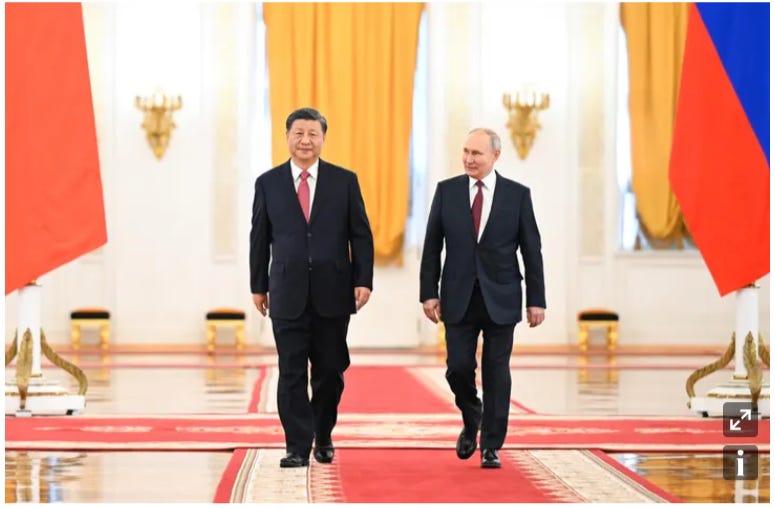

On February 8, 2024, during a telephone conversation on the eve of the chinese New Year, chinese president Xi Jinping spoke with his Russian counterpart Vladimir Putin, the strengthening of the " strategic coordination " between Beijing and Moscow. In fact, this coordination already exists since almost a decade. In 2014, when Russia turned to China, signing agreements of major energy with it, the approximation has often been seen as provisional. However, the relations China-Russia has strengthened not only since the annexation of Crimea in 2014, but since the Russian invasion of the Ukraine in February 2022, that China has not condemned.
Beijing has reiterated that Moscow was its " strategic partner the more important." For its part, Russia has explicitly renewed its support to China on the taiwan issue in the main official documents, including the joint declaration of February 2022 and march 2023, in which Moscow calls Taiwan a part " inalienable " part of China.
The approximation sino-Russian has often been described as "simple" marriage of convenience ", in fact, too unbalanced to last. We refer to henceforth as the 'vassalisation" of Russia by China, which would be equally untenable. The real, bet on the limits of this approximation is risky. Of course, the asymmetry is real between the 2nd and 11th global economic power, but there are also a lot of complementarity.
In addition to the energy cooperation, the two countries should enhance cooperation on technological, scientific, and defense, and continue to conduct joint military exercises. Across all sectors, we observe a significant increase in the volume of trade between the two countries in recent years (+ 30 % in 2022, compared to 2021, and even + 26 % in 2023).
In Beijing, such as Moscow, the bilateral cooperation is not only perceived as a source of economic opportunities or energy. It is seen as a necessity to ensure the maintenance of the regimes in place. The two presidents will support each other in their opposition to any regime change, in the first place their own. And reinforce each the suppression of dissent in their countries. The chinese government has refused to comment on the death of Alexei Navalny, suggesting that it was an " internal affair of Russia ".
In China, the speech antioccidental is exposed now to the big day, with a virulence that we no longer had known since the cultural Revolution, and the conclusion is always that the regional crises and international have been caused in the first place by the United States and their allies, accused of fomenting in sub-hand these disorders. It is this perception which leads to Xi Jinping emphasized at his call to the 8th of February that the " strategic coordination " should enable the two countries to " oppose resolutely at the outside interference in their internal affairs ".
North Korea, an important partner
Within international organizations, China and Russia, permanent members of the security Council of the UN, co-ordinate more on major strategic issues, such as North Korea and Iran, they consider both of them as important partners. This coordination is observable not only in the united Nations, but also to the Organization of cooperation of the Shanghai or within Brics, which they have all worked to the recent enlargement.
Russia, who will be chairing the Brics summit which will be held in Kazan this year, in October, will be greatly aided in his task by China. Because since the beginning of the Russian invasion of the Ukraine, China has done everything to prevent Russia from becoming a State, pariah, by supporting as much as possible the maintenance of a Russian representation in multilateral fora.
Today, China and Russia opposed any major international crisis, directly or indirectly. In addition to Ukraine, their positions on the situation in the Middle East since the terrorist attack on the Hamas-October 7, 2023 are also aligned : the two countries have not condemned the Hamas and are among those most critical of Israel from the beginning of the war.
Against the West
China considers its relationship with Russia as necessary to make a common front against the West. It is certainly a strategy of coalition in which Russia occupies a central place, and that applies more widely to the countries of the " South ", in the developing or emerging economies. China has no interest in seeing weaken Russia. To help preserve the influence of Russian diplomacy in a part of the world, it is to preserve a pole of opposition coalitions across the atlantic.
The coordination is now supported at the highest level, by very frequent exchanges. Vladimir Putin is expected to visit China in 2024, after the October 2023, at which he had been received as a guest of honour at the 3rd forum of the new silk roads in Beijing. This will be his 19th visit to the country since he became president in 2000. For all these reasons, and in light of recent statements on the strengthening of the " strategic coordination ", the positions of China and Russia, should be further aligned in 2024.