

Ujasusi Blog’s South America Desk | 19 April 2026 | 2305 BST
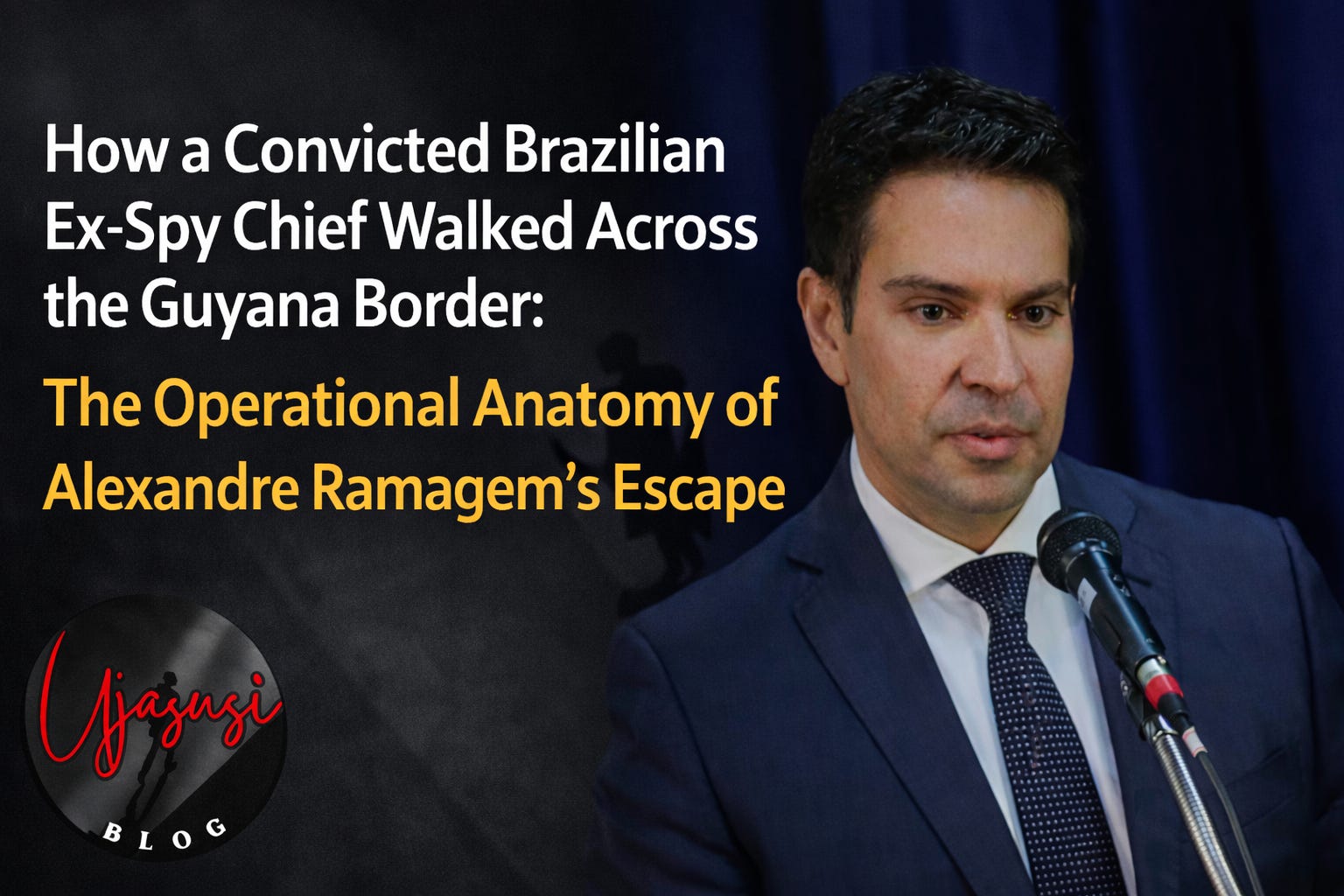
Alexandre Ramagem, former Director-General of the Agência Brasileira de Inteligência (ABIN), was sentenced to sixteen years and one month in prison on 11 September 2025 for his role in the 2022–2023 coup plot that sought to prevent Luiz Inácio Lula da Silva from taking office. Before Brazilian authorities could detain him, Ramagem crossed the Guyana border near Lethem, travelled onward to the United States on a diplomatic passport, and remained at liberty in Florida until US Immigration and Customs Enforcement briefly detained him on 13 April 2026. He was released forty-eight hours later. The escape was not improvised. It was operational tradecraft.
Alexandre Ramagem and the ABIN Politicisation File
Ramagem, a career Federal Police delegate, commanded ABIN from 2019 to 2022 under President Jair Bolsonaro. His directorship coincided with what Brazilian prosecutors later described as the establishment of a parallel intelligence structure within the agency — a geolocation and surveillance operation that tracked approximately thirty thousand targets, including two sitting Supreme Federal Court justices, Alexandre de Moraes and Gilmar Mendes. The Israeli-origin monitoring software at the core of the operation remains the subject of a separate federal indictment covering Ramagem and roughly thirty co-defendants. His September 2025 conviction on coup-related charges triggered automatic loss of his congressional seat and activated the Federal Police’s domestic manhunt. He was already gone.
The Lethem Crossing: Geography of a Deliberate Route
The Brazil–Guyana frontier runs for approximately 1,600 kilometres through dense Amazonian terrain. The only meaningful road crossing sits between Bonfim in Roraima state and Lethem in Guyana’s Upper Takutu region, connected by the Takutu River Bridge. Unlike Brazil’s southern frontiers with Paraguay and Argentina, where immigration posts are integrated and digitally networked, the Lethem–Bonfim corridor operates on manual documentation checks with limited biometric capability and well-documented procedural gaps. Ramagem’s route selection was not accidental. A spy chief with twenty years of operational familiarity with border security architectures would have mapped every northern exit point against its capture probability. Lethem offered the lowest detection profile of any overland route out of Brazil — a calculation consistent with a planner, not a fugitive in panic.
Tradecraft Signatures in the Escape
Three operational markers distinguish Ramagem’s flight from ordinary absconding. The first is documentation: he travelled onward on a diplomatic passport that had not been administratively revoked between his September conviction and his border crossing, despite the automatic penalties that accompany a sixteen-year sentence. The second is timing: he moved during the narrow window between sentencing and the practical activation of custodial arrangements, exploiting the procedural lag that separates Brazilian judicial rulings from Federal Police execution. The third is onward coordination: his arrival in Florida was met by an established support network — Eduardo Bolsonaro, Paulo Figueiredo, and the Immigrex visa consultancy in which Figueiredo holds a partnership stake — capable of filing an asylum application before any extradition instrument could be activated. This is the signature of preparation over months, not days.
Federal Police Failures and Interagency Gaps
The Polícia Federal’s operational posture between 11 September 2025 and Ramagem’s confirmed departure raises questions that Brazilian oversight bodies have not yet answered publicly. A convicted coup-plot defendant with intelligence-service tradecraft and known flight incentive should have been subject to surveillance, passport invalidation, and border alert distribution from the moment the Supreme Federal Court verdict was read. None of these measures appears to have functioned. Brazil’s formal extradition request to the United States was lodged only on 30 December 2025 — more than three months after the conviction and well after Ramagem had established himself in Florida. The Interpol Red Notice sequencing remains opaque. Whether this represents bureaucratic dysfunction or something more deliberate is the question oversight committees must now address. For a readership attuned to intelligence politicisation, the parallels with East African cases — where intelligence officers under political protection have repeatedly evaded domestic accountability through selectively inactive security architectures — are unmistakable.
From Georgetown to Orlando: The US Sanctuary Pipeline
Ramagem’s path from Lethem to Orlando almost certainly transited Georgetown’s Cheddi Jagan International Airport, the only practical onward-travel node from the Guyanese interior. His entry into the United States on a diplomatic passport, followed by the filing of a political asylum application, placed him inside a procedural architecture that effectively suspends extradition exposure while the claim is adjudicated. The ICE encounter in Orlando on 13 April 2026 — reportedly triggered by a traffic stop — tested this architecture and confirmed its durability: Ramagem was released on 15 April, with Bolsonaro allies publicly crediting the Trump administration for the outcome. He is not the only figure sheltering in this pipeline. Eduardo Bolsonaro’s own exile in the United States and the broader network of Brazilian far-right actors operating from Florida constitute a functioning sanctuary infrastructure for individuals facing accountability processes in Brasília.
Strategic Implications for Intelligence Accountability
The Ramagem case will shape intelligence-officer flight calculations across multiple jurisdictions over the next eighteen months. The operational lesson it transmits is specific and dangerous: a politically protected spy chief convicted of regime-level offences can, with adequate planning and bilateral asymmetries, convert a criminal sentence into an asylum claim before any extradition instrument bites. Expect Brazilian opposition figures to pressure the Lula administration for a public audit of the Federal Police’s conduct between September and December 2025 before the October 2026 election cycle intensifies. Expect, equally, that intelligence officers in other jurisdictions — including several African services where politicisation has produced analogous accountability exposures — will study this playbook carefully. The sanctuary architecture that protects Ramagem today is not bespoke. It is a template.