Pope Leo XIV’s Africa Visit Exposes the Catholic Church’s Dual Crisis of Growth and Credibility
Ujasusi Blog | Religion & Intelligence Desk | 14 April 2026 | 0045 BST
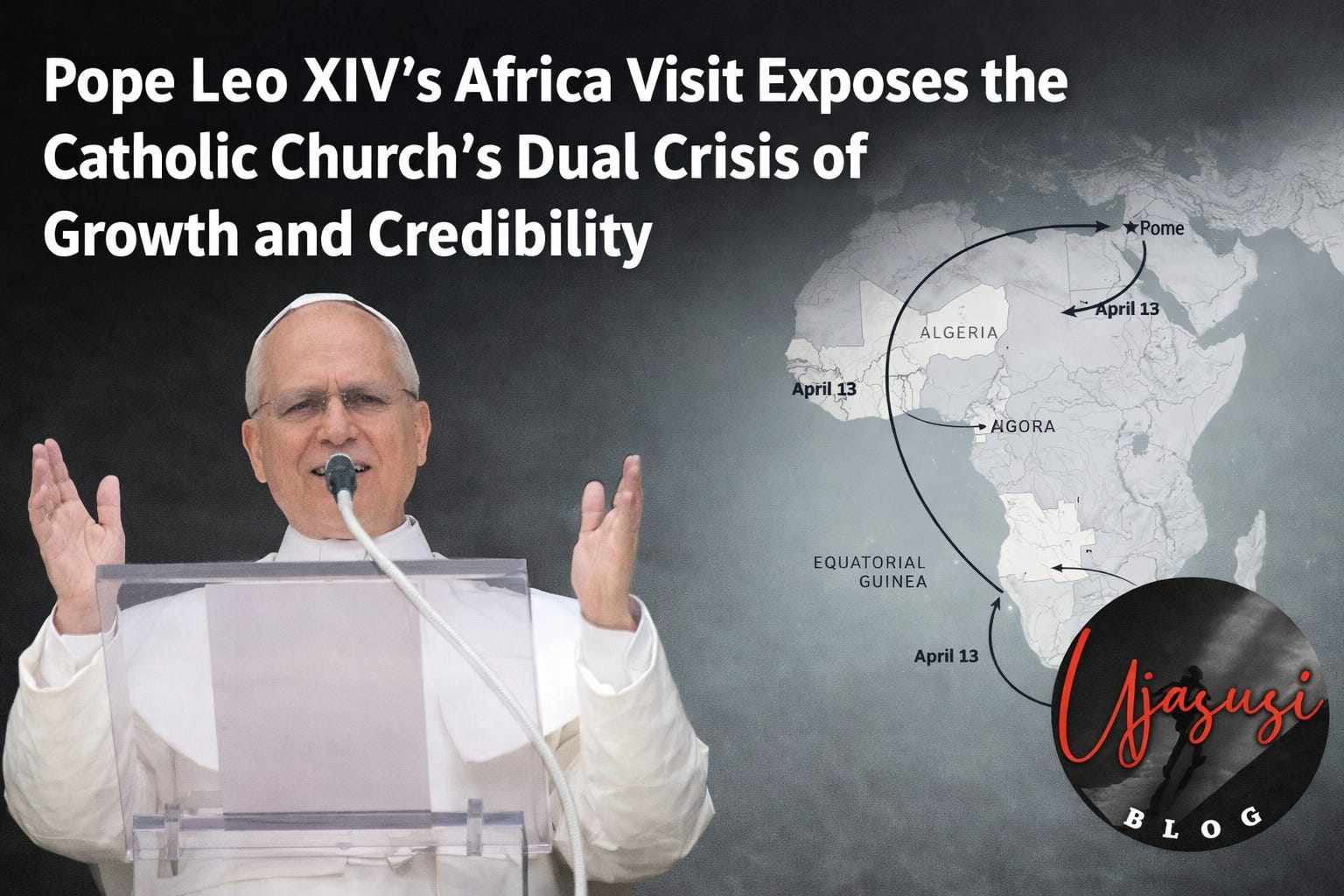
Pope Leo XIV’s 10-day apostolic journey across Algeria, Cameroon, Angola and Equatorial Guinea, running from 13 to 23 April 2026, represents the Vatican’s most direct engagement with the continent where one in five of the world’s 1.4 billion Catholics now lives. The trip occurs as the Church confronts a structural paradox: African Catholicism is expanding at a rate that has overtaken Europe, yet the institution faces existential threats on every front; from Pentecostal competition and Islamist pressure in Africa, to sexual abuse settlements and the rise of Christian nationalism in the West.
Pope Leo XIV’s Augustinian Identity and the Geopolitical Timing of the Africa Trip
Robert Francis Prevost, a Chicago-born Augustinian friar elected on 8 May 2025, became the first American and the first member of the Order of Saint Augustine to lead the Catholic Church. He succeeded Pope Francis, who died in April 2025. His papal name honours Leo XIII, architect of modern Catholic social doctrine during the First Industrial Revolution; Leo XIV has framed his own pontificate as a response to the dislocations of artificial intelligence and the digital era.
The Africa itinerary is the third international journey of his pontificate, following visits to Turkey and Lebanon in November 2025 and Monaco in March 2026. It is, by distance and duration, the most ambitious. The Vatican confirmed 18 flights, 11 cities, and over 11,000 miles across four countries in 11 days. The selection of Algeria carries personal significance: Leo described himself as “a son of Augustine” on the day of his election, and Annaba is the site of the basilica built near where the fifth-century theologian died.
The trip also carries a geopolitical charge. Leo departed Rome on 13 April after a confrontation with President Donald Trump, who attacked the pontiff on Truth Social as “WEAK on Crime” and “terrible for Foreign Policy” over Leo’s criticism of the US-Israeli war in Iran. Leo responded before boarding his flight: “I have no fear of the Trump administration, or speaking out loudly.” The exchange frames the Africa journey not as a pastoral retreat from controversy, but as a continuation of the Vatican’s emerging role as diplomatic counterweight to Washington.
African Catholic Growth Overtakes Europe for the First Time in the Annuario Pontificio 2026
The Annuario Pontificio 2026, drawing on 2024 data, recorded 288 million Catholics in Africa, up from 281 million in 2023, a growth rate of 2.7% that exceeded the continent’s demographic expansion. Africa’s share of global Catholics rose from 19.9% to 20.3%, while Europe’s declined from 20.4% to 20.1%. For the first time in the modern era, the African Church is numerically larger than European Catholicism.
Sources: Annuario Pontificio 2026; Annuarium Statisticum Ecclesiae 2024
In 2025 alone, the African Catholic Church gained 8.3 million new members. Nigeria hosts the world’s largest Catholic seminary. The Democratic Republic of Congo, South Africa and Nigeria rank among the top 10 missionary-sending nations, reversing a century-old pattern of European clerical export to the global south.
Yet the numbers conceal a governance deficit. Only 12% of the College of Cardinals are African. By the time of Pope Francis’s death in April 2025, no African cardinal headed a single Vatican dicastery. Leo has begun addressing this imbalance, but the structural lag between demographic weight and institutional power remains the defining tension within the global Church.
Pentecostal Expansion, Islamist Coercion and the Governance Gap Facing African Catholicism
Growth has not granted the Church security. Three concurrent pressures are reshaping the competitive landscape.
Pentecostal expansion. In 1970, Pentecostals constituted less than 5% of Africa’s population. By 2026, that figure exceeds 12%, representing over 100 million people. The Archbishop of Brazzaville described the phenomenon as “guerrilla warfare on spiritual terrain,” with Pentecostal and revival churches drawing Catholics through promises of immediate material deliverance. Nigeria’s Redeemed Christian Church of God and Ghana’s Church of Pentecost both operate in over 100 countries. Mainline denominations across the continent, including the Catholic Church, have been forced to incorporate charismatic elements into their liturgy to slow membership haemorrhage.
Islamist coercion. Armed groups operating across the Sahel, the Lake Chad Basin, and eastern Congo have imposed conversion demands on Christian communities. In the DRC, militia groups linked to the Allied Democratic Forces have targeted churches and compelled conversions in areas outside state control. This represents a qualitatively different threat from interfaith competition; it is the weaponisation of religion as a tool of territorial consolidation.
The governance gap. The most corrosive challenge may be the one least visible internationally. Across sub-Saharan Africa, devout Catholic practice coexists with endemic corruption in public life. Political leaders attend Mass on Sunday and preside over extraction economies on Monday. The Church’s failure to translate spiritual authority into institutional accountability creates a credibility vacuum that Pentecostal movements, with their emphasis on personal prosperity and direct divine intervention, are filling. African parishes and pastoral programmes remain financially dependent on European and North American donors, limiting the Church’s capacity to operate as an autonomous moral actor.
Algeria, Cameroon, Angola and Equatorial Guinea: The Vatican’s Four-Stop Strategic Calculus
The four-country selection is not arbitrary. Each stop serves a distinct diplomatic and institutional function within the Vatican’s Africa strategy.
Algeria, with fewer than 10,000 Catholics in a population of 48 million Sunni Muslims, is not a pastoral destination. It is a signalling exercise directed at the Islamic world. Leo’s visit to the Great Mosque of Algiers, one of the world’s largest, follows his November 2025 visit to Istanbul’s Blue Mosque. The Augustinian connection to Annaba adds theological depth to what is functionally a diplomatic mission: positioning the Vatican as the primary Western institution capable of sustained dialogue with Muslim-majority states at a moment when Washington’s credibility in that space has collapsed under the weight of the Iran war.
Cameroon tests the Vatican’s capacity for conflict mediation. The Anglophone crisis, which has killed at least 6,500 people since 2017, pits the Francophone-dominated government of President Paul Biya against armed separatist groups in the northwest and southwest. Leo’s decision to travel to Bamenda, the largest Anglophone city and the conflict’s epicentre, for a peace meeting with internally displaced families, traditional leaders, an imam and a Catholic nun, represents the most politically sensitive stop on the itinerary. It is an implicit critique of Yaounde’s handling of the crisis, delivered on Cameroonian soil.
Angola presents the prosperity case: a post-conflict Catholic-majority country where Church-state collaboration has produced visible results. The expected record attendance at the Marian shrine of Muxima will provide the trip’s defining visual for Vatican media: African Catholicism as a mass movement, vibrant and expanding.
Equatorial Guinea, the smallest and most authoritarian of the four host nations, serves as the trip’s moral anchor. Leo plans to visit Bata Prison, criticised internationally for its conditions, and a memorial to victims of the 2021 military base explosions that killed over 100 people in an incident the government attributed to “negligence” but which human rights organisations have demanded be independently investigated. The last papal visit to Equatorial Guinea was John Paul II’s in 1982. Returning after 44 years, to a country where 70% live in poverty under one of Africa’s longest-serving rulers, is a deliberate invocation of Francis’s vision of a Church that goes to the margins.
Sexual Abuse Settlements, Christian Nationalism and the Western Crisis Threatening African Catholic Funding
The Catholic Church’s credibility problem in the global north is no longer a slow bleed. It is a compound crisis with three reinforcing elements.
Sexual abuse and institutional collapse. A January 2025 report from Georgetown University’s Centre for Applied Research in the Apostolate documented over $5 billion in cumulative spending on clergy sexual abuse allegations across US dioceses, eparchies and men’s religious communities since 2004. The October 2024 settlement by the Archdiocese of Los Angeles, totalling $880 million for over 1,300 survivors, was the largest in US Catholic history. The 2020 McCarrick Report exposed how three successive pontificates failed to act on credible allegations against Cardinal Theodore McCarrick, who was laicised in 2019 and died in April 2025. In the US, parish closures are accelerating: the Archdiocese of Baltimore announced plans to eliminate nearly two-thirds of its parishes, citing bankruptcy proceedings triggered by abuse litigation. The University of Notre Dame’s Church Life Journal has calculated that the American Church is losing nine out of ten cradle Catholics who leave the faith.
Christian nationalism’s theological distortion. The Public Religion Research Institute’s 2025 American Values Atlas found that one-third of Americans qualify as Christian nationalism adherents or sympathisers. Among white Catholics, the figure is 35%. Christian nationalism’s core proposition, that the United States was founded as and must remain a Christian nation governed by biblical law, directly contradicts Catholic social teaching on human dignity, the universal destination of goods, and the rights of migrants. Yet conservative Catholic figures, including Vice President JD Vance, a Catholic convert, have been instrumentalised by the movement’s political wing. US Defence Secretary Pete Hegseth, a Protestant, has framed the Iran war as divinely sanctioned, a claim Pope Leo publicly rebuked in a Palm Sunday homily: Jesus “does not listen to the prayers of those who wage war.”
The Trump-Leo confrontation as a defining fracture. Trump’s 12 April 2026 Truth Social attack on the pope, and his since-deleted AI-generated image depicting himself as Jesus, represent a qualitative escalation. The US Conference of Catholic Bishops issued a rare rebuke. Cardinal Blase Cupich of Chicago described the administration’s social media depictions of the Iran bombing campaign as “sickening.” A bipartisan poll reported by the National Catholic Register found that 52% of Catholics now disapprove of Trump and 60% oppose his conduct of the Iran war, a reversal from the 12-point Catholic advantage Trump held over Kamala Harris in 2024.
For African Catholicism, the Western crisis is not a distant problem. European and North American donor funding sustains African dioceses. If abuse litigation continues to drain Western Catholic wealth, and if the Church’s moral authority in the global north collapses under the weight of its own institutional failures, the financial architecture supporting African pastoral operations will erode. Leo’s Africa trip is, in part, an investment in the continent that may soon be asked to sustain the global Church rather than be sustained by it.
Leo XIV’s Post-European Papacy: Whether Governance Will Follow Demographics South
The structural conditions for a global Catholic rebalancing exist. Africa’s demographic weight is unchallengeable. Its vocational pipeline is the only one still expanding; the continent produces more new priests annually than any other region. The Synod on Synodality, concluded under Francis, created at least a theoretical framework for decentralised governance. And Leo himself, an Augustinian with two decades of missionary experience in Peru, is temperamentally inclined towards the global south.
But the obstacles are formidable. The Roman Curia remains European in its operational culture, its career incentives, and its institutional memory. The Dicastery for Evangelisation, which oversees the Church’s missionary activity, has never been led by an African. Financial dependency flows one way: from north to south. And the theological conservatism of many African bishops, particularly on questions of sexuality and gender, creates friction with the progressive direction Leo inherited from Francis and appears determined to continue.
Ujasusi Blog’s assessment: Leo’s Africa trip is best understood not as a pastoral visit but as a reconnaissance mission for the Vatican’s 21st-century survival strategy. The Church’s centre of gravity has already shifted south. The question is whether its governance, financing and theological authority will follow, or whether Africa will remain the continent that fills the pews while Europe and the Americas retain the power to decide what is preached from them. Leo has the personal biography and institutional position to accelerate the transition. Whether he has the time and political capital, against the headwinds of Western institutional decay and the competitive pressures of Pentecostalism and Islam on African soil, is the unresolved question his pontificate will be judged against.
The first American pope is discovering that his most consequential constituency may not be in Washington or Chicago, but in Bamenda, Luanda and Malabo. If Leo’s Africa journey produces nothing more than imagery and homilies, it will be remembered as theatre. If it initiates measurable governance reform, beginning with African appointments to curial leadership, it will mark the moment the Church’s demographic reality began reshaping its power structure. The next 12 months will determine which outcome prevails.
Independent intelligence analysis takes time and resources — if this work matters to you, please consider supporting it by donating HERE