

By Ujasusi Blog Team
In the contemporary landscape of internal security, few threats are as underestimated yet profoundly dangerous as state-sponsored or tolerated police thuggery. In Tanzania, the persistent and well-documented culture of police brutality is not merely a human rights issue or a matter of public misconduct. It is, more dangerously, an emerging intelligence threat with the potential to spark widespread social unrest, degrade citizen trust in state institutions, and fuel anti-state sentiment that can be weaponised by insurgent, terrorist, or external adversarial actors.
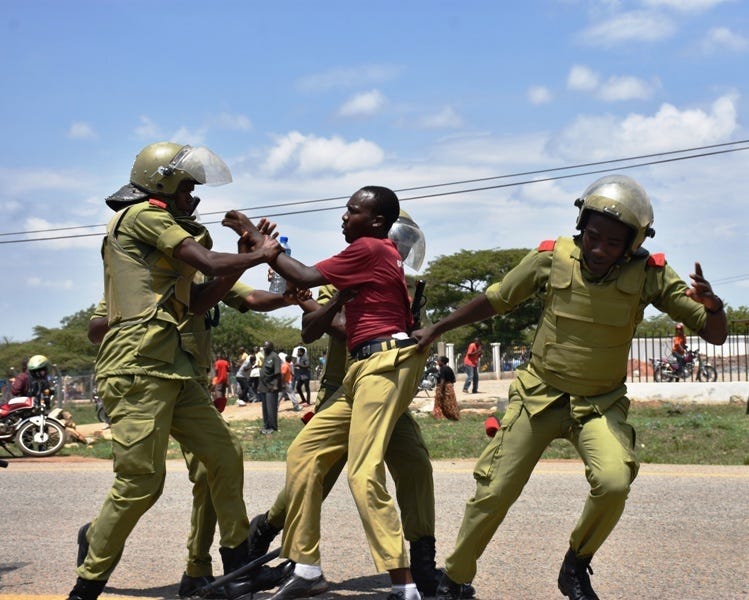
Tanzania's police force, once seen as the guardian of public safety, has increasingly become synonymous with arbitrary arrests, extrajudicial violence, suppression of dissent, and outright thuggery. Citizens have been beaten, tortured, humiliated, and in some cases killed, often without legal recourse or any semblance of accountability. This trend, if left unaddressed, will not only corrode the social fabric of Tanzanian society but will also represent a major failure of intelligence foresight and preventive national security planning.
Understanding Police Thuggery in Tanzania
Police thuggery refers to law enforcement officers acting like criminals—abusing power, using excessive force, engaging in corruption, and violating the very laws they are sworn to uphold. In Tanzania, incidents of such behaviour are widespread and systemic:
Peaceful protestors are being violently dispersed or arrested without cause.
Political activists are being detained without trial or tortured in police custody.
Journalists and whistleblowers are facing intimidation or physical assault.
Extortion by traffic and patrol officers, often targeting the poor.
The use of force during evictions and land disputes favours the powerful.
This is not an isolated problem—institutionalised misconduct persists due to a culture of impunity, weak oversight, and political interference in the policing system.
The Numerical Disparity: A Dangerous Powder Keg
Tanzania's population exceeds 65 million, while the number of active police officers is estimated to be around 45,000–50,000. This means there are more than 1,300 civilians for every police officer. When public sentiment turns decisively against such a small, widely despised force, the state’s capacity to maintain control becomes fragile.
An authoritarian policing model assumes citizens will remain passive, intimidated by the uniform and state machinery. But history—and intelligence theory—teaches us that authoritarianism breeds resistance. From the Arab Spring to the Sudanese revolution, mass mobilisation against state brutality has shown that once fear dissolves and people organise, no amount of force can sustain repression.
Police Brutality as an Intelligence Threat
Intelligence professionals are trained to look for indicators of social volatility, the warning signs before systems collapse or conflict erupts. Police brutality in Tanzania ticks many boxes on that checklist:
Public Grievance Accumulation: Each violent police act compounds decades of mistrust, creating a large, aggrieved population with legitimate grievances.
Erosion of State Legitimacy: The more the police act with impunity, the more the public loses faith in all state institutions. This undermines governance and contributes to the delegitimisation of the political order.
Radicalisation Catalyst: Alienated youth exposed to repeated abuse are fertile ground for radical ideologies. Militant recruiters—whether religious extremists, criminal gangs, or separatist movements—thrive in such environments.
Collapse of Intelligence Penetration: In communities where the police are hated, locals do not report threats or cooperate with intelligence gathering. This blind spot is dangerous in counterterrorism and counterinsurgency contexts.
Precursor to Insurrection: When the oppressed reach a tipping point and alternative political channels are blocked, violent revolt becomes the last resort.
Opportunity for Foreign Exploitation: Adversarial foreign powers can exploit unrest by funding or training anti-government factions, undermining Tanzanian sovereignty.
Thus, the issue is no longer about “police reform” in abstract, but a matter of urgent national security planning and intelligence-driven risk management.
Comparative Case Studies: Lessons from Elsewhere
To underscore the seriousness of police thuggery as an intelligence threat, several comparative examples are instructive.
1. Tunisia (2011)
The Tunisian Revolution, which sparked the wider Arab Spring, was ignited by police harassment and abuse of a street vendor, Mohamed Bouazizi. His self-immolation catalysed mass uprisings. The underlying issue was police impunity and everyday state violence. Tunisia's police force was feared, not respected—and that fear turned into rage.
2. Nigeria (End SARS Movement)
The Special Anti-Robbery Squad (SARS) was disbanded after weeks of violent protests. For years, Nigerians complained of arbitrary killings, torture, and extortion. When the movement erupted, the state initially tried to suppress it with more violence, only increasing public anger and global scrutiny. Although SARS was officially shut down, trust in Nigerian law enforcement remains low.
3. Kenya (Post-Election Violence, 2007–2008)
When Kenyan police violently suppressed political protests and ethnic clashes escalated, over 1,000 people were killed and 600,000 displaced. The lack of accountability in security forces was a key factor that led to mass violence and ethnic reprisals. Intelligence services failed to predict the scale of the public backlash.
Tanzania’s Specific Risk Environment
Tanzania is not immune to similar dynamics. Certain conditions make the country even more vulnerable:
Youth Demographic Bulge: Over 60% of the population is under the age of 25. This group is frequently targeted by police harassment, especially in urban centres like Dar es Salaam, Mwanza, Arusha, and Mbeya.
Authoritarian Drift: From the Magufuli era to the present, the shrinking civic space, clampdowns on opposition, and political manipulation of police functions have contributed to heightened tensions.
Unaddressed Historical Trauma: Incidents such as the brutal dispersal of CHADEMA rallies, the shooting of protestors, and the disappearance or death of activists have gone unpunished.
Information Dissemination: Social media platforms have removed the information monopoly once enjoyed by the state. Videos of police thuggery go viral in seconds, reinforcing public anger and coordinating resistance.
Opposition Realignment: Opposition parties may increasingly exploit the brutality issue to gain traction, turning the public-police rift into a wider political mobilisation campaign.
Intelligence Community's Role and Failures
The Tanzanian intelligence and security community faces a credibility crisis if it fails to raise alarm over this trajectory. Intelligence is not just about countering terrorism or spying on foreign states—it is fundamentally about preventing internal disorder.
Key failures include:
Failure to warn political leaders about the long-term destabilising impact of excessive police force.
Underestimation of digital mobilisation as a threat multiplier in modern civil unrest.
Overreliance on coercion as a stability tool, instead of fostering proactive community-police relations.
Poor monitoring of local sentiment, especially in informal settlements and politically marginalised areas.
If intelligence agencies do not act now, they may find themselves trying to respond after violence has erupted—when it is already too late.
Strategic Recommendations
To mitigate this growing threat, urgent reforms are required at both the policy and intelligence levels:
1. Police Accountability Mechanism
An independent oversight body, empowered to investigate complaints against police officers, must be established. Without accountability, impunity will thrive.
2. Community-Based Intelligence Gathering
Security services should invest in grassroots intelligence networks that operate through trust, not fear. This includes community policing models and public dialogue forums.
3. National Dialogue on Police Reform
A public, inclusive process to rethink the role and culture of the police must be initiated. This should involve civil society, opposition leaders, and youth representatives.
4. Early Warning and Risk Mapping
Tanzania’s intelligence services must create district-level dashboards to monitor public sentiment, track complaints of abuse, and predict flashpoints for unrest.
5. De-Politicisation of Police Functions
The police must be separated from the ruling party's influence. Their mandate should be to protect citizens, not power.
Conclusion: The Clock Is Ticking
Police thuggery in Tanzania is a ticking time bomb. While it may serve short-term political interests and suppress dissent, its long-term costs are staggering. It erodes trust, breeds resentment, and risks igniting the kind of nationwide unrest that has toppled regimes in other parts of the world.
From an intelligence and national security perspective, ignoring the signs of public discontent is no longer an option. The public outnumbers the police by a staggering margin. When their anger reaches a critical mass, no amount of riot gear or tear gas will stop the ensuing chaos. The question is not if, but when this moment arrives—unless decisive action is taken now.
Tanzania must wake up to the invisible war it is waging against its people—a war that will be lost not through bullets or protests, but through the complete breakdown of trust between the governed and the governing. For intelligence professionals, the writing is already on the wall.
Further Reading
The Anatomy of State Repression in East Africa – Institute for Security Studies
Policing and Human Rights in Africa – Amnesty International Reports
Social Media and Political Mobilisation in Africa – African Affairs Journal
Intelligence Failures and Internal Threats – Global Security Review