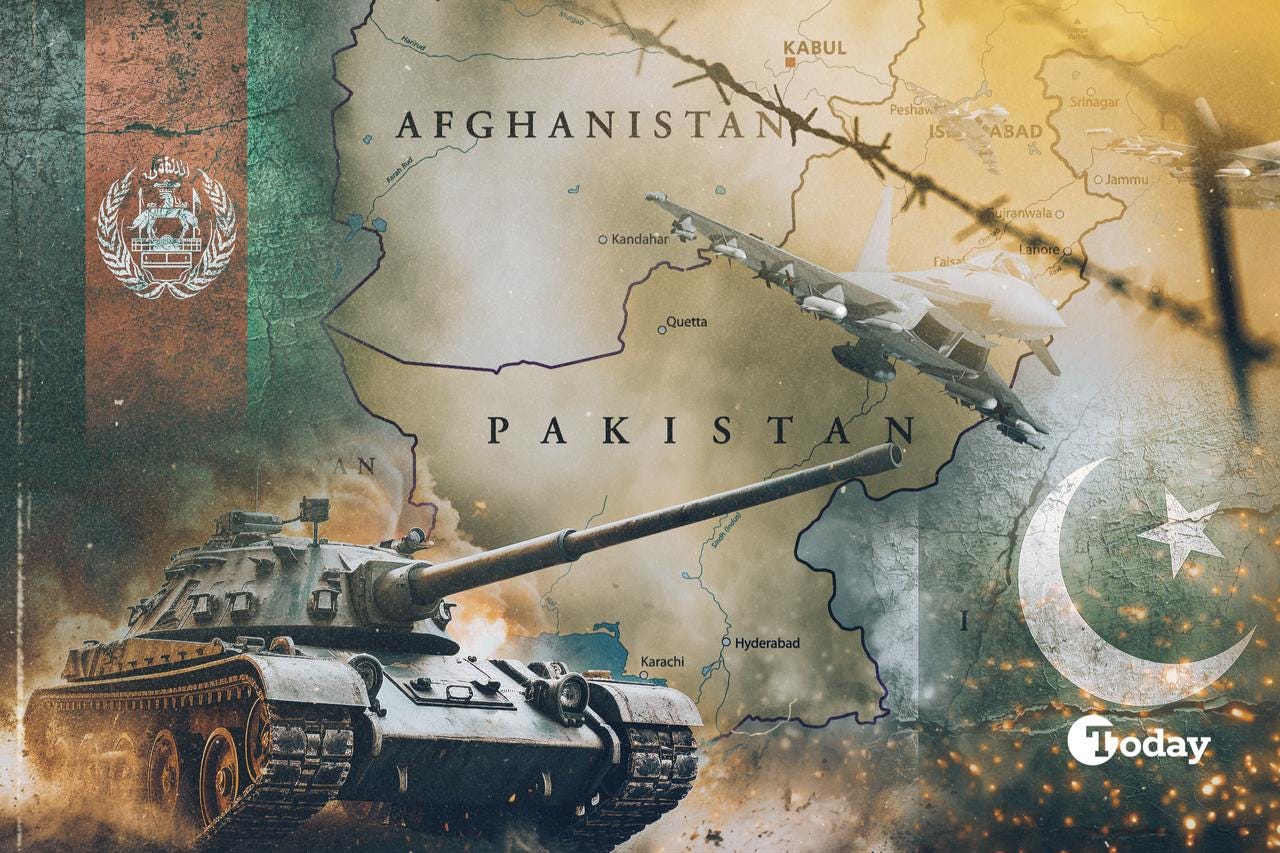
"Open War": Why Pakistan and Afghanistan Are on the Brink of All-Out Military Conflict
Ujasusi Blog’s Global Affairs Desk | 28 February 2026 | 0240
SEO Title: Pakistan–Afghanistan War 2026: Causes, Conflict Timeline & Intelligence Assessment Meta Description: A deep-dive intelligence analysis of the Pakistan–Afghanistan conflict — from the TTP insurgency and Operation Khyber Storm to Operation Ghazab Lil Haqq and the “open war” declaration of February 2026. URL Slug: /pakistan-afghanistan-war-2026-intelligence-analysis
The Pakistan–Afghanistan conflict of 2025–2026 is an active, cross-border military confrontation between Pakistan’s nuclear-armed military establishment and Afghanistan’s Taliban-led government, rooted in Pakistan’s demand that Kabul suppress the Tehreek-e-Taliban Pakistan (TTP) — a designated terrorist organisation using Afghan soil as a sanctuary to wage an insurgency inside Pakistan. As of 27 February 2026, Pakistan’s Defence Minister has declared the two states to be in a condition of “open war.”
❓ What Is the Pakistan–Afghanistan Conflict and Why Is It Happening Now?
The current confrontation is the violent culmination of a structural intelligence and security failure that has been building since August 2021, when the Afghan Taliban retook Kabul following the withdrawal of US and NATO forces. Pakistani officials initially sought international backing for the Afghan Taliban when it took control of Afghanistan in 2021, but attacks in Pakistan by the TTP surged markedly after that takeover. Islamabad’s strategic gamble — cultivating the Taliban as a regional asset for decades — has now produced catastrophic blowback. When CNN asked Pakistan’s Defence Minister Khawaja Asif whether the current spike in violence constituted blowback from Pakistan’s past policies, he replied: “Yeah, I think so.”
The core intelligence dispute is this: Pakistan insists the Afghan Taliban is knowingly harbouring and operationally supporting the TTP; Kabul flatly denies it. Both positions contain partial truths, which is precisely what makes this conflict so analytically complex and diplomatically intractable.
❓ What Are the Root Causes of the Pakistan–Afghanistan War?
🗺️ The Durand Line — An Unresolved Colonial Fault Line
The border between Afghanistan and Pakistan, known as the Durand Line, spans 2,611 kilometres and is not formally recognised by Afghanistan, which argues it was an imposed colonial demarcation that illegitimately divided ethnic Pashtun areas between the two countries. This foundational territorial dispute has never been legally resolved and serves as a persistent grievance that any Afghan government — Taliban or otherwise — can mobilise politically.
🕵️ The TTP Sanctuary Problem — An Intelligence Failure with Kinetic Consequences
The TTP (Tehreek-e-Taliban Pakistan) emerged in 2007 and, despite sharing ideology, ethnicity, and deep social networks with the Afghan Taliban, maintains discrete leadership with the explicit aim of overthrowing the Pakistani state. Pearl Pandya, South Asia senior analyst at the Armed Conflict Location & Event Data Project (ACLED), told Al Jazeera that the porous border provides fighters with a safe haven and that the Afghan Taliban appear unwilling to seriously crack down on the TTP, partly due to prior affinities but also out of fear of TTP militants defecting to their main rival, Islamic State Khorasan Province (ISIS-K).
According to the Pakistan Institute of Peace Studies, Pakistan experienced 699 terrorist attacks in 2025 — a 34 per cent increase from 2024 — killing 1,034 people, a 21 per cent increase on the previous year.
🔗 The Afghan Taliban’s Strategic Calculation
The Taliban also gains political legitimacy domestically by defying Islamabad, since much of the Afghan public is not fond of Pakistan — the country that ironically once sponsored and sheltered the Taliban insurgency throughout the 1990s and into the post-2001 period. Abandoning the TTP would also risk driving the group towards ISIS-K, the Taliban’s most dangerous domestic adversary. This creates a strategic trap from which neither side can easily exit.
❓ What Is the Timeline of the Pakistan–Afghanistan Military Escalation?
Date Event Significance August 2021 US/NATO withdrawal; Afghan Taliban seize Kabul TTP gains operational sanctuary in Afghanistan March 2024 Pakistan conducts second round of airstrikes in Paktika Province Signals shift to kinetic strategy 9 October 2025 Pakistan launches Operation Khyber Storm — airstrikes on Kabul, Khost, Jalalabad, Paktika Targeting TTP Emir Noor Wali Mehsud; he survives 11–19 October 2025 Taliban retaliates; fierce border fighting at Spin Boldak; Qatar/Turkey/Saudi Arabia broker ceasefire Deadliest cross-border clashes since 2021 November 2025 Multiple rounds of peace talks in Istanbul fail No lasting agreement reached 21–22 February 2026 Pakistan carries out airstrikes in Nangarhar, Paktika, Khost UNAMA confirms 13+ civilian deaths 26 February 2026 Afghanistan launches large-scale retaliatory offensive Taliban declares “large-scale offensive operations” along the Durand Line 27 February 2026 Pakistan launches Operation Ghazab Lil Haqq (”Righteous Fury”) — strikes Kabul and Laghman province Pakistan’s Defence Minister declares “open war”
❓ What Are the Military Capabilities of Each Side?
According to the International Institute for Strategic Studies (IISS) Military Balance 2025, Pakistan commands approximately 660,000 active-duty troops, reinforced by nearly 300,000 paramilitary and military police personnel. Its arsenal includes US-made F-16 fighter jets, French Mirage jets, and the jointly Chinese-produced JF-17.
The Afghan Taliban’s military is significantly thinner, with 172,000 active personnel, though the group has announced plans to expand to 200,000. Afghanistan has no fighter jets and no real air force, possessing only six aircraft — some dating to the Soviet era — and 23 helicopters, with an unknown number in airworthy condition.
Capability Pakistan Afghanistan (Taliban) Active Troops 660,000 (IISS 2025) 172,000 active; 200,000 planned (IISS) Air Power F-16s, JF-17, Mirages, armed drones No fighter jets; 6 aircraft, 23 helicopters (airworthiness unknown) Nuclear Status Yes — 170 warheads (IISS) No Armoured Vehicles 6,000+ (IISS) Soviet-era; exact number unknown External Backing Saudi Arabia (mutual defence pact, Sept 2025), US (renewed ties) Isolated internationally; no formal allies
❓ What Is the Intelligence Dimension — Who Is Backing Whom?
From an intelligence analysis standpoint, this conflict has significant proxy dimensions that extend well beyond a simple bilateral dispute.
Pakistan’s accusations against India: Pakistan has frequently accused India of backing the outlawed Balochistan Liberation Army (BLA) and the Pakistani Taliban — allegations New Delhi firmly denies. Whether or not these accusations are operationally accurate, they reflect Islamabad’s perception that the TTP insurgency is being amplified by hostile third-party intelligence services.
The US–Pakistan axis: Since mediating a brief conflict between Pakistan and India earlier in 2025, the United States has bolstered its ties with Pakistan and its Chief of Army Staff, General Asim Munir. Just weeks before the October 2025 airstrikes on Kabul, the US signalled renewed interest in Afghanistan when President Donald Trump called for American military forces to regain control of Bagram Air Base. This realignment has given Pakistan greater strategic confidence to pursue kinetic operations.
Pakistan–Saudi Arabia Defence Pact: Pakistan entered into a mutual defence pact with Saudi Arabia in September 2025, which stipulated that any aggression against either country shall be considered an aggression against both — a significant upgrade in Pakistan’s security guarantees that emboldened its military posture.
China’s role: China may represent the best available external mediator, given that the TTP has attacked Chinese nationals and investments in Pakistan, and the Taliban seek Chinese capital for infrastructure investment. In August 2025, Chinese Foreign Minister Wang Yi met with his Taliban and Pakistani counterparts in Kabul and pledged to work with both Islamabad and Kabul to tackle terrorism.
❓ What Are the Casualty Figures and Current Battlefield Situation?
Casualty claims from both sides diverge sharply — a classic feature of information warfare in opaque conflict zones. Pakistan’s army spokesperson Lt. Gen. Ahmed Sharif Chaudhry stated that Pakistani air and ground operations killed at least 274 Afghan Taliban members and wounded more than 400, while 12 Pakistani soldiers were killed and 27 wounded. Taliban spokesman Zabihullah Mujahid claimed Afghanistan killed 55 Pakistani soldiers, captured others, and destroyed 19 Pakistani military posts — figures Pakistan dismissed as propaganda.
On the civilian toll: UNAMA confirmed that Pakistani airstrikes in late February 2026 killed over 13 civilians and injured an additional seven, with infrastructure in Paktika province damaged or destroyed.
❓ What Does “Open War” Actually Mean in Intelligence and Legal Terms?
Pakistan’s Defence Minister Khawaja Asif’s declaration — “Our patience has now run out. Now it is open war between us” — carries significant weight. Whilst neither state has issued a formal declaration of war under international law, the phrase signals a doctrinal shift from counter-terrorism operations (framed as pursuing non-state actors on foreign soil) to state-on-state confrontation. This matters for intelligence analysts because it suggests Pakistan is prepared to treat Taliban military assets as legitimate targets, not merely TTP infrastructure.
❓ What Are the Prospects for De-escalation?
Pearl Pandya of ACLED assessed that “in the absence of a serious crackdown on the TTP by Afghanistan, further escalation seems inevitable,” with trends for 2026 appearing to be on a par with or slightly higher than the same period in 2025.
Qatar’s minister of state, Mohammed bin Abdulaziz al-Khulaifi, held separate calls with the foreign ministers of both Afghanistan and Pakistan on 27 February in an effort to de-escalate tensions. Turkey’s Foreign Minister Hakan Fidan also conducted separate calls with Pakistani, Afghan, Qatari, and Saudi counterparts. A Qatar-mediated ceasefire was achieved in October 2025 but proved short-lived.
Key de-escalation variables:
Whether the Taliban are willing to visibly suppress TTP leadership on Afghan soil
Whether China can leverage its economic relationship with the Taliban as diplomatic pressure
Whether the US–Pakistan strategic realignment pushes Kabul further towards isolation
Whether Pakistan’s domestic political pressures — from a military burned by TTP attacks — allow space for negotiation
🧭 Intelligence Assessment: Ujasusi Blog Analytical Verdict
The Pakistan–Afghanistan conflict is not a sudden eruption. It is the predictable consequence of three compounding failures: a colonial border dispute never settled by international law; Pakistan’s two-decade strategy of cultivating jihadist proxies that have now turned against the sponsoring state; and the Afghan Taliban’s rational but dangerous calculation that protecting the TTP is strategically preferable to suppressing it.
For African security analysts, this conflict carries a direct lesson: states that historically sponsor non-state armed groups as instruments of foreign policy — a pattern observable from the Sahel to the Great Lakes — consistently incubate the conditions for their own future destabilisation. The ISI’s management of the Taliban and the TTP stands as a textbook case of intelligence blowback.
The conflict will not resolve quickly. Neither side can afford to be seen as capitulating. Pakistan’s military-dominated political establishment cannot accept a TTP insurgency that killed over 1,000 people in 2025 without a decisive response. The Taliban cannot surrender the TTP without fracturing its own ideological coalition. That structural deadlock — not Pakistani airstrikes alone — is the true engine of this war.
Sources: Al Jazeera | CNN | NPR | PBS NewsHour | Foreign Affairs | Encyclopaedia Britannica | IISS Military Balance 2025 | ACLED | UNAMA | Reuters/AL-Monitor Military Factbox | Wikipedia — 2026 Afghanistan–Pakistan conflict