🔥 Operation Epic Fury Explained: Did the US and Israel Kill Ayatollah Khamenei? What We Know
Ujasusi Blog’s Global Affairs Desk | 01 March 2026 | 0135 GMT
⚡ What Happened?
On 28 February 2026, the United States and Israel launched a massive coordinated military assault on Iran. Designated Operation Epic Fury by the Pentagon and Operation Roaring Lion by the IDF, the campaign saw approximately 200 Israeli Air Force jets strike roughly 500 targets across 24 of Iran’s 31 provinces. US forces deployed B-2 stealth bombers, Tomahawk cruise missiles, and — in their first-ever combat use — low-cost autonomous one-way attack drones. Multiple senior Israeli and US officials report that Supreme Leader Ayatollah Ali Khamenei was killed. Iran has not confirmed his death and has produced no proof of life. The operation was ongoing as of 1 March 2026.
❓ What Exactly Is Operation Epic Fury?
Operation Epic Fury is the official Pentagon designation for the US component of the joint campaign, launched at approximately 07:15 Tehran local time on 28 February 2026. President Trump announced the strikes via social media at around 02:30 EST, urging Iranians to “take over your government.” The US Naval Institute confirmed that B-2 bombers, carrier air wings, and Tomahawks were simultaneously deployed alongside the Israeli component.
The Jerusalem Post reported the operation was planned for months, with Mossad identifying a rare window when senior Iranian officials were concentrated at known locations. The IDF described the campaign as the largest air raid in Israeli Air Force history.
❓ What Were the Military Targets?
The IDF confirmed strikes on approximately 500 objectives executed in structured waves by roughly 200 F-35I “Adir” stealth fighters equipped with Scorpius electronic warfare pods. US B-2 bombers delivered GBU-57 Massive Ordnance Penetrators — 30,000-lb bunker-busters — against hardened underground facilities.
Target categories included:
Leadership: Khamenei’s Beit-e Rahbari compound in Tehran’s Pasteur district — satellite imagery shows it destroyed
Military command: Ministry of Defence, IRGC command-and-control nodes, Armed Forces General Staff headquarters
Nuclear and missile sites: Isfahan nuclear complex, Fordow, Parchin explosive research facility, Qom missile storage, Tabriz launch infrastructure
Air defence: SA-65 batteries in Kermanshah, radar arrays across western and central Iran
Naval: Kanarak naval base — imagery shows a warship burning at berth
Civilian harm: A girls’ elementary school in Minab was struck; at least 108 students were killed as of 1 March 2026, drawing international condemnation
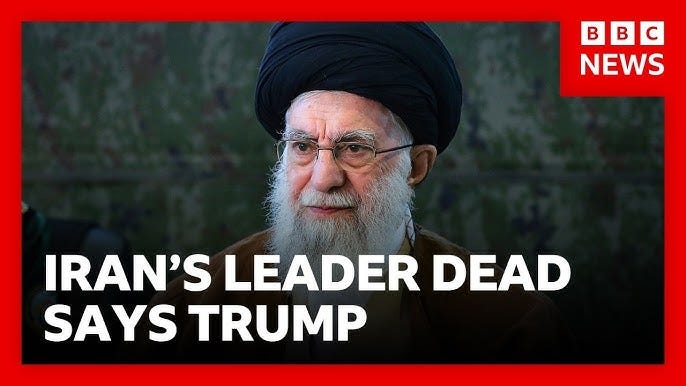
❓ Is Ayatollah Khamenei Dead? What Is the Intelligence Picture?
This remains the defining intelligence question of the operation. The weight of evidence strongly indicates Khamenei was killed, though no official confirmation has emerged and Iran has produced no proof of life in over 18 hours.
Source convergence on Khamenei’s death:
Netanyahu declared in a nationally televised address: “This tyrant no longer exists.” Trump stated on Truth Social that Khamenei was dead. When pressed by ABC News, he said “we believe he is” dead; he told NBC News: “We feel that is a correct story.”
Iranian denials — internally contradictory:
Foreign Minister Araghchi told NBC that Khamenei was “alive as far as I know” — a notable hedge, not a flat denial. Foreign Ministry spokesman Esmail Baghaei told ABC News both Khamenei and President Pezeshkian were “safe and sound.” Separately, an Iranian official told Reuters that Khamenei “was not in Tehran” — directly contradicting the safe-and-sound claim. No video, audio, or photograph of a living Khamenei has been produced.
Iran is simultaneously under a near-total internet blackout, making internal verification impossible.
Assessment: Based on convergent reporting from at least six high-quality Western intelligence and journalistic sources, satellite imagery showing Khamenei’s compound levelled, and total absence of proof of life after 18+ hours, Khamenei is assessed with high confidence to have been killed. The residual uncertainty reflects deliberate information suppression by Tehran, not genuine ambiguity in the intelligence picture.
❓ Which Iranian Officials Were Killed?
The IDF formally confirmed the following kills:
Ali Shamkhani — Secretary of the Supreme National Security Council; lead negotiator in nuclear talks with the Trump administration
Mohammad Pakpour — IRGC Commander-in-Chief; director of proxy force operations across the region
Aziz Nasirzadeh — Minister of Defence; oversaw long-range missile production and nuclear weapons research
Mohammad Bagheri — Chief of Staff of Armed Forces; commanded October 2024 missile strikes on Israel
Mohammad Shirazi — Chief of Khamenei’s military bureau since 1989
Axios additionally reported the deaths of Hossein Jabal Amelian (SPND chairman) and Reza Mozaffari-Nia. Fox News cited a senior US defence official confirming Khamenei dead alongside 5 to 10 other top Iranian leaders killed at a Tehran compound. The Times of Israel reported that succession processes were under way before dawn on Sunday.
Key survivors include President Pezeshkian, Parliament Speaker Ghalibaf, FM Araghchi, and Ali Larijani — now the most consequential surviving civilian official.
❓ What Did Iran’s Retaliatory Strikes Hit?
The IRGC launched multiple waves of ballistic missiles and Shahed drones targeting US military bases and allied states across seven countries:
CENTCOM reported zero US military casualties and described damage to its installations as minimal.
❓ What Is the Status of the Strait of Hormuz?
The IRGC declared the Strait of Hormuz closed to international navigation “until further notice.” Bloomberg reported that oil tankers had largely paused movements, though at least 17 vessels continued transit despite IRGC warnings.
The Strait handles approximately 20% of global oil supply — roughly 20 million barrels per day. Brent crude closed Friday at $72.87/barrel. CNBC reported that Rapidan Energy warned prices could exceed $100/barrel in a prolonged closure, with JP Morgan projecting $120–$130 in a full-blockade scenario. Yemen’s Houthis simultaneously announced renewed Red Sea attacks in solidarity with Iran — threatening a second concurrent maritime chokepoint.
❓ Why Were the Strikes Launched Now? The Strategic Rationale
White House officials provided a four-part rationale: Iran had reconstituted uranium enrichment capacity destroyed during Operation Midnight Hammer (June 2025); US intelligence assessed an imminent Iranian preemptive conventional attack against US regional forces; Trump concluded Iran was negotiating in bad faith; and Mossad identified a rare operational window.
The timing is acutely controversial. Just 24 hours before the strikes, Oman announced a breakthrough: Iran had agreed to never stockpile enriched uranium and to accept full IAEA verification. Three rounds of indirect US-Iran talks had occurred in February, with formal Vienna negotiations scheduled the following week. The CSIS assessed a clear US-Israeli division of labour — Israel targeting leadership, the US targeting capability. Russia and Oman accused Washington of using diplomacy as cover for a pre-planned strike.
❓ How Are Congress and the World Responding?
Trump did not seek congressional authorisation. CNN reported bipartisan War Powers resolutions were introduced simultaneously in both chambers — by Reps. Massie and Khanna in the House, and by Sens. Kaine and Paul in the Senate. Both are expected to fall short of the two-thirds threshold needed to override a veto.
Internationally, the E3 (UK, France, Germany) called for resumed diplomacy without explicitly condemning the initial strikes. Al Jazeera reported Russia issued the strongest condemnation, calling the action “a pre-planned and unprovoked act of armed aggression.” China called for an immediate ceasefire. Qatar condemned Iran’s strikes on its territory as a flagrant sovereignty violation. The UN Security Council held an emergency session but passed no resolution.
❓ What Happens Next? Key Intelligence Indicators
Proof of life from Tehran: No video, audio, or statement from Khamenei had emerged as of publication. This remains the single most consequential intelligence signal.
Succession mechanics: Iran International reports the IRGC was attempting to appoint a successor before Sunday dawn, bypassing the Assembly of Experts. Frontrunners: Mojtaba Khamenei (continuity) and Hassan Khomeini (reformist option).
Strait of Hormuz duration: Sunday evening Asian market openings will produce the first real oil pricing signal. A sustained closure risks prices above $100/barrel and, in a worst-case scenario, global recession.
Phase 2 strikes: The IDF issued an evacuation warning for Isfahan industrial zones, indicating follow-on strikes on remaining nuclear infrastructure are planned.
Proxy escalation: Houthi resumption of Red Sea attacks, potential Kataib Hezbollah strikes against US bases in Iraq, and Hezbollah posture in Lebanon must all be monitored.
Domestic unrest: The IRGC reportedly feared that daylight on 1 March could trigger nationwide protests. Street celebrations were already reported in Tehran neighbourhoods on Saturday night.
Congressional War Powers vote: Expected mid-week; the outcome will shape the legal and political sustainability of continued operations.
Analysis current as of 1 March 2026. This is an active military operation. Follow live coverage via BBC News, NBC News, Iran International, and Al Jazeera. Ujasusi Blog will publish a dedicated intelligence assessment on IRGC succession dynamics and the strategic implications of Khamenei’s confirmed death.