

Ujasusi Blog’s West Africa Monitoring Team | 12 March 2026 | 0105
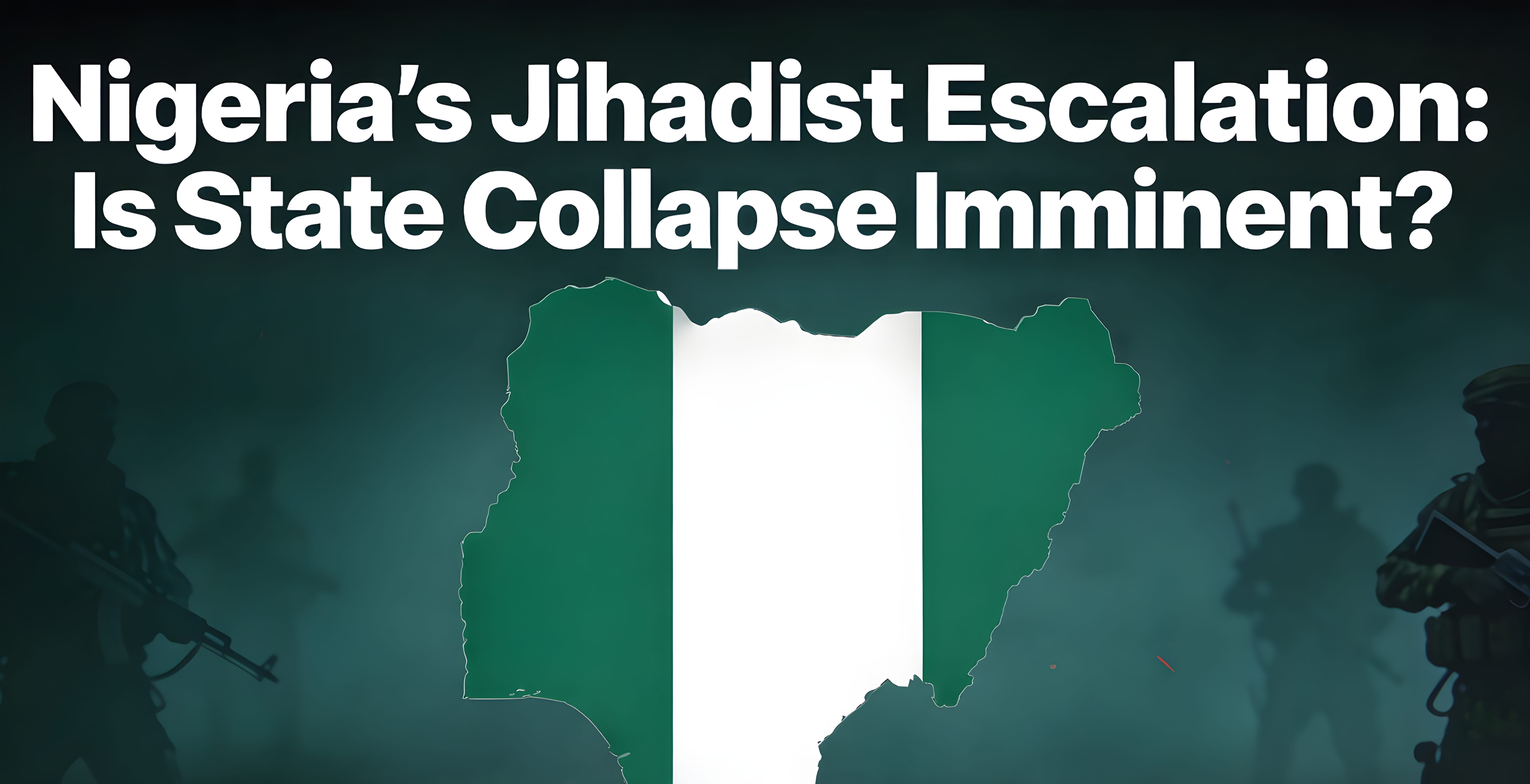
Nigeria faces an accelerating jihadist insurgency led by ISWAP and Boko Haram factions, characterised by coordinated multi-front attacks, systematic weapons seizure from military bases, and widening ungoverned spaces across the northeast. Total state collapse remains unlikely in the near term, but the conditions for protracted strategic erosion of sovereign control are firmly in place and worsening.
🔍 What Is Happening in Nigeria’s Northeast Right Now?
Between 8 and 10 March 2026, the Islamic State West Africa Province (ISWAP) and affiliated Boko Haram factions executed at least six simultaneous attacks across Borno and Yobe states, as well as the wider Lake Chad Basin. The operations were distinguished by their scale, coordination, and deliberate targeting of Nigerian military forward operating bases (FOBs). At least two officers and several soldiers were killed. Security analysts from the Institute for Security Studies and Good Governance Africa estimate the officer death toll for the preceding week at no fewer than four.
ISWAP released video documentation of the haul seized during the raids: heavy weapons, ammunition, dozens of motorcycles, and military vehicles. The Nigerian military acknowledged the attacks constituted “an attempt by the terrorists to overwhelm troop positions,” in a statement attributed to military spokesman Sani Uba.
The operational signature is instructive. ISWAP did not hold the seized bases. The group struck, stripped the positions of military hardware, destroyed the installations, and withdrew into forest sanctuaries. This is not territory-grabbing in the conventional insurgent sense. It is a deliberate logistics strategy designed to sustain a long war at minimal financial cost to the organisation.
🧠 What Does the Intelligence Assessment Tell Us About ISWAP’s Strategic Objectives?
ISWAP’s doctrine, consistent with Islamic State global franchise methodology, prioritises three interlocking strategic objectives:
Attrition warfare: Inflict continuous casualties on Nigerian security forces to degrade morale, reduce operational capacity, and stretch deployments across multiple theatres simultaneously.
Weapons resupply through battlefield seizure: As security researcher Malik Samuel of Good Governance Africa has observed, so long as military bases remain vulnerable to overrun, ISWAP effectively eliminates its own procurement costs for arms. Each raid is both a tactical victory and a logistics operation.
Governance displacement: By demonstrating that the Nigerian state cannot protect its own military infrastructure, ISWAP signals to civilian populations in conflict zones that the state offers neither security nor authority. This accelerates civilian collaboration with or acquiescence to militant governance structures.
The March 2026 attacks represent a qualitative escalation. Senior research fellow Vincent Foucher of France’s National Centre for Scientific Research (CNRS), one of the foremost academic authorities on the Lake Chad insurgency, assessed the attacks as displaying “a remarkable level of coordination” unprecedented in recent operational history. That assessment carries significant intelligence weight: it indicates ISWAP has rehabilitated its command-and-control structures to a level capable of synchronising complex multi-axis operations across a geographically dispersed theatre.
📊 How Does ISWAP Compare to Boko Haram in Terms of Current Threat Posture?
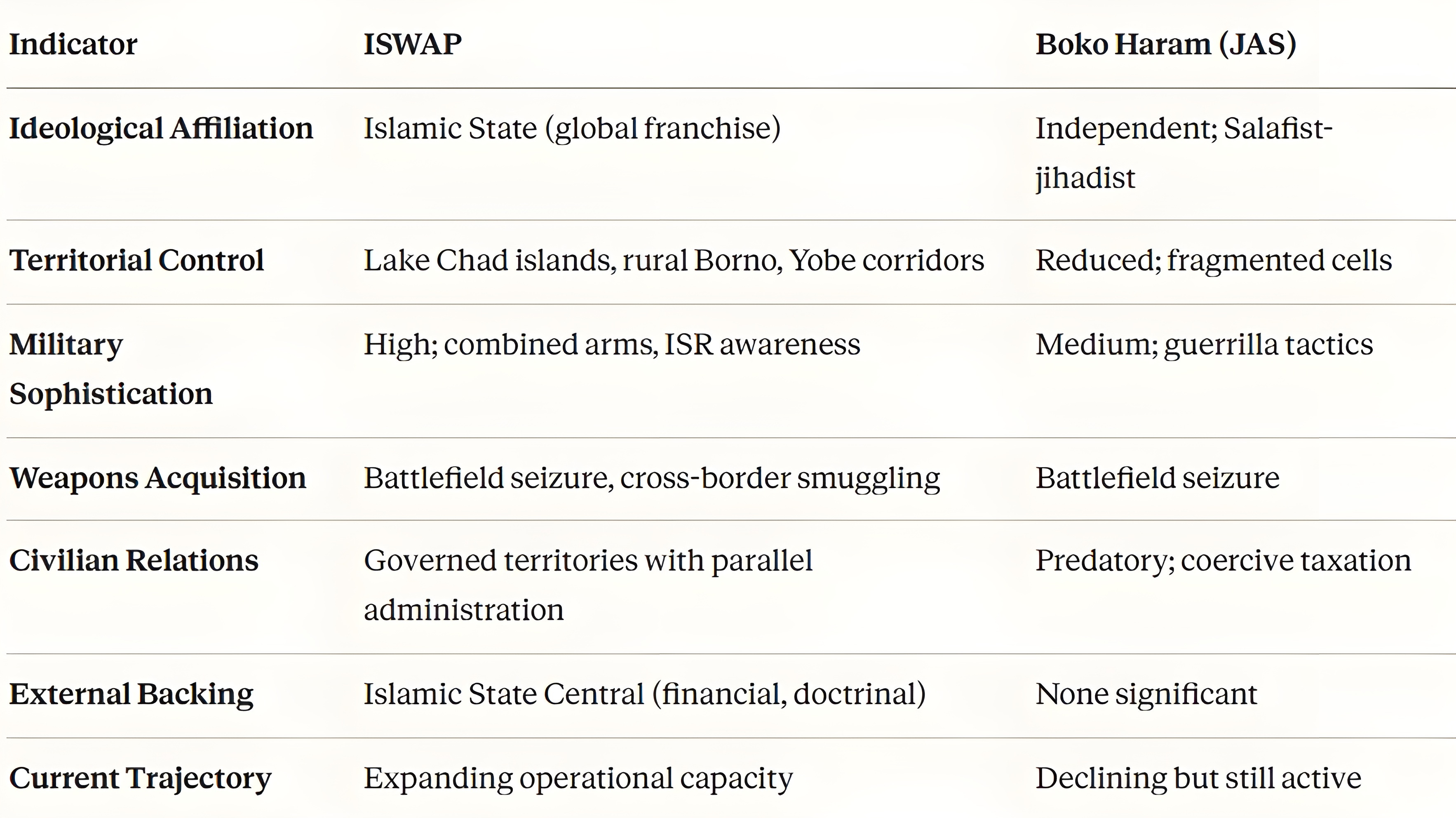
ISWAP has functionally superseded Boko Haram as the dominant jihadist actor in the Lake Chad Basin. Its governance model, which combines brutal enforcement with provision of rudimentary services in controlled areas, more closely resembles the Islamic State’s proto-state architecture than classic insurgent movements. This distinction matters for intelligence assessments because it implies ISWAP is not merely a security threat but an emergent parallel sovereign.
🇺🇸 What Role Is the United States Playing and Is It Making a Difference?
The United States deployed at least 100 military personnel to Nigeria in December 2025 as part of a bilateral security partnership formalised partly in response to claims by President Donald Trump that Nigerian Christians face systematic targeting in the insurgency. The deployment provides training, logistical support, and Intelligence, Surveillance and Reconnaissance (ISR) capabilities.
ISR flights have enabled the Nigerian military to intensify aerial bombardment of ISWAP and Boko Haram hideouts. However, the March 2026 attacks demonstrate the ceiling of ISR-supported airpower as a counterinsurgency instrument. ISWAP has adapted its operational patterns to exploit the time windows between aerial surveillance passes; the group’s fighters move under forest canopy, disperse rapidly post-attack, and exploit the porous Nigeria-Cameroon-Chad-Niger quadripoint, where Lake Chad Basin sovereignty is contested and surveillance coverage is inconsistent.
The U.S. deployment also reflects a geopolitical calculation as much as a security one. The Trump administration’s framing of the conflict through a religious lens, specifically the Christian persecution narrative, has introduced a politically motivated filter over what is a fundamentally complex ethno-political and socio-economic insurgency. This framing risks distorting intelligence priorities and misaligning counterinsurgency resources with the actual drivers of the conflict.
The structural challenge remains: 100 U.S. trainers cannot substitute for the systemic deficiencies in the Nigerian military’s capacity for sustained operations across a theatre spanning hundreds of thousands of square kilometres.
⚠️ What Are the Core Vulnerabilities of the Nigerian Military That ISWAP Is Exploiting?
Security analysts have consistently identified a cluster of structural weaknesses that ISWAP has demonstrated tactical awareness of:
Rapid redeployment cycles: The Nigerian military achieves local successes in specific hotspots but lacks the troop density for persistent presence. Once forces move to address crises elsewhere, ISWAP and affiliated groups reconstitute in vacated areas within weeks.
Forward base exposure: FOBs in the northeast are frequently under-resourced, under-manned, and poorly fortified relative to the threat environment. The March 2026 raids exploited this vulnerability at scale.
Intelligence gaps at the operational level: Despite ISR improvements at the strategic level, tactical human intelligence (HUMINT) networks in rural Borno and Yobe remain thin. ISWAP exploits this gap to conduct pre-operational reconnaissance without detection.
Multi-front overstretch: The Nigerian military simultaneously manages banditry in the Northwest, separatist militancy in the South-East (IPOB/ESN), oil theft and cultist violence in the Niger Delta, and the northeast insurgency. This overstretch is not accidental from ISWAP’s perspective; the group has an incentive to maintain pressure on multiple Nigerian security theatres to prevent concentration of force against it.
Corruption and diversion of defence resources: Transparency International Defence and Security‘s Government Defence Integrity Index assigns Nigeria an ‘E’ rating, its highest corruption risk category, citing billions of dollars lost through fraudulent procurement practices, opaque “security votes” mechanisms, and ghost soldier schemes that divert salaries and hollow out frontline combat strength. Defence sector corruption has, in the assessment of TI-DS researchers, directly inhibited the Nigerian military’s ability to counter the northeast insurgency by leaving security forces under-resourced while enriching a politically connected procurement class.
🌍 What Are the Regional Implications of Escalating ISWAP Operations?
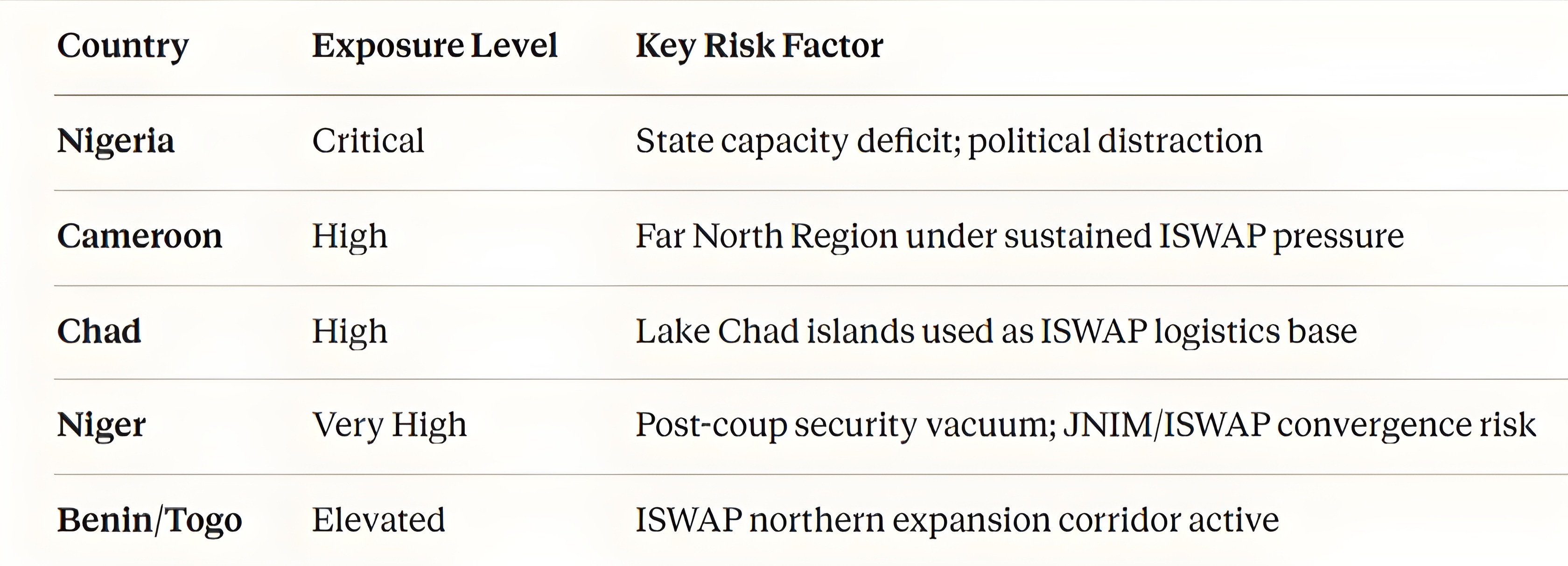
The Lake Chad Basin functions as a unified jihadist operational environment, not four separate national security problems. The Multinational Joint Task Force (MNJTF), the regional security architecture mandated to coordinate counterinsurgency, is operating in its most structurally weakened state since reactivation in 2014. Niger formally withdrew from the force in March 2025; although its participation had been temporarily restored following diplomatic engagement by Nigeria after the July 2023 coup, that restoration proved short-lived. Chad threatened its own withdrawal in November 2024 following a deadly attack in Barkaram, after which it launched a unilateral Operation Haskanite rather than working through the MNJTF framework, signalling a collapse of multilateral trust among contributing nations. The Institute for Security Studies has warned that a weakened MNJTF risks the same fate as the G5 Sahel force, which collapsed after contributing nations prioritised unilateral action over regional coordination.
These fractures are not peripheral to ISWAP’s operational calculus. The Lake Chad islands, which Niger’s Diffa sector was responsible for covering within the MNJTF framework, now function as ISWAP logistics hubs, secure havens, and staging grounds with reduced interdiction risk. The 5th Lake Chad Basin Governors’ Forum, held in January 2025, specifically identified clearing ISWAP from the Tumbuns island chain as a critical priority, precisely because Niger’s effective withdrawal had created an ungoverned maritime corridor that the group is actively exploiting.
🔮 Would Nigeria Eventually Fall Into the Hands of Terrorists? A Structured Intelligence Assessment
This is the question that sits at the centre of regional threat calculus, and it demands a precise analytical answer rather than a political one.
The short answer is: no, not in the conventional sense of territorial conquest. ISWAP’s strategic objective is not to capture Abuja or Lagos. The group does not have the force projection, logistics tail, or popular base to seize and administer Nigeria’s major urban centres. A Taliban-style takeover of the Nigerian capital is not a plausible scenario within any foreseeable planning horizon.
The longer, more troubling answer is: yes, in the strategic sense of functional state failure in specific regions. What Nigeria faces is not imminent collapse but a process of incremental sovereign erosion in the northeast and, increasingly, the northwest. This distinction is critical for both intelligence analysis and policy response.
The scenario that analysts at the Institute for Security Studies and Crisis Group have consistently assessed as most probable is not conquest but consolidation: ISWAP consolidating a durable parallel governance zone across swathes of Borno, Yobe, and the Lake Chad islands, where Nigerian state authority is nominal, courts and administration are absent, and the group extracts resources and recruits with minimal disruption from security forces.
Several compounding factors increase the risk of accelerated erosion:
Political distraction at the federal level: President Bola Tinubu’s administration is visibly preoccupied with economic management and preparation for the 2027 presidential election. Security analysts and civil society actors have publicly accused the administration of prioritising electoral positioning over northeast stabilisation. Political attention is a finite resource, and its diversion from security governance has measurable consequences.
Economic deterioration: Nigeria’s naira devaluation, fuel subsidy removal, and inflation crisis have compressed household incomes across the north, widening the recruitment pool available to jihadist organisations that offer payment, status, and ideological purpose to unemployed young men.
Climate-driven resource competition: Lake Chad has shrunk by approximately 90% since the 1960s. The resulting competition over fishing grounds, agricultural land, and water access between fishing communities and pastoralist groups has generated ethnic conflicts that ISWAP consistently exploits as a recruitment and destabilisation mechanism.
Governance absence as ISWAP’s primary enabler: ISWAP does not primarily recruit by ideological persuasion alone. It fills vacuums left by an absent state. Where there are no courts, no schools, no roads, and no security, ISWAP provides a substitute order. This is not a military problem with a military solution.
🔑 What Would a Credible Counterinsurgency Response Require?
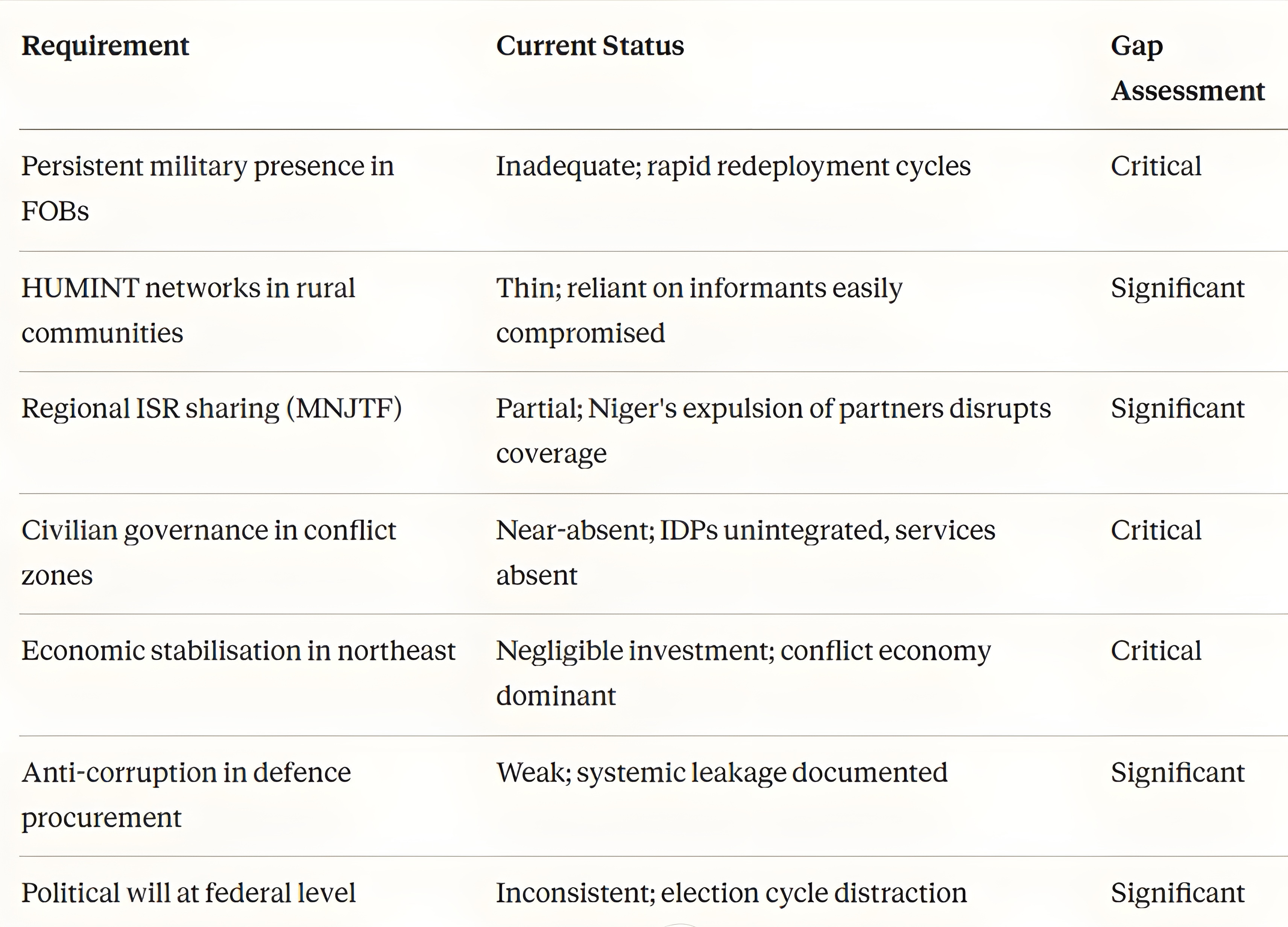
A genuine counterinsurgency strategy for Nigeria’s northeast cannot be built on airpower, external troop deployments, or periodic military offensives. The academic and practitioner consensus, documented across the Combating Terrorism Centre at West Point and the Institute for Security Studies, is unambiguous: sustainable counterinsurgency requires simultaneous military pressure, restored civilian governance, economic integration, and regional diplomatic coordination. Nigeria is currently delivering partial capacity on the first element and negligible capacity on the remaining three.
🧭 Intelligence Assessment: Probability Matrix
The following assessments reflect OSINT-derived analytical judgements:
Probability of full state collapse (ISWAP controlling Nigerian territory beyond Lake Chad region): LOW within a 10-year horizon. Nigeria’s federal structure, military size, economic weight, and urban political resilience make systemic collapse improbable.
Probability of sustained ungoverned zone consolidation (ISWAP retaining effective authority in rural Borno/Yobe/Lake Chad): HIGH and already partially realised. This is the operating environment as of March 2026.
Probability of ISWAP successfully degrading Nigerian military capacity below minimum operational threshold: MEDIUM over a five-year horizon, contingent on sustained political neglect, continued multi-front overstretch, and regional security vacuum persistence.
Probability of escalation into a regional state-breaking crisis: HIGH, elevated from MEDIUM-HIGH following Niger’s confirmed March 2025 MNJTF withdrawal, Chad’s demonstrated unilateralism, and continued U.S. disengagement from the Sahel under the Trump administration’s broader Africa policy retrenchment.
📌 Final Intelligence Assessment
Nigeria will not fall to jihadists in the way Afghanistan fell to the Taliban. The country is too large, too diverse, too urbanised, and too economically significant to succumb to that mode of collapse. But the binary framing of “fall” versus “survival” obscures the more dangerous and more probable trajectory: a prolonged, low-intensity sovereign erosion in which millions of Nigerians in the northeast live under ISWAP’s parallel authority, the Nigerian state’s writ extends only to fortified garrison towns, and the human cost accumulates invisibly, far from the political attention of Abuja.
The March 2026 attacks are not a turning point. They are a data point in a long-run trend of jihadist institutional strengthening and state institutional weakness. The regional security architecture designed to contain that trend, the MNJTF, is fracturing precisely when ISWAP is at its most operationally sophisticated. Unless Nigeria’s federal government treats the northeast as a governance crisis rather than purely a security crisis, and unless Lake Chad Basin states arrest the diplomatic deterioration that is hollowing out their only multilateral defence framework, the trajectory leads not to sudden collapse but to something in many ways worse: a permanent, grinding state of controlled disorder in which ISWAP thrives and the civilian population bears the cost.
Independent intelligence analysis takes time and resources — if this work matters to you, please consider supporting it by donating HERE