

Ujasusi Blog’s Great Lakes Region Monitoring Team | 28 July 2025 | 2130 BST
🔓FREE ACCESS
🌍 Executive Summary
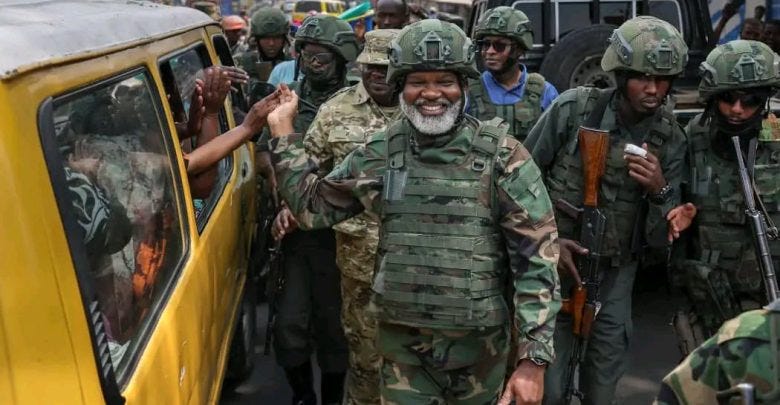
Corneille Nangaa, leader of the Allied Forces for Change (AFC) and the M23 rebel coalition, has issued a strident rejection of both international and Congolese government calls for the group to vacate territories under its control in eastern DRC. His statement comes just days after the signing of a U.S.-endorsed peace agreement between Kinshasa and Kigali in Doha, aimed at ending years of instability in the region.
Nangaa's defiance represents the most explicit repudiation of the Doha framework to date. He not only refuses to withdraw from North and South Kivu but declares that the restoration of state authority will not be led by Kinshasa, but by the AFC/M23 itself. This position significantly raises the stakes for U.S. diplomacy, undermines multilateral conflict-resolution efforts, and signals a prolonged insurgency with increasing political overtones.
🔎 Background: Doha Agreement and U.S. Position
The July 2025 Doha Agreement, signed between the governments of the Democratic Republic of Congo and Rwanda, was heralded as a milestone for peace in the Great Lakes region. It includes provisions for a ceasefire, the disengagement of armed forces, and the mutual recognition of sovereignty.
In statements following the agreement, U.S. Senior Advisor for Africa Massad Boulos stressed that the core objective of the accord was the full restoration of the DRC’s territorial integrity:
“The expected outcome is undoubtedly the restoration of the authority of the State over its entire territory. That is normal for any country, regardless of who the president is.”
This message was echoed by international organisations and regional blocs, urging M23 rebels to vacate occupied zones.
However, the Kinshasa administration's celebratory tone has not translated into material changes on the ground. Armed groups, notably the AFC/M23, continue to maintain strongholds in mineral-rich and strategic areas of eastern DRC.
🔹 Nangaa’s Statement: Key Points of Defiance
In a televised address from an undisclosed location on the night of July 27, Corneille Nangaa sharply criticised the peace process and framed his movement as the only legitimate custodian of national restoration. Key assertions included:
Categorical rejection of U.S. and Kinshasa calls to withdraw: Nangaa labelled the idea of a voluntary exit from North and South Kivu “a fantasy devoid of political, legal, or strategic logic.”
Delegitimisation of the Tshisekedi government: Referring to the Congolese president by his family name “Tshilombo,” Nangaa accused the administration of corruption, tribalism, and constitutional manipulation.
Assertion of revolutionary mandate: He claimed that the AFC/M23 represents the “real aspirations of the people” and invited exiled Congolese to return and join the “revolution.”
Rejection of future negotiations under current conditions: Confidence-building measures, such as releasing political prisoners, have not materialised, rendering further dialogue futile.
“We will not withdraw so the same failed regime can return.”
📊 Strategic Implications
⚠️ For the DRC Government
Loss of narrative control: The framing of the AFC/M23 as a revolutionary alternative undermines Kinshasa's legitimacy domestically and abroad.
Military dilemma: Any direct attempt to dislodge M23 could lead to significant casualties and possible regional escalation.
🇺🇸 For the United States
Challenge to diplomacy: The outright defiance of U.S.-backed peace efforts reflects diminishing leverage over non-state actors.
Policy recalibration: Washington may be forced to rethink its approach, especially if internal DRC political weaknesses persist.
🌎 For Regional Players
Rwanda’s role under scrutiny: Kigali’s real stance may face renewed international attention, particularly if rebel positions continue to hold or expand.
EAC credibility at stake: The East African Community’s attempts at mediation are further complicated by the AFC/M23’s secessionist posture.
🚨 Undermining the Doha Framework
Nangaa’s defiance exposes the fragility of the Doha Agreement, which rests on mutual goodwill and coordinated disarmament. With AFC/M23 refusing to cede control or participate in further talks, the deal risks being reduced to a symbolic gesture.
Moreover, Nangaa’s narrative—framing the Kinshasa government as both oppressive and structurally broken—offers ideological cover for continued armed occupation. This threatens to prolong the status quo and potentially attract new actors to the rebellion.
⚖️ Legitimacy and the War of Narratives
What distinguishes this latest statement is its bold claim to political legitimacy. Nangaa does not merely speak as a rebel leader but as a self-styled revolutionary — one invoking popular sovereignty, anti-corruption rhetoric, and resistance to dictatorship.
This is a direct challenge to Kinshasa’s constitutional order and to international norms that prioritise state-centric conflict resolution. Nangaa's ability to articulate a coherent (albeit insurgent) political agenda grants him a form of soft power often missing in non-state actors.
⏱ Outlook: Short-, Medium-, and Long-Term Scenarios
⏰ Short-Term (0–3 months)
Likely intensification of anti-M23 military operations by FARDC, potentially with regional or private military support.
Increased securitisation of the peace process and stalling of Doha implementation.
Risk of retaliatory action by M23, including targeting civilian populations.
⏱ Medium-Term (3–12 months)
Emergence of parallel governance in rebel-held territories.
External donors may reconsider support to DRC institutions amid governance concerns.
Possibility of new regional summits, this time involving non-state actors.
⏱ Long-Term (12+ months)
Entrenchment of de facto territorial bifurcation between Kinshasa-controlled west and AFC/M23-held east.
Increased calls for federalism or secession from eastern constituencies.
Risk of the AFC/M23 evolving into a quasi-political party, complicating future elections.
🔍 Final Assessment
The Nangaa-M23 defiance represents a critical inflexion point in eastern Congo’s crisis. It challenges the fundamental assumptions of the Doha peace framework, delegitimises Kinshasa’s authority, and reframes the conflict as a political revolution rather than an insurgency.
With regional, continental, and international players all invested in stabilisation, the path forward remains fraught. The durability of the U.S.-brokered peace depends not only on state-to-state relations but on the willingness — or lack thereof — of armed political actors like Nangaa to submit to a centralised authority they view as illegitimate.
The stakes are now significantly higher. This is not merely a question of security. It is a question of who gets to define what the Congolese state is — and who leads it.
☕ Support Ujasusi Blog
If you value the intelligence insights shared here, consider showing your support through a small donation. Your contribution helps keep this platform independent, focused, and thriving.
Or scan the code below

: