

Ujasusi Blog’s Spy Tech Desk | 10 March 2026 | 0120 GMT
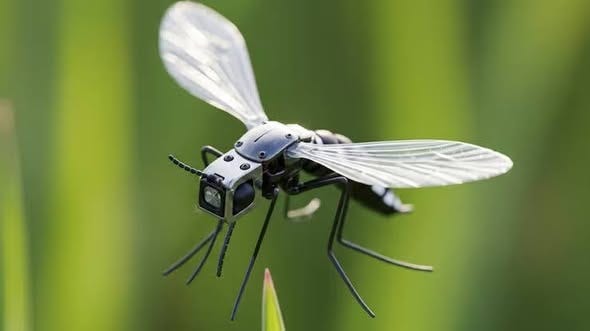
Mosquito-sized surveillance drones are biomimetic micro-air vehicles (MAVs) engineered to imitate insect flight using flapping wings, MEMS microelectronics, and ultra-light materials. Designed for covert reconnaissance, these systems can collect intelligence in confined or sensitive environments where conventional UAVs would be visible, audible, or too large to operate undetected.
Executive Assessment
Insect-scale drones represent one of the most advanced frontiers in surveillance and reconnaissance technology. By mimicking biological flight, these devices promise discreet intelligence collection inside buildings, urban environments, or sensitive facilities where traditional unmanned aerial vehicles cannot operate effectively.
Recent demonstrations in China of mosquito-like drones highlight intensifying global research into micro-air vehicles capable of covert observation. These systems rely on breakthroughs in biomimetic robotics, micro-electronics, and flapping-wing aerodynamics.
Foundational work in this field includes the RoboBee project developed at Harvard University’s Wyss Institute for Biologically Inspired Engineering, which demonstrated insect-scale robotic flight using piezoelectric actuators and ultra-light carbon-fibre structures.
Military interest in micro-drones has long been supported by organisations such as the Defence Advanced Research Projects Agency, which has funded research programmes exploring micro-air vehicles, swarm robotics, and unconventional reconnaissance technologies.
Chinese demonstrations of mosquito-sized drones appear linked to laboratories associated with the National University of Defence Technology, a major defence research institution connected to the technology development ecosystem of the People’s Liberation Army.
Importantly, no publicly verified evidence currently indicates that mosquito-scale drones are operational military systems. Available information suggests that Chinese examples remain research prototypes designed to explore biomimetic flight and micro-surveillance capabilities.
What exactly is a mosquito-sized surveillance drone?
A mosquito drone is a biomimetic unmanned aerial system designed to replicate the flight mechanics of insects.
Unlike conventional drones that rely on propellers, insect drones employ flapping wing propulsion inspired by mosquito or dragonfly aerodynamics.
Typical design characteristics include:
• Mass: often below 1 gram
• Wingspan: approximately 1–3 centimetres
• Wingbeat frequency: around 100–200 Hz
• Sensors: micro cameras, microphones, or environmental detectors
• Navigation: remote control or autonomous AI flight
Much of the fundamental research on insect-scale robotics has been conducted by institutions such as the MIT Biomimetic Robotics Laboratory and the Imperial College London Aerial Robotics Laboratory.
How does insect-scale drone flight work?
Insect drones operate in an aerodynamic regime known as low Reynolds number flight, where traditional aircraft design principles are ineffective.
Lift is generated through rapid oscillation of flexible wings that create vortices above the wing surface.
Key enabling technologies
Flapping wing propulsion
• mimics biological insect flight
• enables hovering and agile manoeuvres
• functions effectively at miniature scale
Piezoelectric actuators
• convert electrical signals into mechanical wing motion
• allow extremely high wingbeat frequencies
MEMS microelectronics
• integrate sensors and processors at microscopic scale
• dramatically reduce power consumption
Advances in micro-electro-mechanical systems fabrication, pioneered in laboratories such as the Berkeley Sensor & Actuator Center at the University of California Berkeley, have enabled the development of increasingly capable micro-robotic systems.
Why would intelligence services use mosquito drones?
For intelligence agencies, the primary value of insect drones lies in stealth access to sensitive environments.
Traditional UAV platforms suffer from several operational constraints:
• audible rotor noise
• visible aircraft structure
• radar detectability
• difficulty entering buildings
Micro-air vehicles can potentially bypass these limitations because they resemble ordinary insects.
Possible intelligence missions include:
• indoor surveillance inside secure facilities
• monitoring diplomatic compounds
• reconnaissance during urban warfare
• close-range signals intelligence collection
The concept echoes earlier Cold War experiments such as the CIA’s Insectothopter surveillance project, an experimental dragonfly-like reconnaissance device developed by the CIA’s Directorate of Science and Technology.
What other technologies exist in the same class?
Research into micro-scale surveillance platforms is occurring globally.

The Black Hornet Nano reconnaissance drone developed by Teledyne FLIR is one of the few micro-UAVs already deployed by several NATO militaries.
The DelFly flapping-wing drone developed at Delft University of Technology demonstrates how insect-style flight can be stabilised using onboard computer vision systems.
Smart Dust, pioneered by researchers at the University of California Berkeley, represents a different but related technology. Rather than flying drones, Smart Dust consists of microscopic wireless sensor nodes capable of forming distributed sensing networks for environmental monitoring, battlefield sensing, and infrastructure surveillance.
How do insect drones compare with traditional UAVs?
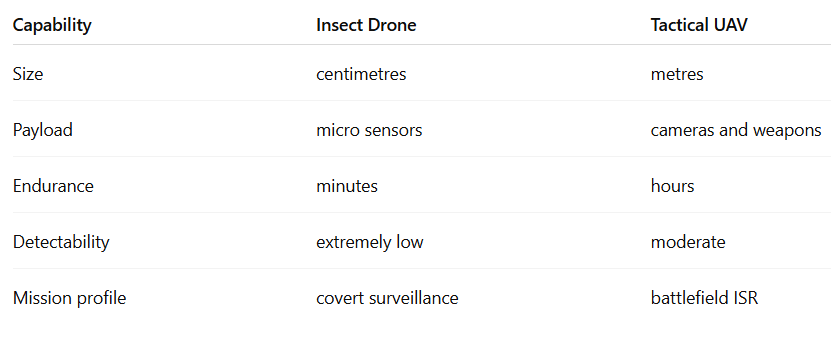
Micro-air vehicles therefore function primarily as complements to conventional reconnaissance drones, rather than replacements.
Strategic intelligence implications
Insect-scale drones introduce significant implications for intelligence and security.
Espionage applications
• surveillance inside government buildings
• monitoring military installations
• intelligence gathering in diplomatic compounds
• covert reconnaissance in dense urban environments
Military implications
• indoor battlefield reconnaissance
• distributed sensor networks
• autonomous swarm surveillance
Research into swarm tactics is underway through initiatives such as the DARPA Offensive Swarm-Enabled Tactics programme.
What are the biggest engineering challenges?
Despite rapid progress, several technical barriers remain.
Energy storage
• micro-batteries have limited capacity
• wireless power transfer remains experimental
Flight stability
• insect-scale drones are highly sensitive to wind turbulence
Sensor miniaturisation
• cameras must operate with extremely low power
Autonomous navigation
• indoor environments require advanced AI vision algorithms
Detection frameworks for extremely small drones are being explored by institutions such as the National Institute of Standards and Technology small-UAS research programme.
Outlook
Mosquito-scale drones remain primarily research prototypes, but advances in artificial intelligence, materials science, and micro-electronics are accelerating their development.
If current technological trajectories continue, insect-scale drones could evolve into one of the most discreet surveillance platforms ever developed.
For intelligence agencies they represent a potential revolution in covert reconnaissance. For counter-intelligence professionals they introduce a new challenge: detecting surveillance systems designed to appear indistinguishable from natural insects.