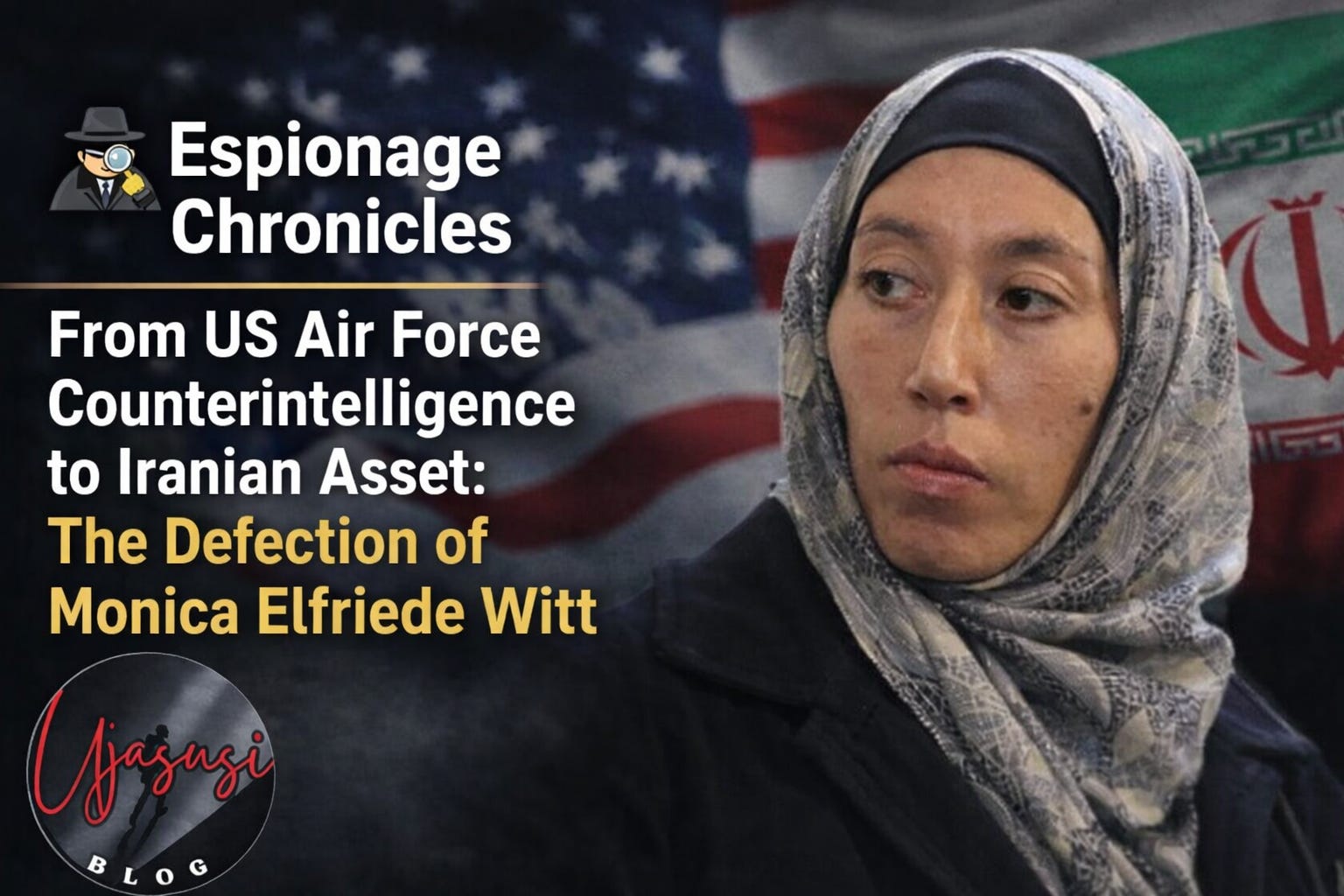
đ”ïž Espionage Chronicles | From US Air Force Counterintelligence to Iranian Asset: The Defection of Monica Elfriede Witt**
Espionage Chronicles | Ujasusi Blog Originals
The Operative
Monica Elfriede Witt served in the United States Air Force from 1997 to 2008, rising to the rank of technical sergeant. Shortly after enlisting, she studied Farsi at the Defence Language Institute in California before deploying overseas to conduct classified signals intelligence missions. She was subsequently assigned to the Air Force Office of Special Investigations as a counterintelligence special agent â one of the most access-sensitive roles in the American military intelligence apparatus.
Per the federal indictment against her, Witt was granted access to top-secret and sensitive compartmented national defence information, including the true names of American intelligence agents and sources operating overseas. She maintained this access throughout her military service and a subsequent contracting career with firms including Booz Allen Hamilton. She was, in short, precisely the kind of officer that adversarial intelligence services spend years attempting to identify and cultivate.
The Iranians found her in fewer than two.
The Radicalisation Pathway
The Witt case is a textbook study in ideological defection â a phenomenon intelligence scholars distinguish sharply from the financially motivated betrayals of Aldrich Ames or Robert Hanssen. There was no payment record, no offshore account, no financial desperation. What drove Witt across the line was a gradual, compounding transformation of belief â accelerated, the evidence suggests, by Iranâs extraordinarily patient cultivation operation.
Wittâs ideological drift began during a six-month deployment to Iraq in 2005, where she developed a deep interest in the Quran and Islamic theology. Wanting to understand the people around her, she immersed herself in Islamic texts â an intellectual curiosity that, over time, hardened into a settled conviction that American foreign policy was fundamentally unjust. By the time she enrolled in a masterâs programme in Middle East studies at George Washington University in Washington DC, her worldview had shifted decisively. Her academic writing criticised US sanctions policy on Iran. Classmates described her capstone presentation as a defence of the Islamic Republic. She was, in the assessment of those who knew her, a woman in the process of choosing a side.
That process was not accidental. It was cultivated.
The Recruitment Vector: New Horizon and the âHollywoodismâ Trap
In February 2012, Witt travelled to Tehran to attend a conference called âHollywoodism,â organised by the New Horizon Organisation â a body the US Treasury Department subsequently designated as an IRGC front. The conference promoted anti-American propaganda, condemned Western moral standards, and propagated Holocaust denial. It was not, despite its academic framing, a cultural exchange. It was, in the assessment of senior CIA officials cited in court proceedings, an intelligence targeting platform â a venue designed specifically to identify, assess, and cultivate potential Western assets.
Witt not only attended. She became a featured participant, appearing in Iranian television videos in which she identified herself as a former US Department of Defence consultant and delivered sharp criticism of the American armed forces. She was, at that point, still a cleared defence contractor.
She returned to Iran for a second âHollywoodismâ conference in 2013. By then, the recruitment was well advanced.
The Spotter and the Handler
The operational architecture of Wittâs recruitment followed classical HUMINT doctrine. A dual American-Iranian citizen â referred to throughout the indictment as âIndividual Aâ and assessed by prosecutors as a spotter and assessor working on behalf of the IRGC â established contact with Witt and began systematically gauging the quality and sensitivity of the information she could provide.
The relationship deepened through 2012. By late that year, Individual A was sufficiently impressed with the intelligence Witt was passing that the handler sent a message jokingly asking whether they should thank the Secretary of Defence for Wittâs training. Wittâs reply, reproduced in the indictment, is one of the most damning pieces of evidence in the case: âLOL, thank the sec of defence? For me? Well, I loved the work, and I am endeavouring to put the training I received to good use instead of evil. Thanks for giving me the opportunity.â
That exchange â casual, even playful in tone â confirmed that Witt was not a passive or manipulated asset. She was an active, willing participant who understood precisely what she was doing.
The FBI Warning
The FBI had identified Witt as a serious insider threat risk by May 2012 â more than a year before her formal defection. Agents conducted a defensive briefing in which they warned her directly that Iranian intelligence services were likely targeting her for recruitment. Witt assured the agents that if she returned to Iran, she would not share any information relating to her past government work.
She then continued passing information.
The decision not to revoke her clearances, not to place her under more aggressive surveillance, and not to pursue administrative separation represents the central counterintelligence failure of this case. The FBI possessed sufficient predicate â foreign conference attendance, appearance in IRGC-sponsored propaganda, documented contact with a known IRGC-linked handler â to act decisively. It chose instead to warn. The damage that followed was the consequence of that choice.
The Defection
On 25 August 2013, Witt emailed Individual A, attaching her military discharge paperwork, a chronological work history, and what the indictment describes as a âconversion narrativeâ â a document establishing her ideological credentials and good faith. Nine minutes later, Individual A forwarded the email, without comment, to an address associated with the Iranian government.
Three days later, Witt boarded a flight from Dubai to Tehran. As she did, she messaged her handler: âIâm signing off and heading out! Coming home âș.â
The phrasing is analytically significant. âComing homeâ was not a mere sentiment. It reflected a completed psychological realignment â Iran had ceased to be a foreign adversary state and had become, in Wittâs self-conception, her true ideological homeland. Upon arrival, the Iranian government provided her with housing and computer equipment to facilitate her work on behalf of the Islamic Republic.
The Damage: Targeting Former Colleagues
What followed was not passive defection. Witt actively weaponised her insider knowledge against the colleagues she had served alongside.
Beginning in July 2013 â before she had even formally defected â Witt conducted repeated Facebook searches for former counterintelligence coworkers, including operatives who had worked on her previous special access programmes. After her arrival in Tehran, she constructed detailed dossiers on at least eight former US government agents, outlining their identities, professional histories, and personal circumstances. She disclosed the classified identity of at least one serving intelligence officer, placing that individualâs life at direct risk.
Iranian cyber operators â Mojtaba Masoumpour, Behzad Mesri, Hossein Parvar, and Mohamad Paryar, all assessed as working on behalf of the IRGC â then used Wittâs target packages to launch a sustained spear-phishing and social media impersonation campaign against those individuals between 2014 and 2015. Fake Facebook personas were constructed in the names of Wittâs former colleagues. Friend requests were sent. Malware-laden links were embedded in messages designed to appear as legitimate news content. The objective was to achieve covert, persistent access to the targetsâ computers and associated networks.
Witt had not merely defected. She had become an active instrument of Iranian intelligence operations against American counterintelligence personnel.
The Indictment
On 8 February 2019 â nearly six years after her defection â a federal grand jury in Washington DC returned an indictment against Witt. The DOJ announced charges of conspiracy to deliver national defence information to a foreign government and delivering national defence information to a foreign government â specifically the government of Iran. The four Iranian cyber operators were charged concurrently with conspiracy, computer intrusion, and aggravated identity theft.
The US Treasury Department sanctioned both the New Horizon Organisation and the Net Peygard Samavat Company â the Iranian IT firm that provided technical support for the hacking operation â on the same day.
Per the FBIâs official wanted listing, Witt is presumed to remain in Iran, which has no extradition treaty with the United States. Arrest warrants have been issued and remain active should she travel outside Iranian territory. As of the date of this publication, Monica Elfriede Witt has not been apprehended.
Analytical Assessment
The Witt case carries several instructive lessons for intelligence professionals and students of counterintelligence.
On ideological defection. Unlike financially motivated traitors, ideologically driven defectors are frequently harder to detect early because their motivation â a genuine shift in belief â generates no financial anomalies or lifestyle changes that trigger standard insider threat monitoring. Witt showed no sudden wealth. She showed a gradual but observable transformation in public statements, social affiliations, and academic output. These were softer indicators, and the system failed to weight them appropriately.
On front-organisation recruitment. The New Horizon conference circuit is a textbook example of how adversarial intelligence services use legitimately appearing academic and cultural events to identify, assess, and cultivate potential assets. Wittâs attendance was flagged â but attendance alone was deemed insufficient to trigger decisive protective action. This speaks to a structural gap in how ideological risk indicators were weighted against behavioural or financial ones.
On the cyber-HUMINT nexus. The Witt case represents an early documented instance of a human defector being deployed not merely to pass classified documents but to actively support a targeted cyber operation against known individuals. The combination of Wittâs intimate knowledge of her former colleagues with IRGC cyber capability created a hybrid threat vector that has since become a standard concern in insider threat doctrine.
On the failure of intervention. The FBIâs decision to warn rather than act when sufficient predicate existed is the operational wound at the centre of this case. Insider threat programmes must have clearly defined trip-wire thresholds at which clearance suspension or administrative separation becomes mandatory â not discretionary. Witt crossed multiple thresholds before any decisive action was taken.
The Espionage Chronicles series documents verified cases of espionage, defection, and intelligence tradecraft for the Ujasusi Blog readership. All cases are drawn from open-source and declassified materials.