Türkiye’s National Intelligence Organisation (MİT) 2025 Activity Report: Strategic Intelligence Assessment
Ujasusi Blog Spy Agencies Monitoring Desk | 23 February 2026 | 0015 GMT
Snapshot
The 2025 Activity Report of Türkiye’s Millî İstihbarat Teşkilâtı (MİT) documents a transformational year in which the organisation executed major foreign intelligence operations across Syria, Gaza, and Ukraine, while advancing the domestic Terrorism‑Free Turkey initiative. With a total budget of 36.4 billion TL and a 99.9% expenditure efficiency rate, MİT conducted counter‑terrorism operations against FETÖ (Fethullahist Terrorist Organisation, the Gülenist network accused of the 2016 coup attempt) and DEAŞ (the Islamic State/ISIS, referred to in Türkiye by its Arabic acronym Daesh), supported the 8 December Syrian Revolution, mediated Gaza ceasefire negotiations, and expanded its technical intelligence capabilities in artificial intelligence, satellite reconnaissance, and cyber operations.
The report notes that MİT’s technical capabilities “added speed and depth to our intelligence ecosystem.”
What Is MİT and What Legal Framework Governs Its Operations?
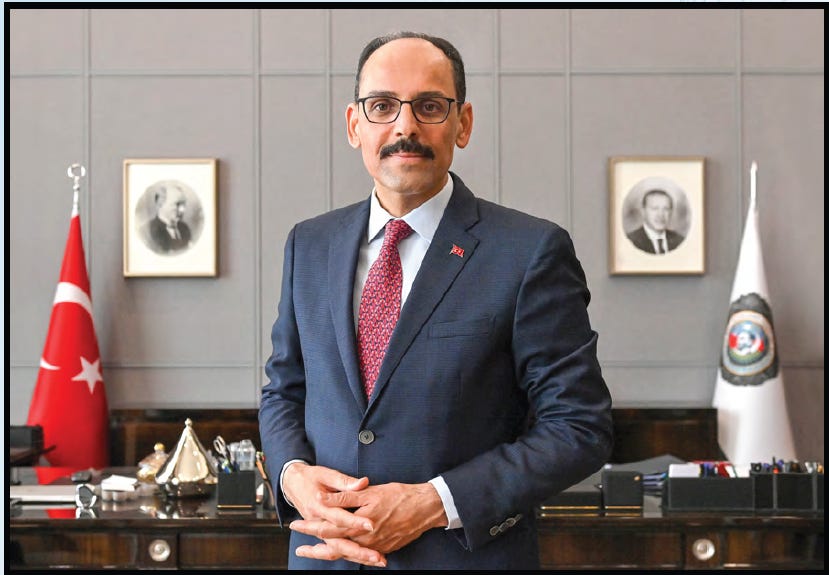
The Millî İstihbarat Teşkilâtı Başkanlığı (National Intelligence Organisation Presidency) is Türkiye’s principal intelligence service, operating under Law No. 2937 of 1 November 1983. It reports directly to the Office of the President, with Ambassador Prof. Dr. İbrahim Kalın serving as President throughout 2025.
MİT’s statutory mandate includes:
Producing intelligence on internal and external threats to Türkiye’s territorial integrity, independence, constitutional order, and national power
Delivering intelligence assessments to senior state leadership
Conducting global foreign intelligence operations
Executing counter‑intelligence activities against hostile services
Managing technical intelligence capabilities (SIGINT, IMINT, cyber)
The organisation’s legal architecture comprises 15 primary legislative instruments, including Law No. 2937, Public Financial Management and Control Law No. 5018, Public Procurement Law No. 4734, and regulations governing overseas personnel, defence industry cooperation, and classified information.
What Financial Resources Did MİT Deploy in 2025?
MİT’s 2025 fiscal profile reflects significant state investment:
Category Amount Initial allocation 28.896 billion TL Final authorised budget 36.435 billion TL Actual expenditure 36.307 billion TL Execution rate 99.64%
The 26.1% increase from initial to final allocation reflects expanded operational requirements amid regional crises. The 99.64% execution rate demonstrates disciplined financial management.
Under Law No. 5018, MİT operates within the National Defence and Security programme, sub‑programme Intelligence Services, enabling performance‑based resource allocation.
Internal controls were conducted by the Financial Services Department, while external audits were performed by the Turkish Court of Accounts (Sayıştay) under Law No. 6085.
What Were MİT’s Primary Operations in Syria in 2025?
MİT played a decisive role in Syria’s political transformation, particularly during the 8 December Revolution, which ended Assad’s rule. The report describes a “holistic approach” across the crisis‑to‑resolution continuum.
Key activities included:
Intelligence support to opposition forces leading to regime change
Preventive operations against emerging post‑Assad threats
Establishment of border‑region intelligence architecture
Coordination with transitional authorities
Counter‑terrorism operations targeting PKK/YPG elements
The report highlights that MİT “took preemptive steps against new threat elements” and prevented “the formation of new threats to our national security in our border region.”
How Did MİT Contribute to Gaza Ceasefire Negotiations?
Throughout 2025, MİT conducted sustained intelligence diplomacy regarding the Gaza conflict, described as having “deeply affected the security architecture of the Middle East.”
Its activities included:
Direct engagement with all ceasefire stakeholders
Facilitating a 60‑day temporary ceasefire
Mediating prisoner‑exchange arrangements
Coordinating humanitarian aid access
Supporting Palestinian reconciliation efforts
Contributing to two‑state solution frameworks
The report states MİT “served as a bridge between all parties,” engaging Israeli services, Hamas, the Palestinian Authority, Egypt, Qatar, and the US.
What Counter‑Terrorism Operations Did MİT Conduct Against FETÖ?
FETÖ refers to the Fethullahist Terrorist Organisation, a global network led by Fethullah Gülen, which Türkiye accuses of orchestrating the 2016 coup attempt.
MİT’s 2025 operations included:
Blocking overseas expansion attempts
Coordinated domestic arrests
Disrupting foreign‑based disinformation campaigns
Tracking financial networks and front organisations
Cooperating with foreign services to restrict FETÖ infrastructure
The report notes MİT focused on organisations “that continue disinformation activities against our country from abroad.”
What Role Did MİT Play in the ‘Terrorism‑Free Turkey’ Initiative?
The Terörsüz Türkiye initiative aims to eliminate terrorism as a factor in domestic politics. MİT held direct operational responsibility in 2025.
Its role included:
Scenario analysis of peace‑process outcomes
Intelligence collection on armed groups in disarmament talks
Security vetting of dialogue participants
Threat assessment of spoiler actors
Coordination with the National Solidarity, Brotherhood and Democracy Commission
Maintaining readiness against potential attacks
The report states MİT “carefully examined all possible scenarios and took its steps without losing vigilance.”
What Technical Intelligence Capabilities Does MİT Possess?
The report highlights significant investment in advanced technical intelligence:
Big data analytics
AI‑driven pattern recognition and predictive analysis
IMINT, including satellite reconnaissance
SIGINT across the electromagnetic spectrum
Independent satellite intelligence infrastructure
Cyber intelligence and operations
These capabilities “strengthen our hand in all our work, adding speed and depth to our intelligence ecosystem.”
How Did MİT Conduct Counter‑Intelligence in 2025?
MİT’s counter‑intelligence directorate targeted foreign intelligence services and proxy entities.
Activities included:
Detecting hostile espionage
Disrupting agent networks
Conducting counter‑surveillance
Implementing technical counter‑measures
Vetting individuals with access to classified material
Investigating suspected intelligence officers under diplomatic cover
The report confirms MİT “ensured that espionage activities were thwarted and agent networks were exposed.”
What International Intelligence Cooperation Did MİT Conduct?
MİT expanded partnerships across Central Asia, the Balkans, the Middle East, and Africa.
Cooperation included:
Bilateral intelligence‑sharing
Joint counter‑terrorism operations
Training programmes
Technical assistance
Operations against shared threats
Intelligence exchange on organised crime
The report states MİT “continued to develop cooperation… especially with services of Central Asian, Balkan, Middle Eastern and African countries.”
What Counter‑Terrorism Operations Did MİT Conduct Against Radical Organisations?
Beyond FETÖ, MİT targeted DEAŞ, the Islamic State (ISIS), known in Türkiye by its Arabic acronym Daesh.
Operations included:
Identifying operatives domestically and abroad
Supporting security forces in arrests
Conducting joint operations with African partners
Disrupting operational planning
Monitoring foreign fighter movements
Tracking financing networks
The report confirms MİT “ensured the apprehension of many organisation members at home and abroad.”
What Is MİT’s Strategic Outlook for 2026 and Beyond?
President Kalın’s foreword anticipates continued global instability, highlighting:
Hybrid threats
Erosion of international norms
Shifting geo‑economic balances
Exponential technological risks
Intensifying US–China rivalry
Trade wars
Africa as a contested geopolitical arena
Nuclear brinkmanship in Ukraine
Proliferation of autonomous weapons
He notes that early 2026 events “indicate that the coming period will be extremely full of uncertainties.”