

Ujasusi Blog’s East Africa Monitoring Team | 16 April 2026 | 0355 BST
EXECUTIVE SUMMARY
The third edition of the Mashariki Cooperation Conference (MCC III), held in Diani, Kwale County, from 8–12 April 2026, has consolidated Kenya’s position as the principal convener of high-stakes continental intelligence dialogue. Operating under the theme “Intelligence for Peace” — with the substantive focus of “Emerging Geopolitical Dynamics and Africa’s Security Architecture” — the conference drew the most significant gathering of intelligence and security chiefs yet assembled under the Mashariki framework. Drawing participation from 76 countries across Africa and beyond, MCC III reinforced its role as a premier platform for intelligence-sharing and for building partnerships against cross-border threats, including terrorism, cybercrime, and transnational organised crime.
The conference generated substantive discourse across four operational domains: the tactical evolution of Al-Shabaab and allied networks; the integration of artificial intelligence into intelligence tradecraft; information warfare and disinformation as instruments of state destabilisation; and the structural inadequacy of existing continental security architecture, including the African Union itself. Ujasusi Intelligence has additionally identified a TISS official in the MCC III conference record — with significant implications for Tanzania’s internal succession landscape. The proceedings carry direct implications for Tanzania and for the future of intelligence multilateralism across Eastern Africa.
CONFERENCE BACKGROUND AND INSTITUTIONAL TRAJECTORY
The Mashariki Cooperation Conference is an NIS-convened initiative that has undergone rapid institutional maturation since its inaugural edition. The first conference, held in Mombasa from 27–31 January 2024, established the foundational objective of deepening cooperation, enhancing collaboration, and broadening coordination between intelligence organisations to address common threats. Its second edition, MCC II, was held in Naivasha in April 2025.
The 2026 edition drew delegates from nearly 100 countries, regional and international organisations, and more than 20 security think tanks — marking it as a rapidly scaling platform for closed-door, high-level security diplomacy. Organisers described MCC III as one of the continent’s most influential closed-door forums on security and statecraft.
The following table situates MCC III within the conference’s institutional trajectory:

The conference’s institutional architecture is anchored in the Kenya National Intelligence Service under Director General Noordin Haji, whose stewardship has been the consistent through-line across all three editions. Interior CS Kipchumba Murkomen framed the conference as Kenya’s deliberate effort to position Africa as a player in global geopolitics rather than a passive arena for external competition.
KEY PRINCIPALS
The principal participants at MCC III included:
Noordin Haji — Director General, Kenya NIS; conference host and lead convener
Musalia Mudavadi — Prime Cabinet Secretary, Kenya; chief guest
Kipchumba Murkomen — Cabinet Secretary, Interior and National Administration
Dorcas Oduor — Attorney General of Kenya
Justice William Ouko — Supreme Court of Kenya
Nelson Koech / Fatuma Dullo — chairs of Kenya’s parliamentary security committees
Dr. Workneh Gebeyehu — Executive Secretary, IGAD
Chief Olusegun Obasanjo — former President of Nigeria
President William Ruto — delivered closing remarks
THEMATIC ANALYSIS
🔴 Al-Shabaab’s Evolving Tactical Model
One of the most operationally significant presentations at MCC III addressed the changing threat model of Al-Shabaab and allied militant networks. Security expert Ibrahim Yanaya, speaking before intelligence chiefs from 70 countries, assessed that extremist networks have continued to outpace security forces, keeping them in a reactive posture — arguing that these groups retain the initiative in deciding when, where, and how to attack. Yanaya underscored that regional states cannot address the threat unilaterally and called for cooperation through AU mechanisms alongside continued intelligence-sharing with neighbouring states and international partners.
This assessment carries direct relevance for Tanzania, which shares a geopolitical neighbourhood with the Al-Shabaab-affected zone and has documented exposure to radicalisation networks in its coastal regions. The argument for multilateral intelligence responses — rather than bilateral or purely national approaches — implicitly challenges the operational adequacy of services that have historically operated under conditions of political subordination and resource constraint.
🔴 Artificial Intelligence in Intelligence Tradecraft
The adoption of AI within intelligence operations emerged as the most technically substantive theme across MCC III. Delegates called for the urgent integration of AI in intelligence gathering and counterterrorism operations, describing it as a critical tool in detecting and preventing attacks.
IGAD Executive Secretary Dr. Workneh Gebeyehu warned of a growing “war against truth” waged through digital manipulation and championed African-led technological solutions, including a hackathon to incubate homegrown innovation. The MCC II precedent is instructive: at the 2025 Naivasha conference, Interior CS Murkomen stressed that traditional surveillance methods are no longer sufficient and urged intelligence agencies to integrate AI for real-time threat detection, social media monitoring, and predictive security measures. By MCC III, this position had shifted from aspiration to operational imperative.
The AI debate at Diani carried a notable critical dimension. One observer present during proceedings noted that the most significant AI-related discussion was not about what AI can do correctly, but what happens when AI systems fail — raising accountability questions when AI-driven assessments lead to erroneous conclusions or operational failures. This is an underdeveloped area in African intelligence doctrine and signals a forthcoming governance gap as services accelerate adoption without commensurate regulatory architecture.
🔴 Information Warfare and the Erosion of Institutional Trust
NIS Director General Haji has consistently framed AI-generated disinformation as having waged a war against truth, with governments identified as the primary targets. At MCC III, this argument was expanded into a systemic diagnosis of institutional erosion across the region.
The conference highlighted the destabilising role of illicit financial flows alongside disinformation, with leaders cautioning that unchecked propaganda and illegal funding networks are amplifying violence and undermining state stability. The coupling of financial crime with information operations represents a more sophisticated analytical frame than in previous MCC editions and reflects a documented convergence in the East African threat environment.
Delegates issued a firm warning — analytically significant in its political directness — against commercialising peace and security, insisting that African states must retain sovereign control over their own security systems. This language reflects growing unease among African intelligence communities about dependency relationships created by Western security assistance programmes, private military contractor presences, and foreign intelligence service embedding arrangements.
🔴 Ruto’s AU Reform Challenge
The most politically resonant intervention at MCC III came from President Ruto’s closing address. Ruto disclosed that fellow African leaders had entrusted him with leading AU reform efforts, arguing that the continental body, as presently constituted, lacks the capacity to provide the leadership required to steer Africa through emerging global challenges.
A serving head of state publicly declaring the AU structurally inadequate — at a forum attended by the intelligence and security chiefs of more than 70 nations — carries weight beyond rhetorical positioning. It signals elite-level consensus around the need to reconstitute the architecture of African security multilateralism. The timing is significant: the statement came against a backdrop of declining Western security engagement with the continent and growing pressure on African states to operationalise self-reliant security frameworks.
🔴 Obasanjo’s Security Blueprint
The most analytically compelling address came from former Nigerian President Olusegun Obasanjo. Drawing on over six decades of experience as a soldier, head of state, and mediator, Obasanjo urged African intelligence chiefs to confront the continent’s deepening geopolitical vulnerabilities with radical clarity, arguing that Africa’s conflicts are not inevitable but the direct result of leadership failures and external interference.
Obasanjo addressed the fracturing global multilateral order directly, pointing to the international community’s deeply inconsistent response to conflicts from Gaza to the Sahel as evidence that the rules-based international order is applied selectively. The precise content of the five-point blueprint — delivered to a closed-door session — has not been reproduced in open-source reporting. This itself is analytically significant: the MCC’s operational security posture around its most substantive sessions limits open-source assessments and may reflect the sensitivity of commitments discussed.
TANZANIA AND TISS: CONFIRMED ATTENDANCE, INTELLIGENCE GAP CLOSED
Open-source reporting on MCC III yielded no named Tanzanian representative and no explicit confirmation of a TISS delegation at Diani. No Kenyan media outlet, wire service, or conference readout named a Tanzanian intelligence official among the attendees.
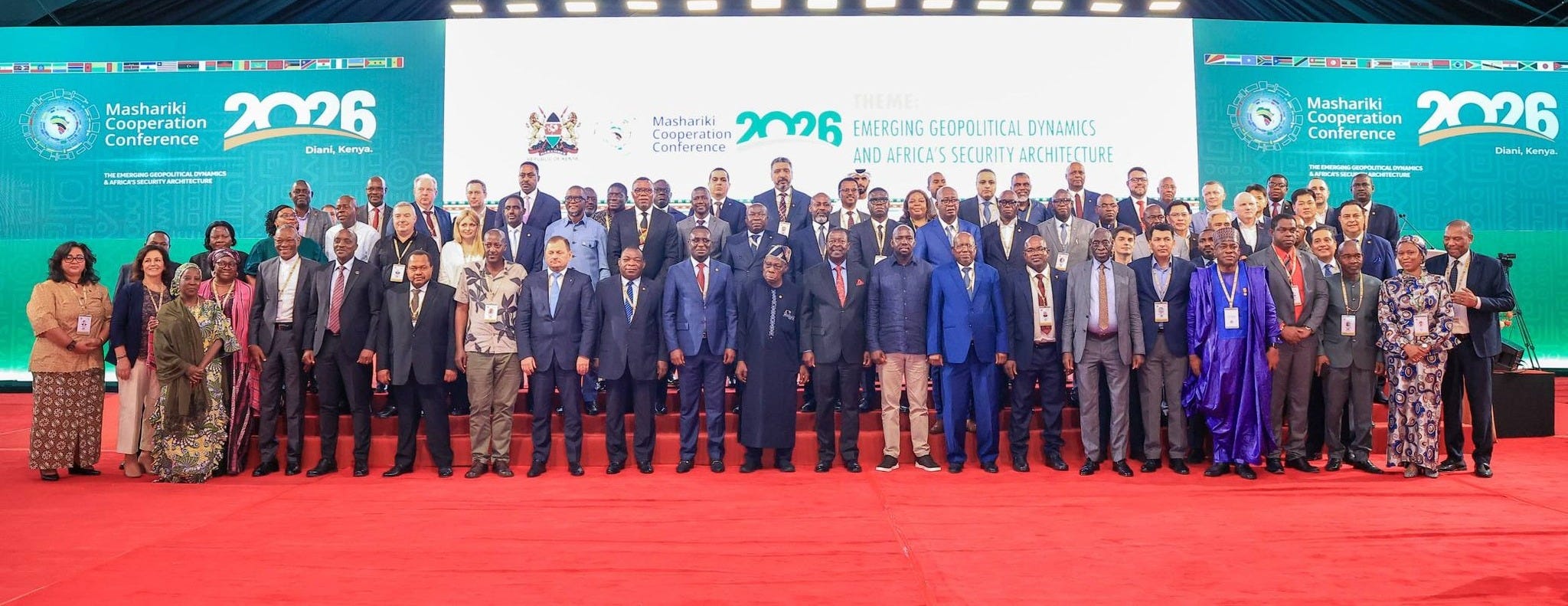
Tanzania was, however, present. Ujasusi Intelligence has identified a TISS official in the MCC III group photograph through source-based recognition — the same individual previously documented representing the DGIS at an official function at Ikulu, Dodoma. His identification confirms that Tanzania participated in MCC III, consistent with its founding-member status established at MCC I in January 2024, and consistent with social media reporting placing security chiefs from 98 countries at Diani.
The identified representative is the Deputy Director General of Intelligence and Security (DGIS), Zanzibar — a civilian official whose presence among uniformed TPDF and Tanzania Police personnel at the Ikulu function places his seniority and institutional role beyond reasonable doubt. His appearance at MCC III in the same capacity confirms Tanzania’s established pattern: participating at the sub-Director General level, quietly, without generating any open-source footprint. That posture — opacity over profile stands in direct contrast to the convener model Kenya is constructing through the MCC.
Assessment: TISS representation at MCC III is confirmed at the sub-DG level through source-based identification. The deployment pattern of the identified official and its implications for Tanzania’s internal succession landscape are addressed in the paid-tier section below.
STRATEGIC IMPLICATIONS FOR EASTERN AFRICA
Kenya’s Intelligence Diplomacy Monopoly. Kenya has now conducted three consecutive MCC editions with growing participation and prestige. By convening spy chiefs and security heads annually, Kenya is fostering practical intelligence partnerships that enhance real-time threat-sharing on groups such as Al-Shabaab, cross-border banditry, and cyberattacks. No comparable initiative exists under the auspices of any other East African intelligence service. This represents a soft-power asymmetry that reinforces Nairobi’s regional primacy in the security domain.
Tanzania’s Structural Marginalisation. Tanzania has participated in Mashariki proceedings but has played no institutional convening role. Given TISS’s operating conditions and Tanzania’s ongoing management of post-election reputational exposure, Tanzania is unlikely to challenge Kenya’s convener monopoly in the medium term. This leaves Tanzania as a consumer — not a producer — of the regional intelligence architecture being constructed under Kenyan auspices. That asymmetry has consequences for Tanzania’s bargaining position within regional security structures.
The AI Governance Gap. The MCC’s emphasis on AI integration without a parallel framework for accountability or error correction creates conditions for intelligence malpractice across adopting services. Services with weak internal oversight mechanisms — several of which are represented within the MCC framework — risk importing AI-driven analytical biases into threat assessments with potentially serious operational consequences.
FINAL ASSESSMENT
MCC III has consolidated a pattern that was visible but uncertain after MCC I and II: Kenya is constructing a durable regional intelligence diplomatic infrastructure, anchored in NIS institutional capacity and the personal authority of Noordin Haji, that is reshaping how African security services relate to one another outside the formal AU and IGAD frameworks.
The conference’s combination of closed-door operational sessions with high-profile political messaging — culminating in a presidential closing address calling for AU structural reform — signals an ambition extending well beyond annual intelligence-sharing. The MCC is being positioned as the legitimating forum for an emerging African security consensus: intelligence-led, AI-enabled, disinformation-aware, and institutionally sceptical of both external dependency and existing multilateral structures.
Whether MCC III produces substantive joint intelligence protocols or remains aspirational discourse will be determinable only across the subsequent six to twelve months. The pattern across all three editions has been one of declared intent without verifiable institutional follow-through. The absence of a published formal communiqué — flagged as “forthcoming” — means the conference’s binding operational commitments remain opaque. That opacity may be deliberate. For a forum that explicitly markets itself as a space for candid closed-door dialogue, opacity is not a failure of process — it is the product.
Ujasusi Intelligence has identified a TISS official in the MCC III record whose deployment pattern raises a significant succession question. The forward-looking assessment, including the TISS succession analysis and operational recommendations, is available exclusively to paid subscribers.