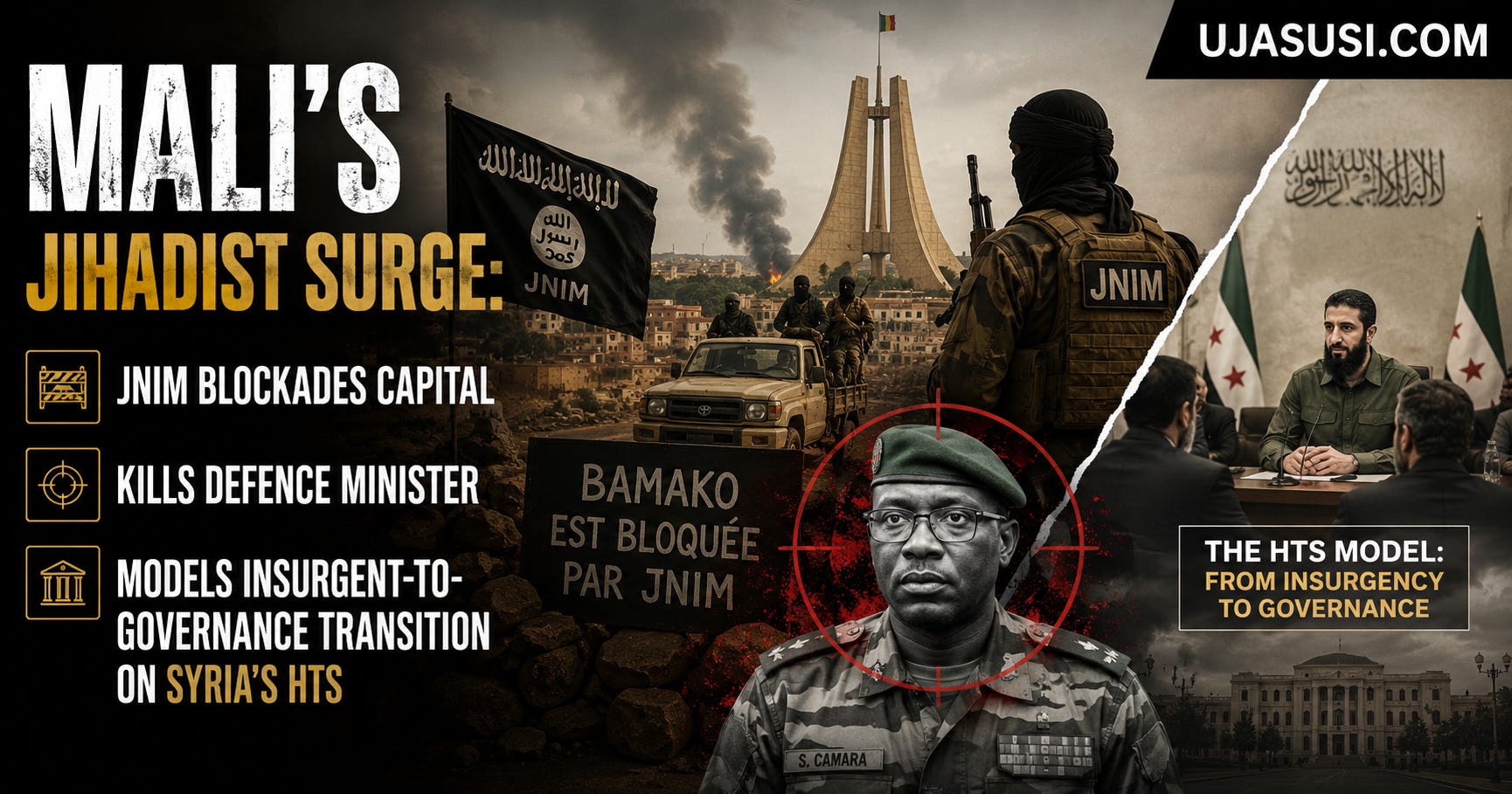
Mali's Jihadist Surge: JNIM Blockades Capital, Kills Defence Minister, Models Insurgent-to-Governance Transition on Syria's HTS
Ujasusi Terorism Monitor Desk | 25 May 2026 | 0130
EXECUTIVE SUMMARY
Jama’at Nusrat al-Islam wal-Muslimin (JNIM) has launched its most consequential military offensive since the Sahel insurgency began in 2012, exposing critical vulnerabilities in Mali’s security architecture and forcing a reassessment of the conflict’s political resolution pathways. The group’s simultaneous strikes on geographically dispersed military installations, the killing of Mali’s Defence Minister in proximity to Bamako, and the capture of strategic northern towns represent a qualitative escalation in both operational capability and political ambition. Intelligence indicators suggest JNIM is deliberately modelling elements of its strategic posture on Hayat Tahrir al-Sham’s (HTS) Syrian trajectory — a precedent with significant implications for regional security stakeholders, including Washington.
SITUATION REPORT
Operational Developments
JNIM conducted coordinated multi-vector attacks against Malian Armed Forces (FAMa) positions across hundreds of miles of territory, demonstrating command-and-control capability at a scale not previously recorded. The operation was executed in conjunction with Tuareg separatist elements, confirming a tactical convergence between jihadist and ethno-nationalist armed factions that security planners had long assessed as structurally incompatible.
The group maintains a sustained blockade on food and fuel supplies to Bamako, a coercive instrument that compounds pressure on the ruling military junta beyond purely kinetic engagement. FAMa and its Russian partner forces — deployed under the Wagner Group successor framework — have been unable to break the blockade, raising questions about the operational limits of the junta-Moscow security partnership.
Territorial Control and Governance
JNIM administers substantial portions of northern and central Mali as de facto sovereign space. Within these areas, the group has operationalised parallel governance institutions addressing land disputes, water allocation conflicts between sedentary agricultural communities and nomadic pastoralists, and localised criminal activity. Field reporting indicates JNIM representatives have moderated enforcement of certain ideological strictures in response to local community pressure, including accommodation of Christian minority populations — a notable tactical departure from earlier operational doctrine.
This governance footprint serves a dual function: it fills the administrative vacuum created by the Malian state’s withdrawal, and it positions JNIM as a legitimate stakeholder in the eyes of affected populations — a precondition for any viable political settlement.
ANALYTICAL ASSESSMENT
The HTS Precedent: Applicable or Aspirational?
Sources with access to JNIM-adjacent networks indicate the group’s senior leadership has drawn explicit strategic lessons from HTS’s transformation in Syria’s Idlib province. HTS, formerly designated as a terrorist organisation with al-Qaida affiliation, governed Idlib as a quasi-state for several years before its December 2024 offensive ended Bashar al-Assad’s government. Its leader, Ahmed al-Sharaa — previously subject to a US$2 million US Government bounty — subsequently assumed the role of Syria’s interim head of state.
The structural parallels are partial but analytically significant. JNIM has not formally renounced its al-Qaida affiliation, and continues to channel revenue — derived from kidnap-for-ransom operations, taxation of controlled populations, and cattle theft — to al-Qaida’s central organisation. This distinguishes its current posture from HTS, which progressively severed operational ties with the transnational network as part of its deliberate rebranding.
The absence of an external state patron analogous to Turkey further constrains the HTS template’s applicability. Turkey provided HTS with material support, diplomatic cover, and a controlled external environment conducive to institutional consolidation. JNIM operates without a comparable external guarantor.
Nevertheless, the group’s operational behaviour — reduced targeting of civilian infrastructure, rhetorical shift toward localised grievances rather than transnational jihad, and investment in community governance — reflects a pragmatic recalibration consistent with the early phases of HTS’s strategic evolution.
Junta Conduct and Recruitment Drivers
Any assessment of JNIM’s trajectory must account for the conduct of the opposing force. FAMa and Russian partner personnel have been credibly implicated in mass atrocities, including the documented execution of over 500 men in the village of Moura in 2022. Reported cluster munition deployment in northern Mali and alleged civilian killings in central Mali during the current reporting period compound the reputational damage to the junta’s counter-insurgency posture.
Structural conditions — endemic state corruption, acute poverty, and the near-total absence of functional governance across large rural areas — continue to sustain jihadist recruitment pipelines that neither military pressure nor humanitarian programming has disrupted.
EXTERNAL ACTOR ASSESSMENT
United States
The Trump administration has moved to repair bilateral relations with Mali’s junta, lifting targeted sanctions on several officials and restoring intelligence-sharing mechanisms. A Malian airstrike against a jihadist operative in 2025 was attributed in part to renewed US intelligence support. Options reportedly under consideration include expanded targeting assistance against JNIM’s senior leadership cadre.
This posture carries significant risks. JNIM has not publicly threatened US interests or personnel — a distinction that matters for legal and political legitimacy of any kinetic engagement. Lethal targeting of JNIM leadership could accelerate the group’s departure from its current al-Qaida-restraint posture and drive fighters toward the Islamic State in the Greater Sahara (ISGS), which does not observe comparable restraint regarding Western targets.
Russia
The Russia-Mali security partnership, formalised through Wagner successor structures, has failed to achieve its stated counter-insurgency objectives. The inability to break JNIM’s Bamako blockade constitutes a demonstrable operational failure that mirrors — and may exceed — the strategic shortfalls of the preceding French and EU missions. Russia’s reputational exposure in Mali is now a compounding liability.
INDICATORS AND WARNINGS
The following developments would indicate JNIM is advancing beyond tactical recalibration toward strategic repositioning:
Formal or informal communications with Malian government intermediaries or third-party mediators
Sustained reduction in attacks on international humanitarian operations
Public statements distancing JNIM from transnational al-Qaida objectives
Continued consolidation of parallel governance institutions in northern Mali
OUTLOOK
The conflict in Mali has reached an inflection point. JNIM’s current offensive has demonstrated that a military solution on the junta’s terms is not achievable within any near-term timeframe. The group’s governance activities and rhetorical moderation do not constitute a transformation — they constitute a posture. Whether that posture evolves into a durable political repositioning depends substantially on whether credible dialogue frameworks emerge and whether external actors, particularly the United States, assess engagement as less costly than continued militarisation.
A contact group mechanism involving US, European, Middle Eastern, and African Union stakeholders represents the most structurally viable pathway toward a negotiated framework. The Syria precedent, however imperfect, demonstrates that designated terrorist organisations can transition into political actors under the right constellation of pressures and incentives. Mali is not Syria. But the strategic logic of managed de-escalation applies across both theatres.
The Sahel now accounts for the majority of global terrorism-related fatalities. Mali’s trajectory is not a peripheral concern — it is the central variable in West African security.